
Construction Extended Reality Market Report 2026
Global Outlook – By Device Type (Augmented Reality (AR), Virtual Reality (VR), Mixed Reality (MR)), By Application (Design And Planning, Project Management, Training And Simulation, Maintenance And Operations, Other Applications), By End-User (Architecture, Engineering, And Construction (AEC) Firms, Real Estate Developers, Contractors And Builders, Government And Public Infrastructure Agencies, Other End-Users) – Market Size, Trends, Strategies, and Forecast to 2030
Construction Extended Reality Market Overview
• Construction Extended Reality market size has reached to $6.63 billion in 2025 • Expected to grow to $19.19 billion in 2030 at a compound annual growth rate (CAGR) of 23.6% • Growth Driver: Increase In Infrastructure Projects Fueling The Growth Of The Market Due To Rapid Urbanization And Demand For Efficient Planning • Market Trend: Strategic Collaborations Enhancing Market Reach And Technological Innovation • North America was the largest region in 2025 and Asia-Pacific is the fastest growing region.What Is Covered Under Construction Extended Reality Market?
Construction extended reality refers to the integration of immersive digital environments with physical construction processes, enabling enhanced visualization and interaction within simulated settings. It combines various immersive experiences to create a dynamic interface between the real and virtual worlds. This approach allows for a more intuitive understanding of spatial elements and workflows in construction. The main device types In construction extended reality are augmented reality (AR), virtual reality (VR), and mixed reality (MR). Augmented reality (AR) is a technology that overlays digital content, such as 3D models, images, or data, onto the real-world environment using devices like smart glasses, tablets, or smartphones. It is applied for design and planning, project management, training and simulation, maintenance and operations, and others by several end-users, including architecture, engineering, and construction (AEC) firms, real estate developers, contractors and builders, government and public infrastructure agencies, and others.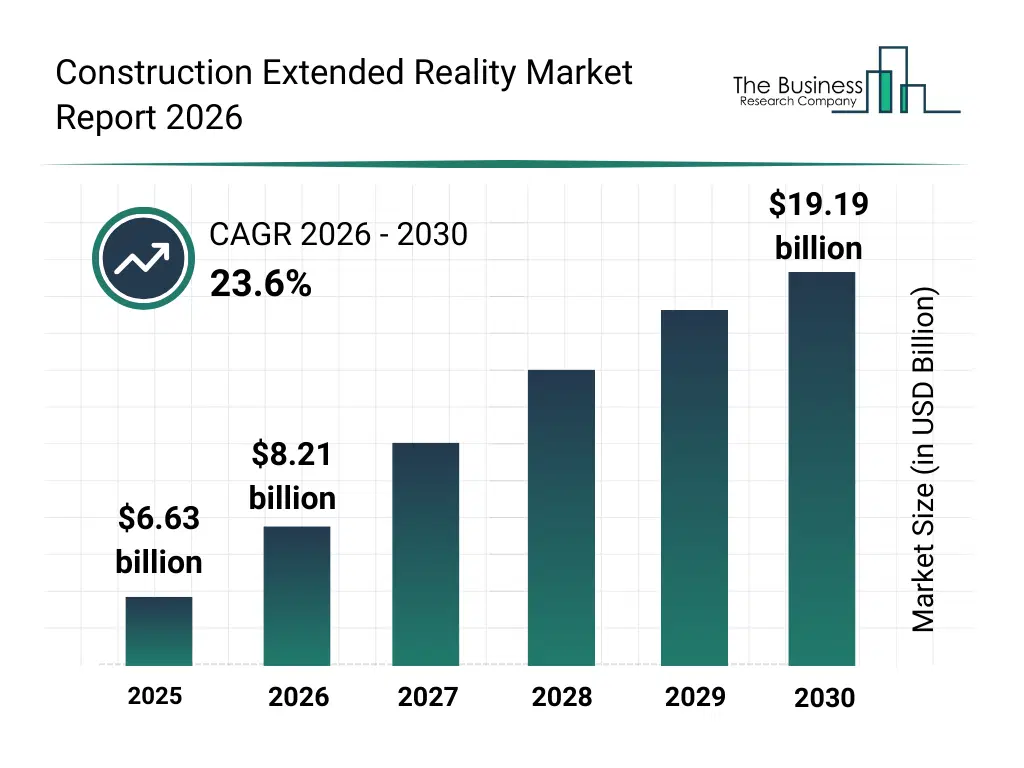
What Is The Construction Extended Reality Market Size and Share 2026?
The construction extended reality market size has grown exponentially in recent years. It will grow from $6.63 billion in 2025 to $8.21 billion in 2026 at a compound annual growth rate (CAGR) of 23.9%. The growth in the historic period can be attributed to rising use of virtual modeling in construction, growing adoption of xr for design validation, increasing reliance on immersive training tools, expansion of digital collaboration workflows, rising demand for remote visualization solutions.What Is The Construction Extended Reality Market Growth Forecast?
The construction extended reality market size is expected to see exponential growth in the next few years. It will grow to $19.19 billion in 2030 at a compound annual growth rate (CAGR) of 23.6%. The growth in the forecast period can be attributed to increasing integration of AI-driven xr tools, rising adoption of mixed reality in field operations, growth in cloud-connected immersive platforms, expanding use of xr for clash detection, increasing deployment of advanced reality capture systems. Major trends in the forecast period include integration of AI-enhanced xr visualization, expansion of high-fidelity virtual modeling platforms, adoption of cloud-based immersive collaboration tools, growth of IOT-connected xr workflows, automation of xr-driven construction simulations.
Global Construction Extended Reality Market Segmentation
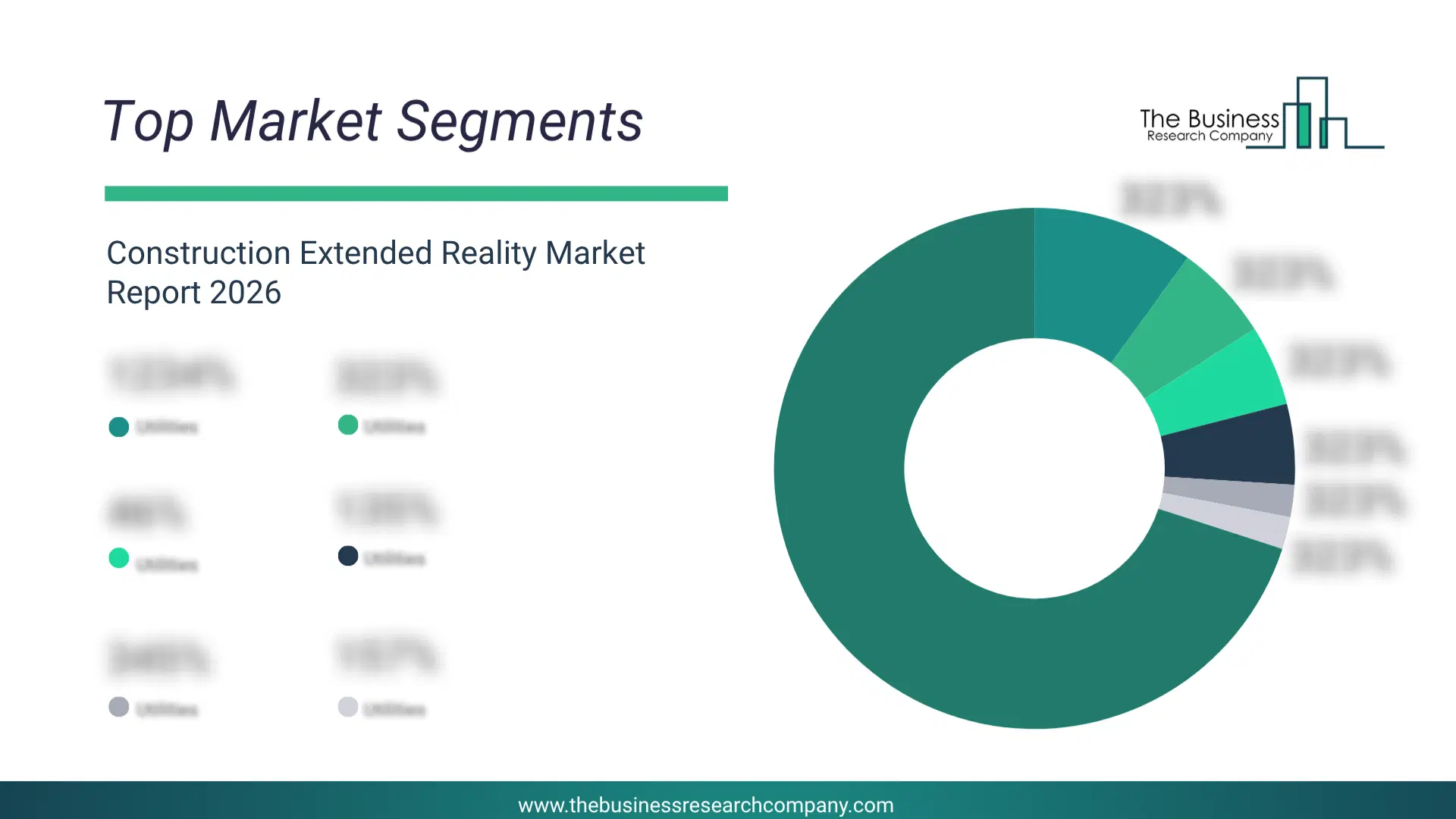
1) By Device Type: Augmented Reality (AR), Virtual Reality (VR), Mixed Reality (MR) 2) By Application: Design And Planning, Project Management, Training And Simulation, Maintenance And Operations, Other Applications 3) By End-User: Architecture, Engineering, And Construction (AEC) Firms, Real Estate Developers, Contractors And Builders, Government And Public Infrastructure Agencies, Other End-Users Subsegments: 1) By Augmented Reality (AR): Smart Glasses, Head-Mounted Displays (HMDs), Handheld Devices, Heads-Up Displays (HUDs) 2) By Virtual Reality (VR): Head-Mounted Displays (HMDs), Gesture-Tracking Devices, Data Gloves, Virtual Projectors And Cave Automatic Virtual Environment Systems 3) By Mixed Reality (MR): Head-Mounted Displays (HMDs), Smart Glasses, Mixed Realty Controllers, Spatial Mapping DevicesWhat Is The Driver Of The Construction Extended Reality Market?
The Increasing infrastructure projects are expected to propel the growth of the construction extended reality market going forward. Infrastructure projects refer to large-scale developments focused on constructing or upgrading essential systems such as roads, bridges, utilities, and communication networks that are vital for a region’s economic growth and daily functioning. The increase in infrastructure projects is driven by rapid urbanization, which heightens the need for better transportation, housing, and utility services to support expanding urban populations. Construction extended reality supports infrastructure projects by offering immersive design visualization, helping stakeholders detect and address design challenges early, and ultimately minimizing costly mistakes and project delays. For instance, in December 2024, according to Homes England, a UK-based government agency, around 10,434 housing units were completed in the first half of 2024–2025, a 32% increase compared to the 7,929 affordable homes completed during the same timeframe In 2023–2024. Therefore, the increasing infrastructure projects are driving the growth of the construction extended reality industry.What Is The Driver Of The Construction Extended Reality Market?
The growing government and private investments in digital transformation are expected to propel the growth of the construction extended reality market going forward. Government and private investments in digital transformation refer to financial commitments by public and private entities to adopt and integrate advanced digital technologies to enhance efficiency, innovation, and overall operational performance. Government and private investments in digital transformation are increasing to enhance operational efficiency by leveraging digital technologies that streamline processes, reduce costs, and improve productivity. Government and private investments in digital transformation help construction extended reality by promoting the adoption of AR, VR, and MR technologies that enhance design visualization, on-site collaboration, worker training, and overall construction efficiency. For instance, in June 2025, according to Engineering in a Digital Age, an Ireland-based software company, in 2024, data center planning applications in the UK surged by more than 40%, with Microsoft committing £2.5 billion ($3.18 billion) to double the nation’s AI infrastructure capacity by 2026. Therefore, The growing government and private investments in digital transformation are driving the growth of the construction extended reality industry.Key Players In The Global Construction Extended Reality Market
Major companies operating in the construction extended reality market are Microsoft Corporation, Sony Group Corporation, Lenovo Group Limited, Accenture Plc, NVIDIA Corporation, Seiko Epson Corporation, Autodesk Inc., Trimble Inc., PTC Inc., Unity Technologies, Bentley Systems Incorporated, Magic Leap Inc., EON Reality Inc., RealWear Inc., HoloPundits Inc., Vuzix Corporation, Varjo Technologies Oy, ManageXR, Simbott, and Immersafety.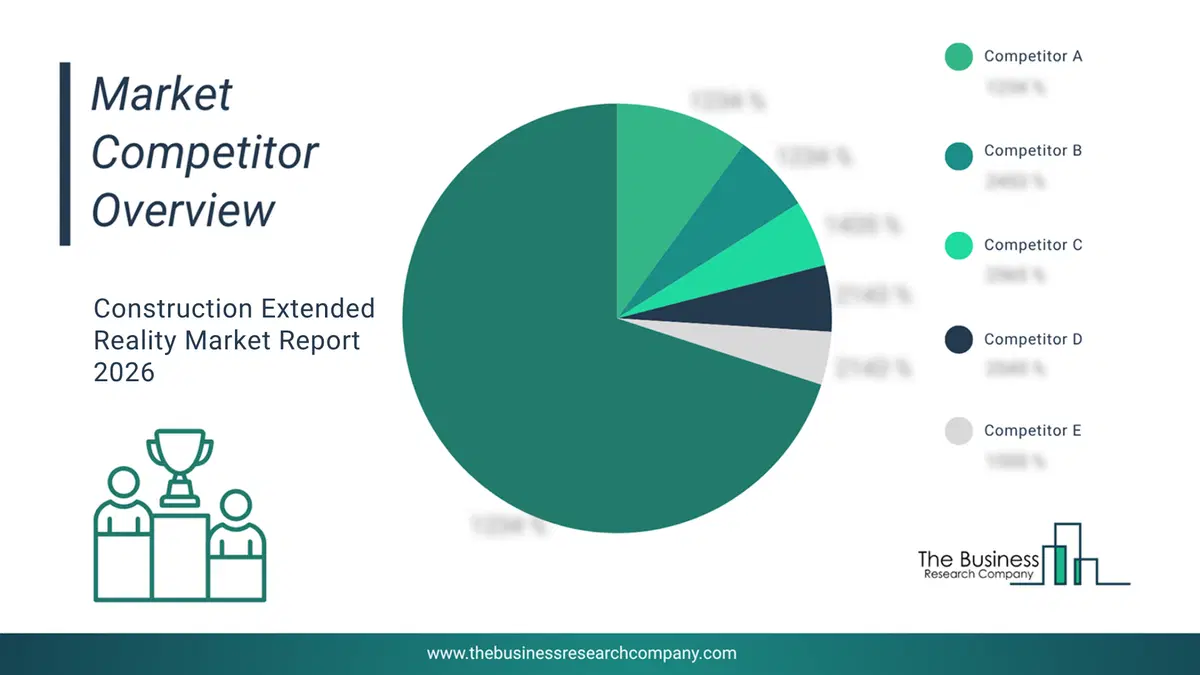
This chart is for illustrative purposes; the full report includes a detailed competitor analysis and comprehensive overview of the top 10 companies in the market.
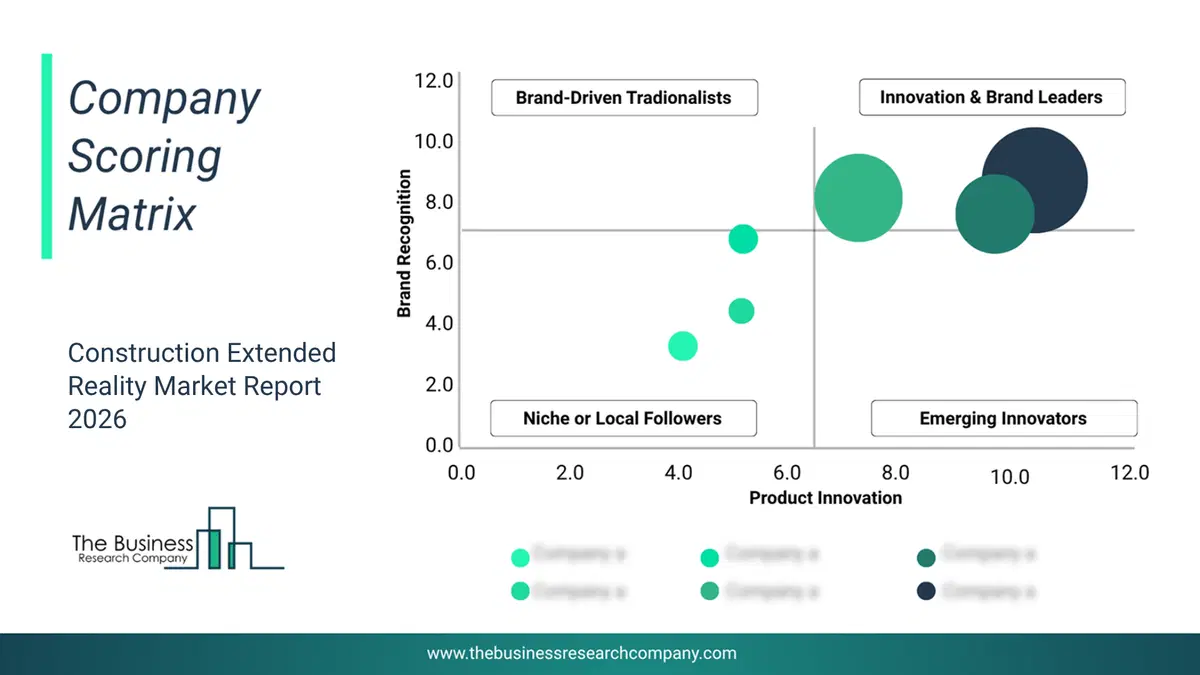
This chart maps companies by product innovation and brand strength, with bubble size indicating relative revenue, helping identify market leaders, challengers, and niche players. This is an illustrative chart; the full report provides a complete and accurate competitive analysis.
Global Construction Extended Reality Market Trends and Insights
Major companies operating in the construction extended reality market are focusing on strategic collaborations to allow companies to access new markets and customer bases. Strategic collaborations are cooperative agreements between organizations that join forces to achieve mutual long-term objectives by combining their resources, expertise, or capabilities. For instance, in January 2025, Capital Group, a US-based investment management company, partnered with FORCE Technology, a Denmark-based technology consultancy and service company, to launch the extended reality (XR) full mission bridge simulator, SimFlex. It offers a unique training experience by combining real ship equipment with a high-quality virtual bridge environment, enhancing realism and immersion. It includes advanced navigation systems from FURUNO Hellas S.A., such as ECDIS, autopilot, and radar, within a fully green-screened setup. One of its standout features is the ability to connect global teams in shared training scenarios, promoting collaboration across distances. It also supports eco-friendly practices by reducing both energy consumption and the need for physical travel.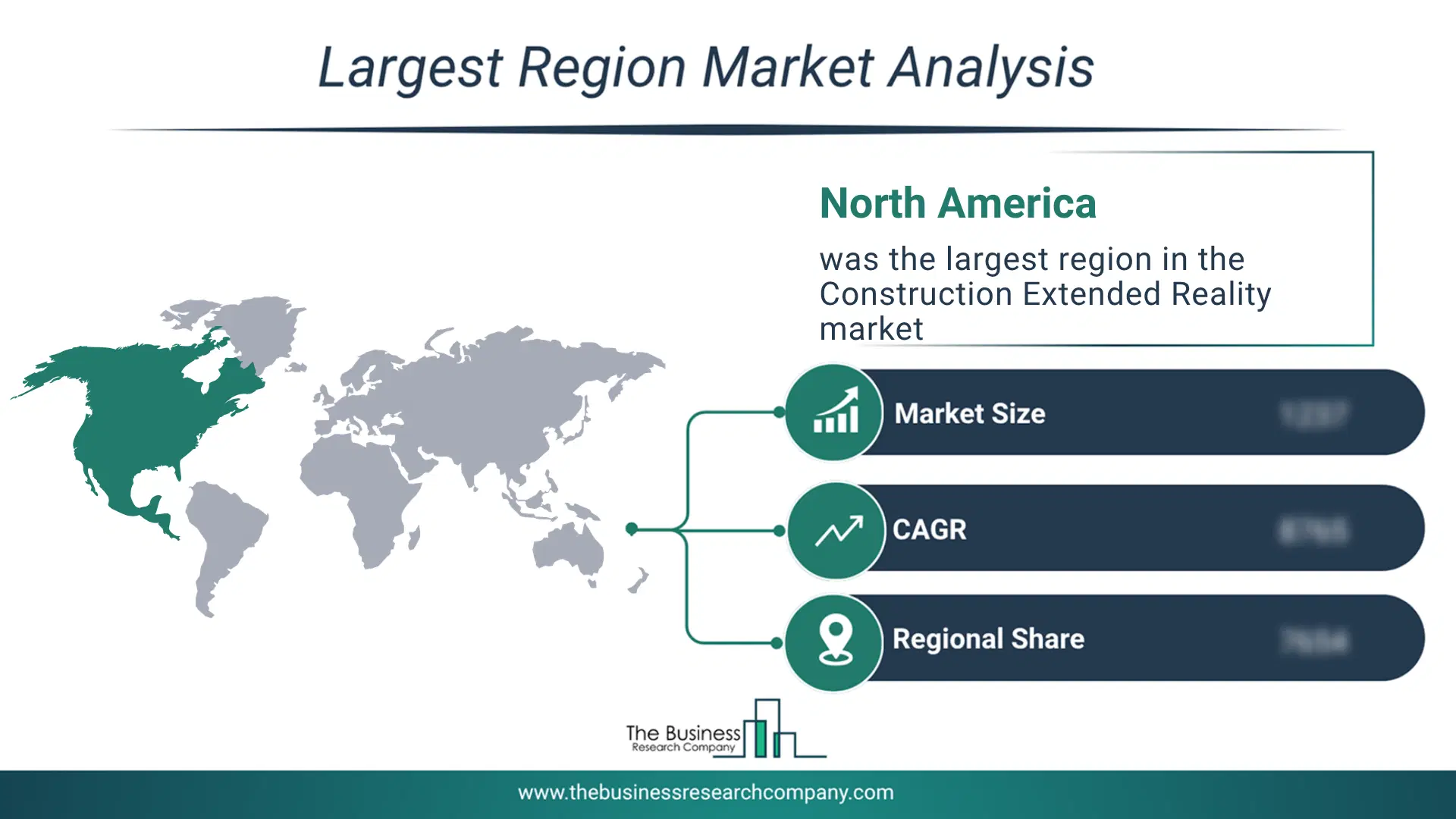
Regional Insights
North America was the largest region in the construction extended reality market in 2025. Asia-Pacific is expected to be the fastest-growing region in the forecast period. The regions covered in this market report are Asia-Pacific, South East Asia, Western Europe, Eastern Europe, North America, South America, Middle East, Africa. The countries covered in this market report are Australia, Brazil, China, France, Germany, India, Indonesia, Japan, Taiwan, Russia, South Korea, UK, USA, Canada, Italy, Spain.What Defines the Construction Extended Reality Market?
The construction extended reality market consists of revenues earned by entities by providing services such as virtual modeling, remote collaboration, project visualization, design validation, and clash detection. The market value includes the value of related goods sold by the service provider or included within the service offering. The construction extended reality market also includes sales of virtual reality headsets, mixed reality displays, reality capture systems, and on-site AR display units. Values in this market are ‘factory gate’ values, that is the value of goods sold by the manufacturers or creators of the goods, whether to other entities (including downstream manufacturers, wholesalers, distributors and retailers) or directly to end customers. The value of goods in this market includes related services sold by the creators of the goods.How is Market Value Defined and Measured?
The market value is defined as the revenues that enterprises gain from the sale of goods and/or services within the specified market and geography through sales, grants, or donations in terms of the currency (in USD unless otherwise specified). The revenues for a specified geography are consumption values that are revenues generated by organizations in the specified geography within the market, irrespective of where they are produced. It does not include revenues from resales along the supply chain, either further along the supply chain or as part of other products.
This chart presents market attractiveness based on a quantitative evaluation of growth, competition, strategic alignment, and risk, offering a clear view of opportunity areas for decision-making. This chart is for illustrative purposes; the full report contains the complete analysis.

This chart highlights the Total Addressable Market (TAM) by estimating the maximum revenue opportunity using an assumption-driven approach, supporting strategic planning and opportunity sizing across markets. The chart is illustrative; the full report provides a more comprehensive analysis.
What Key Data and Analysis Are Included in theConstruction Extended Reality Market Report 2026?
The construction extended reality market research report is one of a series of new reports from The Business Research Company that provides market statistics, including industry global market size, regional shares, competitors with the market share, detailed market segments, market trends and opportunities, and any further data you may need to thrive in the construction extended reality industry. The market research report delivers a complete perspective of everything you need, with an in-depth analysis of the current and future state of the industry.Construction Extended Reality Market Report Forecast Analysis
| Report Attribute | Details |
|---|---|
| Market Size Value In 2026 | $8.21 billion |
| Revenue Forecast In 2030 | $19.19 billion |
| Growth Rate | CAGR of 23.9% from 2026 to 2030 |
| Base Year For Estimation | 2025 |
| Actual Estimates/Historical Data | 2020-2025 |
| Forecast Period | 2026 - 2030 |
| Market Representation | Revenue in USD Billion and CAGR from 2026 to 2030 |
| Segments Covered | Device Type, Application, End-User |
| Regional Scope | Asia-Pacific, Western Europe, Eastern Europe, North America, South America, Middle East, Africa |
| Country Scope | The countries covered in this market report are Australia, Brazil, China, France, Germany, India, Indonesia, Japan, Taiwan, Russia, South Korea, UK, USA, Canada, Italy, Spain |
| Key Companies Profiled | Microsoft Corporation, Sony Group Corporation, Lenovo Group Limited, Accenture Plc, NVIDIA Corporation, Seiko Epson Corporation, Autodesk Inc., Trimble Inc., PTC Inc., Unity Technologies, Bentley Systems Incorporated, Magic Leap Inc., EON Reality Inc., RealWear Inc., HoloPundits Inc., Vuzix Corporation, Varjo Technologies Oy, ManageXR, Simbott, and Immersafety. |
| Customization Scope | Request for Customization |
| Pricing And Purchase Options | Explore Purchase Options |