
Construction Fabrics Market Report 2026
Global Outlook – By Type (Woven, Non-Woven, Other Types), By Material (Polyester, Nylon, PTFE (Polytetrafluoroethylene), Silicone Glass, ETFE (Ethylene Tetrafluoroethylene), Other Materials), By Application (Acoustic Fabric, Tensile Architecture, Awnings And Canopies, Other Applications) – Market Size, Trends, Strategies, and Forecast to 2030
Construction Fabrics Market Overview
• Construction Fabrics market size has reached to $5.9 billion in 2025 • Expected to grow to $8.24 billion in 2030 at a compound annual growth rate (CAGR) of 7% • Growth Driver: Surge In Construction Activities Fuels Growth In The Construction Fabrics Market • Market Trend: Strategic Partnerships Drive Innovation In Sustainable Construction Materials From Industrial Waste • Europe was the largest region in 2025 and Asia-Pacific is the fastest growing region.What Is Covered Under Construction Fabrics Market?
Construction fabrics are textiles that are specifically designed and manufactured for use in construction projects. These fabrics are used to reinforce concrete, stabilize soil, control erosion, provide temporary shelter, and create barriers. The main types of construction fabrics are woven, non-woven, and others. Woven construction fabrics are materials made by interlacing two or more sets of yarn or threads at right angles to create a strong and durable textile. They are processed from various materials such as polyester, nylon, PTFE (polytetrafluoroethylene), cotton, silicone glass, ETFE (ethylene tetrafluoroethylene), and others, used for various applications such as acoustic fabric, tensile architecture, awnings and canopies, and others.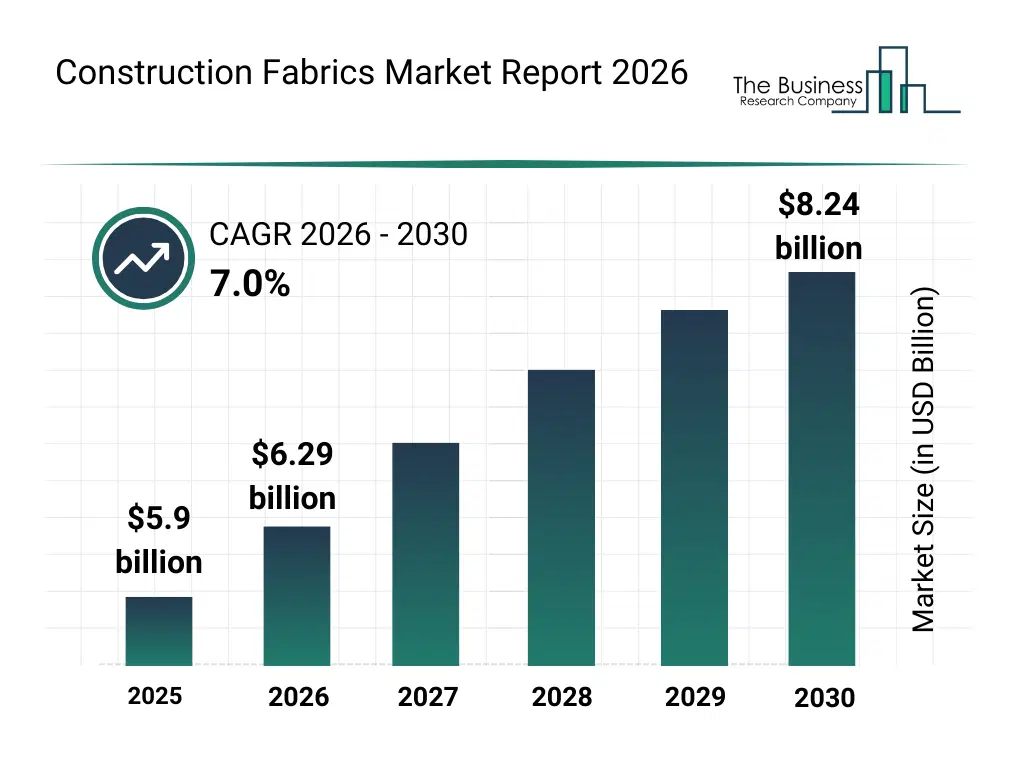
What Is The Construction Fabrics Market Size and Share 2026?
The construction fabrics market size has grown strongly in recent years. It will grow from $5.9 billion in 2025 to $6.29 billion in 2026 at a compound annual growth rate (CAGR) of 6.6%. The growth in the historic period can be attributed to expansion of infrastructure development projects, growth in urban construction activities, increasing adoption of soil stabilization techniques, availability of synthetic textile materials, rising use in temporary construction solutions.What Is The Construction Fabrics Market Growth Forecast?
The construction fabrics market size is expected to see strong growth in the next few years. It will grow to $8.24 billion in 2030 at a compound annual growth rate (CAGR) of 7.0%. The growth in the forecast period can be attributed to increasing investments in sustainable construction, rising demand for lightweight building materials, expansion of smart infrastructure projects, growing adoption of advanced composite fabrics, increasing focus on long-term structural durability. Major trends in the forecast period include increasing use of geotextiles in infrastructure projects, rising demand for erosion control fabrics, expansion of tensile architecture applications, growing adoption of non-woven construction fabrics, enhanced focus on durable and weather-resistant materials.
Global Construction Fabrics Market Segmentation
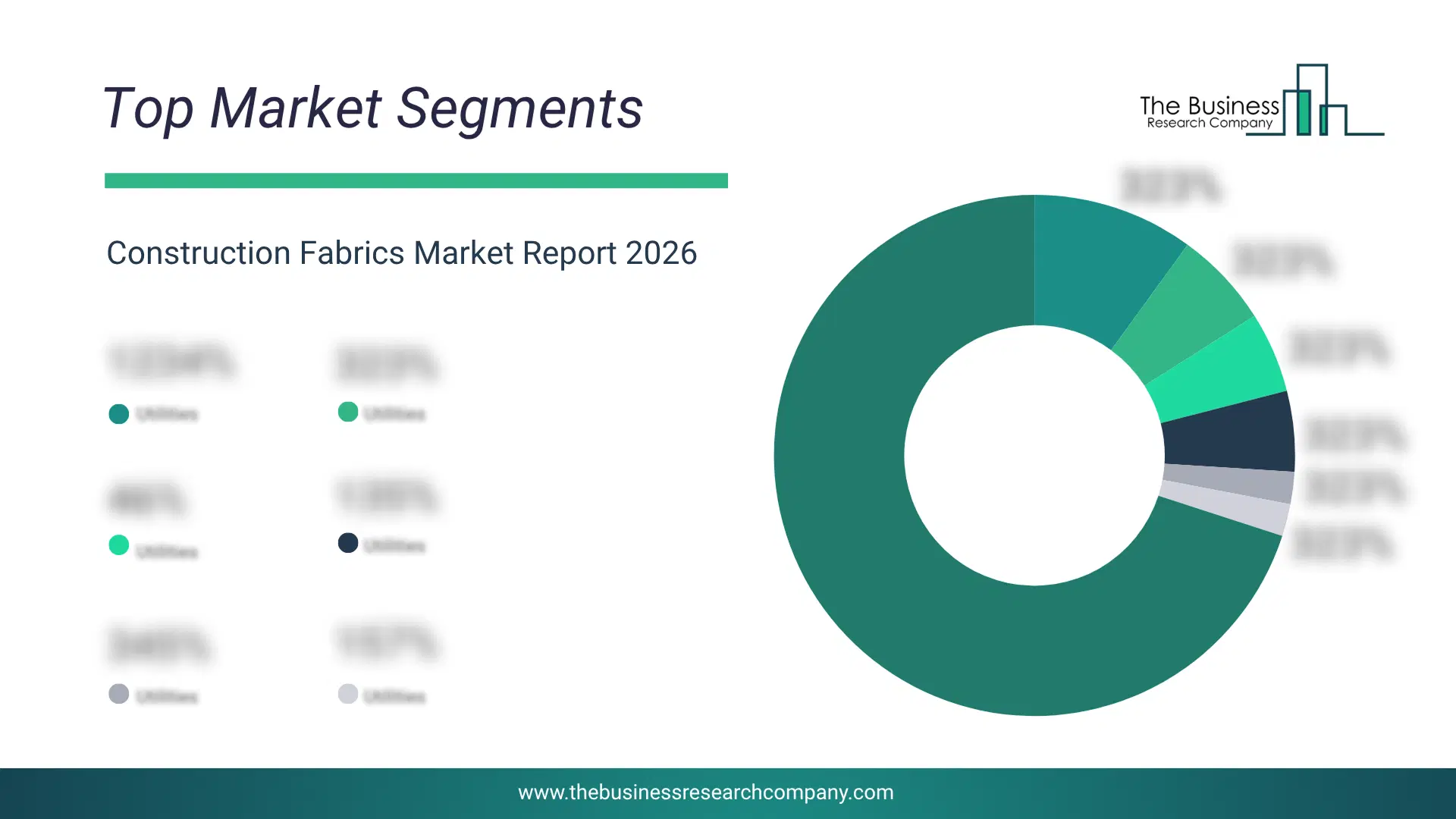
1) By Type: Woven, Non-Woven, Other Types 2) By Material: Polyester, Nylon, PTFE (Polytetrafluoroethylene), Silicone Glass, ETFE (Ethylene Tetrafluoroethylene), Other Materials 3) By Application: Acoustic Fabric, Tensile Architecture, Awnings And Canopies, Other Applications Subsegments: 1) By Woven: Plain Woven Fabrics, Twill Woven Fabrics, Satin Woven Fabrics 2) By Non-Woven: Spunbond Non-Woven Fabrics, Meltblown Non-Woven Fabrics, Needlepunch Non-Woven Fabrics 3) By Other Types: Knitted Fabrics, Composite Fabrics, Coated FabricsWhat Is The Driver Of The Construction Fabrics Market?
The rise in construction activities is expected to propel the growth of the construction fabrics market going forward. Construction activities use advanced techniques, materials, and technologies to construct buildings, infrastructure, and other structures. Construction textiles are used in construction because they are lighter than traditional building materials, making shipping and installation easier. Construction fabric can assist the construction industry by providing lightweight, durable, and versatile materials for building and construction purposes. For instance, in February 2023, according to the United States Census Bureau, a US-based primary agency of the Federal Statistics System, construction spending in February 2023 was estimated to be $1, 844.1 billion, increasing from $1, 753.1 billion in February 2022. Additionally, Construction spending in the first two months of 2023 was $260.8 billion, which increased from $246.1 billion in the same period in 2022. Moreover, in March 2023, according to the United States Census Bureau, a US-based principal agency of the federal statistical system, the number of privately owned housing units approved by building permits in February was 1, 524, 000 on a seasonally adjusted yearly basis. This is 13.8% more than the January rate, which was corrected to 1, 339, 000. Therefore, the rise in construction activities is driving the growth of the construction fabrics industry.Key Players In The Global Construction Fabrics Market
Major companies operating in the construction fabrics market are Sioen Industries NV, Low & Bonar plc, Sattler AG, Taiyo Kogyo Corporation, Serge Ferrari SA, Saint-Gobain SA, Hiraoka & Co Ltd, Endutex Coated Technical Textiles SA, Verseidag-Indutex GmbH, Hightex GmbH, Seaman Corporation, EREZ Thermoplastic Products, Dongwon Industry Co, Seele Inc, Sefar AG, Novum Membranes GmbH, Freudenberg SE, Toray Industries Inc, Teijin Limited, Milliken & Company, Ahlstrom-Munksjö Oyj, Berry Global Inc, Heytex Group, Obeikan Technical Fabrics Co, Herculite Products Inc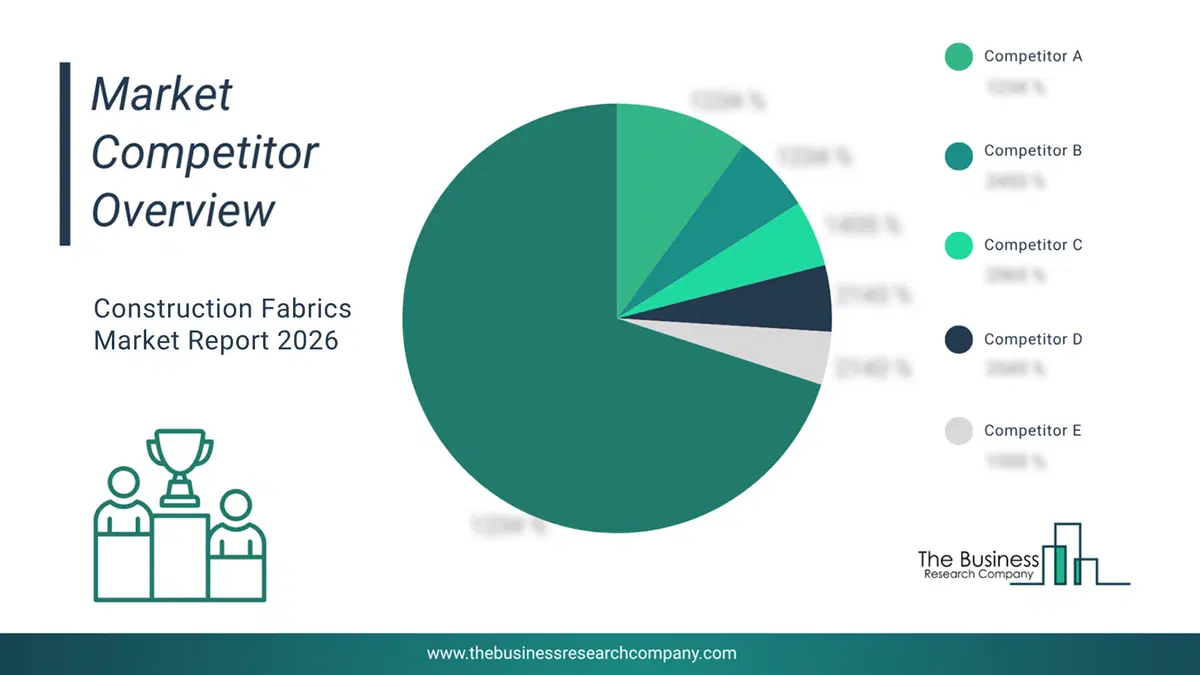
This chart is for illustrative purposes; the full report includes a detailed competitor analysis and comprehensive overview of the top 10 companies in the market.
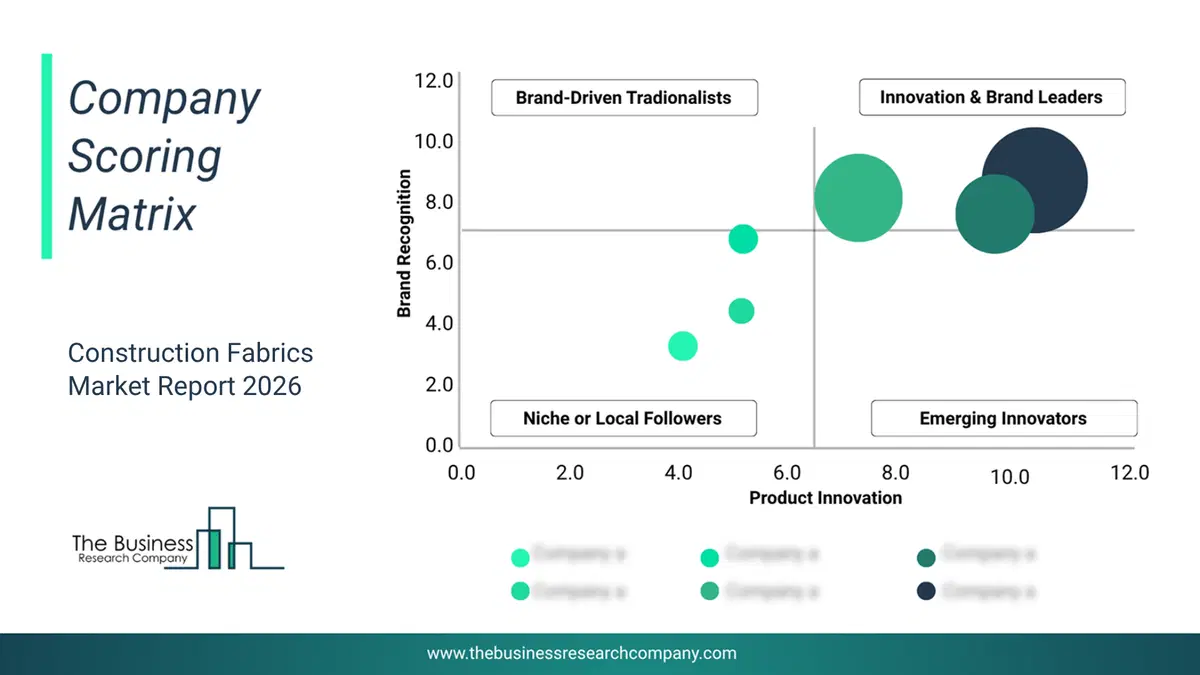
This chart maps companies by product innovation and brand strength, with bubble size indicating relative revenue, helping identify market leaders, challengers, and niche players. This is an illustrative chart; the full report provides a complete and accurate competitive analysis.
Global Construction Fabrics Market Trends and Insights
Major companies operating in the construction fabric market are focused on adopting strategic partnerships to recycle industrial waste, turn it into environmentally acceptable building materials, and gain a competitive edge in the market. Such collaborations focus on developing sustainable materials that reduce waste, promote circularity, and contribute to a more environmentally friendly construction industry. For instance, in November 2023, Hayleys Fabric, a Sri Lanka-based textile manufacturing company, partnered with Pro Green Laboratories of the University of Moratuwa, a Sri Lanka-based university, to upcycle industrial waste and convert it into sustainable, environmentally friendly construction materials. The partnership, launched under the FaBriEco banner, aims to develop eco-friendly, low-cost products for the local market from dye waste, fabric waste, and fly ash generated in the textile industry. The concept draws upon the research undertaken by Pro Green Laboratories, whose patents on sustainable products include mud concrete blocks and polymerized self-compacting mud blocks. With the project, Hayleys Fabric seeks to replace conventional waste management techniques with one in which hazardous and toxic waste produced as a result can be handled and recycled into sustainable building materials.What Are Latest Mergers And Acquisitions In The Construction Fabrics Market?
In August 2024, Geofabrics Australasia Pty Ltd, an Australia-based manufacturing company, acquired Bayset for an undisclosed amount. With this acquisition, Geofabrics Australasia aims to expand its footprint in the waterproofing, flooring, and concrete repair industries, further diversifying its product portfolio and strengthening its position in key market segments. Bayset is an Australia-based waterproofing products company that specializes in providing construction solutions with a focus on waterproofing and concrete repair industries.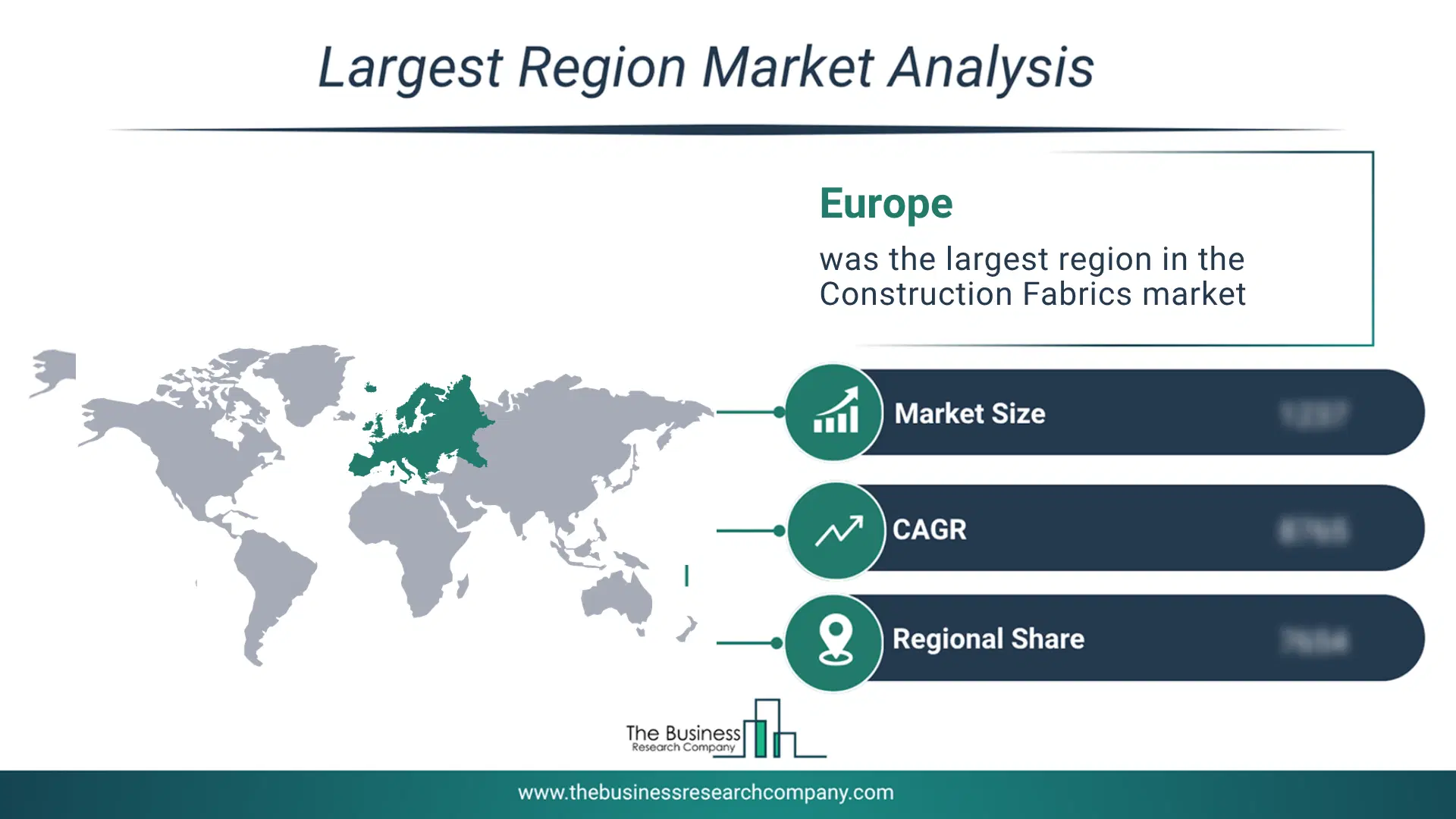
Regional Outlook
Europe was the largest region in the construction fabrics market in 2025. Asia-Pacific is expected to be the fastest-growing region in the global construction fabrics market during the forecast period. The regions covered in this market report are Asia-Pacific, South East Asia, Western Europe, Eastern Europe, North America, South America, Middle East, Africa. The countries covered in this market report are Australia, Brazil, China, France, Germany, India, Indonesia, Japan, Taiwan, Russia, South Korea, UK, USA, Canada, Italy, Spain.What Defines the Construction Fabrics Market?
The construction fabrics market consists of sales of geotextiles, geogrids, geomembranes, polythene sheeting. Values in this market are ‘factory gate’ values, that is the value of goods sold by the manufacturers or creators of the goods, whether to other entities (including downstream manufacturers, wholesalers, distributors, and retailers) or directly to end customers. The value of goods in this market includes related services sold by the creators of the goods.How is Market Value Defined and Measured?
The market value is defined as the revenues that enterprises gain from the sale of goods and/or services within the specified market and geography through sales, grants, or donations in terms of the currency (in USD unless otherwise specified). The revenues for a specified geography are consumption values that are revenues generated by organizations in the specified geography within the market, irrespective of where they are produced. It does not include revenues from resales along the supply chain, either further along the supply chain or as part of other products.
This chart presents market attractiveness based on a quantitative evaluation of growth, competition, strategic alignment, and risk, offering a clear view of opportunity areas for decision-making. This chart is for illustrative purposes; the full report contains the complete analysis.

This chart highlights the Total Addressable Market (TAM) by estimating the maximum revenue opportunity using an assumption-driven approach, supporting strategic planning and opportunity sizing across markets. The chart is illustrative; the full report provides a more comprehensive analysis.
What Key Data and Analysis Are Included in the Construction Fabrics Market Report 2026?
The construction fabrics market research report is one of a series of new reports from The Business Research Company that provides market statistics, including Market Report 2026?global market size, regional shares, competitors with the market share, detailed market segments, market trends and opportunities, and any further data you may need to thrive in the construction fabrics Market Report 2026? The market research report delivers a complete perspective of everything you need, with an in-depth analysis of the current and future state of the Market Report 2026?Construction Fabrics Market Report Forecast Analysis
| Report Attribute | Details |
|---|---|
| Market Size Value In 2026 | $6.29 billion |
| Revenue Forecast In 2030 | $8.24 billion |
| Growth Rate | CAGR of 6.6% from 2026 to 2030 |
| Base Year For Estimation | 2025 |
| Actual Estimates/Historical Data | 2020-2025 |
| Forecast Period | 2026 - 2030 |
| Market Representation | Revenue in USD Billion and CAGR from 2026 to 2030 |
| Segments Covered | Type, Material, Application |
| Regional Scope | Asia-Pacific, Western Europe, Eastern Europe, North America, South America, Middle East, Africa |
| Country Scope | The countries covered in the report are Australia, Brazil, China, France, Germany, India, Indonesia, Japan, Taiwan, Russia, South Korea, UK, USA, Canada, Italy, Spain. |
| Key Companies Profiled | Sioen Industries NV, Low & Bonar plc, Sattler AG, Taiyo Kogyo Corporation, Serge Ferrari SA, Saint-Gobain SA, Hiraoka & Co Ltd, Endutex Coated Technical Textiles SA, Verseidag-Indutex GmbH, Hightex GmbH, Seaman Corporation, EREZ Thermoplastic Products, Dongwon Industry Co, Seele Inc, Sefar AG, Novum Membranes GmbH, Freudenberg SE, Toray Industries Inc, Teijin Limited, Milliken & Company, Ahlstrom-Munksjö Oyj, Berry Global Inc, Heytex Group, Obeikan Technical Fabrics Co, Herculite Products Inc |
| Customization Scope | Request for Customization |
| Pricing And Purchase Options | Explore Purchase Options |