

Construction Polymers Market Report 2026
Global Outlook – By Type (Polyvinyl Chloride, Polyethylene, Polypropylene, Polyurethane, Polystyrene, Other Types), By Technology (Polymerization Technology, Dispersion Technology, Nanotechnology Integration, Curing Technology), By Formulation (Waterborne Polymer Formulations, Solvent Based Formulations, Powder Based Formulations, Hybrid Formulations), By Distribution Channel (Direct Sales, Distributors And Wholesalers, Retail Stores, Online Sales), By Application (Concrete Repair And Rehabilitation, Flooring, Waterproofing, Roofing, Sealants And Adhesives, Pipes And Fittings, Insulation, Protective Coatings, Structural Composites, Other Applications) – Market Size, Trends, Strategies, and Forecast to 2035
Construction Polymers Market Overview
• Construction Polymers market size has reached to $191.88 billion in 2025 • Expected to grow to $299.01 billion in 2030 at a compound annual growth rate (CAGR) of 9.2% • Growth Driver: Surge In Construction And Infrastructure Development Fueling The Growth Of The Market Due To Rising Demand For Durable Materials • Market Trend: Innovations In Redispersible Polymer Powder Technology Enhance Performance And Durability In Dry Construction Mixtures • Asia-Pacific was the largest region and fastest growing region.What Is Covered Under Construction Polymers Market?
Construction polymers are polymer-based materials used in construction to enhance properties such as adhesion, sealing, waterproofing, flexibility, durability, strength, and resistance to chemicals and environmental conditions. They include adhesives, sealants, coatings, waterproofing materials, polymer-modified concrete and mortars, and other specialty construction products used in residential, commercial, industrial, and infrastructure applications. The main types of construction polymers include polyvinyl chloride, polyethylene, polypropylene, polyurethane, polystyrene, and other types. Polyvinyl chloride refers to a versatile synthetic polymer widely used in construction materials because of its durability, chemical resistance, and weather resistance. These polymers are produced using polymerization technology, dispersion technology, nanotechnology integration, and curing technology, and are available in waterborne polymer formulations, solvent based formulations, powder based formulations, and hybrid formulations. They are distributed through direct sales, distributors and wholesalers, retail stores, and online sales, and find application in concrete repair and rehabilitation, flooring, waterproofing, roofing, sealants and adhesives, pipes and fittings, insulation, protective coatings, structural composites, and other applications.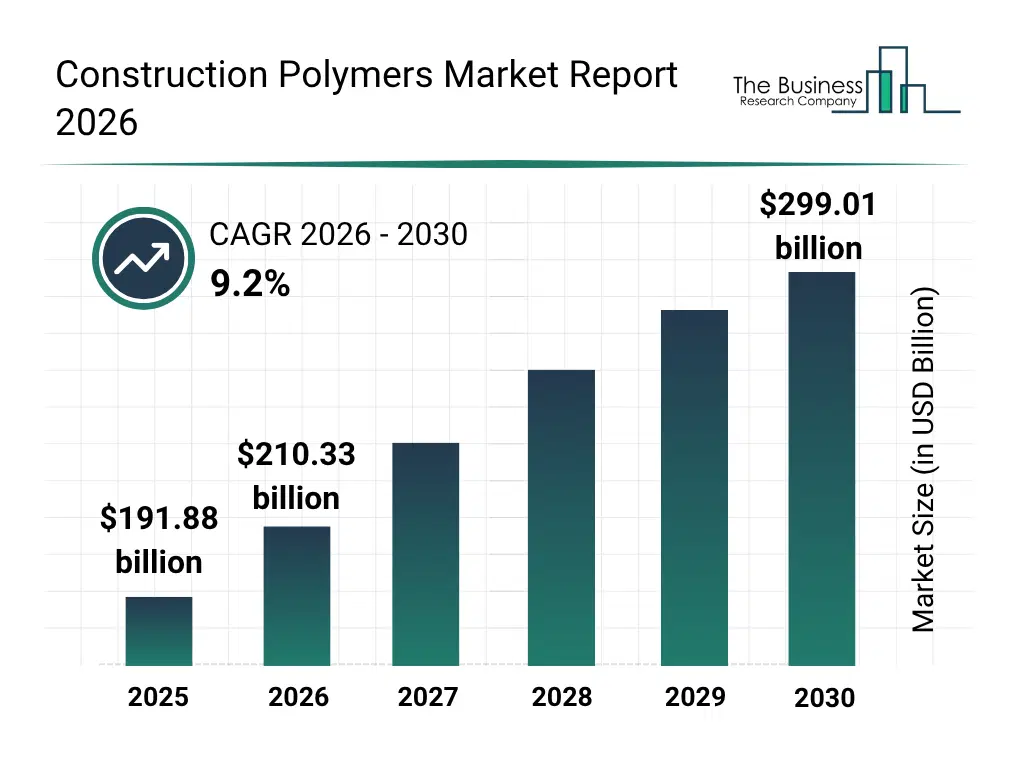
What Is The Construction Polymers Market Size and Share 2026?
The construction polymers market size has grown strongly in recent years. It will grow from $191.88 billion in 2025 to $210.33 billion in 2026 at a compound annual growth rate (CAGR) of 9.6%. The growth in the historic period can be attributed to increasing construction and infrastructure development, rising demand for durable construction materials, growing adoption of polymer-based waterproofing solutions, expansion of flooring and protective coating applications, increasing renovation and rehabilitation activities.What Is The Construction Polymers Market Growth Forecast?
The construction polymers market size is expected to see strong growth in the next few years. It will grow to $299.01 billion in 2030 at a compound annual growth rate (CAGR) of 9.2%. The growth in the forecast period can be attributed to growing demand for energy-efficient buildings, increasing infrastructure modernization investments, rising adoption of sustainable construction materials, expanding use of advanced polymer composites, increasing demand for high-performance sealants and adhesives. Major trends in the forecast period include development of low-voc construction polymers, growing use of polymer-modified concrete, advancements in high-performance waterproofing polymers, increasing demand for rapid-curing polymer materials, development of self-healing polymer-based construction materials.Tariff Impact On Construction Polymers Market
Tariffs are impacting the construction polymers market by increasing the cost of imported polymer resins, chemical additives, specialty formulations, and manufacturing equipment used to produce construction materials. Polyurethane, polyvinyl chloride, polyethylene, and polymer-based coatings and adhesives may face greater cost pressures, particularly in North America, Europe, and Asia-Pacific where construction polymer supply chains rely on international raw material trade. However, tariffs can encourage manufacturers to localize resin production, diversify suppliers, and develop alternative formulations, supporting domestic manufacturing and supply-chain resilience.
Global Construction Polymers Market Segmentation
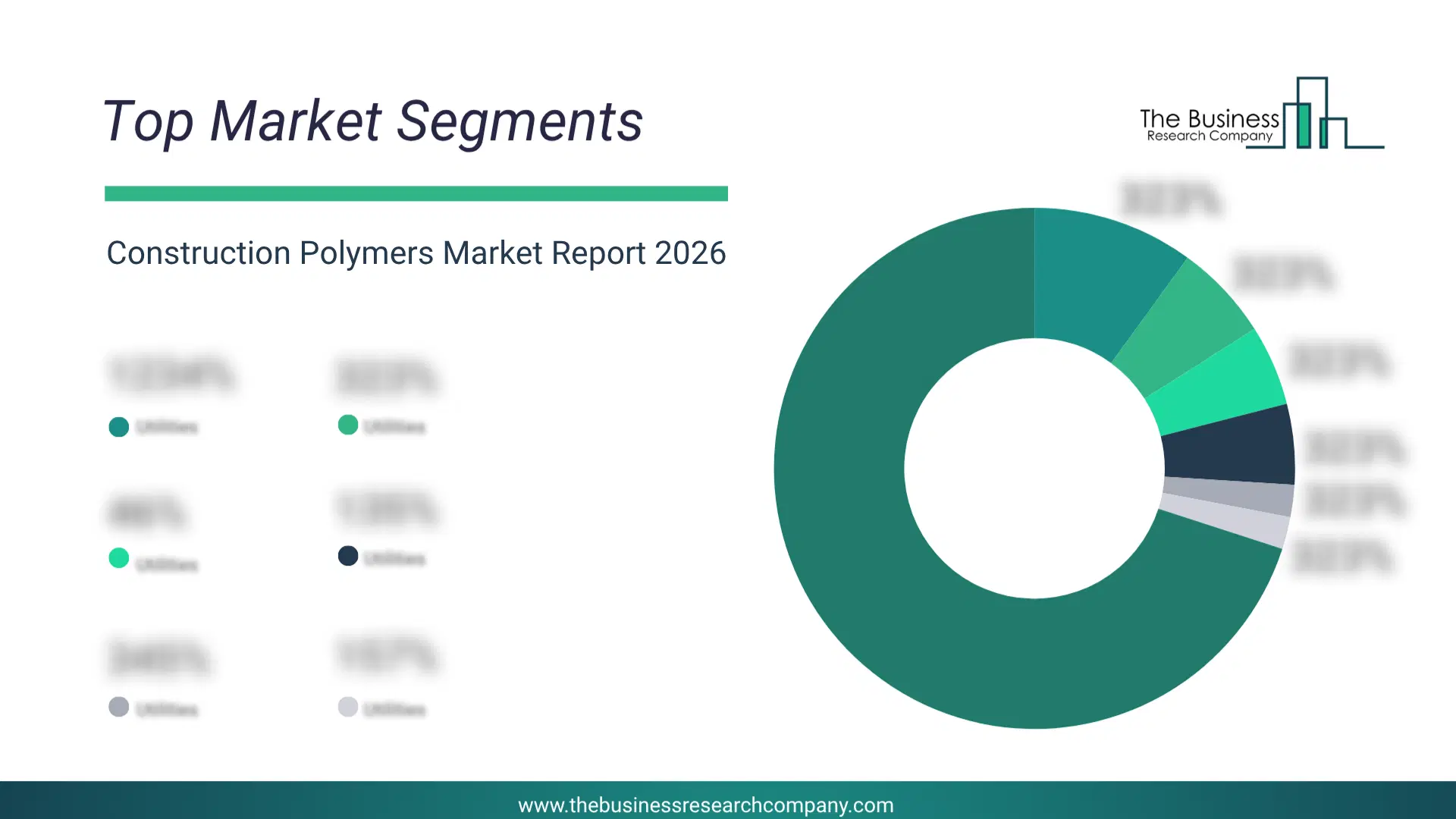
2) By Technology: Polymerization Technology, Dispersion Technology, Nanotechnology Integration, Curing Technology 3) By Formulation: Waterborne Polymer Formulations, Solvent Based Formulations, Powder Based Formulations, Hybrid Formulations 4) By Distribution Channel: Direct Sales, Distributors And Wholesalers, Retail Stores, Online Sales 5) By Application: Concrete Repair And Rehabilitation, Flooring, Waterproofing, Roofing, Sealants And Adhesives, Pipes And Fittings, Insulation, Protective Coatings, Structural Composites, Other Applications Subsegments: 1) By Polyvinyl Chloride: Rigid Polyvinyl Chloride, Flexible Polyvinyl Chloride, Chlorinated Polyvinyl Chloride 2) By Polyethylene: High Density Polyethylene, Low Density Polyethylene, Linear Low Density Polyethylene 3) By Polypropylene: Homopolymer Polypropylene, Copolymer Polypropylene, Random Copolymer Polypropylene 4) By Polyurethane: Rigid Polyurethane Foam, Flexible Polyurethane Foam, Polyurethane Elastomers 5) By Polystyrene: General Purpose Polystyrene, High Impact Polystyrene, Expanded Polystyrene 6) By Other Types: Acrylonitrile Butadiene Styrene, Polycarbonate, Polyamide, Ethylene Vinyl Acetate, Polyvinyl ButyralWhat Is The Driver Of The Construction Polymers Market?
The rising construction and infrastructure development is expected to propel the growth of the construction polymers market going forward. Construction and infrastructure development refers to the planning, design, construction, renovation, and expansion of residential, commercial, industrial, transportation, and public utility projects that support economic and social development. Construction and infrastructure development are rising due to increasing investments in residential, commercial, and public infrastructure projects, driving demand for advanced construction materials. The growing construction and infrastructure development supports the construction polymers by increasing the demand for durable, lightweight, corrosion-resistant, weather-resistant, and energy-efficient polymer-based materials used in applications such as concrete repair, flooring, waterproofing, roofing, sealants, adhesives, and piping systems. For instance, in July 2026, according to the Office for National Statistics (ONS), a UK-based government department, investments in infrastructure by the private sector totaled £31.3 billion (approximately $40.6 billion) in 2025, while private-sector net stocks of infrastructure were estimated at £506.7 billion (approximately $657.6 billion). Therefore, the rising construction and infrastructure development is driving the growth of the construction polymers industry.Key Players In The Global Construction Polymers Market
Major companies operating in the construction polymers market are BASF SE, Compagnie de Saint-Gobain, Dow Inc., LyondellBasell Industries N.V., 3M Company, Henkel AG & Co. KGaA, INEOS Group Limited, Evonik Industries AG, Sika AG, Arkema S.A., RPM International Inc., Wacker Chemie AG, Huntsman Corporation, KCC Corporation, Mapei S.p.A., H.B. Fuller Company, Pidilite Industries Limited, Master Builders Solutions Holdings GmbH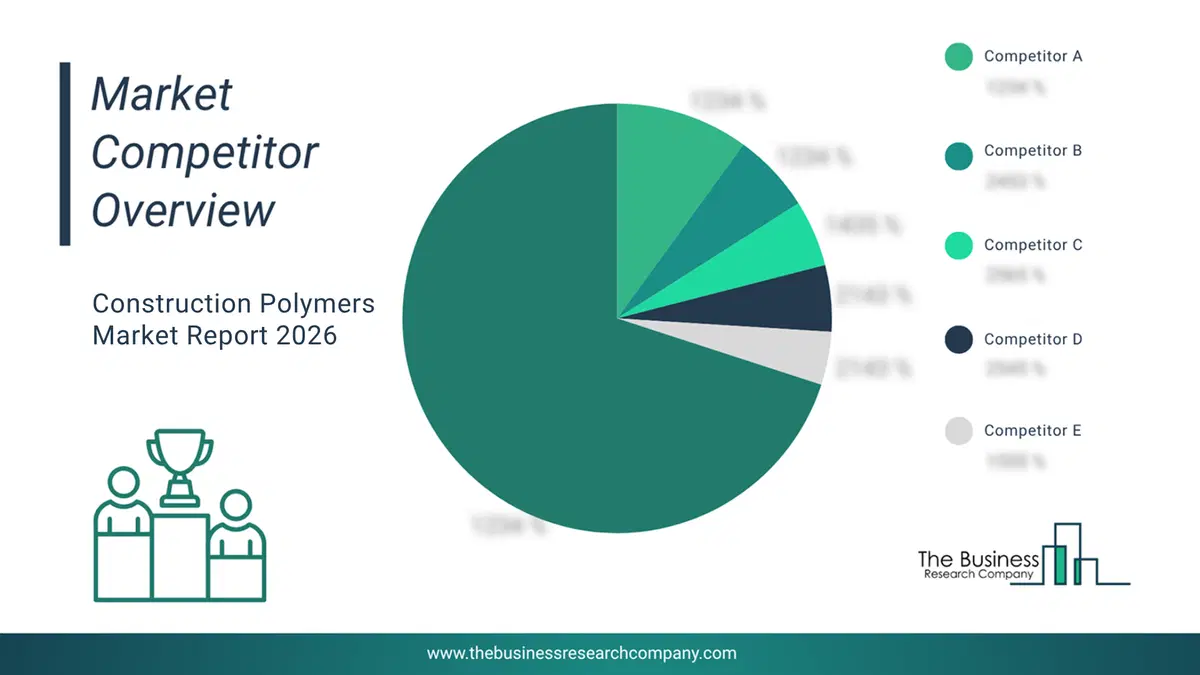
This chart is for illustrative purposes; the full report includes a detailed competitor analysis and comprehensive overview of the top 10 companies in the market.
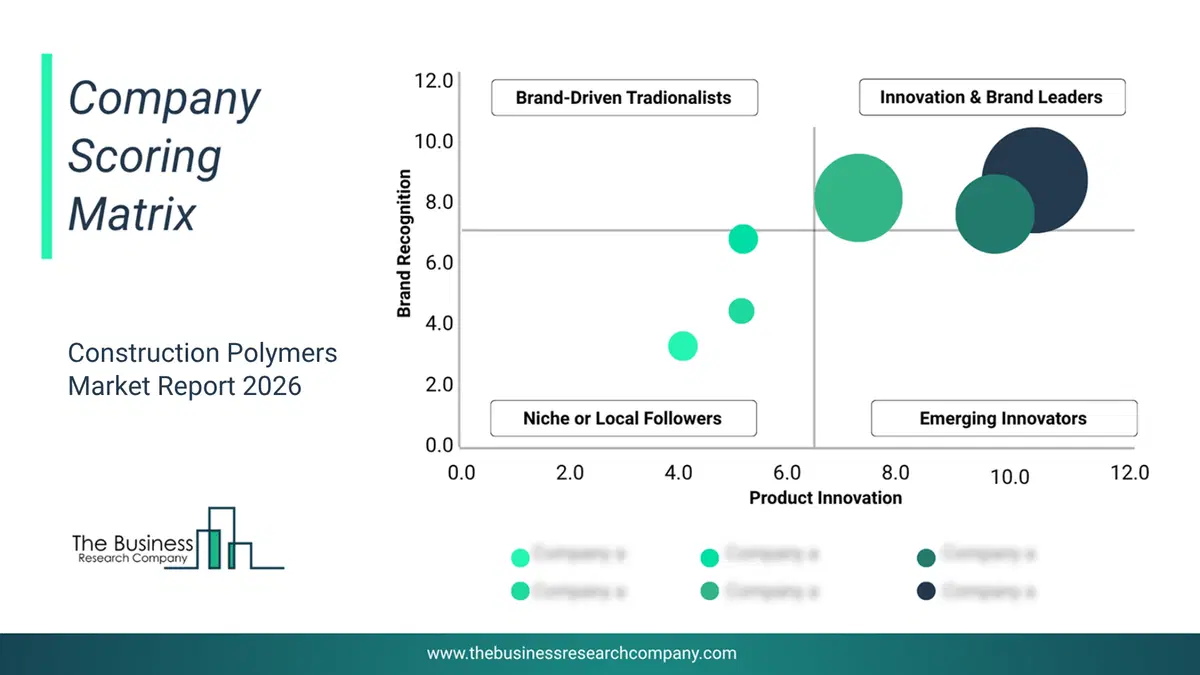
This chart maps companies by product innovation and brand strength, with bubble size indicating relative revenue, helping identify market leaders, challengers, and niche players. This is an illustrative chart; the full report provides a complete and accurate competitive analysis.
Global Construction Polymers Market Trends and Insights
Major companies operating in the construction polymers market are focusing on developing advanced polymer solutions, such as redispersible polymer powders, to improve the strength, adhesion, flexibility, and durability of dry construction materials. Redispersible polymer powders are polymer-based additives that redisperse in water to enhance the performance of cementitious and gypsum-based construction mixtures. For instance, in March 2026, Pigment LLC, a Russia-based chemical manufacturer, launched a new production line for redispersible polymer powders designed for dry construction mixtures. The new product portfolio is designed for tile adhesives, repair mortars, self-leveling compounds, plaster, and thermal insulation systems. It improves bonding strength, crack resistance, and water resistance while enhancing the durability and long-term performance of construction materials.What Are Latest Mergers And Acquisitions In The Construction Polymers Market?
In February 2025, Compagnie de Saint-Gobain S.A., a France-based building materials and construction solutions company, acquired Fosroc for an undisclosed amount. Through this acquisition, Saint-Gobain aims to strengthen its global construction chemicals platform, expand its presence in high-growth markets such as India and the Middle East, and enhance its construction polymers capabilities through Fosroc’s portfolio and vertical integration opportunities in polymer production. Fosroc is a UK-based construction chemicals manufacturer that provides construction polymers.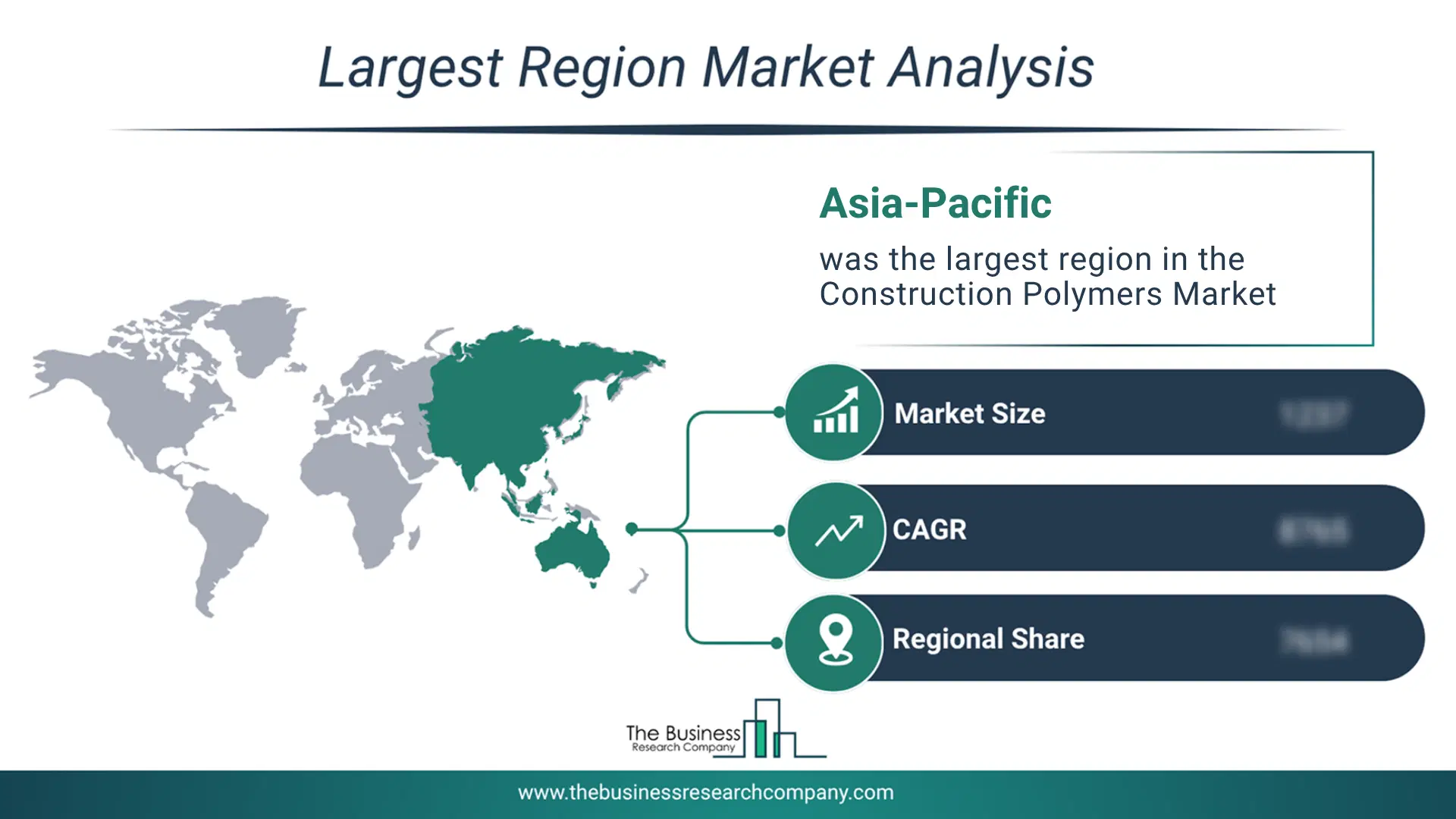
Regional Outlook/Insights
Asia-Pacific was the largest region in the construction polymers market in 2025. Asia-Pacific is expected to be the fastest-growing region in the forecast period. The regions covered in this market report are Asia-Pacific, South East Asia, Western Europe, Eastern Europe, North America, South America, Middle East, Africa. The countries covered in this market report are Australia, Brazil, China, France, Germany, India, Indonesia, Japan, Taiwan, Russia, South Korea, UK, USA, Canada, Italy, Spain.What Defines the Construction Polymers Market?
The construction polymers market consists of sales of polymer-modified construction materials, construction-grade acrylic polymers, construction-grade polyurethane polymers, construction-grade epoxy polymers, polymer-modified cement additives, polymer waterproofing compounds, construction polymer resins, and specialty polymers for construction applications. Values in this market are ‘factory gate’ values, that is, the value of goods sold by the manufacturers or creators of the goods, whether to other entities (including downstream manufacturers, wholesalers, distributors, and retailers) or directly to end customers. The value of goods in this market includes related services sold by the creators of the goods.How is Market Value Defined and Measured?
The market value is defined as the revenues that enterprises gain from the sale of goods and/or services within the specified market and geography through sales, grants, or donations in terms of the currency (in USD unless otherwise specified). The revenues for a specified geography are consumption values that are revenues generated by organizations in the specified geography within the market, irrespective of where they are produced. It does not include revenues from resales along the supply chain, either further along the supply chain or as part of other products.
This chart presents market attractiveness based on a quantitative evaluation of growth, competition, strategic alignment, and risk, offering a clear view of opportunity areas for decision-making. This chart is for illustrative purposes; the full report contains the complete analysis.

This chart highlights the Total Addressable Market (TAM) by estimating the maximum revenue opportunity using an assumption-driven approach, supporting strategic planning and opportunity sizing across markets. The chart is illustrative; the full report provides a more comprehensive analysis.
What Key Data and Analysis Are Included in the Construction Polymers Market Report 2026?
The construction polymers market research report is one of a series of new reports from The Business Research Company that provides market statistics, including industry global market size, regional shares, competitors with the market share, detailed market segments, market trends and opportunities, and any further data you may need to thrive in the construction polymers industry. The market research report delivers a complete perspective of everything you need, with an in-depth analysis of the current and future state of the industry.Construction Polymers Market Report Forecast Analysis
| Report Attribute | Details |
|---|---|
| Market Size Value In 2026 | $210.33 billion |
| Revenue Forecast In 2030 | $299.01 billion |
| Growth Rate | CAGR of 9.2% from 2026 to 2035 |
| Base Year For Estimation | 2025 |
| Actual Estimates/Historical Data | 2020-2025 |
| Forecast Period | 2026 - 2030 |
| Market Representation | Revenue in USD Billion and CAGR from 2026 to 2030 |
| Segments Covered | Type, Technology, Formulation, Distribution Channel, Application |
| Regional Scope | Asia-Pacific, Western Europe, Eastern Europe, North America, South America, Middle East, Africa |
| Country Scope | The countries covered in the report are Australia, Brazil, China, France, Germany, India, Indonesia, Japan, Taiwan, Russia, South Korea, UK, USA, Canada, Italy, Spain. |
| Customization Scope | Request for Customization |
| Pricing And Purchase Options | Explore Purchase Options |