

Construction Robotics Market Report 2026
Global Outlook – By Type (Demolition, Bricklaying, 3D Printing, Surveillance, Concrete Structural Erection, Finishing Work, Doors And Windows Installation, Other Types), By Sales Type (New Sales, Aftermarket), By End-User (Residential, Industrial, Commercial) – Market Size, Trends, Strategies, and Forecast to 2030
Construction Robotics Market Overview
• Construction Robotics market size has reached to $6.55 billion in 2025 • Expected to grow to $15.39 billion in 2030 at a compound annual growth rate (CAGR) of 18.6% • Growth Driver: Growth Of Construction Robotics Driven By Increasing Residential Sector Demand • Market Trend: Advanced Construction Robotics With The Emergence Of Rebar-Installing Technologies • North America was the largest region in 2025 and Europe is the fastest growing region.Market Gains By 2030 – Top Opportunities By Segment
Market Gain identifies the most promising market opportunities by highlighting the segments or products expected to generate the highest incremental revenue growth over the next five years.
What Is Covered Under Construction Robotics Market?
Construction robotics refers to the use of automated machines and robotic systems in the construction industry to perform tasks traditionally carried out by human workers. These robots can be used for various activities, including building, demolition, bricklaying, concrete pouring, welding, and even inspection and surveying. Construction robotics are designed to perform tasks traditionally done by humans, aiming to enhance productivity, precision, safety, and efficiency in construction projects. The main types of construction robotics are demolition, bricklaying, 3d printing, surveillance, concrete structural erection, finishing work, doors and windows installation, and others. Demolition refers to the process of tearing down or destroying buildings, structures, or parts of structures in a controlled manner. These are sold through various sales types such as new sales, aftermarket. These are used by various end-users such as residential, industrial, and commercial.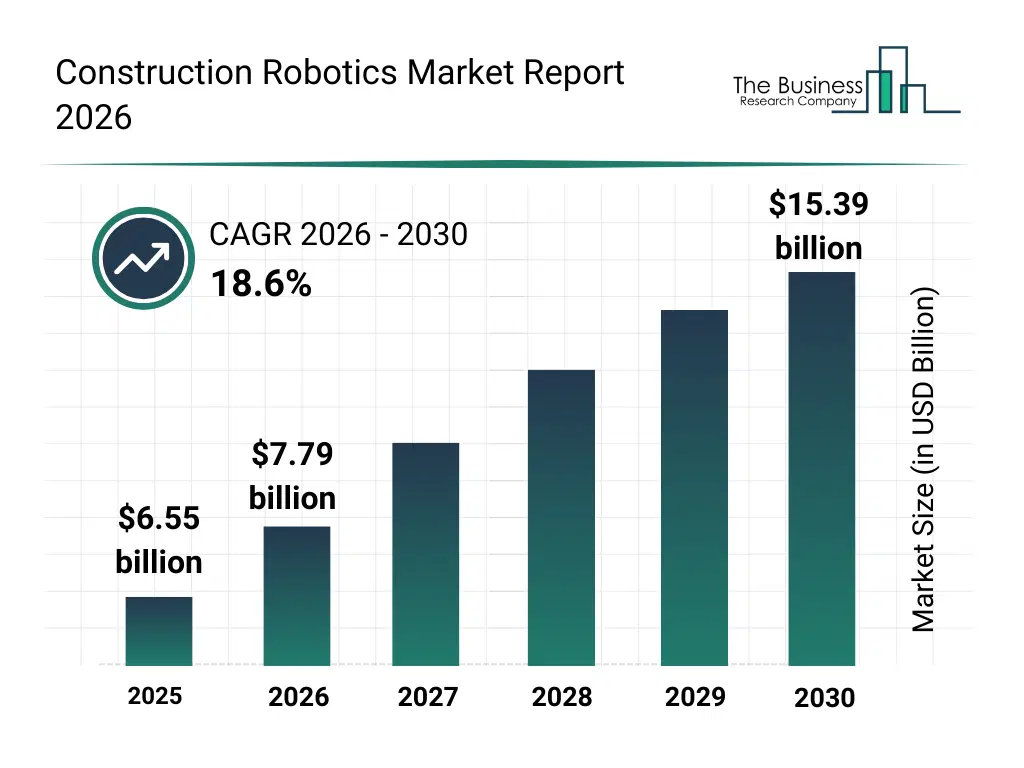
What Is The Construction Robotics Market Size and Share 2026?
The construction robotics market size has grown rapidly in recent years. It will grow from $6.55 billion in 2025 to $7.79 billion in 2026 at a compound annual growth rate (CAGR) of 18.9%. The growth in the historic period can be attributed to labor shortages in construction, safety concerns on job sites, demand for faster project delivery, growth in urban infrastructure, need for precision construction.What Is The Construction Robotics Market Growth Forecast?
The construction robotics market size is expected to see rapid growth in the next few years. It will grow to $15.39 billion in 2030 at a compound annual growth rate (CAGR) of 18.6%. The growth in the forecast period can be attributed to smart city development, adoption of autonomous construction sites, rising infrastructure investments, digital transformation of construction, productivity improvement initiatives. Major trends in the forecast period include rising adoption of robotic demolition systems, growing use of automated bricklaying solutions, expansion of construction 3d printing robots, increased deployment of inspection and surveillance robots, integration of robotics in finishing operations.
Global Construction Robotics Market Segmentation
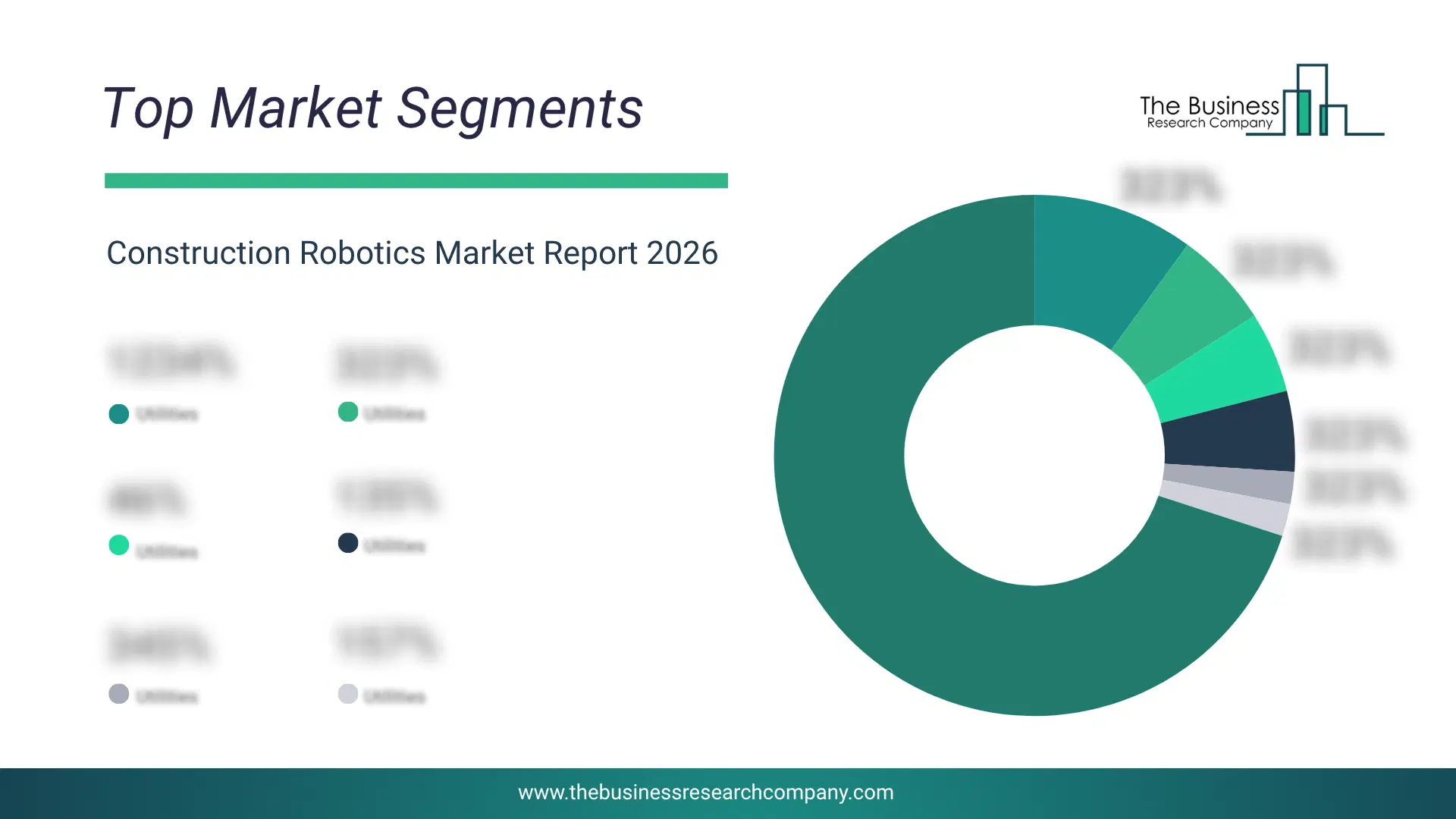
1) By Type: Demolition, Bricklaying, 3D Printing, Surveillance, Concrete Structural Erection, Finishing Work, Doors And Windows Installation, Other Types 2) By Sales Type: New Sales, Aftermarket 3) By End-User: Residential, Industrial, Commercial Subsegments: 1) By Demolition: Robotic Demolition Arms, Remote-Controlled Demolition Robots 2) By Bricklaying: Automated Bricklaying Machines, Robotic Bricklaying Systems 3) By 3D Printing: Robotic 3D Concrete Printers, Additive Manufacturing Systems for Construction 4) By Surveillance: Drones for Site Monitoring, Robotic Surveillance Systems 5) By Concrete Structural Erection: Robotic Systems for Steel and Concrete Erection, Automated Formwork Systems 6) By Finishing Work: Robotic Painting Systems, Automated Flooring Installation Robots 7) By Doors and Windows Installation: Robotic Door Installation Systems, Automated Window Fitting Machines 8) By Other Types: Robotic Surveying Equipment, Construction Logistics Robots, Maintenance and Inspection Robots The top segments in the construction robotics market will be: • New Sales will reach $2393.55 Million by 2025. • Industrial will reach $1454.05 Million by 2025. • Residential will reach $1157.63 Million by 2025. • Aftermarket will reach $1110.01 Million by 2025. • Demolition will reach $1065.71 Million by 2025.What Is The Driver Of The Construction Robotics Market?
The increase in construction in the residential sectors is expected to propel the growth of the construction robotics market going forward. The residential sector refers to areas designated for living spaces, such as homes and apartments. The increase in construction in residential sectors is due to increased productivity, addressing labor shortages, improving safety, and reducing construction time and costs. Construction robots provide uniformity and consistency in their work, ensuring that construction standards are met consistently across all projects and help to improve the efficiency, safety, and overall quality of residential construction projects. For instance, in March 2024, according to the Australian Bureau of Statistics, an Australia-based government agency, there were 30,992 dwellings of private new houses in 2023, rising 3.7% from December and an increase of 14.6% since March 2023. Further, private and other residential completions increased to 14,844 dwellings, a 5.6% increase compared with December 2023. Therefore, the increase in construction in the residential sectors is driving growth in the construction robotics industry.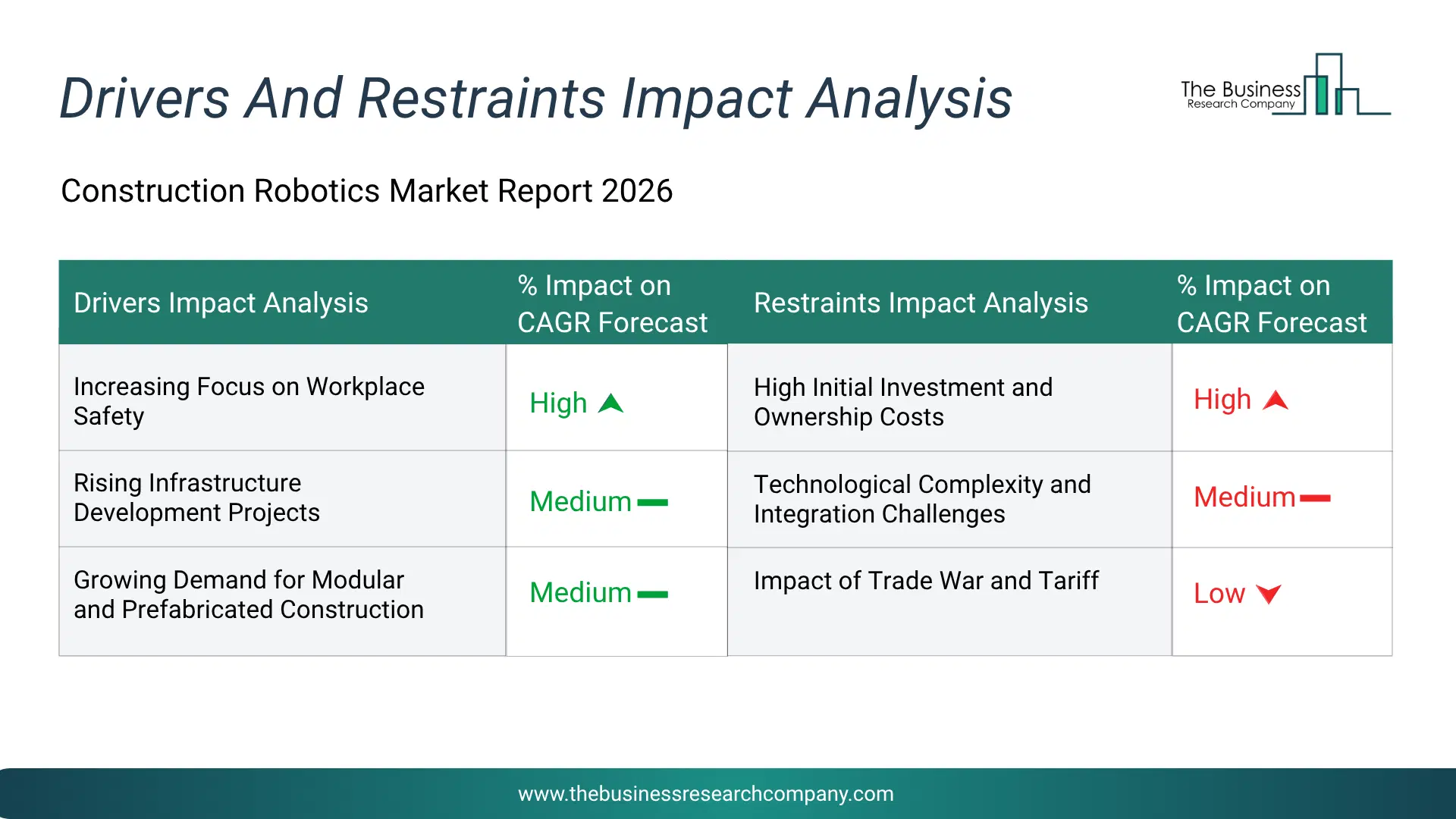
Infographic Chart Showing Key Market Drivers Analysis And Restraints For Construction Robotics Market
The chart presents an impact analysis of key drivers and restraints, quantifying their relative influence on the market's growth rate and helping assess the balance between growth enablers and limiting factors. This chart offers a high-level perspective; the full report contains more detailed insights.
How Will The Drivers Impact Growth In The Global Construction Robotics Market?
• Increasing Focus on Workplace Safety (High) – The increasing emphasis on workplace safety will become a key driver of growth in the construction robotics market by 2030. The increasing focus on workplace safety is driving the adoption of construction robotics, as these technologies reduce human exposure to high-risk tasks on job sites. Robotic systems can handle hazardous, repetitive, or physically demanding operations such as heavy material handling, wall finishing, or concrete printing with greater precision and consistency, minimizing the likelihood of injuries and accidents. By automating these processes, construction companies enhance overall site safety while maintaining productivity. This shift toward safer, tech-enabled job sites is accelerating the integration of robotics across the construction industry. As a result, the growing deployment of workplace safety is anticipated to contributing to a 2.0% annual growth in the market. • Rising Infrastructure Development Projects (Medium) – The growing focus on infrastructure development project will emerge as a major factor driving the expansion of the construction robotics market by 2030. Rising infrastructure development projects are significantly boosting the adoption of construction robotics, as large-scale public and private investments demand faster, more efficient and high-quality building solutions. with increasing pressure to complete complex transportation, energy and urban infrastructure projects on time and within budget, robotic systems offer a scalable way to automate tasks such as concrete work, structural assembly and finishing. These technologies enhance precision, reduce labor constraints and improve overall project timelines. As infrastructure initiatives expand globally, robotics are becoming an essential tool for modernizing and accelerating construction processes. Consequently, the accelerating adoption of infrastructure development project capabilities is projected to contributing to a 1.5% annual growth in the market. • Growing Demand for Modular and Prefabricated Construction (Medium) – The expanding integration of modular and prefabricated construction processes will serve as a key growth catalyst for the construction robotics market by 2030, The growing demand for modular and prefabricated construction is fueling the expansion of construction robotics, as developers seek faster, more precise and scalable solutions. Robotic systems enable automated fabrication, assembly and the finishing of building components in controlled environments, enhancing efficiency and reducing human error. As modular construction gains popularity for its cost-effectiveness, speed and reduced on-site disruption, robotics play a crucial role in standardizing processes and ensuring high-quality output. This trend is driving innovation in construction automation to meet the increasing needs of residential, commercial and infrastructure projects. Therefore, this growing integration of modular and prefabricated construction operations is projected to supporting to a 1.0% annual growth in the market. • Increasing Government Initiatives (Low) – The increasing emphasis on government initiatives will become a significant driver contributing to the growth of the construction robotics market by 2030 As public agencies invest in modernizing infrastructure and promoting innovation in the construction sector. Programs focused on smart city development, affordable housing and sustainable construction often include funding and incentives for automation technologies that improve efficiency, safety and quality. Grants, subsidies and pilot projects help construction firms, especially in emerging markets adopt robotic solutions for tasks like 3D printing, prefabrication and material handling. In addition, regulatory support for digital construction practices encourages wider integration of robotics into standard building workflows. Consequently, the rising adoption of government initiatives strategies is projected to contributing to a 0.8% annual growth in the market.How Will The Restraints Impact Growth In The Global Construction Robotics Market?
• High Initial Investment and Ownership Costs (High) – High Initial Investment and Ownership Costs will restrict the growth of the Construction Robotics market during the forecast period. Construction robots involve significant capital investment in equipment, software, and integration services, often costing hundreds of thousands of dollars. The high cost of ownership, including maintenance and training expenses, makes robotics adoption challenging for many construction firms, particularly small and medium-sized contractors. This financial barrier limits market penetration and adoption rates. • Technological Complexity and Integration Challenges (Medium) – Technological Complexity and Integration Challenges will restrict the growth of the Construction Robotics market during the forecast period. Construction robots require integration with existing workflows, software systems, and site operations, presenting significant technical challenges. The complexity of programming and operating robotic systems requires specialized skills that are scarce in the construction industry. Integration issues can lead to operational delays and cost overruns, discouraging adoption. • Impact of Trade War and Tariff (Medium) – Impact of Trade War and Tariff will restrict the growth of the Construction Robotics market during the forecast period. Construction robots rely on imported components including sensors, actuators, control systems, and specialized materials. Trade tariffs and supply chain disruptions increase component costs and can delay deliveries. These cost increases make construction robotics less economically viable for some applications.Key Players In The Global Construction Robotics Market
Major companies operating in the construction robotics market are Husqvarna AB, KUKA Robotics, Scaled Robotics, Brokk AB, Boston Dynamics, Con Mech Engineers Ltd., HoloBuilder Inc., Doxel Inc., COBOD International AS, Ekso Bionics Holdings Inc., Giatec Scientific Inc., Built Robotics Inc., Construction Robotics LLC, KEWAZO, Dusty Robotics, Branch Technology, Advanced Construction Robotics Inc., Fabrica AI, Hyperion Robotics, OKIBO
This chart is for illustrative purposes; the full report includes a detailed competitor analysis and comprehensive overview of the top 10 companies in the market.
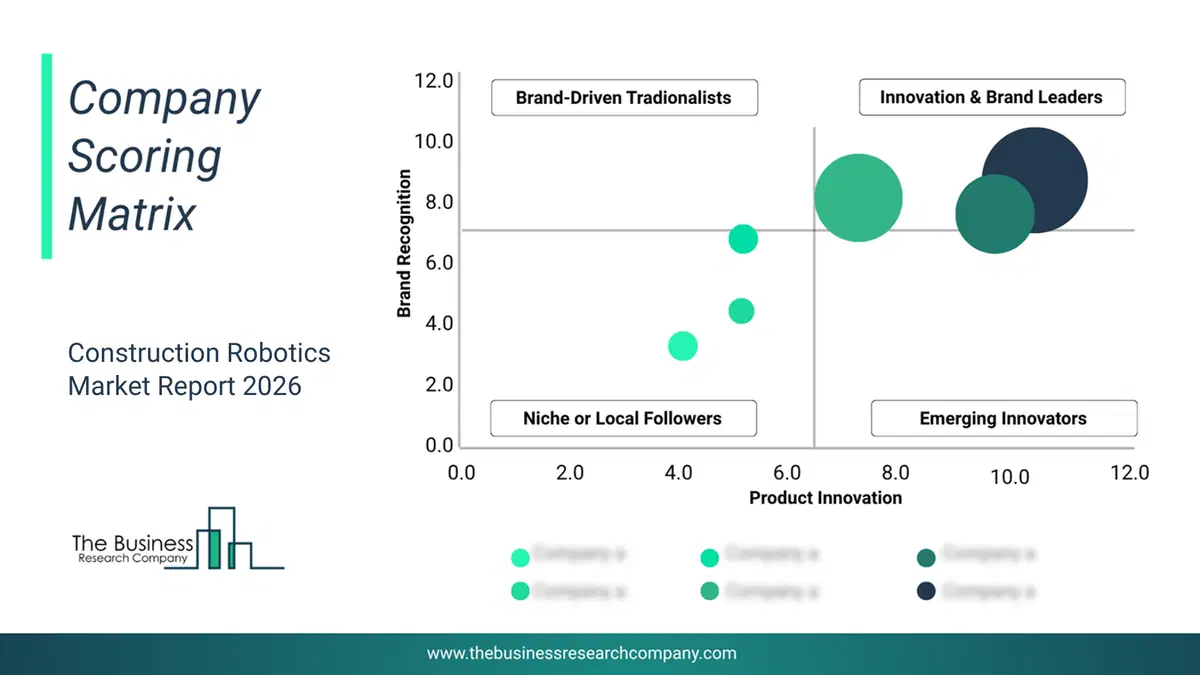
This chart maps companies by product innovation and brand strength, with bubble size indicating relative revenue, helping identify market leaders, challengers, and niche players. This is an illustrative chart; the full report provides a complete and accurate competitive analysis.
Global Construction Robotics Market Trends and Insights
Major companies operating in the construction robotics market are focused on developing innovative robots, such as rebar installing robots to enhance automation in construction tasks, improve efficiency and precision in the installation process, and reduce the labor-intensive nature of rebar placement. Rebar-installing robots are specialized machines designed to automate the process of placing and securing steel reinforcing bars (rebar) in concrete structures that enhance the efficiency, precision, and safety of construction projects, making them a valuable tool in modern construction practices. For instance, in March 2023, Advanced Construction Robotics (ACR), a US-based company that manufactures construction robots, launched IronBOT, the first robot designed specifically for lifting, carrying, and placing rebar. IronBOT is intended to augment construction crews by handling the physically demanding task of rebar installation. It can lift and place rebar bundles in transverse and longitudinal orientations without requiring heavy lifting from workers.What Are Latest Mergers And Acquisitions In The Construction Robotics Market?
In January 2023, Built Robotics, a US-based Startup specializing in automating construction equipment through innovative software and hardware solutions, acquired Roin Technologies for an undisclosed amount. This acquisition is aimed at accelerating Built's roadmap for automated construction equipment. Roin Technologies is a US-based company that manufactures construction robots.
Regional Outlook
North America was the largest region in the construction robotics market in 2025. Europe is expected to be the fastest-growing region in the market going forward. The regions covered in this market report are Asia-Pacific, South East Asia, Western Europe, Eastern Europe, North America, South America, Middle East, Africa The countries covered in this market report are Australia, Brazil, China, France, Germany, India, Indonesia, Japan, Taiwan, Russia, South Korea, UK, USA, Canada, Italy, Spain.What Defines the Construction Robotics Market?
The construction robotics market consists of revenues earned by entities by providing material handling, inspection, and monitoring. The market value includes the value of related goods sold by the service provider or included within the service offering. The construction robotics market also includes sales of robotic arms, collaborative robots, and material-handling robots. Values in this market are ‘factory gate’ values, that is the value of goods sold by the manufacturers or creators of the goods, whether to other entities (including downstream manufacturers, wholesalers, distributors, and retailers) or directly to end customers. The value of goods in this market includes related services sold by the creators of the goods.How is Market Value Defined and Measured?
The market value is defined as the revenues that enterprises gain from the sale of goods and/or services within the specified market and geography through sales, grants, or donations in terms of the currency (in USD unless otherwise specified). The revenues for a specified geography are consumption values that are revenues generated by organizations in the specified geography within the market, irrespective of where they are produced. It does not include revenues from resales along the supply chain, either further along the supply chain or as part of other products.
This chart presents market attractiveness based on a quantitative evaluation of growth, competition, strategic alignment, and risk, offering a clear view of opportunity areas for decision-making. This chart is for illustrative purposes; the full report contains the complete analysis.

This chart highlights the Total Addressable Market (TAM) by estimating the maximum revenue opportunity using an assumption-driven approach, supporting strategic planning and opportunity sizing across markets. The chart is illustrative; the full report provides a more comprehensive analysis.
What Key Data and Analysis Are Included in the Construction Robotics Market Report 2026?
The construction robotics market research report is one of a series of new reports from The Business Research Company that provides market statistics, including industry global market size, regional shares, competitors with the market share, detailed market segments, market trends and opportunities, and any further data you may need to thrive in the construction robotics industry. The market research report delivers a complete perspective of everything you need, with an in-depth analysis of the current and future state of the industry.Construction Robotics Market Report Forecast Analysis
| Report Attribute | Details |
|---|---|
| Market Size Value In 2026 | $7.79 billion |
| Revenue Forecast In 2030 | $15.39 billion |
| Growth Rate | CAGR of 18.9% from 2026 to 2030 |
| Base Year For Estimation | 2025 |
| Actual Estimates/Historical Data | 2020-2025 |
| Forecast Period | 2026 - 2030 |
| Market Representation | Revenue in USD Billion and CAGR from 2026 to 2030 |
| Segments Covered | Type, Sales Type, End-User |
| Regional Scope | Asia-Pacific, Western Europe, Eastern Europe, North America, South America, Middle East, Africa |
| Country Scope | The countries covered in the report are Australia, Brazil, China, France, Germany, India, Indonesia, Japan, Taiwan, Russia, South Korea, UK, USA, Canada, Italy, Spain. |
| Key Companies Profiled | Husqvarna AB, KUKA Robotics, Scaled Robotics, Brokk AB, Boston Dynamics, Con Mech Engineers Ltd., HoloBuilder Inc., Doxel Inc., COBOD International AS, Ekso Bionics Holdings Inc., Giatec Scientific Inc., Built Robotics Inc., Construction Robotics LLC, KEWAZO, Dusty Robotics, Branch Technology, Advanced Construction Robotics Inc., Fabrica AI, Hyperion Robotics, OKIBO |
| Customization Scope | Request for Customization |
| Pricing And Purchase Options | Explore Purchase Options |