
Construction Waste Recycling Market Report 2026
Global Outlook – By Material (Wood, Metal, Bricks, Concrete, Other Materials), By Recycling Method (On-Site Recycling, Off-Site Recycling), By Organization Size (Small And Medium Enterprises, Large Enterprises), By Application (Recycled Aggregates Production, Road Base And Pavement Materials, Metal Reuse And Manufacturing Feedstock, Wood Products And Biomass Fuel, Land Reclamation Or Fill Material, New Building Materials Production), By End User (Residential Construction, Commercial Construction, Industrial Construction, Infrastructure And Public Works) – Market Size, Trends, Strategies, and Forecast to 2030
Construction Waste Recycling Market Overview
• Construction Waste Recycling market size has reached to $19.71 billion in 2025 • Expected to grow to $25.22 billion in 2030 at a compound annual growth rate (CAGR) of 5.1% • Growth Driver: Rising Environmental Concerns Driving The Market Growth Due To Deforestation, Pollution, And Resource Depletion • Market Trend: Integration Of Mobile Recycling Systems Advancing Decentralized Waste Management • Asia-Pacific was the largest region and fastest growing region.Market Gains By 2030 – Top Opportunities By Segment
Market Gain identifies the most promising market opportunities by highlighting the segments or products expected to generate the highest incremental revenue growth over the next five years.
What Is Covered Under Construction Waste Recycling Market?
Construction waste recycling is the process of collecting and processing waste materials generated from construction and demolition activities, such as concrete, wood, metals, and bricks. These materials are then reused or converted into new construction products to reduce landfill disposal and conserve natural resources. The main materials of construction waste recycling include wood, metal, bricks, concrete, and other materials. Wood refers to reclaimed construction timber that is processed for reuse in building materials, biomass fuel, or engineered wood products after sorting and treatment. The different recycling methods include on-site recycling and off-site recycling and the various organization sizes include small and medium enterprises and large enterprises. They find application across involved are recycled aggregates production, road base and pavement materials, metal reuse and manufacturing feedstock, wood products and biomass fuel, land reclamation or fill material, and new building materials production, and they are utilized by end users including residential construction, commercial construction, industrial construction, and infrastructure and public works.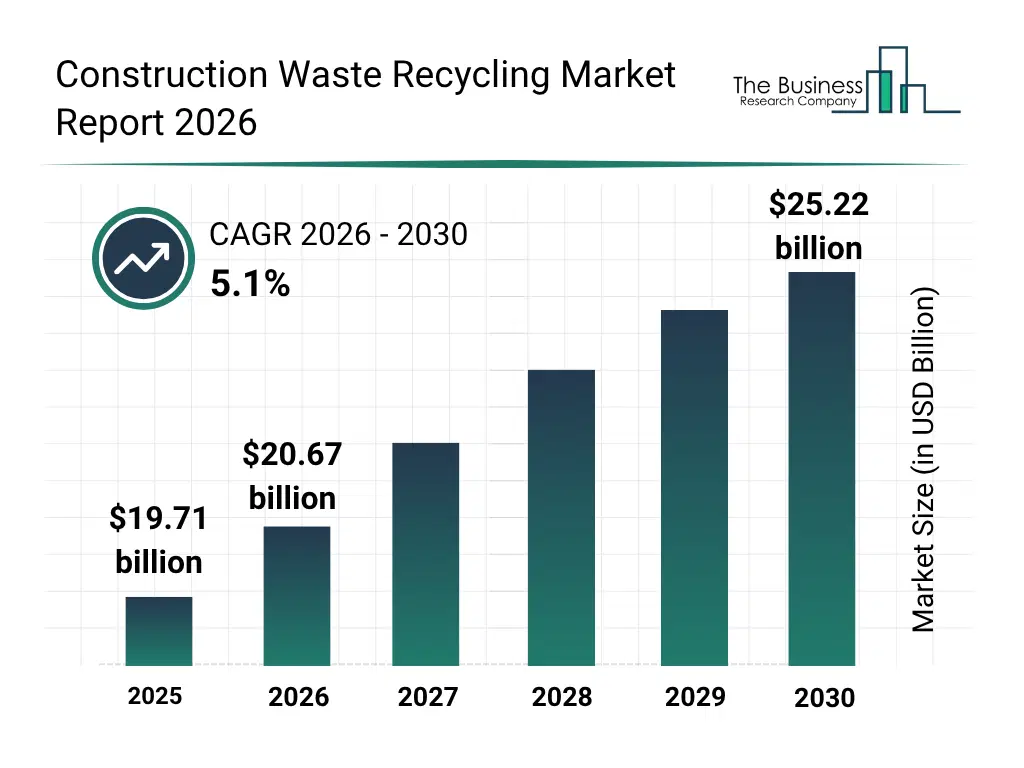
What Is The Construction Waste Recycling Market Size and Share 2026?
The construction waste recycling market size has grown steadily in recent years.It will grow from $19.71 billion in 2025 to $20.67 billion in 2026 at a compound annual growth rate (CAGR) of 4.9%. The growth in the historic period can be attributed to rising urbanization and infrastructure development, increasing construction and demolition waste generation, growing environmental regulations on landfill disposal, early adoption of recycling practices in developed economies, increasing awareness of resource conservation in construction sector.What Is The Construction Waste Recycling Market Growth Forecast?
The construction waste recycling market size is expected to see strong growth in the next few years.It will grow to $25.22 billion by 2030 at a compound annual growth rate (CAGR) of 5.1%. The growth in the forecast period can be attributed to tightening global sustainability and zero waste regulations, increasing adoption of circular economy construction models, rising demand for green building materials, expansion of smart waste management infrastructure, growing investment in automated recycling and material recovery technologies.Major trends in the forecast period include increasing adoption of circular construction practices to minimize landfill waste and maximize material reuse, rising demand for recycled aggregates in sustainable infrastructure development projects, growing use of advanced material recovery facilities for efficient sorting of construction debris, expansion of deconstruction practices replacing traditional demolition to improve material recovery rates, increasing integration of sustainable building certifications driving construction waste recycling adoption.
Global Construction Waste Recycling Market Segmentation
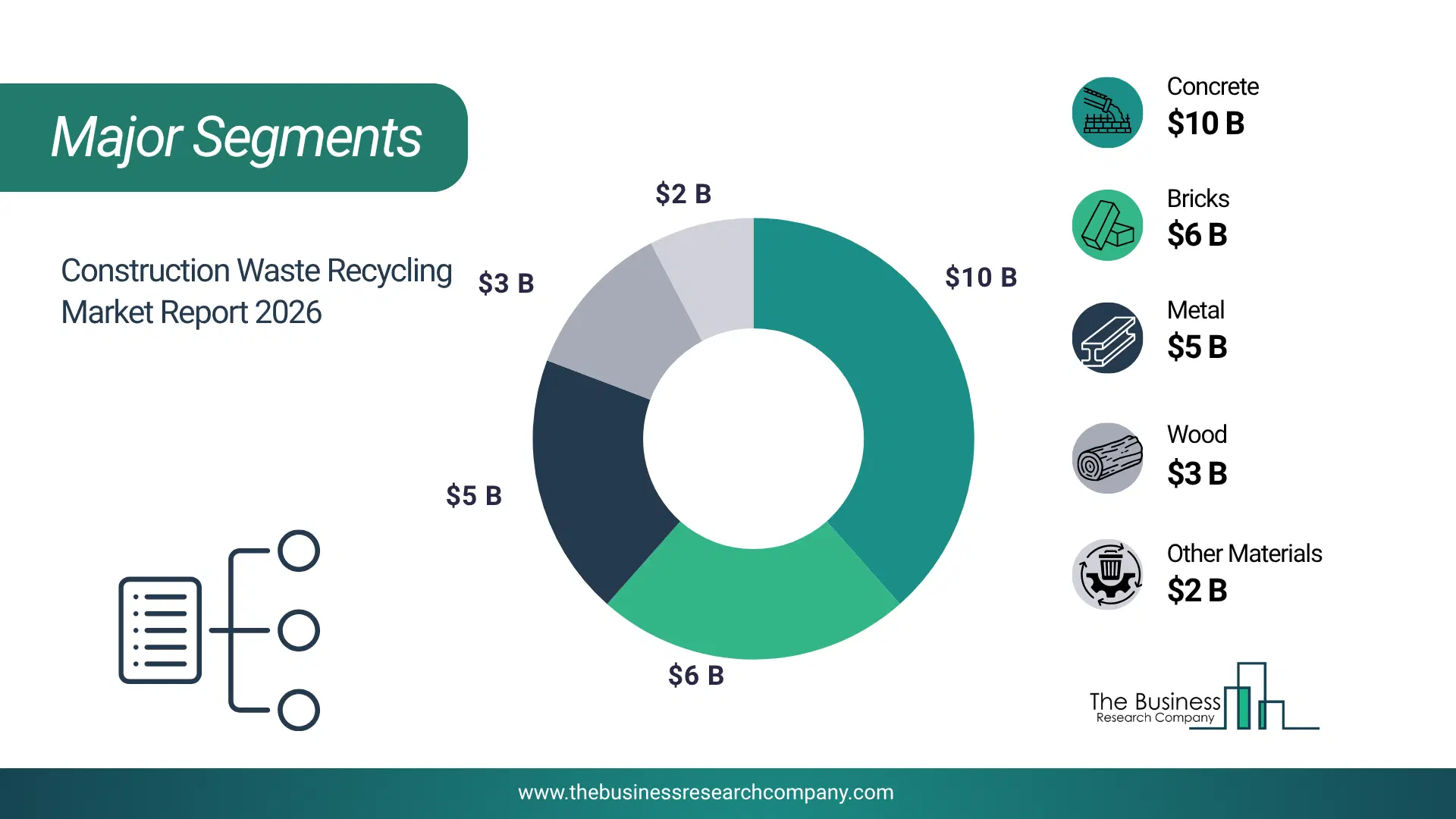
1) By Material: Wood, Metal, Bricks, Concrete, Other Materials 2) By Recycling Method: On-Site Recycling, Off-Site Recycling 3) By Organization Size: Small And Medium Enterprises, Large Enterprises 4) By Application: Recycled Aggregates Production, Road Base And Pavement Materials, Metal Reuse And Manufacturing Feedstock, Wood Products And Biomass Fuel, Land Reclamation Or Fill Material, New Building Materials Production 5) By End User: Residential Construction, Commercial Construction, Industrial Construction, Infrastructure And Public Works Subsegments: 1) By Wood: Untreated Construction Wood Waste, Treated Timber Waste, Engineered Wood Waste, Pallet And Packaging Wood Waste, Demolition Wood Waste, Wood Chips And Sawdust Recovery 2) By Metal: Ferrous Metal Scrap, Non Ferrous Metal Scrap, Steel Reinforcement Waste, Aluminum Construction Scrap, Copper Wiring And Piping Waste, Mixed Metal Construction Debris 3) By Bricks: Clay Brick Waste, Concrete Bricks Waste, Silicate Bricks Waste, Demolition Brick Rubble, Broken Brick Aggregates, Reusable Brick Recovery 4) By Concrete: Reinforced Concrete Waste, Plain Concrete Waste, Precast Concrete Waste, Concrete Rubble, Crushed Concrete Aggregates, High Strength Concrete Waste 5) By Other Materials: Asphalt Waste, Glass Construction Waste, Plastic Construction Waste, Gypsum And Drywall Waste, Insulation Material Waste, Composite Material Waste The top segments in the construction waste recycling market will be: • Concrete will reach $10.46 Billion by 2030. • Bricks will reach $5.6 Billion by 2030. • Metal will reach $4.7 Billion by 2030. • Wood will reach $2.77 Billion by 2030. • Other Materials will reach $1.68 Billion by 2030.What Is The Driver Of The Construction Waste Recycling Market?
The rising environmental concerns are expected to propel the growth of the construction waste recycling industry going forward.Environmental concerns are issues caused by human activities that harm the natural environment, including pollution, climate change, and resource depletion.Environmental concerns are rising due to deforestation for urban expansion and agriculture, which reduces forest cover, disrupts ecosystems, and increases carbon dioxide levels in the atmosphere.Construction waste recycling helps address environmental concerns by reducing the amount of construction debris sent to landfills, conserving natural resources through material reuse (such as concrete, metal, and wood), and lowering pollution and carbon emissions associated with raw material extraction and disposal.For instance, in September 2024, according to the European Court of Auditors, a Luxembourg-based government agency, the commission aimed for 25% of the EU’s agricultural land to be farmed organically by 2030, marking a substantial increase from 10.5% in 2022.Therefore, the rising environmental concerns are driving the growth of the construction waste recycling industry.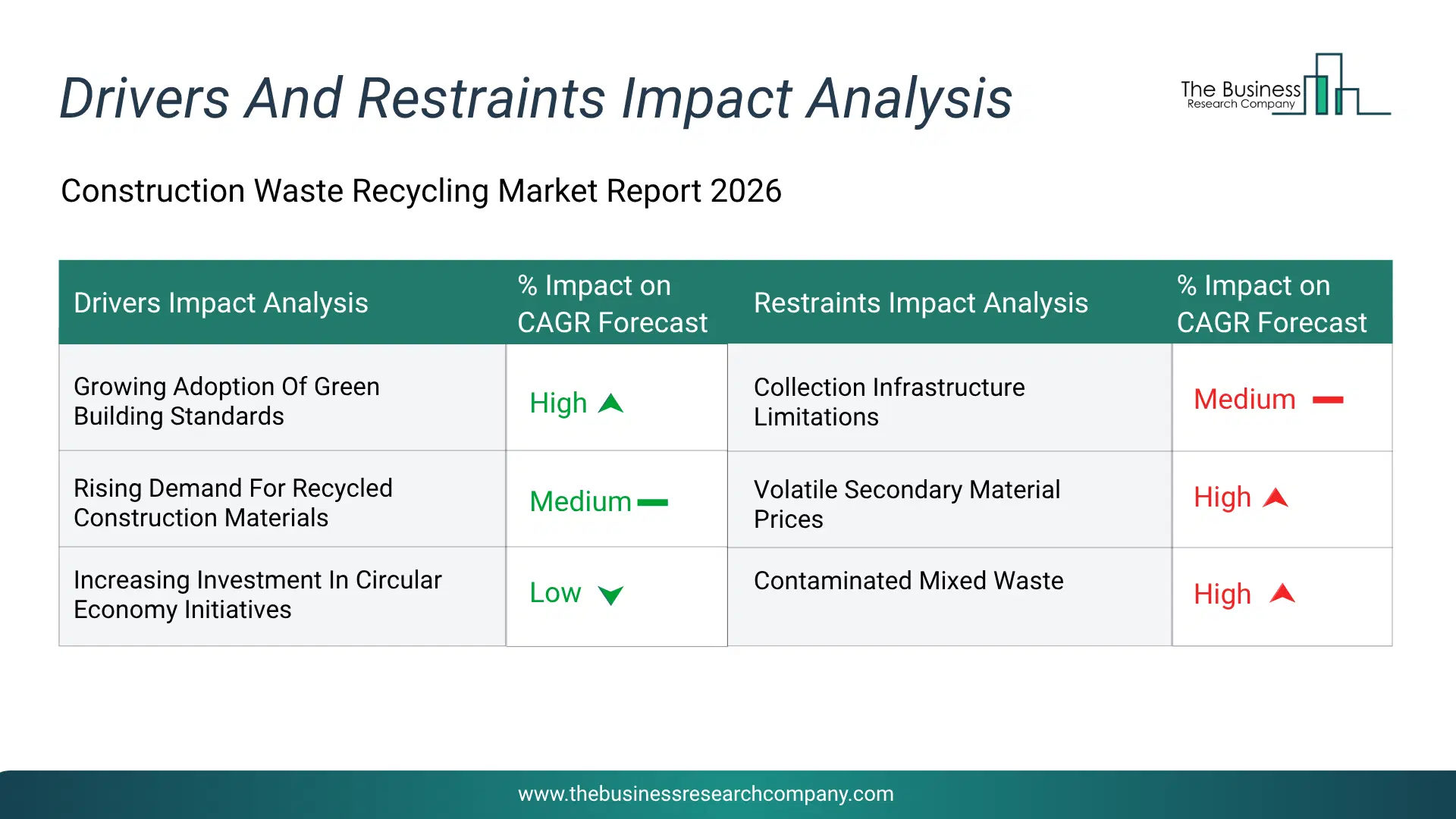
Infographic Chart Showing Key Market Drivers Analysis And Restraints For Construction Waste Recycling Market
The chart presents an impact analysis of key drivers and restraints, quantifying their relative influence on the market's growth rate and helping assess the balance between growth enablers and limiting factors. This chart offers a high-level perspective; the full report contains more detailed insights.
How Will The Drivers Impact Growth In The Global Construction Waste Recycling Market Market?
• Growing Adoption Of Green Building Standards (High) – During the forecast period, the growing adoption of green building standards is expected to become a key growth driver for the construction waste recycling market by 2030. The increasing implementation of green building certifications is encouraging construction companies to integrate sustainable waste management practices into project lifecycles. Builders and developers are prioritizing recycling and reuse of construction materials to meet environmental compliance requirements and reduce carbon footprints. This shift promotes the use of advanced recycling technologies and efficient waste segregation systems at construction sites. Additionally, sustainability-focused building frameworks are driving demand for recycled aggregates and materials that align with eco-friendly construction goals. As a result, companies are increasingly investing in waste recycling infrastructure to support certification requirements. • Rising Demand For Recycled Construction Materials (Medium) – During the forecast period, the rising demand for recycled construction materials is expected to emerge as a major factor driving the expansion of the construction waste recycling market by 2030. The increasing preference for cost-effective and sustainable building materials is encouraging the use of recycled products such as aggregates, metals, and wood in construction projects. Developers are recognizing the economic and environmental advantages of incorporating recycled materials, particularly in large-scale infrastructure and urban development projects. This demand is further supported by advancements in material processing technologies that improve the quality and usability of recycled outputs. In addition, the growing emphasis on reducing dependence on virgin raw materials is accelerating the adoption of recycled alternatives. These trends are leading to increased investments in recycling facilities and material recovery systems. • Increasing Investment In Circular Economy Initiatives (Low) – During the forecast period, the increasing investment in circular economy initiatives is expected to act as a key growth catalyst for the construction waste recycling market by 2030. The growing focus on circular economy principles is encouraging stakeholders to maximize material reuse and minimize construction waste generation. Governments, private companies, and industry bodies are investing in systems that promote closed-loop material cycles and efficient resource utilization. These initiatives are driving the development of advanced recycling infrastructure, digital tracking systems, and integrated waste management solutions. Furthermore, the alignment of construction practices with circular economy goals is improving material recovery rates and reducing landfill dependency. This shift is also fostering collaborations across the construction and recycling industries to enhance operational efficiency.How Will The Restraints Impact Growth In The Global Construction Waste Recycling Market Market?
• Collection Infrastructure Limitations (High) – During the forecast period, collection infrastructure limitations act as a major restraint for the construction waste recycling market by restricting the efficient collection, sorting, and transportation of construction and demolition waste. Many regions lack adequate transfer stations, material recovery facilities, and on-site segregation systems, leading to higher logistics and handling costs. Fragmented or inconsistent collection networks make it difficult to gather sufficient recyclable volumes at scale. As a result, recyclable materials are often diverted to landfills despite recovery potential. Limited infrastructure also discourages smaller construction projects from participating in recycling programs. Together, these challenges reduce recycling efficiency, market penetration, and overall revenue growth. • Volatile Secondary Material Prices (Medium) – During the forecast period, volatile secondary material prices act as a major restraint for the construction waste recycling market by creating uncertainty in revenue streams for recyclers. Frequent fluctuations in the prices of recycled aggregates, metals, and wood make it difficult for recycling operators to plan investments and manage operating costs effectively. When prices of virgin construction materials fall, recycled alternatives become less competitive, reducing demand from construction companies. This price instability weakens profit margins and discourages long-term contracts with buyers. As a result, recycling facilities face higher financial risk and delayed capacity expansion. Overall, market volatility limits investor confidence and slows the growth of construction waste recycling activities. • Contaminated Mixed Waste (Low) – During the forecast period, contaminated mixed waste acts as a major restraint in the construction waste recycling market because poor on-site segregation leads to different materials being combined with hazardous or non-recyclable substances. This contamination increases the time, labor, and cost required for sorting and processing recyclable materials. It also lowers material recovery rates, as heavily contaminated waste often must be diverted to landfills instead of recycling streams. The presence of contaminants reduces the quality leads to recycled outputs, making them less attractive to construction end users. Inconsistent waste composition further complicates recycling operations and reduces processing efficiency. As a result, recyclers face higher operational risks and reduced profitability, limiting market growth.Key Players In The Global Construction Waste Recycling Market
Major companies operating in the construction waste recycling market are Waste Management Inc., Veolia Environnement S. A., Republic Services Inc., Waste Connections Inc., SUEZ Recycling and Recovery Holdings, Remondis SE & Co. KG, Clean Harbors Inc., GFL Environmental Inc., FCC Environment LLC, Renewi plc, Biffa Group Limited, Casella Waste Systems Inc., Paprec Group, ALBA Group, Holcim Group, Heidelberg Materials, TOMRA Systems ASA, CDE Global, Vulcan Materials Company, Rubicon Technologies, Cement Roadstone Holdings, Clean Earth Inc., Dulsco Group LLC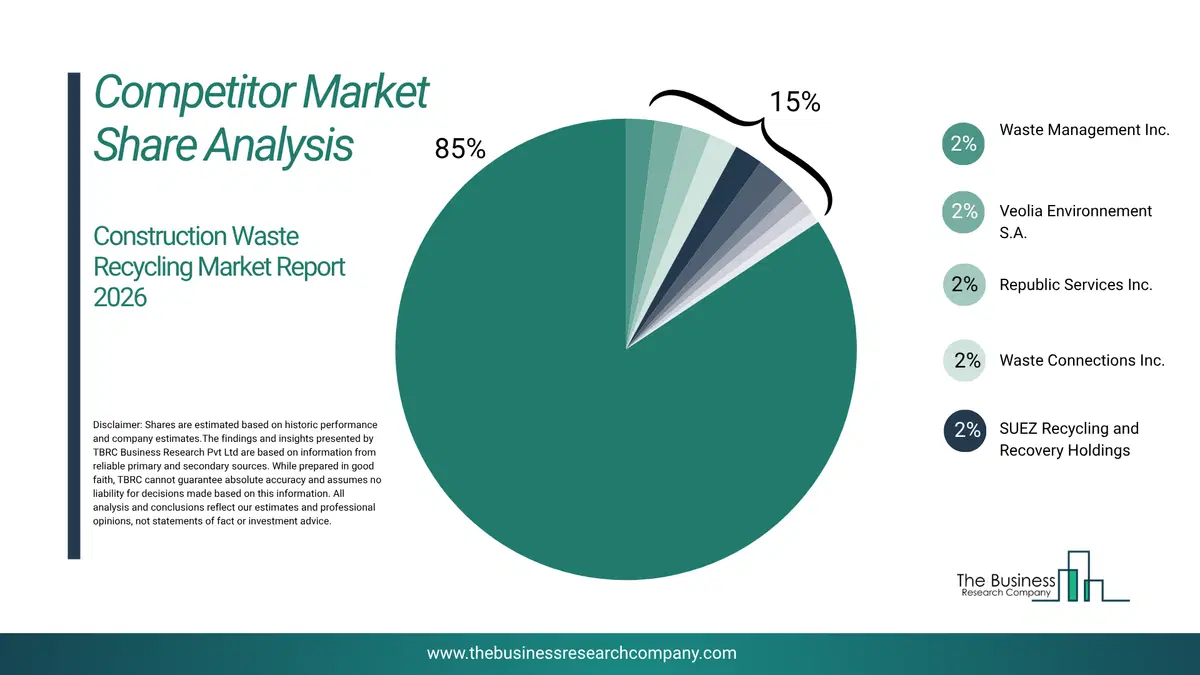
This chart is for illustrative purposes; the full report includes a detailed competitor analysis and comprehensive overview of the top 10 companies in the market.
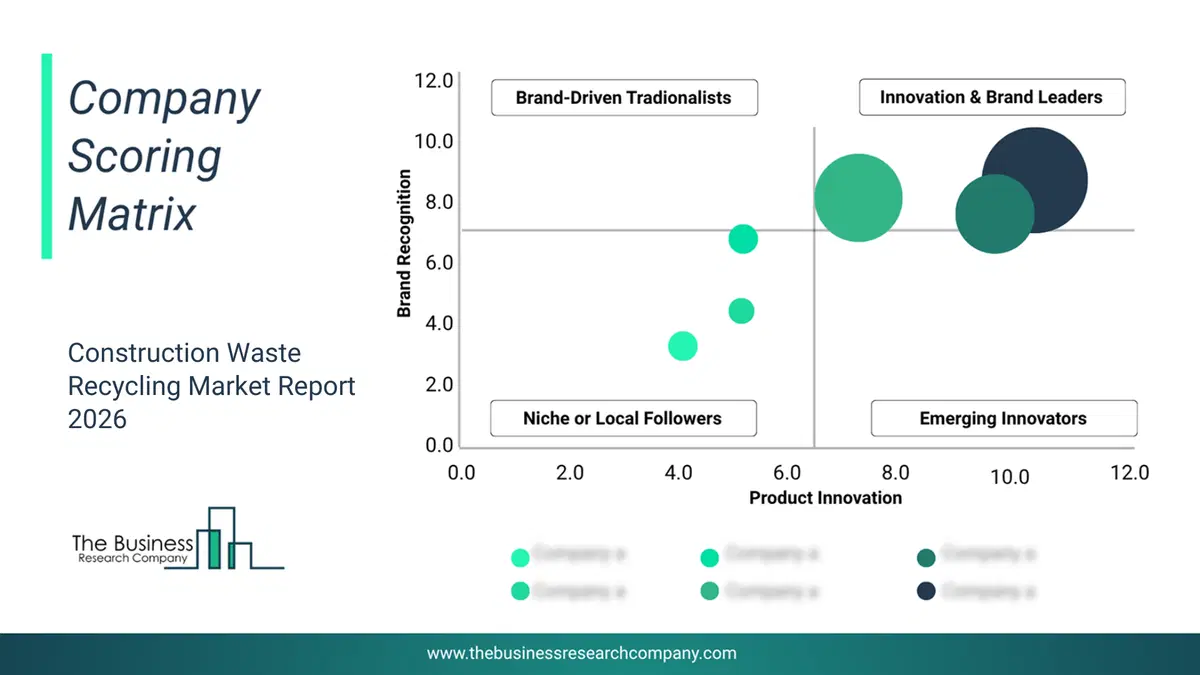
This chart maps companies by product innovation and brand strength, with bubble size indicating relative revenue, helping identify market leaders, challengers, and niche players. This is an illustrative chart; the full report provides a complete and accurate competitive analysis.
Global Construction Waste Recycling Market Trends and Insights
Major companies operating in the construction waste recycling market are focusing on developing innovative solutions, such as on-site material processing equipment, to process demolition waste directly at project sites, reducing transportation costs, improving efficiency, and accelerating material reuse. On-site material processing equipment refers to portable machinery designed to crush, screen, and separate construction waste into reusable aggregates at the source. For instance, in October 2025, Eggersmann GmbH, a Germany-based manufacturer and engineering company, launched the ROKTEC IC 1000 mobile impact crusher, designed for processing mineral construction waste into high-quality substitute building materials. The system features a large infeed capacity of up to 800 mm, integrated screening and magnetic separation, and a closed-loop crushing circuit with a return conveyor to ensure uniform output. By enabling the production of precisely graded materials from concrete, asphalt, and bricks, the solution supports immediate reuse in applications such as road substructures, enhances operational efficiency, reduces equipment wear through pre-screening mechanisms, and advances sustainable construction practices through decentralized, high-quality material recovery.What Are Latest Mergers And Acquisitions In The Construction Waste Recycling Market?
In April 2023, Holcim Ltd., a Switzerland-based building materials and sustainable construction solutions company, acquired H. Sivyer Transport Limited for an undisclosed amount. With this acquisition, Holcim aims to strengthen its circular construction capabilities, expand its recycled construction and demolition waste operations in the London market, and advance its strategic goal of recycling 10 million tons of construction and demolition waste. H. Sivyer Transport Limited is a UK-based waste management company that offers construction waste recycling solutions.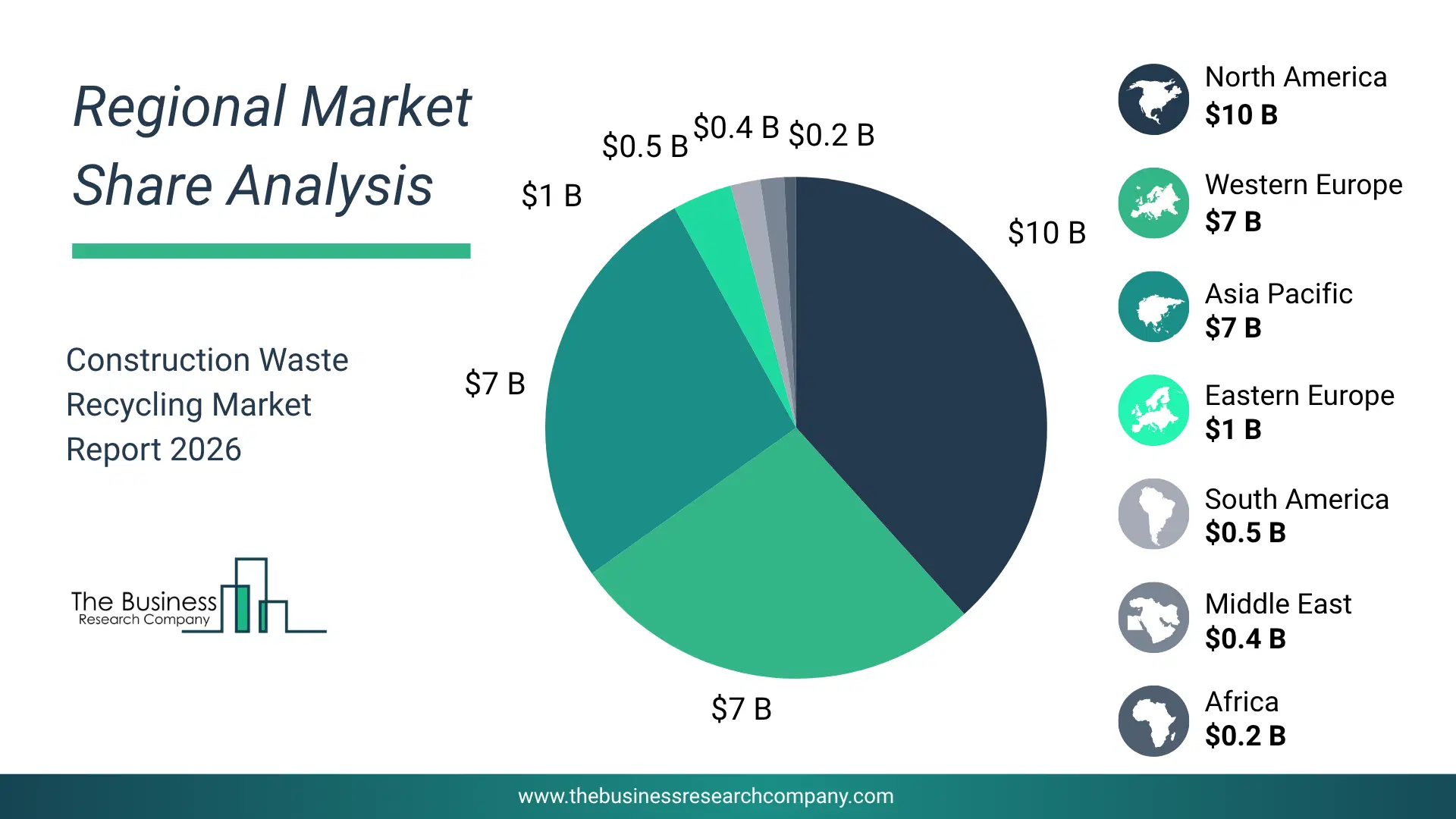
Regional Insights
Asia-Pacific was the largest region in the construction waste recycling market in 2025 and is expected to be the fastest-growing region in the forecast period. The regions covered in this market report are Asia-Pacific, South East Asia, Western Europe, Eastern Europe, North America, South America, Middle East and Africa. The countries covered in this market report are Australia, Brazil, China, France, Germany, India, Indonesia, Japan, Taiwan, Russia, South Korea, UK, USA, Canada, Italy, Spain.What Defines the Construction Waste Recycling Market?
The construction waste recycling market includes revenues earned by entities through the waste audit and assessment services, environmental compliance and reporting services, and recycled material marketing and sales services. The market value includes the value of related goods sold by the service provider or included within the service offering. Only goods and services traded between entities or sold to end consumers are included.What is the Market Assessment and Strategic Outlook for the Construction Waste Recycling Industry?
The construction waste recycling market research report is one of a series of new reports from The Business Research Company that provides market statistics, including industry global market size, regional shares, competitors with the market share, detailed market segments, market trends and opportunities, and any further data you may need to thrive in the construction waste recycling industry. The market research report delivers a complete perspective of everything you need, with an in-depth analysis of the current and future state of the industry.
This chart presents market attractiveness based on a quantitative evaluation of growth, competition, strategic alignment, and risk, offering a clear view of opportunity areas for decision-making. This chart is for illustrative purposes; the full report contains the complete analysis.

This chart highlights the Total Addressable Market (TAM) by estimating the maximum revenue opportunity using an assumption-driven approach, supporting strategic planning and opportunity sizing across markets. The chart is illustrative; the full report provides a more comprehensive analysis.
What is the Market Assessment and Strategic Outlook for the Construction Waste Recycling Market Report 2026?
The construction waste recycling market research report is one of a series of new reports from The Business Research Company that provides construction waste recycling market statistics, including construction waste recycling industry global market size, regional shares, competitors with a construction waste recycling market share, detailed construction waste recycling market segments, market trends and opportunities, and any further data you may need to thrive in the construction waste recycling industry. This construction waste recycling market research report delivers a complete perspective of everything you need, with an in-depth analysis of the current and future scenario of the industry.Construction Waste Recycling Market Report Forecast Analysis
| Report Attribute | Details |
|---|---|
| Market Size Value In 2026 | $20.67 billion |
| Revenue Forecast In 2030 | $25.22 billion |
| Growth Rate | CAGR of 5.1% from 2026 to 2030 |
| Base Year For Estimation | 2025 |
| Actual Estimates/Historical Data | 2020-2025 |
| Forecast Period | 2026 - 2030 |
| Market Representation | Revenue in USD Billion and CAGR from 2026 to 2030 |
| Segments Covered | Material, Recycling Method, Organization Size, Application, End User |
| Regional Scope | Asia-Pacific, Western Europe, Eastern Europe, North America, South America, Middle East, Africa |
| Country Scope | The countries covered in the report are Australia, Brazil, China, France, Germany, India, Indonesia, Japan, Taiwan, Russia, South Korea, UK, USA, Canada, Italy, Spain. |
| Key Companies Profiled | Waste Management Inc., Veolia Environnement S. A., Republic Services Inc., Waste Connections Inc., SUEZ Recycling and Recovery Holdings, Remondis SE & Co. KG, Clean Harbors Inc., GFL Environmental Inc., FCC Environment LLC, Renewi plc, Biffa Group Limited, Casella Waste Systems Inc., Paprec Group, ALBA Group, Holcim Group, Heidelberg Materials, TOMRA Systems ASA, CDE Global, Vulcan Materials Company, Rubicon Technologies, Cement Roadstone Holdings, Clean Earth Inc., Dulsco Group LLC |
| Customization Scope | Request for Customization |
| Pricing And Purchase Options | Explore Purchase Options |