

Contact Us
  Search
The Business Research Company Logo
Consumer Credit Market 2025
Published :May 2025
Pages :331
Format :PDF
Delivery Time :2-3 Business Days
Why 2-3 days? We update the report with the latest data and news before delivery. Let us know if you need us to expedite.
Report Price :$4,490.00

Consumer Credit Market 2025

By Service Type (Credit Services, Software), By Credit Type (Revolving Credits, Non-Revolving Credits), By Issuer Type (Banks And Finance Companies, Credit Unions, Other Issuers), By Payment Method (Direct Deposit, Debit Card, Other Payment Methods), By Application (Individual, Enterprise, Other Applications), And By Region, Opportunities And Strategies – Global Forecast To 2035
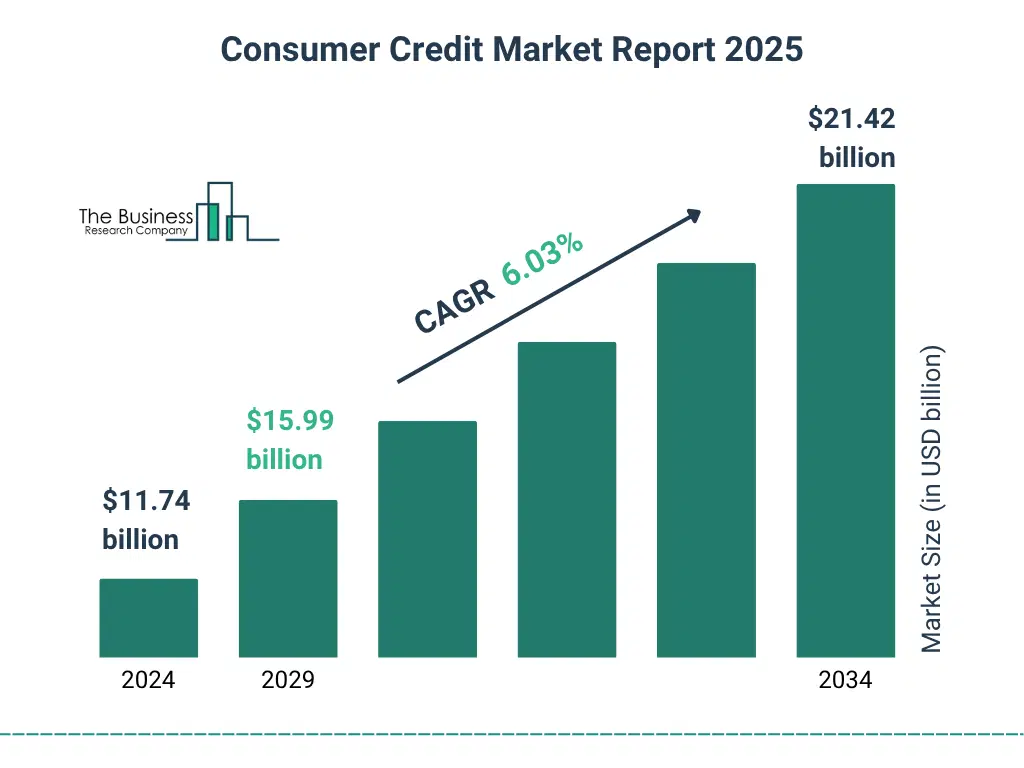
Consumer Credit Market Size and growth rate 2025 to 2029: Graph

Consumer Credit Market Definition

Consumer credit is a type of financial arrangement under which borrowers obtain money for personal, household, or family purposes and excludes business or commercial usage. Consumers utilize that credit to acquire goods and services and repay the costs over a defined time instead of paying the full amount upfront. Examples of consumer credits include credit cards, personal loans, auto loans, and installment plans. Repayment is usually done monthly and charges interest. Consumer credit is an important concept because it enhances purchasing power and therefore gives borrowers much-needed flexibility to better manage their expenses, emergencies, or large purchases.
Research Expert

Book your 30 minutes free consultation with our research experts

Consumer Credit Market Size

The global consumer credit market reached a value of nearly $11,739.43 million in 2024, having grown at a compound annual growth rate (CAGR) of 4.12% since 2019. The market is expected to grow from $11,739.43 million in 2024 to $15,987.33 million in 2029 at a rate of 6.37%. The market is then expected to grow at a CAGR of 6.03% from 2029 and reach $21,421.09 million in 2034. Growth in the historic period resulted from the increasing cybersecurity threats, growing number of small businesses, decentralized finance (DeFi) expansion and favorable government initiatives. Factors that negatively affected growth in the historic period were shortage of skilled expertise and limited consumer awareness. Going forward, rising digitalization, rising cross-border payments, increasing demand for personalized financial services and rising use of cryptocurrency will drive the growth. Factor that could hinder the growth of the consumer credit market in the future include regulatory uncertainty and legacy system and integration complexity.

Consumer Credit Market Drivers

The key drivers of the consumer credit market include: Rising Middle-Class Population in Emerging Markets Emerging markets, particularly in Asia, Africa, and Latin America, are experiencing substantial economic growth, leading to the expansion of the middle-class population. This demographic shift results in increased disposable income and a heightened demand for consumer goods and services, including credit products. As more individuals move to urban areas, access to financial institutions and credit facilities becomes more prevalent. The proliferation of smartphones and internet connectivity facilitates the adoption of digital banking and lending platforms, making credit more accessible. For example, India's middle-class population is projected to more than double in the next decade. This surge is expected to drive significant growth in the consumer credit market, with projections indicating a 15% compound annual growth rate (CAGR). Factors such as urbanization and the rise of digital lending platforms contribute to this trend.

Consumer Credit Market Restraints

The key restraints on the consumer credit market include: Household Debt Saturation and Weak Wage Growth As consumer debt levels continue to rise, many households may reach a debt saturation point, where they cannot take on additional loans without financial strain. If wage growth fails to keep pace with inflation and rising living costs, consumers will have less disposable income, reducing their ability to service existing debts or take on new credit. This can lead to lower borrowing rates and higher loan defaults, limiting market growth. Canada’s household debt-to-income ratio reached 186.5% in 2023, meaning that for every $1 of disposable income, households owed $1.86 in debt. This increasing debt burden, combined with slow wage growth, is expected to limit new borrowing in 2024-2029, leading banks to tighten credit approval processes.

Need data on a specific region in this market?

Opportunities And Recommendations In The Consumer Credit Market

Opportunities – The top opportunities in the consumer credit market segmented by service type will arise in the credit services segment, which will gain $3,285.72 million of global annual sales by 2029. The top opportunities in the consumer credit market segmented by credit type will arise in the non-revolving credits segment, which will gain $2,959.95 million of global annual sales by 2029. The top opportunities in the consumer credit market segmented by issuer will arise in the banks and finance companies segment, which will gain $3,233.53 million of global annual sales by 2029. The top opportunities in the consumer credit market segmented by payment method will arise in the debit card segment, which will gain $2,636.94 million of global annual sales by 2029. The top opportunities in the consumer credit market segmented by application will arise in the individual segment, which will gain $3,245.77 million of global annual sales by 2029. The consumer credit market size will gain the most in the USA at $1,109.56 million. Recommendations- To take advantage of the opportunities, The Business Research Company recommends the consumer credit to focus on digital transformation and personalization, focus on leveraging alternative data for credit assessment, focus on expanding buy-now-pay-later options, focus on leveraging AI and ML for enhanced risk assessment and customer experience, focus on expanding micro-loan and mobile credit platforms, focus on expanding credit access to stimulate growth, expand in emerging markets, continue to focus on developed markets, focus on expanding distribution channels for consumer credit companies, focus on optimizing pricing strategies to enhance competitiveness, focus on digital marketing and targeted campaigns, focus on partnerships with fintech companies and focus on targeting the right consumer segments.
Chat with us