
Consumer Electronics Retail Market Report 2026
Global Outlook – By Product Type (Smartphones, Laptops Or Computers, Televisions Or Displays, Audio Devices, Wearable Devices, Home Appliances, Gaming Consoles Or Accessories, Cameras Or Imaging Devices, Tablets Or Electronic Readers), By Retail Channel (Standalone Stores, Shopping Malls, Brand Owned Websites, Third Party E-Commerce Platforms, Omni Channel Retailers, Other Retail Channels), By Application (Residential, Commercial), By End User (Individual Consumers, Small Businesses, Enterprises) – Market Size, Trends, Strategies, and Forecast to 2030
Consumer Electronics Retail Market Overview
• Consumer Electronics Retail market size has reached to $996.8 billion in 2025 • Expected to grow to $1221.72 billion in 2030 at a compound annual growth rate (CAGR) of 4.3% • Growth Driver: Increasing Smartphone Penetration Drives Growth In The Market Due To Expanding Mobile Commerce • Market Trend: Expanding Retail Presence Through Immersive Shopping Experiences • Asia-Pacific was the largest region and fastest growing region.What Is Covered Under Consumer Electronics Retail Market?
Consumer electronics retail refers to the business of distributing and selling consumer electronic goods directly to end users through physical stores, online channels, or omnichannel retail networks. It focuses on retail operations, customer engagement, sales, and after-sales services, acting as the primary interface between manufacturers and consumers. The main product types of consumer electronics retail include smartphones, laptops or computers, televisions or displays, audio devices, wearable devices, home appliances, gaming consoles or accessories, cameras or imaging devices, and tablets or electronic readers. Smartphones refer to multifunctional mobile devices equipped with communication, computing, internet connectivity, and application capabilities that represent one of the largest product categories in consumer electronics retail. These products are sold through standalone stores, shopping malls, brand owned websites, third party E-Commerce Platforms, omni channel retailers, and other retail channels. The various applications involved are residential and commercial and they are utilized by end users including individual consumers, small businesses, and enterprises.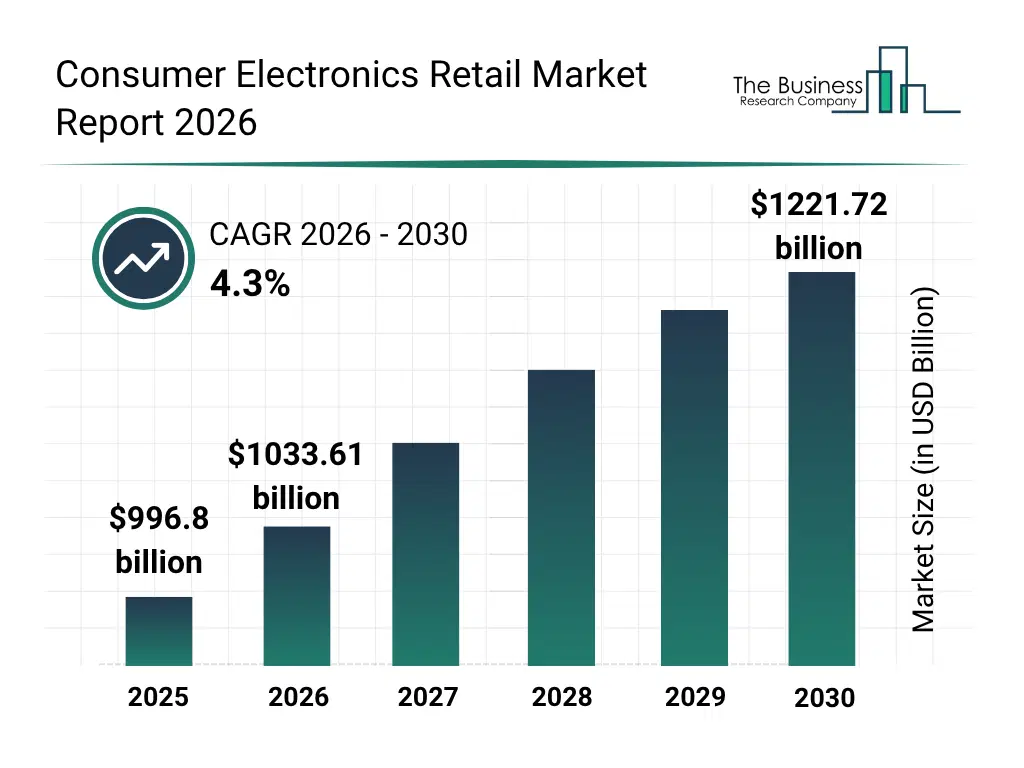
What Is The Consumer Electronics Retail Market Size and Share 2026?
The consumer electronics retail market size has grown steadily in recent years. It will grow from $996.8 billion in 2025 to $1033.61 billion in 2026 at a compound annual growth rate (CAGR) of 3.7%. The growth in the historic period can be attributed to increasing consumer demand for smartphones and electronic devices, growing expansion of organized retail networks, rising adoption of online shopping platforms, increasing disposable income and consumer spending on electronics, growing availability of diverse consumer electronic product categories.What Is The Consumer Electronics Retail Market Growth Forecast?
The consumer electronics retail market size is expected to see steady growth in the next few years. It will grow to $1221.72 billion in 2030 at a compound annual growth rate (CAGR) of 4.3%. The growth in the forecast period can be attributed to increasing adoption of AI-driven customer experience solutions, rising growth of e-commerce and omnichannel retail ecosystems, growing demand for personalized electronics purchasing experiences, increasing integration of digital payment and financing solutions, expanding focus on sustainable and energy-efficient consumer electronics products. Major trends in the forecast period include increasing adoption of omnichannel retail strategies for consumer electronics sales, growing use of personalized customer engagement and recommendation systems, rising demand for flexible payment and financing options in electronics purchases, increasing expansion of direct to consumer sales models by electronics brands, growing focus on enhanced after sales support and warranty management services.
Global Consumer Electronics Retail Market Segmentation
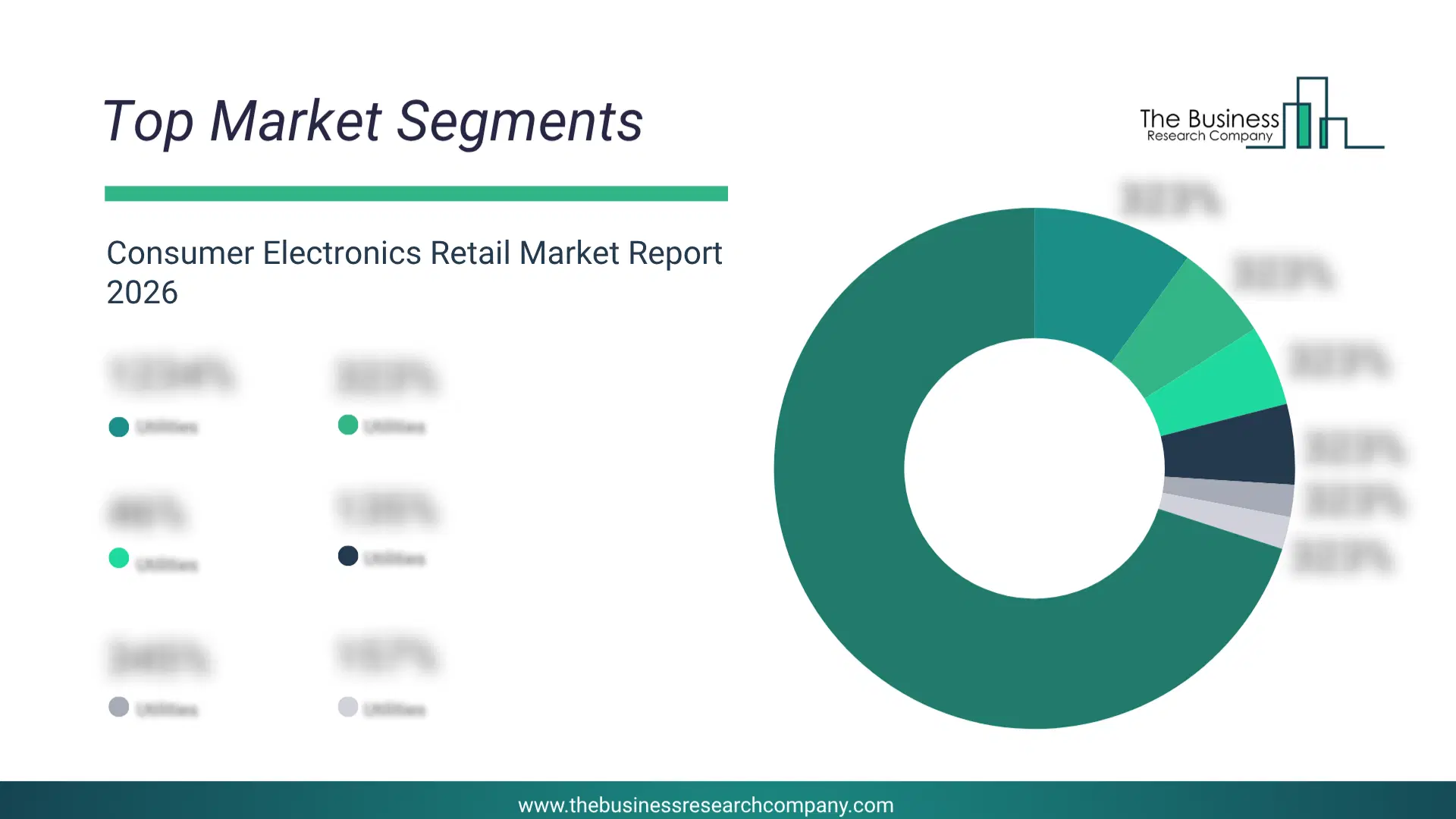
1) By Product Type: Smartphones, Laptops Or Computers, Televisions Or Displays, Audio Devices, Wearable Devices, Home Appliances, Gaming Consoles Or Accessories, Cameras Or Imaging Devices, Tablets Or Electronic Readers 2) By Retail Channel: Standalone Stores, Shopping Malls, Brand Owned Websites, Third Party E-Commerce Platforms, Omni Channel Retailers, Other Retail Channels 3) By Application: Residential, Commercial 4) By End User: Individual Consumers, Small Businesses, Enterprises Subsegments: 1) By Smartphones: Android Smartphones, Apple Operating System Smartphones, Foldable Smartphones, Rugged Smartphones, Fifth Generation Smartphones 2) By Laptops Or Computers: Laptops, Desktop Computers, All In One Computers, Gaming Computers, Workstations 3) By Televisions Or Displays: Light Emitting Diode Televisions, Organic Light Emitting Diode Televisions, Quantum Dot Light Emitting Diode Televisions, Smart Televisions, Monitors 4) By Audio Devices: Headphones, Earbuds, Bluetooth Speakers, Soundbars, Home Audio Systems 5) By Wearable Devices: Smartwatches, Fitness Trackers, Smart Rings, Smart Glasses, Wearable Health Monitoring Devices 6) By Home Appliances: Refrigerators, Washing Machines, Air Conditioners, Microwave Ovens, Vacuum Cleaners 7) By Gaming Consoles Or Accessories: Home Gaming Consoles, Handheld Gaming Consoles, Gaming Controllers, Gaming Headsets, Virtual Reality Accessories 8) By Cameras Or Imaging Devices: Digital Cameras, Mirrorless Cameras, Digital Single Lens Reflex Cameras, Action Cameras, Camcorders 9) By Tablets Or Electronic Readers: Android Tablets, Apple Operating System Tablets, Windows Tablets, Electronic Readers, Detachable Two In One TabletsWhat Is The Driver Of The Consumer Electronics Retail Market?
The increasing smartphone penetration is expected to propel the growth of the consumer electronics retail market going forward. Smartphone penetration refers to the percentage of a population that owns or uses a smartphone within a specific region or demographic group. Smartphone penetration is increasing due to the growing availability of affordable smartphones, making advanced mobile technology and internet access accessible to a larger population. Smartphone penetration supports the growth of consumer electronics retail by enabling consumers to easily browse, compare, and purchase electronic products through mobile shopping platforms. For instance, in May 2025, according to Ericsson, a Sweden-based telecommunications company, 5G mobile subscriptions are projected to grow from 1.62 billion in 2023 to 6.29 billion by 2030. Therefore, the increasing smartphone penetration is driving the growth of the consumer electronics retail industry.Key Players In The Global Consumer Electronics Retail Market
Major companies operating in the consumer electronics retail market are Amazon.com Inc., Walmart Inc., Best Buy Co. Inc., JD.com Inc., MediaMarktSaturn Retail Group, Apple Inc., Fnac Darty SA, Costco Wholesale Corporation, Target Corporation, JB Hi-Fi Limited, Harvey Norman Holdings Limited, Suning.com Co. Ltd., Boulanger S.A., Xiaomi Corporation, Reliance Retail Ventures Limited, El Corte Inglés S.A., Lotte Himart Co. Ltd.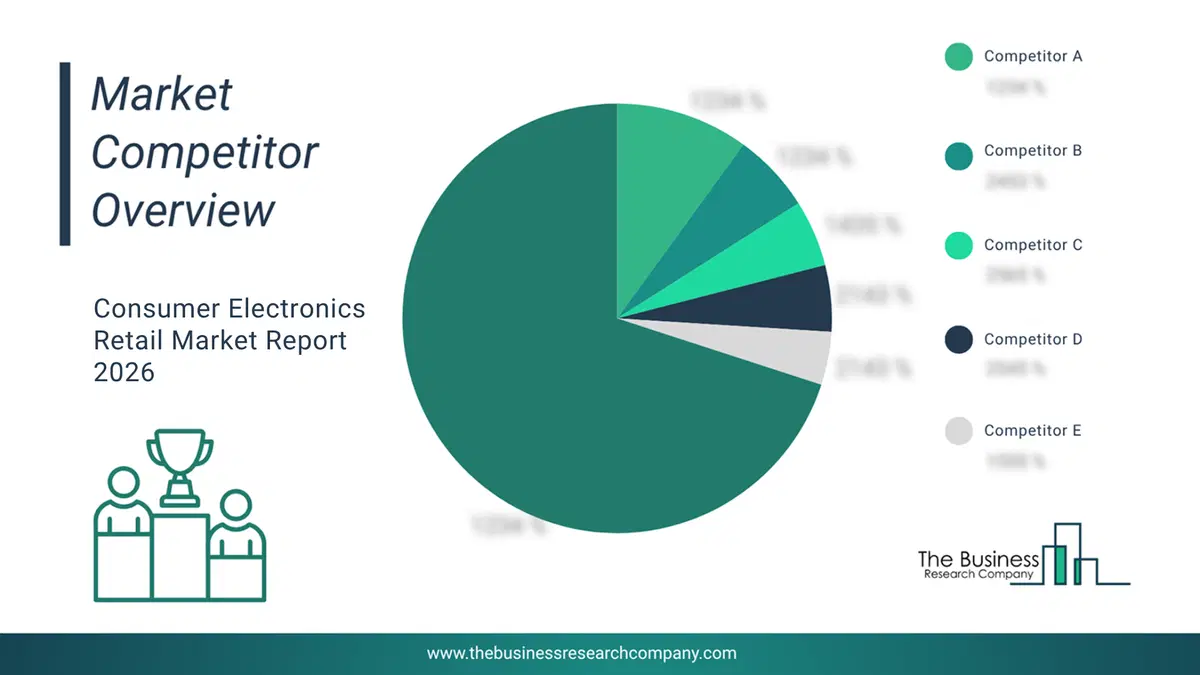
This chart is for illustrative purposes; the full report includes a detailed competitor analysis and comprehensive overview of the top 10 companies in the market.
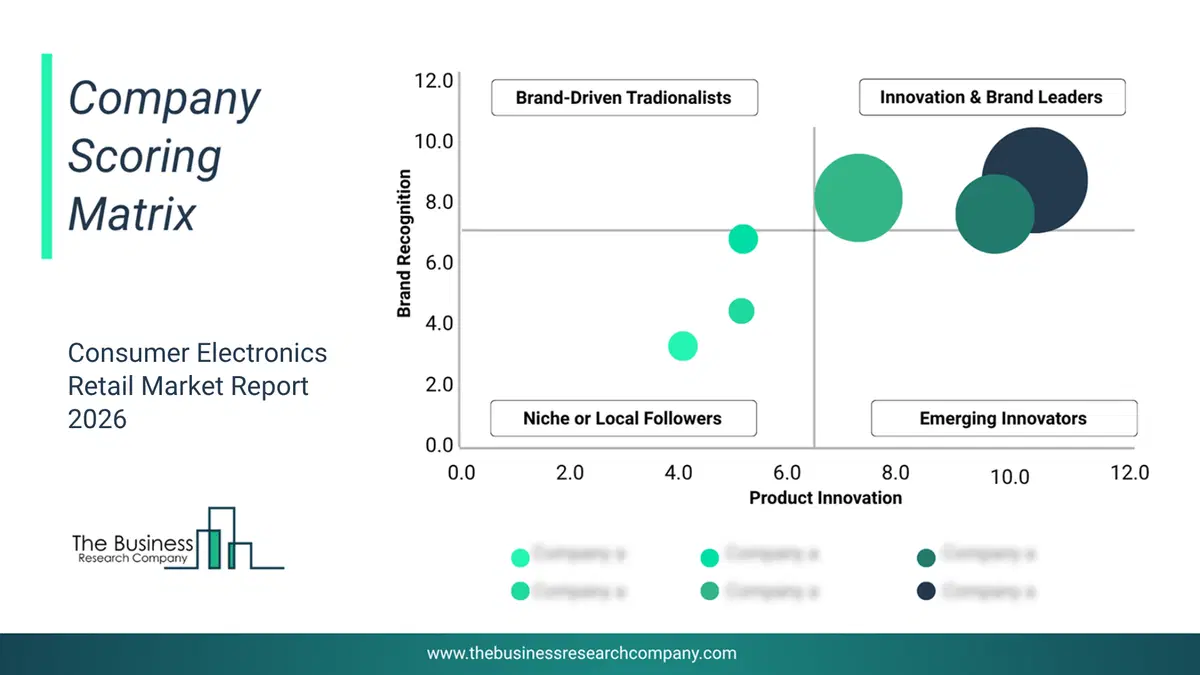
This chart maps companies by product innovation and brand strength, with bubble size indicating relative revenue, helping identify market leaders, challengers, and niche players. This is an illustrative chart; the full report provides a complete and accurate competitive analysis.
Global Consumer Electronics Retail Market Trends and Insights
Major companies operating in the consumer electronics retail market are focusing on developing innovative solutions such as large-format experiential retail stores to enhance customer engagement, expand omnichannel retail presence, and provide immersive product experiences. Large-format experiential retail stores refer to expansive retail outlets that allow customers to interact with, test, and receive expert guidance on a wide range of consumer electronics products within a single location. For instance, in November 2024, Acer Inc., an India-based technology company, launched Acer Plaza, its first mega store, in Ahmedabad, India. The store is designed to provide a comprehensive shopping destination for Acer's complete portfolio of consumer electronics and computing products. It offers benefits such as hands-on product demonstrations, personalized expert assistance, and an extensive selection of devices and accessories. The launch aims to help customers make informed purchasing decisions while supporting the growing trend toward experience-driven omnichannel consumer electronics retailing.What Are Latest Mergers And Acquisitions In The Consumer Electronics Retail Market?
In April 2024, Public Power Corporation S.A. (PPC), a Greece-based integrated energy utility company, acquired Kotsovolos from Currys plc for an undisclosed amount. Through this acquisition, Public Power Corporation aims to accelerate its transformation into an integrated provider of products and services by expanding its presence in the consumer electronics retail market. Kotsovolos is a Greece-based consumer electronics and home appliance retailer.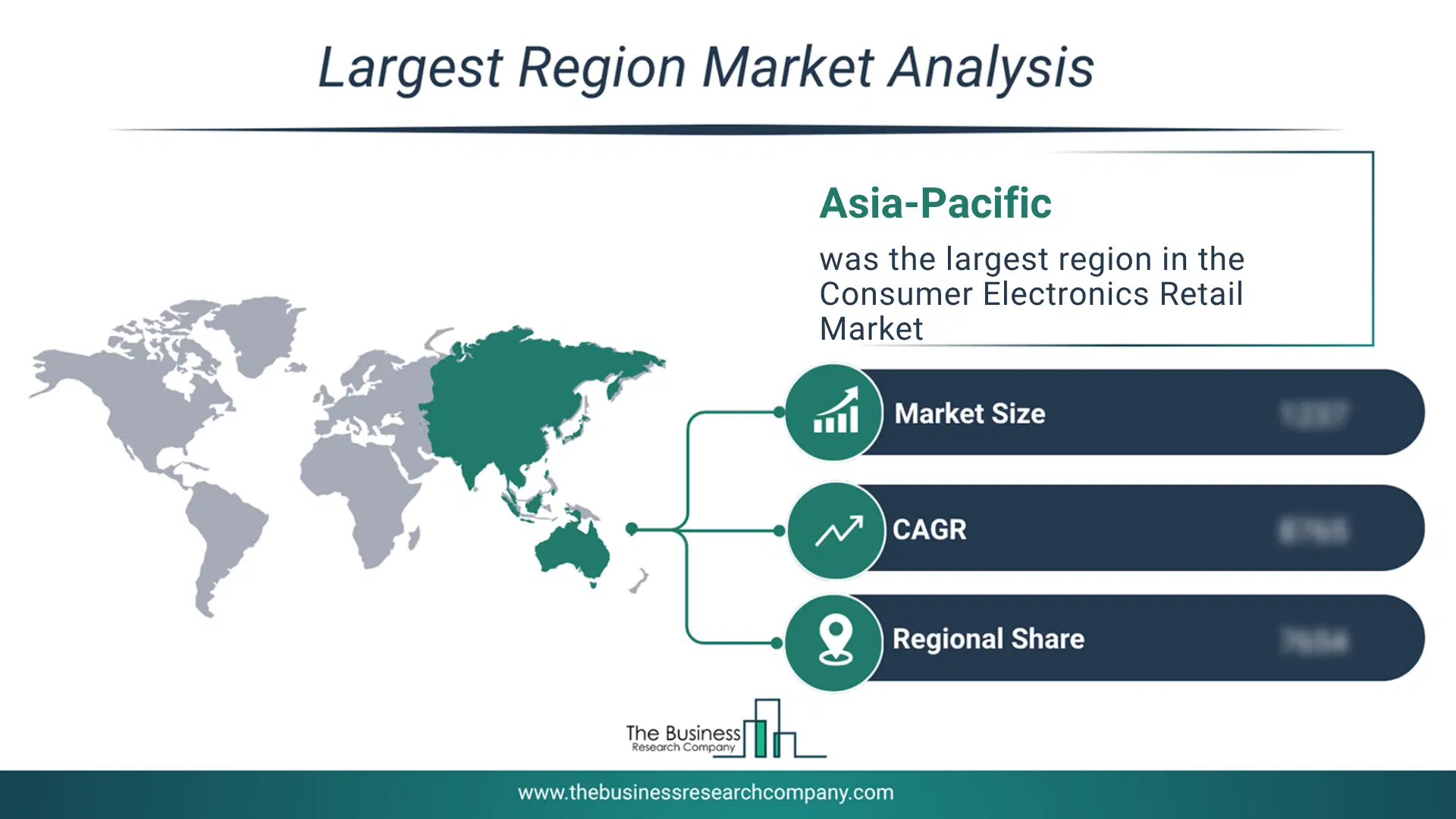
Regional Insights
Asia-Pacific was the largest region in the consumer electronics retail market in 2025. Asia-Pacific is expected to be the fastest-growing region in the forecast period. The regions covered in this market report are Asia-Pacific, South East Asia, Western Europe, Eastern Europe, North America, South America, Middle East, Africa. The countries covered in this market report are Australia, Brazil, China, France, Germany, India, Indonesia, Japan, Taiwan, Russia, South Korea, UK, USA, Canada, Italy, Spain.What Defines the Consumer Electronics Retail Market?
The consumer electronics retail market includes revenues earned by entities by providing services such as online retail and e-commerce services, product consultation and purchasing assistance, and installation and setup services. The market value includes the value of related goods sold by the service provider or included within the service offering. Only goods and services traded between entities or sold to end consumers are included.How is Market Value Defined and Measured?
The market value is defined as the revenues that enterprises gain from the sale of goods and/or services within the specified market and geography through sales, grants, or donations in terms of the currency (in USD unless otherwise specified). The revenues for a specified geography are consumption values that are revenues generated by organizations in the specified geography within the market, irrespective of where they are produced. It does not include revenues from resales along the supply chain, either further along the supply chain or as part of other products.
This chart presents market attractiveness based on a quantitative evaluation of growth, competition, strategic alignment, and risk, offering a clear view of opportunity areas for decision-making. This chart is for illustrative purposes; the full report contains the complete analysis.

This chart highlights the Total Addressable Market (TAM) by estimating the maximum revenue opportunity using an assumption-driven approach, supporting strategic planning and opportunity sizing across markets. The chart is illustrative; the full report provides a more comprehensive analysis.
What Key Data and Analysis Are Included in the Consumer Electronics Retail Market Report 2026?
The consumer electronics retail market research report is one of a series of new reports from The Business Research Company that provides market statistics, including industry global market size, regional shares, competitors with the market share, detailed market segments, market trends and opportunities, and any further data you may need to thrive in the consumer electronics retail industry. The market research report delivers a complete perspective of everything you need, with an in-depth analysis of the current and future state of the industry.Consumer Electronics Retail Market Report Forecast Analysis
| Report Attribute | Details |
|---|---|
| Market Size Value In 2026 | $1033.61 billion |
| Revenue Forecast In 2030 | $1221.72 billion |
| Growth Rate | CAGR of 4.3% from 2026 to 2030 |
| Base Year For Estimation | 2025 |
| Actual Estimates/Historical Data | 2020-2025 |
| Forecast Period | 2026 - 2030 |
| Market Representation | Revenue in USD Billion and CAGR from 2026 to 2030 |
| Segments Covered | Product Type, Retail Channel, Application, End User |
| Regional Scope | Asia-Pacific, Western Europe, Eastern Europe, North America, South America, Middle East, Africa |
| Country Scope | The countries covered in the report are Australia, Brazil, China, France, Germany, India, Indonesia, Japan, Taiwan, Russia, South Korea, UK, USA, Canada, Italy, Spain. |
| Key Companies Profiled | Amazon.com Inc., Walmart Inc., Best Buy Co. Inc., JD.com Inc., MediaMarktSaturn Retail Group, Apple Inc., Fnac Darty SA, Costco Wholesale Corporation, Target Corporation, JB Hi-Fi Limited, Harvey Norman Holdings Limited, Suning.com Co. Ltd., Boulanger S.A., Xiaomi Corporation, Reliance Retail Ventures Limited, El Corte Inglés S.A., Lotte Himart Co. Ltd. |
| Customization Scope | Request for Customization |
| Pricing And Purchase Options | Explore Purchase Options |