
Container Tracking Market Report 2026
Global Outlook – By Offering (Hardware; Software; Service), By Technology Type (Radio Frequency Identification (RFID); Global Positioning System (GPS); Cellular; Satellite), By Mode Of Transportation (Maritime; Land; Air), By End-User (Food And Beverage; Consumer Goods; Vehicle Transport; Healthcare; Industrial Products; Other End-Users) – Market Size, Trends, Strategies, and Forecast to 2030
Container Tracking Market Overview
• Container Tracking market size has reached to $10.85 billion in 2025 • Expected to grow to $15.73 billion in 2030 at a compound annual growth rate (CAGR) of 7.7% • Growth Driver: Rising Cargo Theft Is Driving The Growth Of The Container Tracking Market. • Market Trend: Advancements In Container Tracking Enhancing Security And Efficiency • Asia-Pacific was the largest region in 2025.What Is Covered Under Container Tracking Market?
Container tracking refers to the use of technology to monitor and manage the location, condition, and status of shipping containers throughout their journey from origin to destination. It utilizes a real-time global positioning system, radio frequency identification, and Internet of Things (IoT) technologies to monitor and manage the location, condition, and status of shipping containers throughout their journey, enhancing visibility and efficiency in the supply chain. The main offerings of container tracking are hardware, software, and service. Hardware refers to the physical devices used to monitor and record the location and condition of containers throughout their journey. The technology includes radio frequency identification (RFID), global positioning system (GPS), and cellular, and satellite systems. Container tracking applies to various modes of transportation, including maritime, land, and air, and it is utilized by end users in sectors such as food and beverage, consumer goods, vehicle transport, healthcare, industrial products, and others.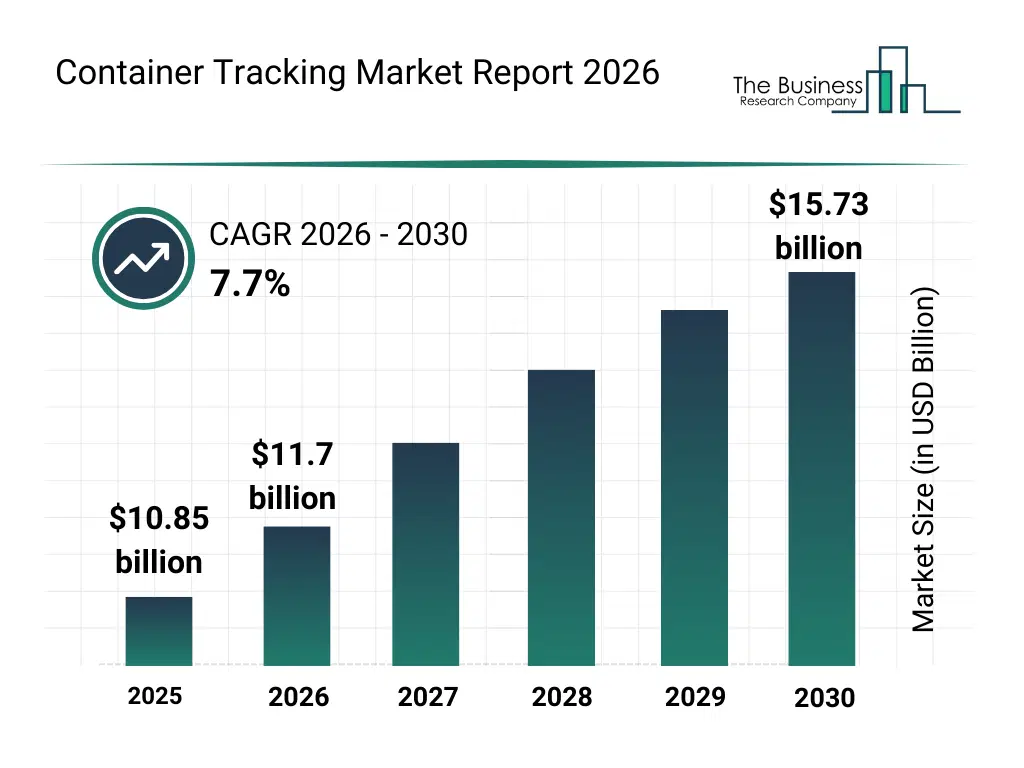
What Is The Container Tracking Market Size and Share 2026?
The container tracking market size has grown strongly in recent years. It will grow from $10.85 billion in 2025 to $11.7 billion in 2026 at a compound annual growth rate (CAGR) of 7.8%. The growth in the historic period can be attributed to expansion of global containerized trade, rising complexity of international supply chains, increasing incidents of cargo loss and delays, adoption of GPS-based logistics tracking, growth of intermodal transportation.What Is The Container Tracking Market Growth Forecast?
The container tracking market size is expected to see strong growth in the next few years. It will grow to $15.73 billion in 2030 at a compound annual growth rate (CAGR) of 7.7%. The growth in the forecast period can be attributed to increasing demand for real-time logistics intelligence, rising investments in smart ports and terminals, expansion of cold chain and pharma logistics, growing adoption of ai-driven supply chain optimization, increasing regulatory focus on cargo traceability. Major trends in the forecast period include increasing deployment of real-time container visibility solutions, rising adoption of multi-sensor tracking devices, growing integration of predictive analytics in container management, expansion of end-to-end supply chain transparency tools, enhanced focus on condition monitoring for sensitive cargo.

Global Container Tracking Market Segmentation
1) By Offering: Hardware, Software, Service 2) By Technology Type: Radio Frequency Identification (RFID), Global Positioning System (GPS), Cellular, Satellite 3) By Mode Of Transportation: Maritime, Land, Air 4) By End-User: Food And Beverage, Consumer Goods, Vehicle Transport, Healthcare, Industrial Products, Other End-Users Subsegments: 1) By Hardware: GPS Trackers, RFID Tags, Sensors (Temperature, Humidity, Motion), Satellite Communication Devices 2) By Software: Real-Time Tracking Platforms, Data Analytics And Reporting Software, Container Management Systems, Fleet And Logistics Management Software 3) By Service: Installation And Maintenance Services, Data Processing And Analysis Services, Cloud-Based Tracking Services, Consulting And Integration ServicesWhat Is The Driver Of The Container Tracking Market?
The rising cargo theft is expected to propel the growth of the container tracking market going forward. Cargo theft is growing due to increased economic pressures leading to higher criminal activity and the sophistication of theft methods outpacing current security measures. Additionally, the rise in e-commerce has expanded the volume and value of goods being transported, making cargo an attractive target for thieves. Container tracking helps mitigate cargo theft by providing real-time location and status updates, allowing for immediate action if unauthorized movement is detected. It also enhances overall security through detailed monitoring and historical data analysis. For instance, in January 2025, according to CargoNet, a US based global data analytics provider, in 2024, reported cargo theft incidents across the United States and Canada reached 3,625, a 27% increase from 2023, with the average value per theft rising to over $202,000, up from $187,895 in 2023. Therefore, rising cargo theft is driving the growth of the container tracking industry.Key Players In The Global Container Tracking Market
Major companies operating in the container tracking market are A.P. Moller - Maersk A/S, CMA CGM Group, Cosco Shipping Lines Co Ltd., NetSuite Inc., Hapag-Lloyd AG, Mediterranean Shipping Company S.A., Orient Overseas Container Line Limited, DP World Logistics FZE, Yang Ming Marine Transport Corporation, Zim Integrated Shipping Services Ltd., Evergreen Marine Corporation, Wan Hai Lines Ltd., Kawasaki Kisen Kaisha Ltd, Hyundai Merchant Marine Co., Ltd., Zebra Technologies Corporation, Ocean Network Express Pte. Ltd., Project44 Inc., CargoWise, E2open Parent Holdings Inc., ORBCOMM Inc., Hanjin Logistics Corporation, Pacific International Lines (Pte) Ltd., GoComet, CargoSmart Ltd.
This chart is for illustrative purposes; the full report includes a detailed competitor analysis and comprehensive overview of the top 10 companies in the market.

This chart maps companies by product innovation and brand strength, with bubble size indicating relative revenue, helping identify market leaders, challengers, and niche players. This is an illustrative chart; the full report provides a complete and accurate competitive analysis.
Global Container Tracking Market Trends and Insights
Major companies operating in the container tracking market are focusing on developing advanced solutions, such as dry container tracking, to enhance security, improve logistics efficiency, and provide real-time visibility. Dry container tracking refers to the monitoring and management of standard shipping containers used for transporting cargo that do not require special conditions, such as refrigeration or a controlled atmosphere. For instance, in April 2024, Hapag-Lloyd., a Germany-based maritime transport company, launched a new live position product that delivers comprehensive, on-demand door-to-door visibility through extensive use of Internet of Things (IoT) technology. It offers unique features such as real-time visibility of shipments, a user-friendly interface for easy tracking by container or booking number, on-demand information updates, and plans for future enhancements such as application programming interface integration and estimated time of arrival (ETA) predictions.What Are Latest Mergers And Acquisitions In The Container Tracking Market?
In April 2024, Sinay, a France-based developer of a big data platform, acquired SafeCube for an undisclosed amount. Through this acquisition, Sinay aims to expand its container tracking capabilities and provide more comprehensive logistics solutions to its customers in the maritime industry. SafeCube is a France-based developer of an end-to-end shipment tracking platform that involves container tracking.
Regional Outlook
Asia-Pacific was the largest region in the container tracking market in 2025. The regions covered in this market report are Asia-Pacific, South East Asia, Western Europe, Eastern Europe, North America, South America, Middle East, Africa. The countries covered in this market report are Australia; Brazil; China; France; Germany; India; Indonesia; Japan; Taiwan; Russia; South Korea; UK; USA; Canada; Italy; Spain.What Defines the Container Tracking Market?
The container tracking market includes revenues earned by entities by providing services such as real-time location tracking, condition monitoring, customizable alerts and notifications, security solutions, and consulting and support services. The market value includes the value of related goods sold by the service provider or included within the service offering. The container tracking market also consists of sales of radio frequency identification (RFID) tags, environmental sensors, alert systems, batteries, and solar panels. Values in this market are ‘factory gate’ values, that is, the value of goods sold by the manufacturers or creators of the goods, whether to other entities (including downstream manufacturers, wholesalers, distributors, and retailers) or directly to end customers. The value of goods in this market includes related services sold by the creators of the goods.How is Market Value Defined and Measured?
The market value is defined as the revenues that enterprises gain from the sale of goods and/or services within the specified market and geography through sales, grants, or donations in terms of the currency (in USD unless otherwise specified). The revenues for a specified geography are consumption values that are revenues generated by organizations in the specified geography within the market, irrespective of where they are produced. It does not include revenues from resales along the supply chain, either further along the supply chain or as part of other products.
This chart presents market attractiveness based on a quantitative evaluation of growth, competition, strategic alignment, and risk, offering a clear view of opportunity areas for decision-making. This chart is for illustrative purposes; the full report contains the complete analysis.

This chart highlights the Total Addressable Market (TAM) by estimating the maximum revenue opportunity using an assumption-driven approach, supporting strategic planning and opportunity sizing across markets. The chart is illustrative; the full report provides a more comprehensive analysis.
What Key Data and Analysis Are Included in the Container Tracking Market Report 2026?
The container tracking market research report is one of a series of new reports from The Business Research Company that provides market statistics, including Market Report 2026?global market size, regional shares, competitors with the market share, detailed market segments, market trends and opportunities, and any further data you may need to thrive in the container tracking Market Report 2026? The market research report delivers a complete perspective of everything you need, with an in-depth analysis of the current and future state of the Market Report 2026?Container Tracking Market Report Forecast Analysis
| Report Attribute | Details |
|---|---|
| Market Size Value In 2026 | $11.7 billion |
| Revenue Forecast In 2030 | $15.73 billion |
| Growth Rate | CAGR of 7.8% from 2026 to 2030 |
| Base Year For Estimation | 2025 |
| Actual Estimates/Historical Data | 2020-2025 |
| Forecast Period | 2026 - 2030 - 2030 |
| Market Representation | Revenue in USD Billion and CAGR from 2026 to 2030 |
| Segments Covered | Offering, Technology Type, Mode Of Transportation, End-User |
| Regional Scope | Asia-Pacific, Western Europe, Eastern Europe, North America, South America, Middle East, Africa |
| Country Scope | The countries covered in the report are Australia, Brazil, China, France, Germany, India, Indonesia, Japan, Taiwan, Russia, South Korea, UK, USA, Canada, Italy, Spain. |
| Key Companies Profiled | A.P. Moller - Maersk A/S, CMA CGM Group, Cosco Shipping Lines Co Ltd., NetSuite Inc., Hapag-Lloyd AG, Mediterranean Shipping Company S.A., Orient Overseas Container Line Limited, DP World Logistics FZE, Yang Ming Marine Transport Corporation, Zim Integrated Shipping Services Ltd., Evergreen Marine Corporation, Wan Hai Lines Ltd., Kawasaki Kisen Kaisha Ltd, Hyundai Merchant Marine Co., Ltd., Zebra Technologies Corporation, Ocean Network Express Pte. Ltd., Project44 Inc., CargoWise, E2open Parent Holdings Inc., ORBCOMM Inc., Hanjin Logistics Corporation, Pacific International Lines (Pte) Ltd., GoComet, CargoSmart Ltd. |
| Customization Scope | Request for Customization |
| Pricing And Purchase Options | Explore Purchase Options |