
Content Policy Enforcement For Artificial Intelligence (AI) Market Report 2026
Global Outlook – By Component (Software, Hardware, Services), By Deployment Mode (Cloud Based, On Premises, Hybrid), By Organization Size (Small And Medium Enterprises (SMEs), Large Enterprises), By Application (Social Media, E-Commerce, Online Gaming, Digital Advertising, Enterprise Platforms, Other Applications), By End User (Banking, Financial Services And Insurance (BFSI), Healthcare, Retail And E-Commerce, Media And Entertainment, Information Technology (IT) And Telecommunications, Government, Other End Users) – Market Size, Trends, Strategies, and Forecast to 2030
Content Policy Enforcement For Artificial Intelligence (AI) Market Overview
• Content Policy Enforcement For Artificial Intelligence (AI) market size has reached to $2.8 billion in 2025 • Expected to grow to $7.03 billion in 2030 at a compound annual growth rate (CAGR) of 20.3% • Growth Driver: Surge In Growth In Digital And User-Generated Content Fueling The Growth Of The Market Due To Expanding Online Content Creation • Market Trend: Meta Launched Enhanced AI Moderation System To Improve Real-Time Content Policy Enforcement • North America was the largest region in 2025 and Asia-Pacific is the fastest growing region.What Is Covered Under Content Policy Enforcement For Artificial Intelligence (AI) Market?
Content policy enforcement for artificial intelligence (AI) refers to solutions and technologies that ensure artificial intelligence (AI) systems comply with established content guidelines, ethical standards, and regulatory requirements. These systems monitor, detect, and filter inappropriate, harmful, or non-compliant content generated or processed by artificial intelligence (AI) models, enabling safe and responsible deployment. The main components of content policy enforcement for artificial intelligence (AI) are software, hardware, and services. Software refers to AI-driven tools and platforms that monitor, analyze, and enforce content policies by detecting, filtering, and moderating text, images, audio, and video across digital platforms. These solutions are deployed through cloud-based, on-premises, and hybrid deployment modes and are designed for organizations of different sizes, including small and medium enterprises (SMEs) and large enterprises. They are used across various applications, such as social media, e-commerce, online gaming, digital advertising, enterprise platforms, and other applications, and cater to multiple end-user industries, including banking, financial services and insurance (BFSI), healthcare, retail and e-commerce, media and entertainment, information technology (IT) and telecommunications, government, and other end users.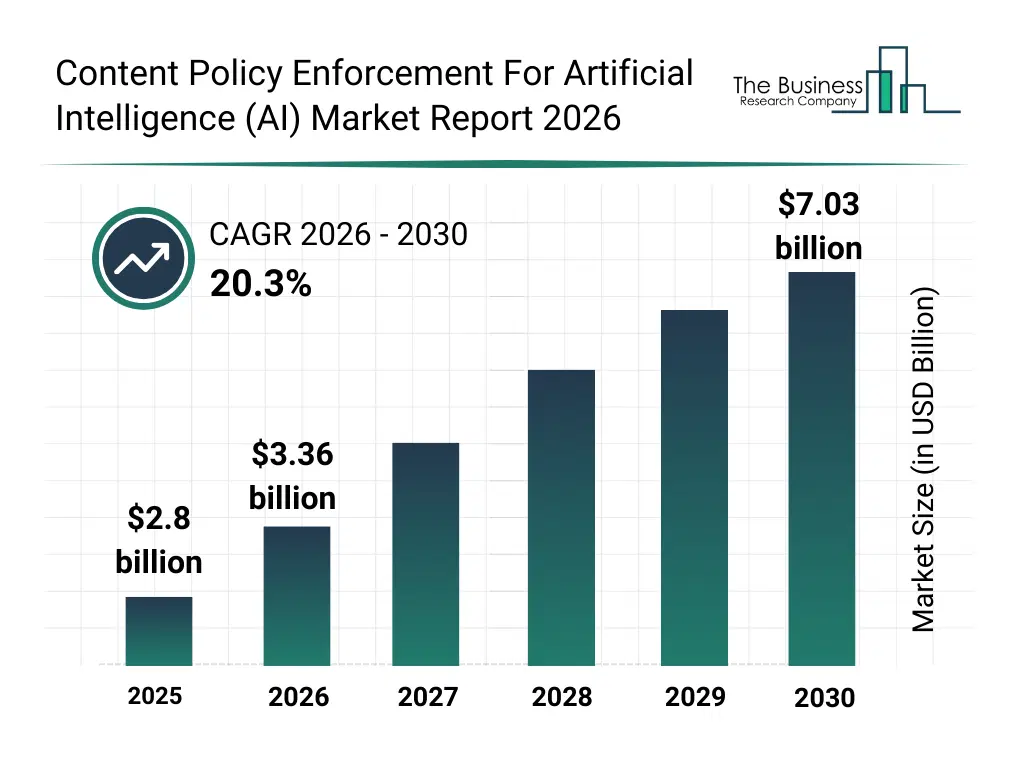
What Is The Content Policy Enforcement For Artificial Intelligence (AI) Market Size and Share 2026?
The content policy enforcement for artificial intelligence (AI) market size has grown exponentially in recent years. It will grow from $2.8 billion in 2025 to $3.36 billion in 2026 at a compound annual growth rate (CAGR) of 20.0%. The growth in the historic period can be attributed to increasing volume of user-generated digital content, expansion of social media and online platforms, early adoption of content moderation tools, rising regulatory scrutiny on digital content, growth of AI-generated content.What Is The Content Policy Enforcement For Artificial Intelligence (AI) Market Growth Forecast?
The content policy enforcement for artificial intelligence (AI) market size is expected to see exponential growth in the next few years. It will grow to $7.03 billion in 2030 at a compound annual growth rate (CAGR) of 20.3%. The growth in the forecast period can be attributed to increasing enforcement of digital content regulations, growing demand for automated moderation at scale, expansion of AI-generated content monitoring, rising investments in trust and safety infrastructure, increasing adoption of cross-platform policy enforcement. Major trends in the forecast period include increasing deployment of AI-based content moderation systems, rising adoption of real-time policy enforcement tools, growing integration of nlp-based content analysis, expansion of automated compliance reporting, enhanced focus on scalable content risk management.
Global Content Policy Enforcement For Artificial Intelligence (AI) Market Segmentation
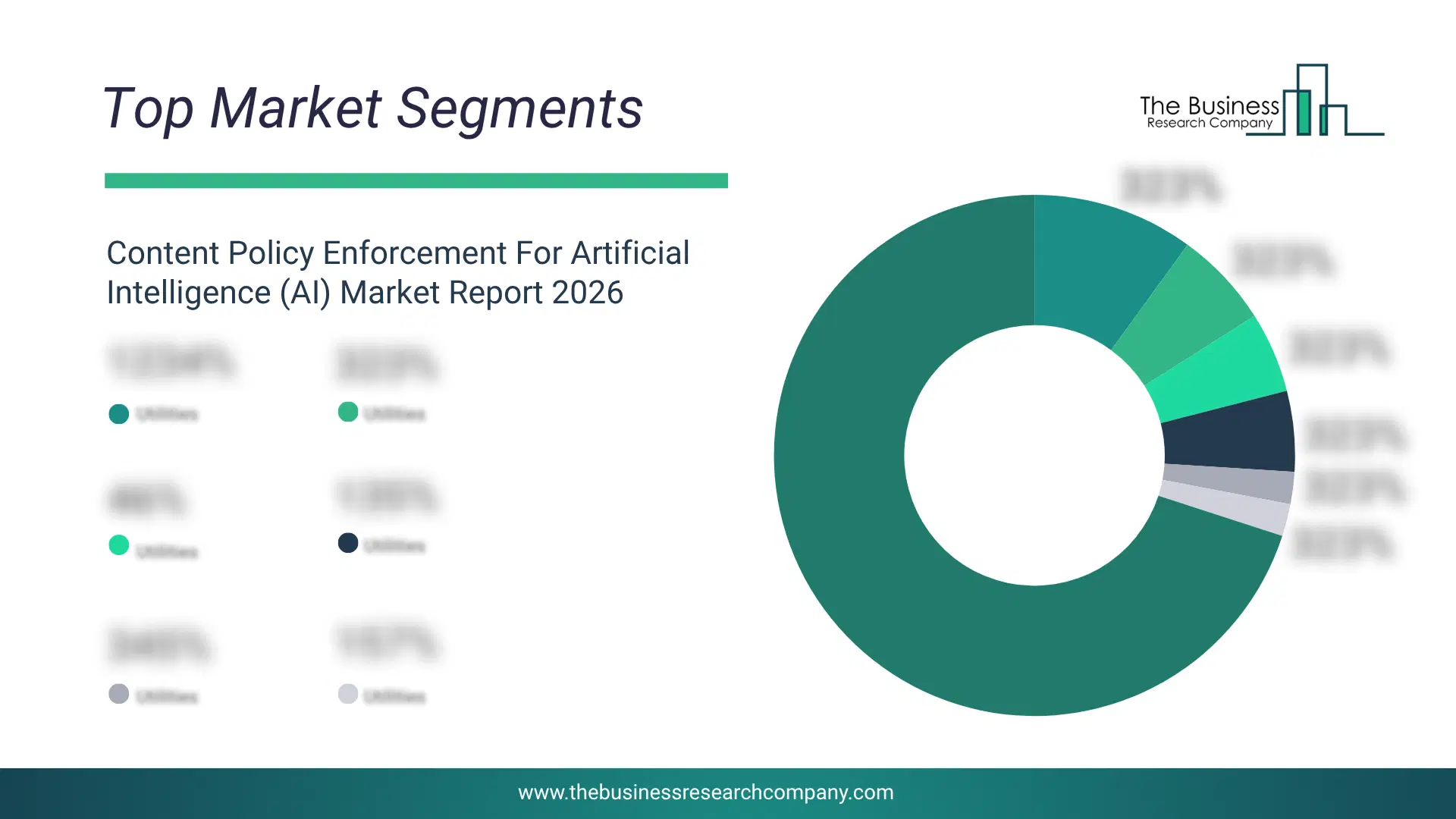
1) By Component: Software; Hardware; Services 2) By Deployment Mode: Cloud Based; On Premises; Hybrid 3) By Organization Size: Small And Medium Enterprises (SMEs); Large Enterprises 4) By Application: Social Media; E-Commerce; Online Gaming; Digital Advertising; Enterprise Platforms; Other Applications 5) By End User: Banking, Financial Services And Insurance (BFSI); Healthcare; Retail And E-Commerce; Media And Entertainment; Information Technology (IT) And Telecommunications; Government; Other End Users Subsegments: 1) By Software: Content Filtering; Threat Detection; Compliance Management; Risk Assessment; Data Privacy Management; Policy Automation; Monitoring And Reporting; Access Control 2) By Hardware: Servers; Network Appliances; Security Gateways; Storage Devices; Processing Units; Firewalls; Encryption Modules; Authentication Devices 3) By Services: Consulting Services; Implementation Services; Integration Services; Support And Maintenance; Training Services; Managed Services; Auditing Services; Policy Advisory ServicesWhat Is The Driver Of The Content Policy Enforcement For Artificial Intelligence (AI) Market?
The growth in digital and user-generated content is expected to propel the growth of the content policy enforcement for the artificial intelligence (AI) market going forward. Digital and user-generated content means all text, images, videos, and other media that individuals and organizations publish online through digital platforms. Digital and user-generated content are rising as increasing global internet connectivity and access enable more people to create and upload original content online. Content policy enforcement for AI solutions helps platforms manage rapidly increasing user contributions by automatically identifying, categorizing, and moderating content against policy standards to ensure safe and compliant digital environments. For instance, in November 2025, according to the University of Maine, a US-based public university, the number of social media users worldwide reached 4.8 billion, representing 59.9% of the global population and marking an increase of 150 million users (+3.2%) from April 2022 to April 2023. Therefore, a growth in digital and user-generated content is expected to drive the growth of the content policy enforcement for the artificial intelligence (AI) market.Key Players In The Global Content Policy Enforcement For Artificial Intelligence (AI) Market
Major companies operating in the content policy enforcement for artificial intelligence (AI) market are Hive AI Inc., ActiveFence Ltd., OpenWeb Ltd., Fiddler AI Inc., Arthur AI Inc., Unitary Technologies Ltd., Aporia Technologies Ltd., CalypsoAI Corp., Bodyguard.AI SAS, Lakera AI AG, Robust Intelligence Inc., Holistic AI Ltd., Credo AI Inc., Truera Inc., AIShield Pte. Ltd., Fairly AI Inc., Saidot AI Ltd., Trustible Technology Inc., Modulate Inc., Spectrum Labs Inc., Preamble AI Inc., Musubi AI Inc.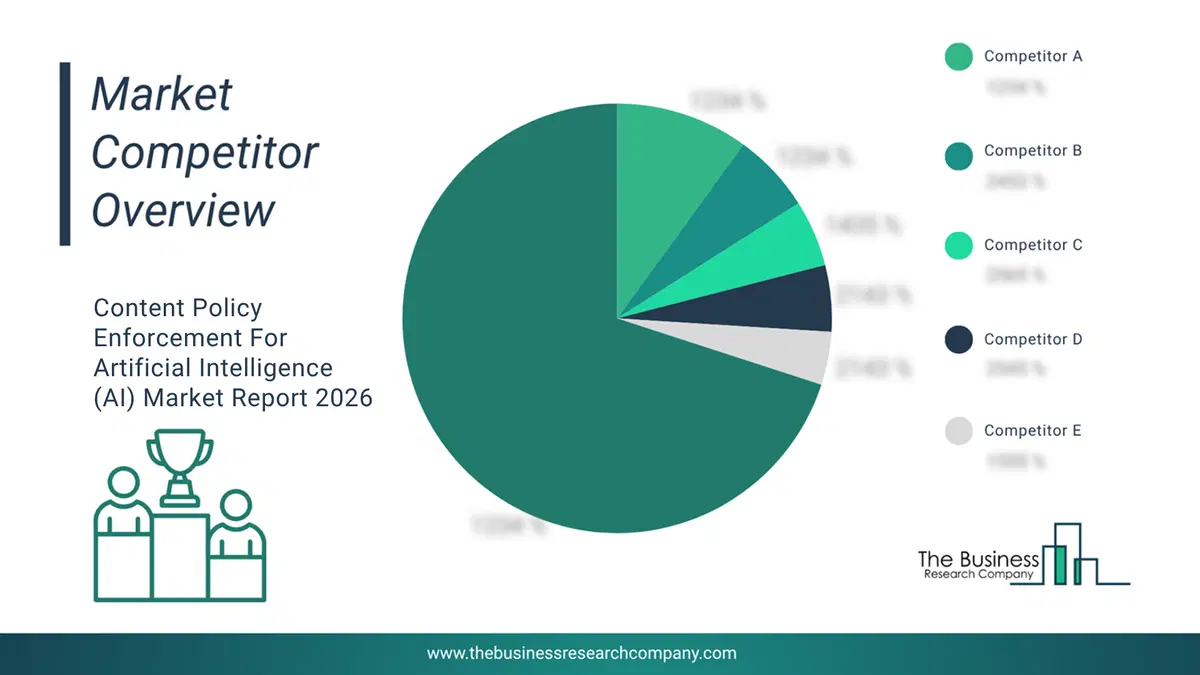
This chart is for illustrative purposes; the full report includes a detailed competitor analysis and comprehensive overview of the top 10 companies in the market.
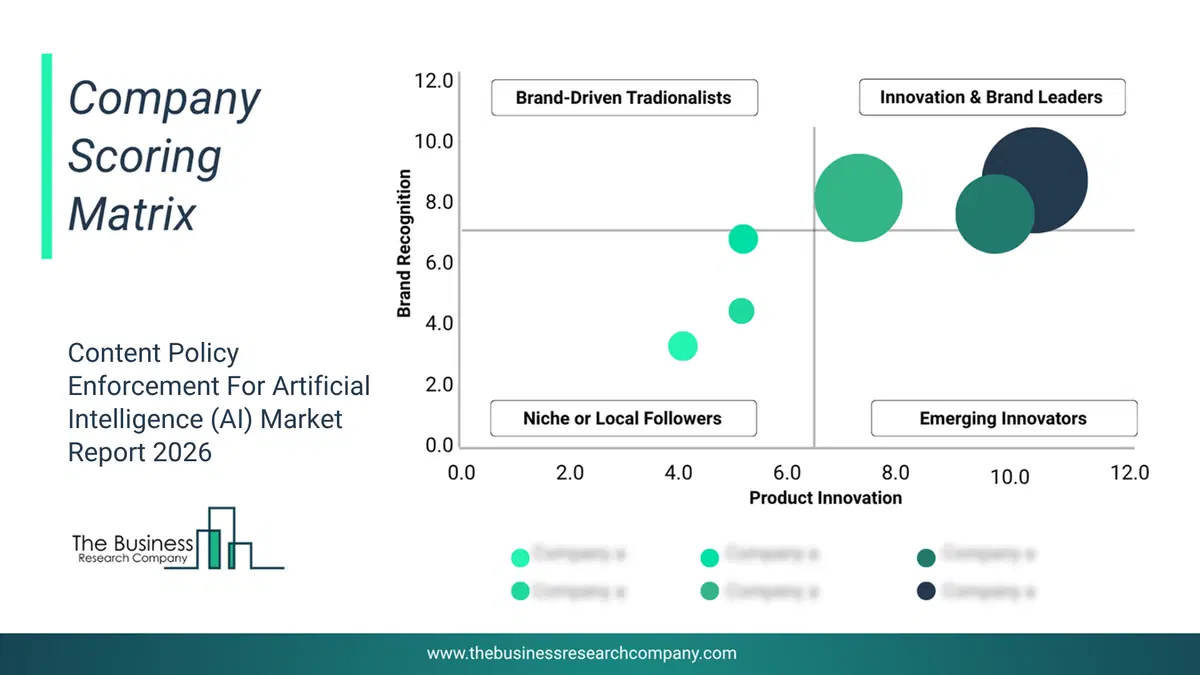
This chart maps companies by product innovation and brand strength, with bubble size indicating relative revenue, helping identify market leaders, challengers, and niche players. This is an illustrative chart; the full report provides a complete and accurate competitive analysis.
Global Content Policy Enforcement For Artificial Intelligence (AI) Market Trends and Insights
Major companies operating in the content policy enforcement for the artificial intelligence (AI) market are focusing on automated multimodal AI moderation systems, such as AI-driven contextual content classifiers, to detect, interpret, and enforce content policies consistently across text, image, audio, and video formats at scale. AI-driven contextual content classifiers are artificial intelligence systems that analyze the meaning, intent, and surrounding context of digital content across formats to accurately categorize material and enforce content policies beyond simple keyword or rule-based detection. For instance, in July 2025, Meta Platforms Inc., a US-based social media and technology company, launched an enhanced AI-powered moderation system to improve real-time detection and enforcement of content policies across text, image, and video formats. It offers faster and more accurate detection of harmful, misleading, and policy-violating content across its platforms. It uses advanced machine learning models that can understand conversational and cultural context, helping reduce errors like wrongful removals. With few-shot and zero-shot learning, the system can adapt quickly to new and emerging harmful content types even with limited labeled data. It also strengthens enforcement against AI-generated spam by limiting distribution and monetization of low-quality content.What Are Latest Mergers And Acquisitions In The Content Policy Enforcement For Artificial Intelligence (AI) Market?
In January 2025, IntouchCX, a Canada‑based provider of customer experience, trust & safety, and AI‑enhanced digital solutions, acquired WebPurify for an undisclosed amount. With this acquisition, IntouchCX aimed to expand its trust and safety portfolio by integrating advanced AI‑powered and human‑augmented content moderation capabilities to enhance policy enforcement, platform safety, and user engagement for its global clients. WebPurify is a US‑based company that provides a broad range of content moderation services, both AI-based and human.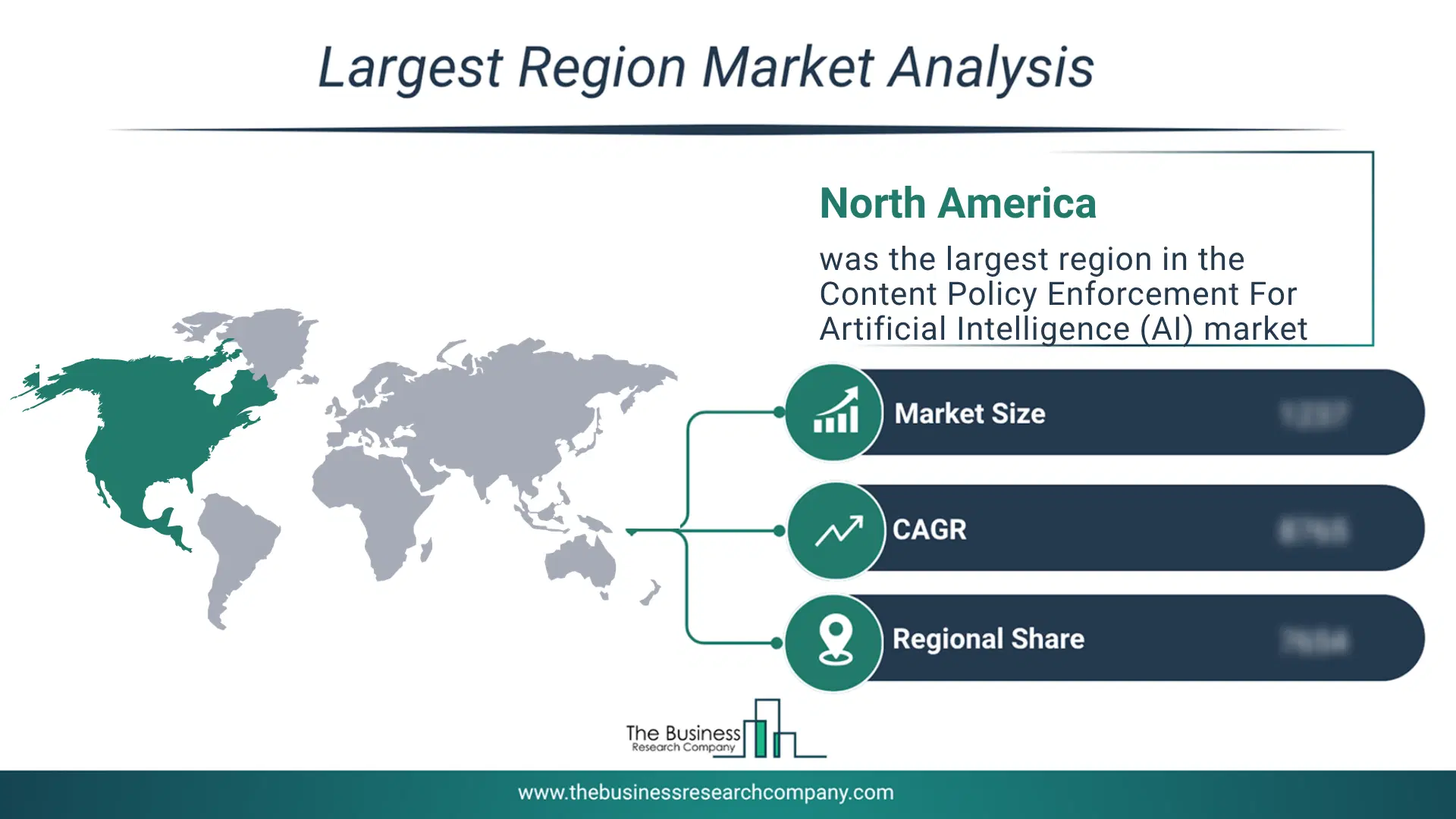
Regional Insights
North America was the largest region in the content policy enforcement for artificial intelligence (AI) market in 2025. Asia-Pacific is expected to be the fastest-growing region in the forecast period. The regions covered in this market report are Asia-Pacific, South East Asia, Western Europe, Eastern Europe, North America, South America, Middle East, Africa. The countries covered in this market report are Australia, Brazil, China, France, Germany, India, Indonesia, Japan, Taiwan, Russia, South Korea, UK, USA, Canada, Italy, Spain.What Defines the Content Policy Enforcement For Artificial Intelligence (AI) Market?
The content policy enforcement for artificial intelligence (AI) consists of revenues earned by entities by providing solutions such as policy compliance auditing, harmful or inappropriate content detection, risk assessment and reporting, custom policy rule implementation, real-time monitoring and alerting, and ongoing support and advisory services. The market value includes the value of related goods sold by the service provider or included within the service offering. The content policy enforcement for artificial intelligence (AI) includes sales of artificial intelligence (AI) model auditing tools, natural language processing (NLP) modules, content scanning software, and cloud-based enforcement platforms. Values in this market are ‘factory gate’ values, that is, the value of goods sold by the manufacturers or creators of the goods, whether to other entities (including downstream manufacturers, wholesalers, distributors, and retailers) or directly to end customers. The value of goods in this market includes related services sold by the creators of the goods.How is Market Value Defined and Measured?
The market value is defined as the revenues that enterprises gain from the sale of goods and/or services within the specified market and geography through sales, grants, or donations in terms of the currency (in USD unless otherwise specified). The revenues for a specified geography are consumption values that are revenues generated by organizations in the specified geography within the market, irrespective of where they are produced. It does not include revenues from resales along the supply chain, either further along the supply chain or as part of other products.
This chart presents market attractiveness based on a quantitative evaluation of growth, competition, strategic alignment, and risk, offering a clear view of opportunity areas for decision-making. This chart is for illustrative purposes; the full report contains the complete analysis.

This chart highlights the Total Addressable Market (TAM) by estimating the maximum revenue opportunity using an assumption-driven approach, supporting strategic planning and opportunity sizing across markets. The chart is illustrative; the full report provides a more comprehensive analysis.
What Key Data and Analysis Are Included in the Content Policy Enforcement For Artificial Intelligence (AI) Market Report 2026?
The content policy enforcement for artificial intelligence (ai) market research report is one of a series of new reports from The Business Research Company that provides market statistics, including industry global market size, regional shares, competitors with the market share, detailed market segments, market trends and opportunities, and any further data you may need to thrive in the content policy enforcement for artificial intelligence (ai) industry. The market research report delivers a complete perspective of everything you need, with an in-depth analysis of the current and future state of the industry.Content Policy Enforcement For Artificial Intelligence (AI) Market Report Forecast Analysis
| Report Attribute | Details |
|---|---|
| Market Size Value In 2026 | $3.36 billion |
| Revenue Forecast In 2030 | $7.03 billion |
| Growth Rate | CAGR of 20.3% from 2026 to 2030 |
| Base Year For Estimation | 2025 |
| Actual Estimates/Historical Data | 2020-2025 |
| Forecast Period | 2026 - 2030 |
| Market Representation | Revenue in USD Billion and CAGR from 2026 to 2030 |
| Segments Covered | Component, Deployment Mode, Organization Size, Application, End User |
| Regional Scope | Asia-Pacific, Western Europe, Eastern Europe, North America, South America, Middle East, Africa |
| Country Scope | The Countries Covered In This Market Report Are Australia, Brazil, China, France, Germany, India, Indonesia, Japan, Taiwan, Russia, South Korea, Uk, Usa, Canada, Italy, Spain. |
| Key Companies Profiled | Hive AI Inc., ActiveFence Ltd., OpenWeb Ltd., Fiddler AI Inc., Arthur AI Inc., Unitary Technologies Ltd., Aporia Technologies Ltd., CalypsoAI Corp., Bodyguard.AI SAS, Lakera AI AG, Robust Intelligence Inc., Holistic AI Ltd., Credo AI Inc., Truera Inc., AIShield Pte. Ltd., Fairly AI Inc., Saidot AI Ltd., Trustible Technology Inc., Modulate Inc., Spectrum Labs Inc., Preamble AI Inc., Musubi AI Inc. |
| Customization Scope | Request for Customization |
| Pricing And Purchase Options | Explore Purchase Options |