

Control Flow Seam Sealer Market Report 2026
Global Outlook – By Component Type (Single-Component, Two-Component), By Product Type (Polyurethane Seam Sealers, Silicone Seam Sealers, Acrylic Seam Sealers, Polyester Seam Sealers, Bituminous Seam Sealers), By Distribution Channel (Direct Sales, Online Retail, Distributors And Wholesalers, Specialty Stores, Industrial Supply Stores), By Application (Automotive, Aerospace, Construction, Marine, Other Applications), By End-User (Original Equipment Manufacturers (OEMs), Aftermarket) – Market Size, Trends, Strategies, and Forecast to 2030
Control Flow Seam Sealer Market Overview
• Control Flow Seam Sealer market size has reached to $1.04 billion in 2025 • Expected to grow to $1.44 billion in 2030 at a compound annual growth rate (CAGR) of 6.7% • Growth Driver: Surge In Vehicle Production Fueling The Growth Of The Market Due To Rising Automotive Demand And Manufacturing Advancements • North America was the largest region in 2025.What Is Covered Under Control Flow Seam Sealer Market?
Control flow seam sealer is a high-performance sealant used in automotive and industrial settings to seal joints, seams, and panel overlaps. Its controlled flow properties allow it to fill gaps evenly without running, ensuring thorough coverage. It helps block out moisture, dust, and air, protecting against corrosion and reinforcing structural strength. The main types of control flow seam sealers are single-component and two-component. Single-component control flow seam sealers are ready-to-use, air- or heat-cured sealants ideal for quick, efficient sealing in automotive, aerospace, and industrial applications. The product types include polyurethane seam sealers, silicone seam sealers, acrylic seam sealers, polyester seam sealers, and bituminous seam sealers, and are distributed through various distribution channels, including direct sales, online retail, distributors and wholesalers, specialty stores, and industrial supply stores. It is applicable in several applications, such as automotive, aerospace, construction, and marine, among others, and is used by various end users, including original equipment manufacturers (OEMs) and aftermarket.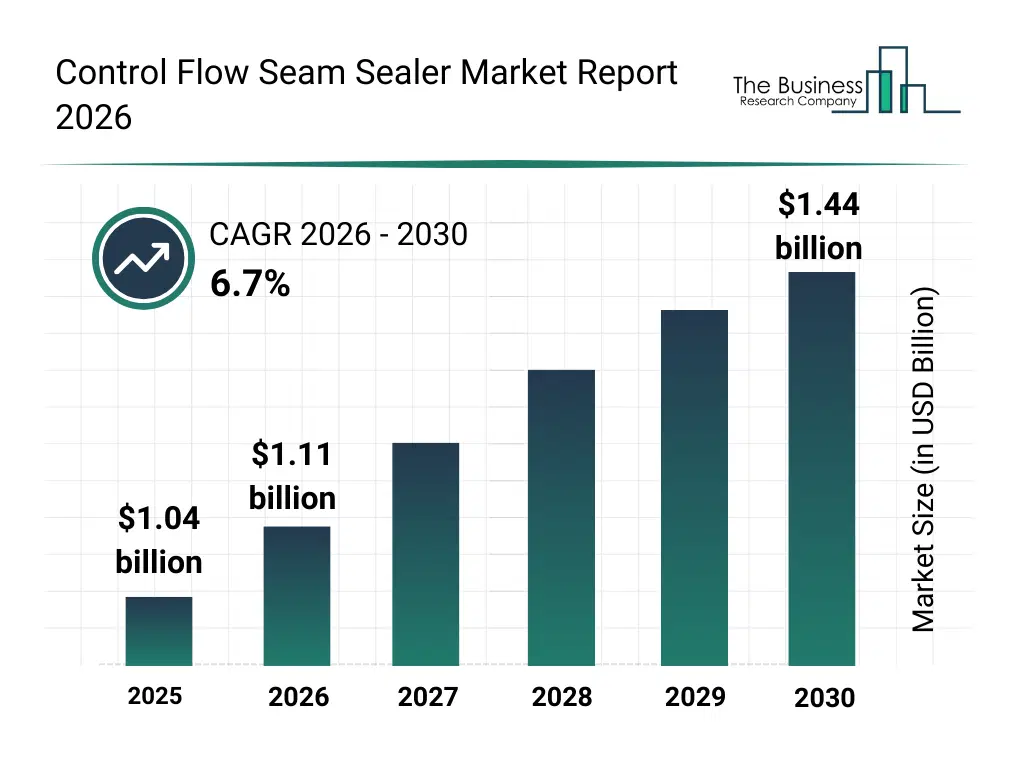
What Is The Control Flow Seam Sealer Market Size and Share 2026?
The control flow seam sealer market size has grown strongly in recent years. It will grow from $1.04 billion in 2025 to $1.11 billion in 2026 at a compound annual growth rate (CAGR) of 7.0%. The growth in the historic period can be attributed to automotive body corrosion prevention needs, growth in vehicle production volumes, expansion of industrial assembly lines, demand for structural reinforcement, adoption of seam sealing in manufacturing.What Is The Control Flow Seam Sealer Market Growth Forecast?
The control flow seam sealer market size is expected to see strong growth in the next few years. It will grow to $1.44 billion in 2030 at a compound annual growth rate (CAGR) of 6.7%. The growth in the forecast period can be attributed to electric vehicle body manufacturing growth, demand for low voc sealants, automation in automotive plants, advanced material compatibility requirements, expansion of aerospace applications. Major trends in the forecast period include increasing adoption of automated sealing applications, rising demand for corrosion resistant sealants, shift toward lightweight vehicle assembly, growth in high precision body sealing, rising use of single component sealers.Tariff Impact On Control Flow Seam Sealer Market
Tariffs have influenced the control flow seam sealer market by increasing costs of imported chemical raw materials, polymers, and formulation additives. The impact is most visible in automotive and aerospace applications across Asia Pacific and Europe. These cost pressures affect pricing strategies and supplier margins. At the same time, tariffs encourage localized production and regional sourcing of sealant materials.
Global Control Flow Seam Sealer Market Segmentation
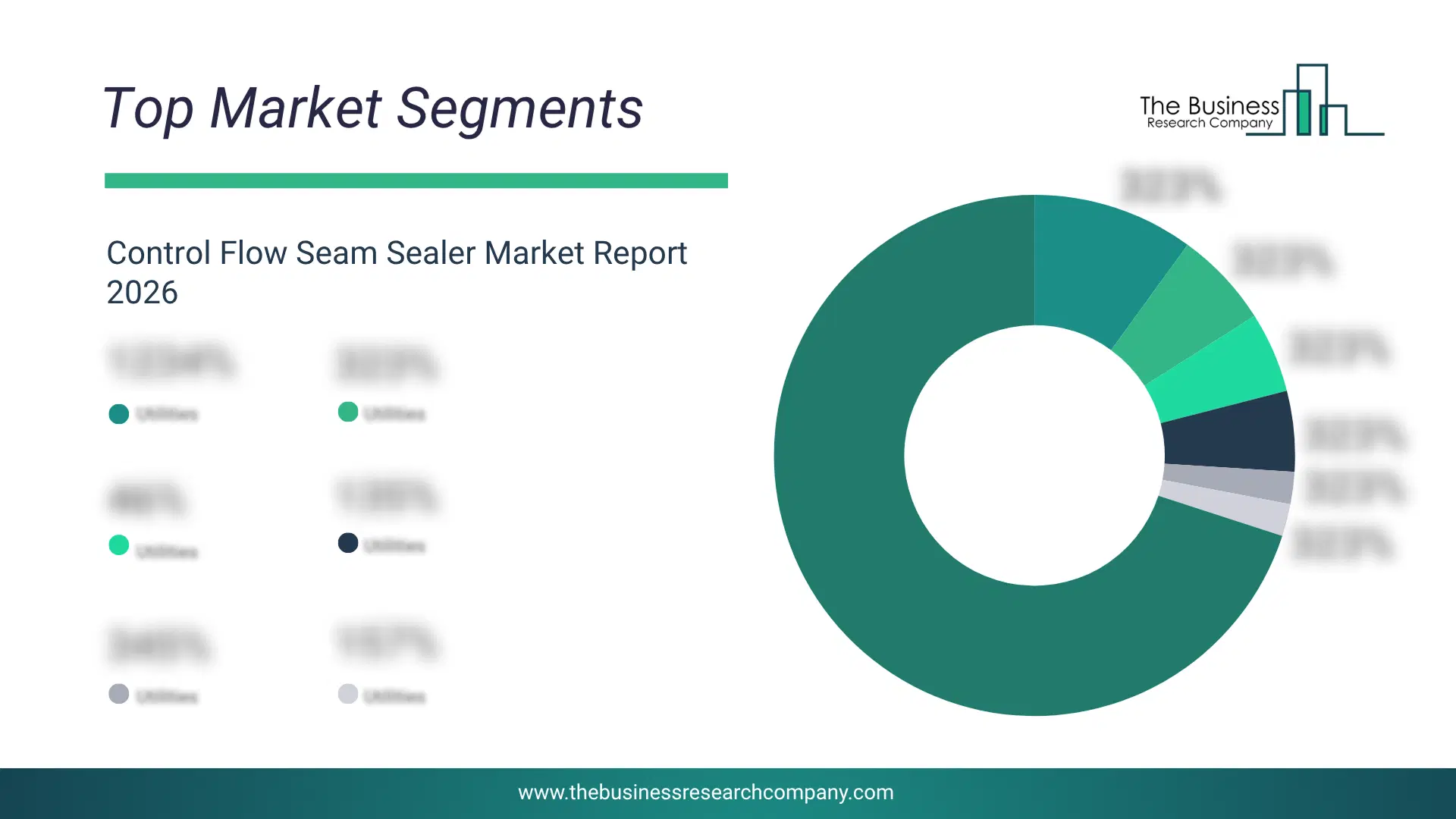
1) By Component Type: Single-Component, Two-Component 2) By Product Type: Polyurethane Seam Sealers, Silicone Seam Sealers, Acrylic Seam Sealers, Polyester Seam Sealers, Bituminous Seam Sealers 3) By Distribution Channel: Direct Sales, Online Retail, Distributors And Wholesalers, Specialty Stores, Industrial Supply Stores 4) By Application: Automotive, Aerospace, Construction, Marine, Other Applications 5) By End-User: Original Equipment Manufacturers (OEMs), Aftermarket Subsegments: 1) By Single-Component: Solvent-Based, Water-Based, Silicone-Based, Polyurethane-Based, MS Polymer-Based 2) By Two-Component: Epoxy-Based, Polyurethane-Based, Acrylic-Based, Hybrid Systems, Methacrylate-BasedWhat Are The Drivers Of The Control Flow Seam Sealer Market?
The growing production of vehicles is expected to propel the growth of the control flow seam sealer market going forward. Vehicles are transport systems built to carry passengers or cargo from one location to another. Rising urbanization is fueling higher vehicle ownership as growing city populations boost demand for transport. Control flow seam sealer strengthens vehicles by sealing seams to block moisture, air, and dust, preventing corrosion. It also enhances structural stability and reduces noise, ensuring long-term reliability and performance. For instance, in March 2024, according to the European Automobile Manufacturers Association (ACEA), a Belgium-based automobile industry group, global car manufacturing reached nearly 76 million units, reflecting a substantial 10.2% increase from the previous year. European car production also saw strong growth, reaching nearly 15 million units with a year-on-year rise of 12.6%. Therefore, the growing production of vehicles is driving the growth of the control flow seam sealer industry. The growing aerospace sector is expected to propel the growth of the control flow seam sealer market going forward. The aerospace sector involves the design, manufacturing, and innovation of aircraft, spacecraft, and supporting systems for commercial and military use. The aerospace sector is growing as rising global defense spending fuels demand for advanced technologies to strengthen military capabilities. Control flow seam sealers in aerospace ensure accurate and uniform sealing of joints, enhancing structural strength and preventing leaks. They boost durability, shield against environmental damage, and support overall aircraft safety. For instance, in January 2024, according to the International Air Transport Association (IATA), a Canada-based trade association for the world’s airlines, total air traffic in 2023, measured in revenue passenger kilometers (RPKs), rose by 36.9% compared to 2022. International traffic alone climbed by 41.6% during the same period. Therefore, the growing aerospace sector is driving the growth of the control flow seam sealer industry. The increasing demand for construction industry is expected to propel the growth of the control flow seam sealer market going forward. The construction industry involves the development and execution of infrastructure, residential, commercial, and industrial structures from planning and design to completion. The construction industry is growing due to rising urbanization, driving demand for housing and infrastructure to support expanding city populations. Control flow seam sealers enhance construction quality by sealing building joints against air, moisture, and dust. This improves energy efficiency and strengthens the structure’s durability. For instance, in February 2025, according to US Census Bureau, a US-based government statistical agency, construction spending during December 2024 was estimated at a seasonally adjusted annual rate of $2,192.2 billion, 4.3 percent above the December 2023 estimate of $2,101.3 billion. Therefore, increasing demand for construction industry is driving the growth of the control flow seam sealer industry.Key Players In The Global Control Flow Seam Sealer Market
Major companies operating in the control flow seam sealer market are Henkel AG & Co. KGaA, 3M Company, Sika AG, Dow Inc., H.B. Fuller Company, RPM International Inc., Bostik SA, PPG Industries, Inc., Axalta Coating Systems Ltd., BASF SE, Arkema S.A., SEM Products, Inc., Transtar Autobody Technologies, Inc., Evercoat, Wacker Chemie AG, Huntsman Corporation, Covestro AG, Chemence Inc., LORD Corporation, H.B. Fuller Company – Automotive Adhesives Division, Soudal Group, Momentive Performance Materials Inc.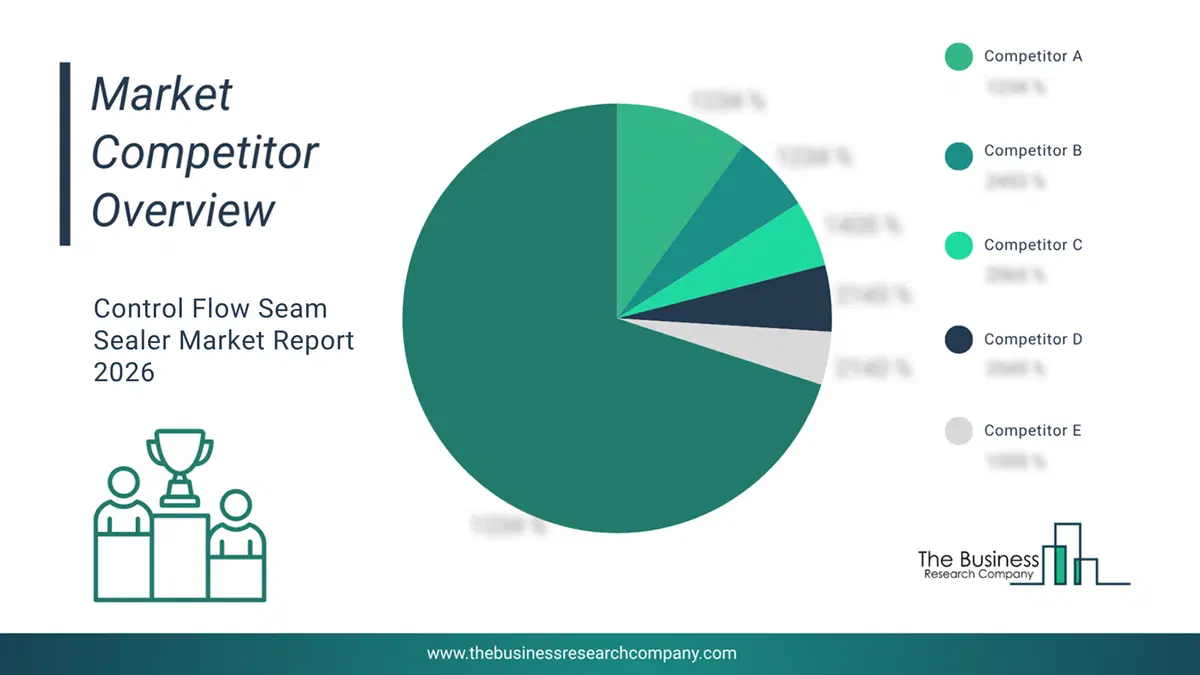
This chart is for illustrative purposes; the full report includes a detailed competitor analysis and comprehensive overview of the top 10 companies in the market.
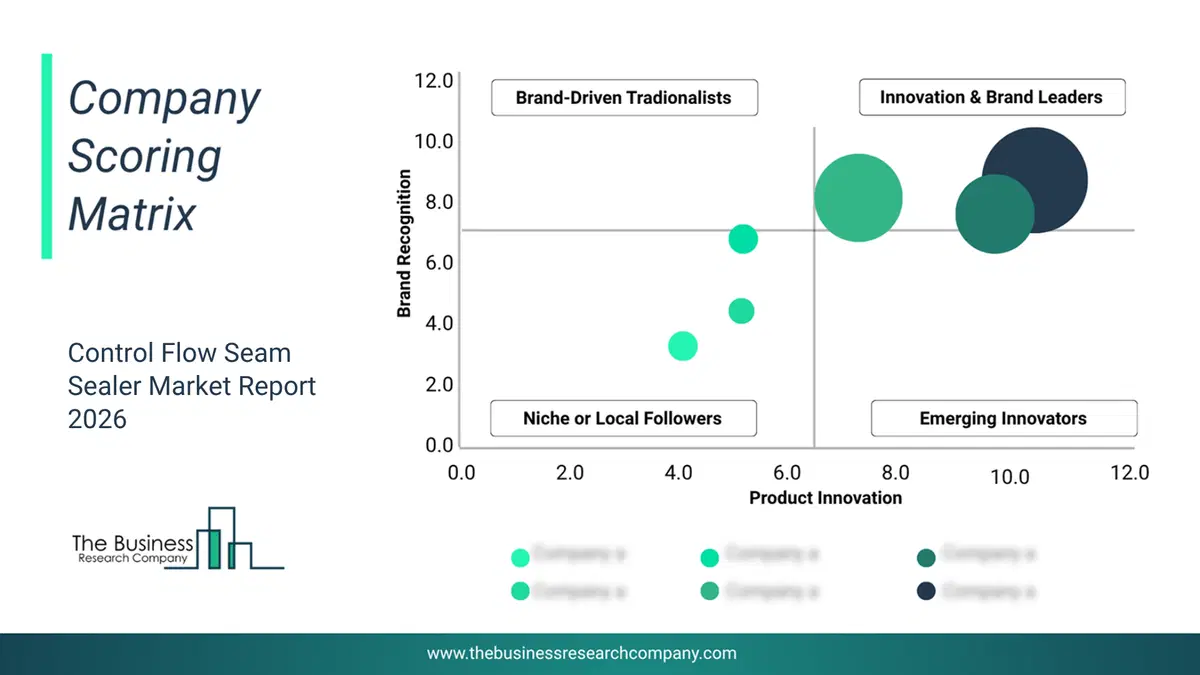
This chart maps companies by product innovation and brand strength, with bubble size indicating relative revenue, helping identify market leaders, challengers, and niche players. This is an illustrative chart; the full report provides a complete and accurate competitive analysis.
Regional Outlook
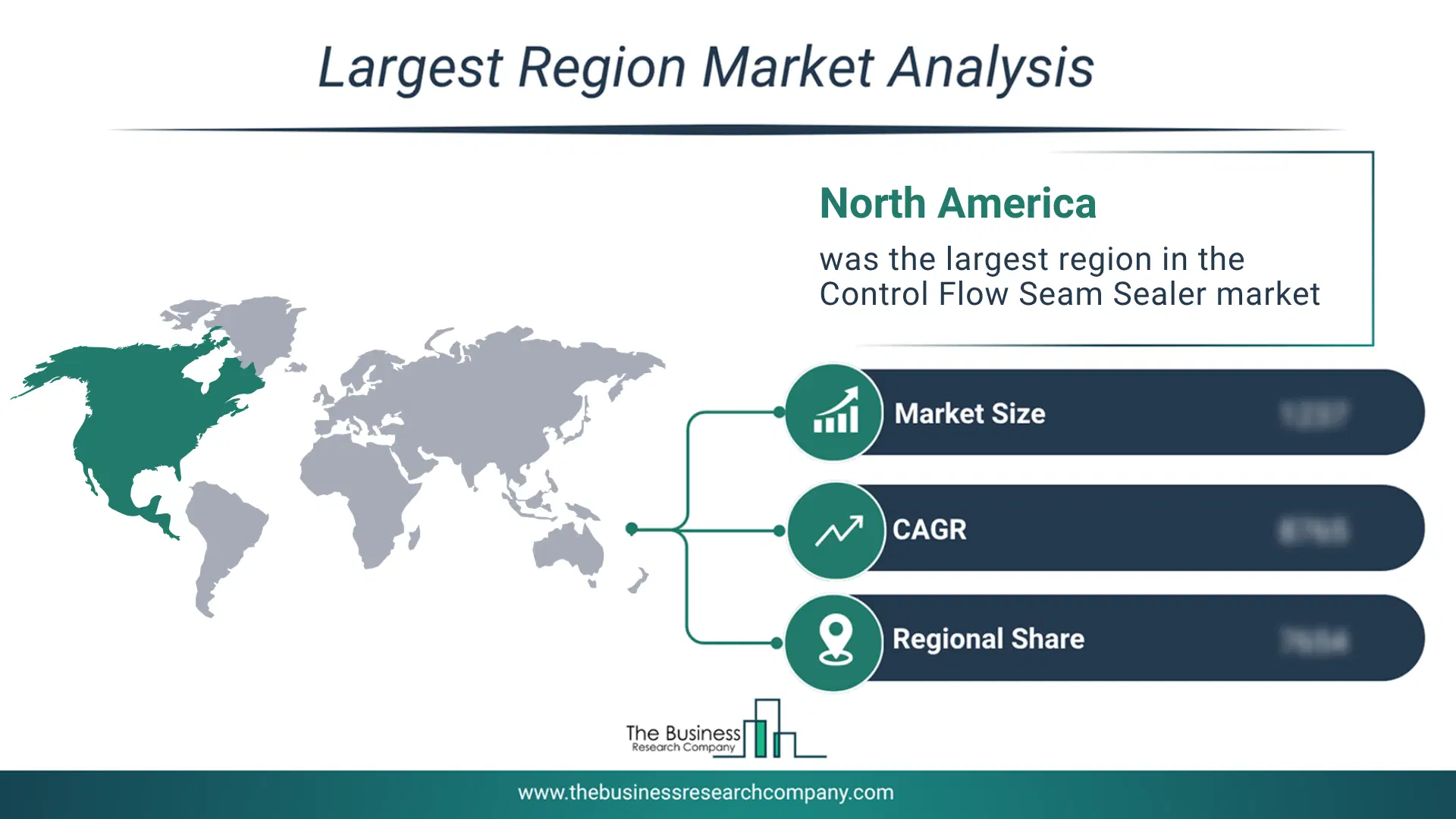
North America was the largest region in the control flow seam sealer market in 2025. The regions covered in this market report are Asia-Pacific, South East Asia, Western Europe, Eastern Europe, North America, South America, Middle East, Africa The countries covered in this market report are Australia, Brazil, China, France, Germany, India, Indonesia, Japan, Taiwan, Russia, South Korea, UK, USA, Canada, Italy, Spain.What Defines the Control Flow Seam Sealer Market?
The control flow seam sealer market consists of sales of water-based seam sealer, solvent-based seam sealer, hot melt seam sealer and pressure-sensitive seam sealer. Values in this market are ‘factory gate’ values, that is, the value of goods sold by the manufacturers or creators of the goods, whether to other entities (including downstream manufacturers, wholesalers, distributors, and retailers) or directly to end customers. The value of goods in this market includes related services sold by the creators of the goods.How is Market Value Defined and Measured?
The market value is defined as the revenues that enterprises gain from the sale of goods and/or services within the specified market and geography through sales, grants, or donations in terms of the currency (in USD unless otherwise specified). The revenues for a specified geography are consumption values that are revenues generated by organizations in the specified geography within the market, irrespective of where they are produced. It does not include revenues from resales along the supply chain, either further along the supply chain or as part of other products.
This chart presents market attractiveness based on a quantitative evaluation of growth, competition, strategic alignment, and risk, offering a clear view of opportunity areas for decision-making. This chart is for illustrative purposes; the full report contains the complete analysis.

This chart highlights the Total Addressable Market (TAM) by estimating the maximum revenue opportunity using an assumption-driven approach, supporting strategic planning and opportunity sizing across markets. The chart is illustrative; the full report provides a more comprehensive analysis.
What Key Data and Analysis Are Included in the Control Flow Seam Sealer Market Report 2026?
The control flow seam sealer market research report is one of a series of new reports from The Business Research Company that provides market statistics, including industry global market size, regional shares, competitors with the market share, detailed market segments, market trends and opportunities, and any further data you may need to thrive in the control flow seam sealer industry. The market research report delivers a complete perspective of everything you need, with an in-depth analysis of the current and future state of the industry.Control Flow Seam Sealer Market Report Forecast Analysis
| Report Attribute | Details |
|---|---|
| Market Size Value In 2026 | $1.11 billion |
| Revenue Forecast In 2030 | $1.44 billion |
| Growth Rate | CAGR of 6.7% from 2026 to 2030 |
| Base Year For Estimation | 2025 |
| Actual Estimates/Historical Data | 2020-2025 |
| Forecast Period | 2026 - 2030 |
| Market Representation | Revenue in USD Billion and CAGR from 2026 to 2030 |
| Segments Covered | Component Type, Product Type, Distribution Channel, Application, End-User |
| Regional Scope | Asia-Pacific, Western Europe, Eastern Europe, North America, South America, Middle East, Africa |
| Key Companies Profiled | Henkel AG & Co. KGaA, 3M Company, Sika AG, Dow Inc., H.B. Fuller Company, RPM International Inc., Bostik SA, PPG Industries, Inc., Axalta Coating Systems Ltd., BASF SE, Arkema S.A., SEM Products, Inc., Transtar Autobody Technologies, Inc., Evercoat, Wacker Chemie AG, Huntsman Corporation, Covestro AG, Chemence Inc., LORD Corporation, H.B. Fuller Company – Automotive Adhesives Division, Soudal Group, Momentive Performance Materials Inc. |
| Customization Scope | Request for Customization |
| Pricing And Purchase Options | Explore Purchase Options |