
Controller Area Network (CAN) Bus Device Internet Of Things (IoT) Gateways Market Report 2026
Global Outlook – By Type (2 Can Bus Ports, 4 Can Bus Ports, Other Types), By Vehicle Type (Passenger Vehicles, Commercial Vehicles, Off Highway Vehicles), By Deployment (On Premise, Cloud Based, Hybrid), By Application (Can-bus Network Diagnosis And Test, Electric Power Communication Network, Industrial Control Devices, High-speed And Large Data Communications, Other Applications), By End User (Automotive, Manufacturing, Transportation And Logistics, Energy And Utilities, Agriculture) – Market Size, Trends, Strategies, and Forecast to 2030
Controller Area Network (CAN) Bus Device Internet Of Things (IoT) Gateways Market Overview
• Controller Area Network (CAN) Bus Device Internet Of Things (IoT) Gateways market size has reached to $1.67 billion in 2025 • Expected to grow to $2.49 billion in 2030 at a compound annual growth rate (CAGR) of 8.5% • Growth Driver: Increasing Adoption Of Connected Vehicles Driving The Market Growth Due To Growing Consumer Demand For Smart Mobility • Market Trend: Next-Generation Gateways Driving Smarter Vehicle Connectivity And Advanced Real-Time Fleet Management Solutions • North America was the largest region in 2025 and Asia-Pacific is the fastest growing region.What Is Covered Under Controller Area Network (CAN) Bus Device Internet Of Things (IoT) Gateways Market?
A controller area network (CAN) bus device internet of things (IoT) gateways are hardware interface that connects devices using the controller area network (CAN) protocol to the internet of things (IoT) ecosystem. It translates can-bus signals into IP-based communication, enabling data from vehicles, machinery, or industrial equipment to be monitored and managed remotely. These gateways facilitate real-time data acquisition, control, and integration with cloud platforms or analytics systems. The main types of controller area network (CAN) bus device internet of things (IoT) gateways include 2 CAN bus ports, 4 CAN bus ports, and other types. 2 CAN bus ports provide dual-channel connectivity for vehicles and industrial systems to communicate via CAN protocols. These gateways are designed for passenger vehicles, commercial vehicles, and off-highway vehicles and can be deployed on-premise, via cloud-based solutions, or using hybrid models. They find application in CAN-bus network diagnosis and test, electric power communication networks, industrial control devices, high-speed and large data communications, and other applications, serving end users including automotive, manufacturing, transportation and logistics, energy and utilities, and agriculture.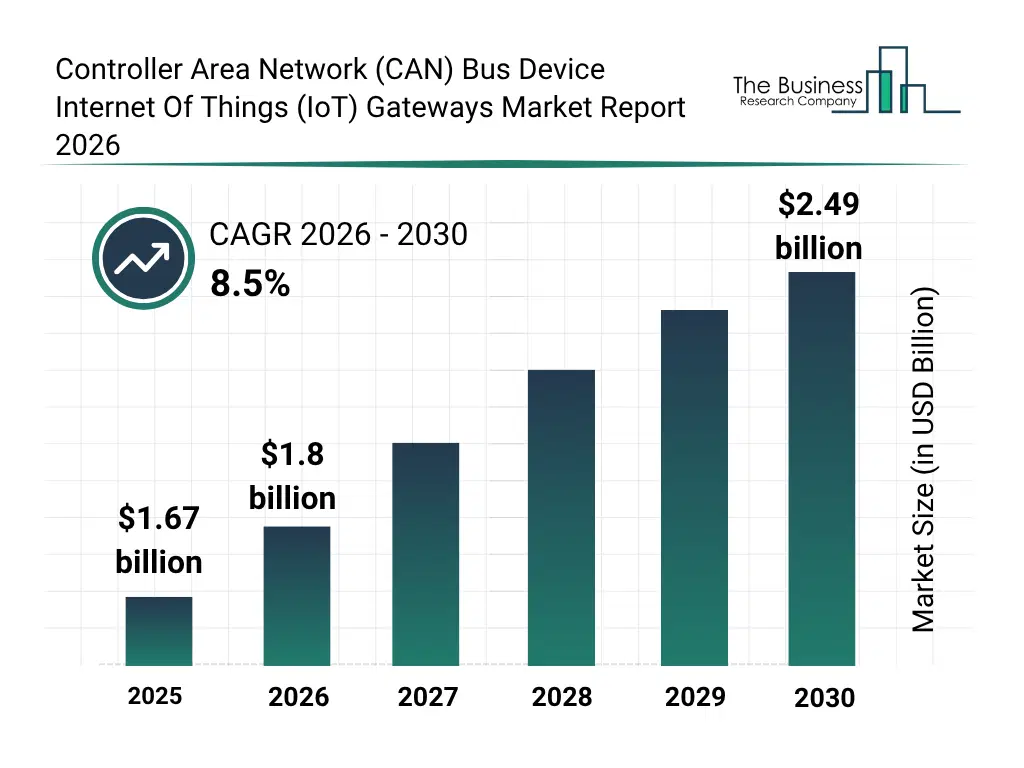
What Is The Controller Area Network (CAN) Bus Device Internet Of Things (IoT) Gateways Market Size and Share 2026?
The controller area network (CAN) bus device internet of things (IoT) gateways market size has grown strongly in recent years. It will grow from $1.67 billion in 2025 to $1.8 billion in 2026 at a compound annual growth rate (CAGR) of 8.2%. The growth in the historic period can be attributed to rising use of can-bus systems in automotive and industrial vehicles, increasing industrial automation, adoption of embedded gateway solutions, growing need for real-time monitoring, expansion of manufacturing IoT initiatives.What Is The Controller Area Network (CAN) Bus Device Internet Of Things (IoT) Gateways Market Growth Forecast?
The controller area network (CAN) bus device internet of things (IoT) gateways market size is expected to see strong growth in the next few years. It will grow to $2.49 billion in 2030 at a compound annual growth rate (CAGR) of 8.5%. The growth in the forecast period can be attributed to increasing deployment of cloud-based can-bus gateways, rising demand for electric power communication networks, growing adoption in off-highway and commercial vehicles, expansion of hybrid and connected deployment models, increasing need for predictive maintenance and analytics. Major trends in the forecast period include increasing adoption of dual and quad can-bus port gateways, rising demand for cloud-based deployment solutions, growing integration with industrial control systems, expansion of high-speed and large data communication capabilities, rising focus on vehicle network diagnostics and testing.
Global Controller Area Network (CAN) Bus Device Internet Of Things (IoT) Gateways Market Segmentation
1) By Type: 2 Can Bus Ports, 4 Can Bus Ports, Other Types 2) By Vehicle Type: Passenger Vehicles, Commercial Vehicles, Off Highway Vehicles 3) By Deployment: On Premise, Cloud Based, Hybrid 4) By Application: Can-bus Network Diagnosis And Test, Electric Power Communication Network, Industrial Control Devices, High-speed And Large Data Communications, Other Applications 5) By End User: Automotive, Manufacturing, Transportation And Logistics, Energy And Utilities, Agriculture Subsegments: 1) By 2 Can Bus Ports: Dual Channel Controller Area Network Interface Gateways, Industrial Dual Port Controller Area Network Gateways, Dual Controller Area Network Port Embedded Gateways, Dual Port Controller Area Network To Ethernet Gateways, Dual Port Controller Area Network To Cellular Gateways 2) By 4 Can Bus Ports: Quad Channel Controller Area Network Interface Gateways, Industrial Quad Port Controller Area Network Gateways, Four Port Controller Area Network To Ethernet Gateways, Four Port Controller Area Network To Cellular Gateways, Multi Network Quad Controller Area Network Gateways 3) By Other Types: Single Port Controller Area Network Gateways, Multi Port Controller Area Network Gateways, Controller Area Network To Wi Fi Gateways, Controller Area Network To Bluetooth Gateways, Controller Area Network To Serial Communication Gateways, Controller Area Network To Cloud Enabled GatewaysWhat Is The Driver Of The Controller Area Network (CAN) Bus Device Internet Of Things (IoT) Gateways Market?
The increasing adoption of connected vehicles is expected to propel the growth of the controller area network (CAN) bus device internet of things (IoT) gateways market going forward. Connected vehicles are automobiles equipped with internet connectivity and wireless communication capabilities that enable them to exchange data with external systems and other vehicles. The adoption of connected vehicles is rising due to growing consumer demand for enhanced safety features, as modern drivers increasingly prioritize advanced driver assistance systems and real-time traffic information to improve road safety and reduce accidents. CAN-bus device IoT gateways enable connected vehicles by seamlessly bridging in-vehicle controller area network (CAN) data with cloud-based platforms, allowing real-time monitoring, predictive maintenance, remote diagnostics, and vehicle-to-everything (V2X) communication, transforming raw automotive signals into actionable insights that enhance safety, efficiency, and user experience. For instance, according to the ANNUAL REPORT 2024 by 5G Automotive Association (5GAA), a Germany-based cross-industry organization, the number of connected vehicles has grown substantially, with over 300 million vehicles worldwide now featuring advanced connectivity. Therefore, the increasing adoption of connected vehicles is driving the growth of the controller area network (CAN) bus device internet of things (IoT) gateways industry.Key Players In The Global Controller Area Network (CAN) Bus Device Internet Of Things (IoT) Gateways Market
Major companies operating in the controller area network (CAN) bus device internet of things (iot) gateways market are Advantech Co. Ltd., Kontron AG, HMS Industrial Networks AB, ADLINK Technology Inc., Moxa Inc., CalAmp Corp., NEXCOM International Co. Ltd., Lantronix Inc., Hilscher Gesellschaft für Systemautomation mbH, Dewesoft d.o.o., 3onedata Co. Ltd., Actia Group, ICP DAS Co. Ltd., Jinan USR IOT Technology Co. Ltd., Minew Technologies Co. Ltd., esd electronics gmbh, Bueno Electric Co. Ltd., proconX Inc., TITAN Electronics Ltd., and Queclink Wireless Solutions Co. Ltd.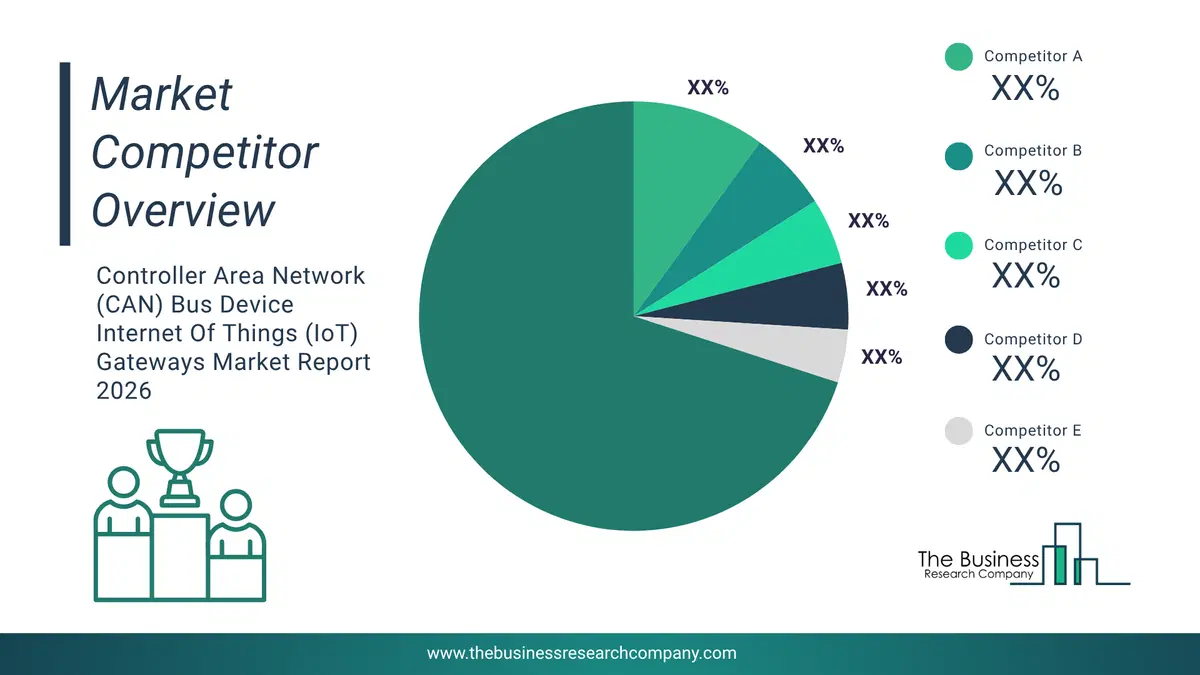
This chart is for illustrative purposes; the full report includes a detailed competitor analysis and comprehensive overview of the top 10 companies in the market.
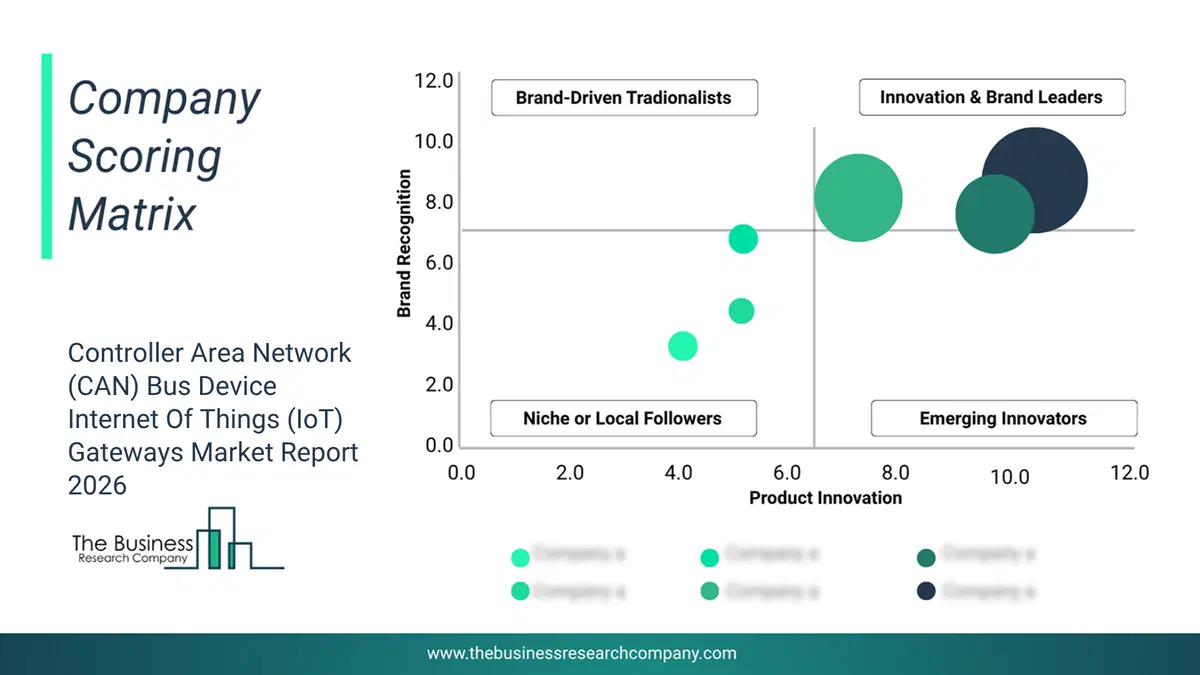
This chart maps companies by product innovation and brand strength, with bubble size indicating relative revenue, helping identify market leaders, challengers, and niche players. This is an illustrative chart; the full report provides a complete and accurate competitive analysis.
Global Controller Area Network (CAN) Bus Device Internet Of Things (IoT) Gateways Market Trends and Insights
Major companies operating in the controller area network (CAN) bus device Internet of Things (IoT) gateways market are focusing on developing advanced vehicle IoT gateway solutions to enable real-time data monitoring, seamless vehicle connectivity, and intelligent fleet management. These gateways are designed to interface directly with in-vehicle CAN bus systems, allowing continuous data acquisition from electronic control units (ECUs), sensors, and control modules, and securely transmitting this data to cloud platforms for analysis and decision-making. Advanced vehicle IoT gateways support multiple communication protocols and connectivity options, enabling remote diagnostics, predictive maintenance, asset tracking, and efficient fleet operations. For instance, in July 2024, Bivocom Co., Ltd., a China-based IoT technology company, launched the VG465 Vehicle IoT Gateway, an advanced gateway designed to enhance in-vehicle connectivity and data management. The VG465 supports CAN bus communication for vehicle data collection and features dual-SIM 4G connectivity, Wi-Fi 6, Bluetooth, USB 3.0/2.0 ports, and built-in GPS for real-time vehicle tracking. It is equipped with 8GB RAM and 64GB Flash memory to support advanced edge applications, along with a micro-SD slot for expandable storage.What Are Latest Mergers And Acquisitions In The Controller Area Network (CAN) Bus Device Internet Of Things (IoT) Gateways Market?
In April 2024, HMS Networks AB, a Sweden based industrial communication technology company, acquired Red Lion Controls Inc. for $345 million. With this acquisition, HMS Networks expanded its industrial automation and connectivity product portfolio and strengthened its global market presence, particularly in North America and Europe, enabling broader cross selling and solutions integration. Red Lion Controls Inc. is a US-based manufacturing company that specializes in providing controller area network (CAN) bus device internet of things (IoT) gateways and industrial controllers.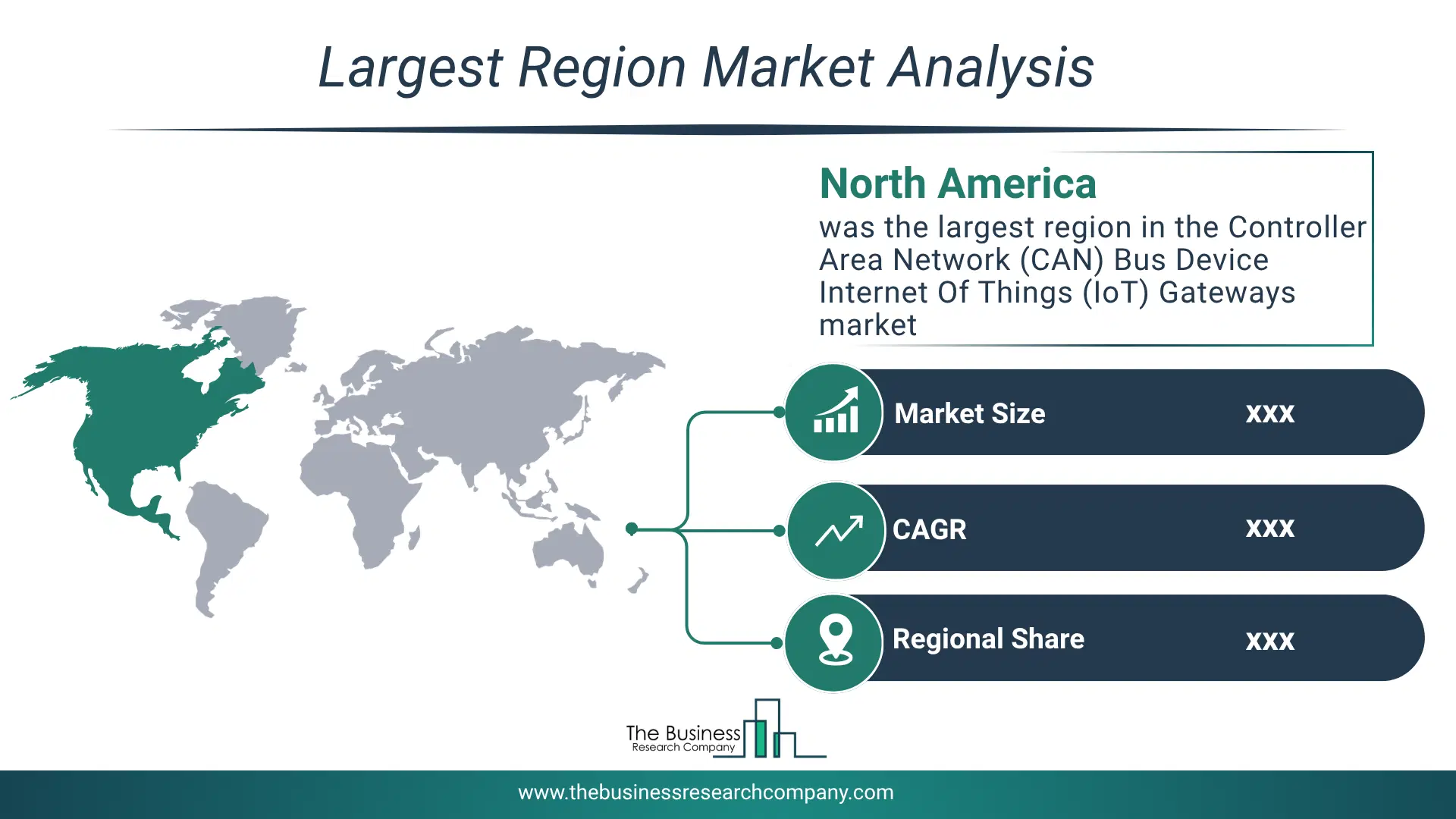
Regional Insights
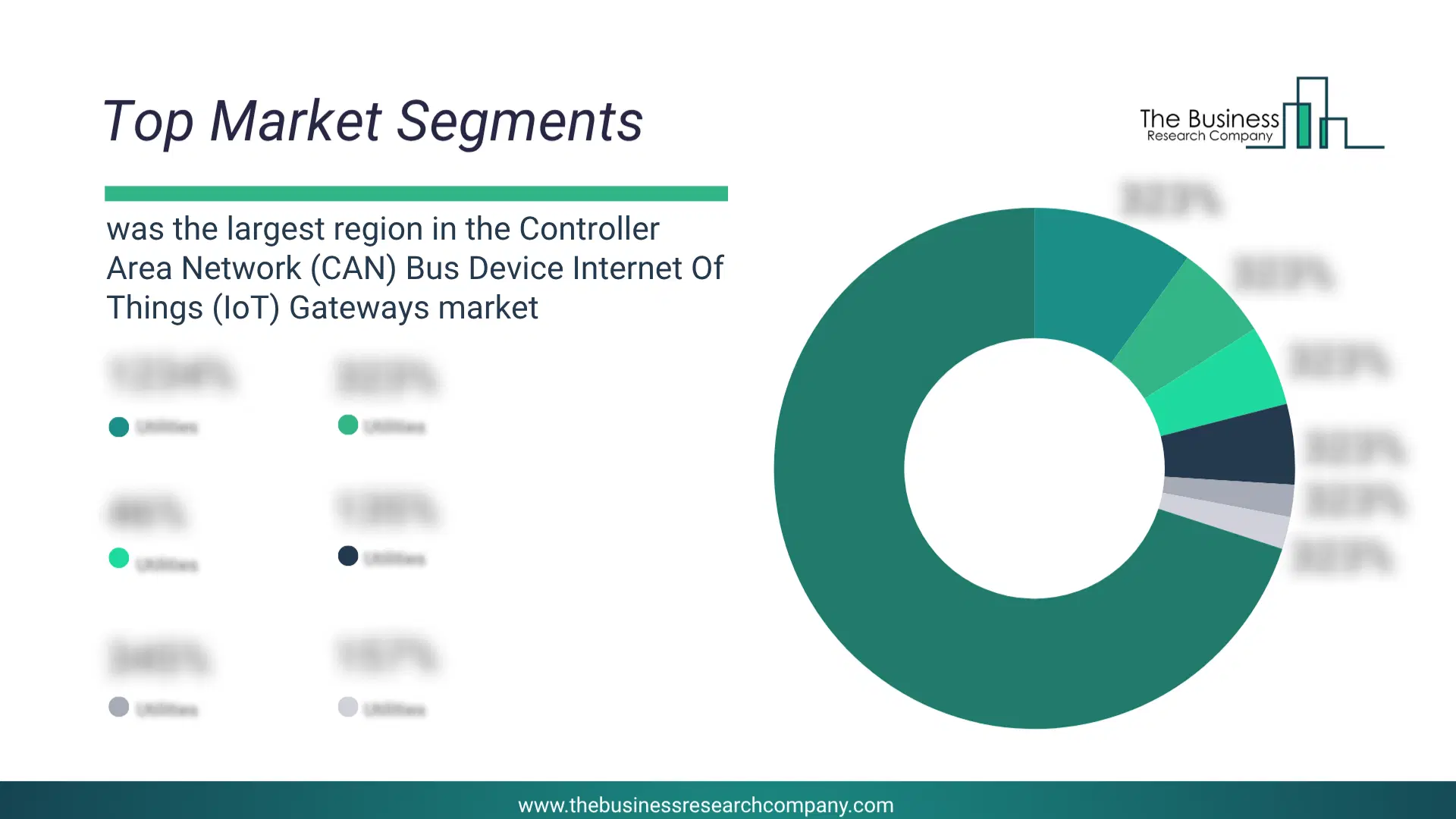
North America was the largest region in the controller area network (CAN) bus device internet of things (IoT) gateways market in 2025. Asia-Pacific is expected to be the fastest-growing region in the forecast period. The regions covered in this market report are Asia-Pacific, South East Asia, Western Europe, Eastern Europe, North America, South America, Middle East, Africa. The countries covered in this market report are Australia, Brazil, China, France, Germany, India, Indonesia, Japan, Taiwan, Russia, South Korea, UK, USA, Canada, Italy, Spain.What Defines the Controller Area Network (CAN) Bus Device Internet Of Things (IoT) Gateways Market?
The controller area network (CAN) bus device internet of things (IoT) gateways market consists of sales of embedded modules and gateways, cellular converters, protocol translators, network expansion devices, software platforms and middleware, CAN-enabled sensors and actuators. Values in this market are ‘factory gate’ values, that is the value of goods sold by the manufacturers or creators of the goods, whether to other entities (including downstream manufacturers, wholesalers, distributors and retailers) or directly to end customers. The value of goods in this market includes related services sold by the creators of the goods.How is Market Value Defined and Measured?
The market value is defined as the revenues that enterprises gain from the sale of goods and/or services within the specified market and geography through sales, grants, or donations in terms of the currency (in USD unless otherwise specified). The revenues for a specified geography are consumption values that are revenues generated by organizations in the specified geography within the market, irrespective of where they are produced. It does not include revenues from resales along the supply chain, either further along the supply chain or as part of other products.
This chart presents market attractiveness based on a quantitative evaluation of growth, competition, strategic alignment, and risk, offering a clear view of opportunity areas for decision-making. This chart is for illustrative purposes; the full report contains the complete analysis.

This chart highlights the Total Addressable Market (TAM) by estimating the maximum revenue opportunity using an assumption-driven approach, supporting strategic planning and opportunity sizing across markets. The chart is illustrative; the full report provides a more comprehensive analysis.
What Key Data And Analysis Are Included In The Controller Area Network (CAN) Bus Device Internet Of Things (IoT) Gateways Market Report 2026?
The controller area network (can) bus device internet of things (iot) gateways market research report is one of a series of new reports from The Business Research Company that provides market statistics, including industry global market size, regional shares, competitors with the market share, detailed market segments, market trends and opportunities, and any further data you may need to thrive in the controller area network (can) bus device internet of things (iot) gateways industry. The market research report delivers a complete perspective of everything you need, with an in-depth analysis of the current and future state of the industry.Controller Area Network (CAN) Bus Device Internet Of Things (IoT) Gateways Market Report Forecast Analysis
| Report Attribute | Details |
|---|---|
| Market Size Value In 2026 | $1.8 billion |
| Revenue Forecast In 2030 | $2.49 billion |
| Growth Rate | CAGR of 8.2% from 2026 to 2030 |
| Base Year For Estimation | 2025 |
| Actual Estimates/Historical Data | 2020-2025 |
| Forecast Period | 2026 - 2030 |
| Market Representation | Revenue in USD Billion and CAGR from 2026 to 2030 |
| Segments Covered | Type, Vehicle Type, Deployment, Application, End User |
| Regional Scope | Asia-Pacific, Western Europe, Eastern Europe, North America, South America, Middle East, Africa |
| Country Scope | The countries covered in the report are Australia, Brazil, China, France, Germany, India, Indonesia, Japan, Taiwan, Russia, South Korea, UK, USA, Canada, Italy, Spain. |
| Key Companies Profiled | Advantech Co. Ltd., Kontron AG, HMS Industrial Networks AB, ADLINK Technology Inc., Moxa Inc., CalAmp Corp., NEXCOM International Co. Ltd., Lantronix Inc., Hilscher Gesellschaft für Systemautomation mbH, Dewesoft d.o.o., 3onedata Co. Ltd., Actia Group, ICP DAS Co. Ltd., Jinan USR IOT Technology Co. Ltd., Minew Technologies Co. Ltd., esd electronics gmbh, Bueno Electric Co. Ltd., proconX Inc., TITAN Electronics Ltd., and Queclink Wireless Solutions Co. Ltd. |
| Customization Scope | Request for Customization |
| Pricing And Purchase Options | Explore Purchase Options |