
Cooking Robot Market Report 2026
Global Outlook – By Robot Type (Fixed Kitchen Cooking Robots, Robotic Food Preparation And Assembly Systems, Beverage Preparation Robots, Mobile And Modular Cooking Robots), By Application (Fast Food And Quick-Service Restaurants (QSRs), Beverage Preparation, Protein And Meat Cooking, Bakery And Dessert Preparation, Multi-Cuisine Meal Preparation), By End-User (Commercial, Residential) – Market Size, Trends, Strategies, and Forecast to 2030
Cooking Robot Market Overview
• Cooking Robot market size has reached to $4.25 billion in 2025 • Expected to grow to $7.86 billion in 2030 at a compound annual growth rate (CAGR) of 13.1% • Growth Driver: Expanding Commercial Food Service Industry Drives Growth In Cooking Robot Market • Market Trend: AI-Driven Robotic Cooking Systems Gaining Momentum Through Advanced Automation And Convenience • North America was the largest region in 2025 and Asia-Pacific is the fastest growing region.What Is Covered Under Cooking Robot Market?
A cooking robot refers to an automated device designed to assist in or perform cooking tasks with precision and efficiency. They are equipped with advanced technologies to create consistent and high-quality meals. These robots are used in both residential and commercial settings, offering benefits such as increased productivity, reduced labor costs, and enhanced food safety. The main types of cooking robots include cobots, selective compliance assembly robot arms (SCARA), delta robots, and others. Cobots are designed to work alongside humans in kitchen environments, assisting with tasks such as food preparation and assembly to improve productivity and flexibility in commercial kitchens by automating repetitive tasks while ensuring safety and interaction with kitchen staff. The applications include beverage making, meat processing, fast food preparation, and others, and end users include commercial and residential.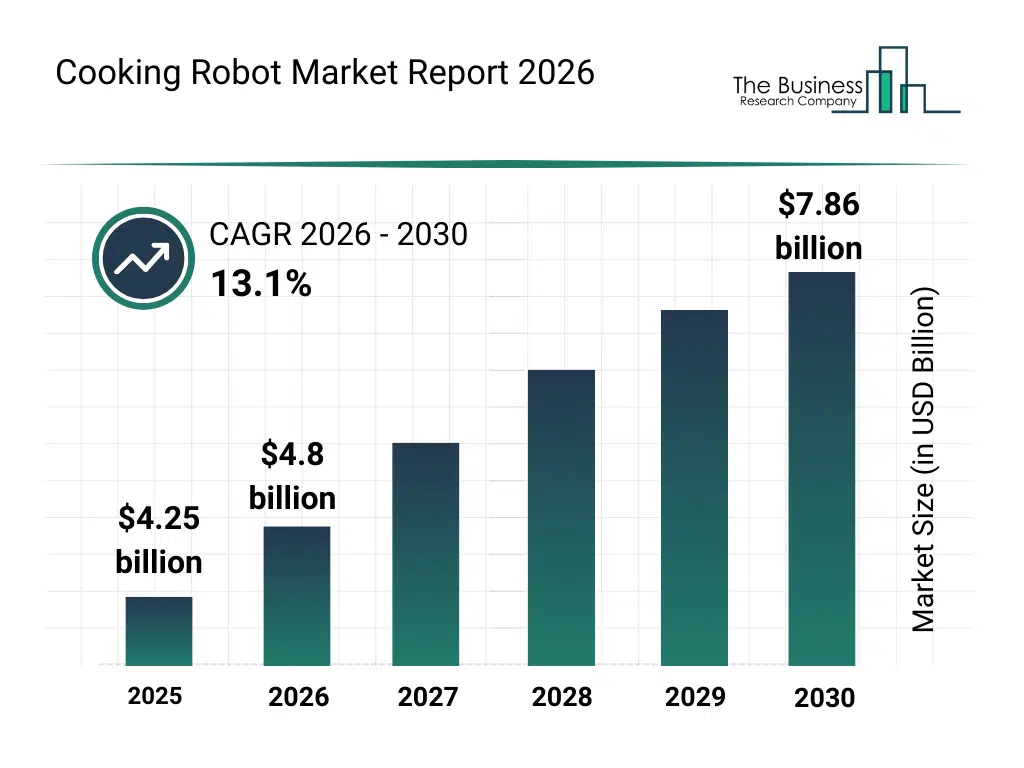
What Is The Cooking Robot Market Size and Share 2026?
The cooking robot market size has grown rapidly in recent years. It will grow from $4.25 billion in 2025 to $4.8 billion in 2026 at a compound annual growth rate (CAGR) of 12.9%. The growth in the historic period can be attributed to expansion of quick service restaurant chains, rising labor shortages in foodservice, increasing demand for standardized food quality, growth of cloud kitchens, advancements in robotic hardware.What Is The Cooking Robot Market Growth Forecast?
The cooking robot market size is expected to see rapid growth in the next few years. It will grow to $7.86 billion in 2030 at a compound annual growth rate (CAGR) of 13.1%. The growth in the forecast period can be attributed to increasing adoption of robotic kitchens in households, rising investments in smart appliances, expansion of automated food preparation in hospitals and institutions, growing focus on contactless cooking solutions, increasing AI integration in food robotics. Major trends in the forecast period include increasing adoption of fully automated cooking processes, rising integration of AI-based recipe optimization, growing demand for consistent food quality automation, expansion of robotic kitchens in commercial settings, enhanced focus on food safety and hygiene.Tariff Impact On Cooking Robot Market
Tariffs are impacting the cooking robot market by increasing costs of imported robotic arms, sensors, control processors, heating elements, and precision actuators. Commercial foodservice operators in North America, Europe, and parts of Asia-Pacific are most affected due to reliance on imported robotics hardware and electronics. These tariffs are raising equipment procurement costs and slowing large-scale deployment in restaurants. However, they are also driving local assembly, regional partnerships, and innovation in cost-efficient robotic cooking platforms tailored to domestic markets.
Global Cooking Robot Market Segmentation
1) By Robot Type: Fixed Kitchen Cooking Robots, Robotic Food Preparation And Assembly Systems, Beverage Preparation Robots, Mobile And Modular Cooking Robots 2) By Application: Fast Food And Quick-Service Restaurants (QSRs), Beverage Preparation, Protein And Meat Cooking, Bakery And Dessert Preparation, Multi-Cuisine Meal Preparation 3) By End-User: Commercial, Residential Subsegments: 1) By Fixed Kitchen Cooking Robots: Robotic Frying Systems, Robotic Grilling Systems, Robotic Stir-Frying And Sautéing Systems 2) By Robotic Food Preparation And Assembly Systems: Ingredient Dispensing Robots, Mixing And Portioning Robots, Assembly & Plating Robots 3) By Beverage Preparation Robots: Robotic Coffee And Tea Machines, Robotic Bartenders And Drink Mixing Robots 4) By Mobile And Modular Cooking Robots: Mobile Cooking Stations, Modular Multi-Cuisine Cooking RobotsWhat Is The Driver Of The Cooking Robot Market?
The expanding commercial food service industry is expected to propel the growth of the cooking robot market going forward. The commercial food service industry refers to businesses and establishments that prepare and serve food and beverages to customers for profit. The expanding commercial food service industry is driven by the popularity of fast-casual restaurants, which offer higher-quality food at lower prices than full-service restaurants. Additionally, higher disposable incomes and innovations such as online ordering, food delivery apps, and digital payments enhance customer convenience and fuel industry growth. Cooking robots simplify and streamline operations in the commercial food service industry, helping businesses control costs, maintain consistency, and ensure high standards of food safety and quality. For instance, in June 2024, according to the US Bureau of Labor Statistics, a US-based federal fact-finding agency, the number of establishments in food services and drinking places in private industry for the 4th quarter of 2023 was 711,159, an increase of 4.28% compared to 695,817 during the 1st quarter of 2023. Therefore, the expanding commercial food service industry will drive the cooking robot industry.Key Players In The Global Cooking Robot Market
Major companies operating in the cooking robot market are Moley Robotics Ltd., Miso Robotics Inc., Nala Robotics Inc., Chowbotics Ltd., Picnic Works, Inc., SavorEat Ltd., Dexai Robotics Inc., Briggo, Inc., Truebird Inc., Karakuri Ltd., Kitchen Robotics Ltd., Chefee Robotics Inc., Bear Robotics Inc., Spyce Foods, LLC, Creator Global Inc., Cafe X Technologies, Inc., Makr Shakr S.r.l., Rozum Robotics Food Solutions, Milkit Ltd., Sally Robotics Inc., Coffee Bar Robotics, Euphotic Labs Pvt. Ltd., Wobot AI Pvt. Ltd., Soft Robotics Kitchen Systems, RoboChef Systems Inc.
This chart is for illustrative purposes; the full report includes a detailed competitor analysis and comprehensive overview of the top 10 companies in the market.
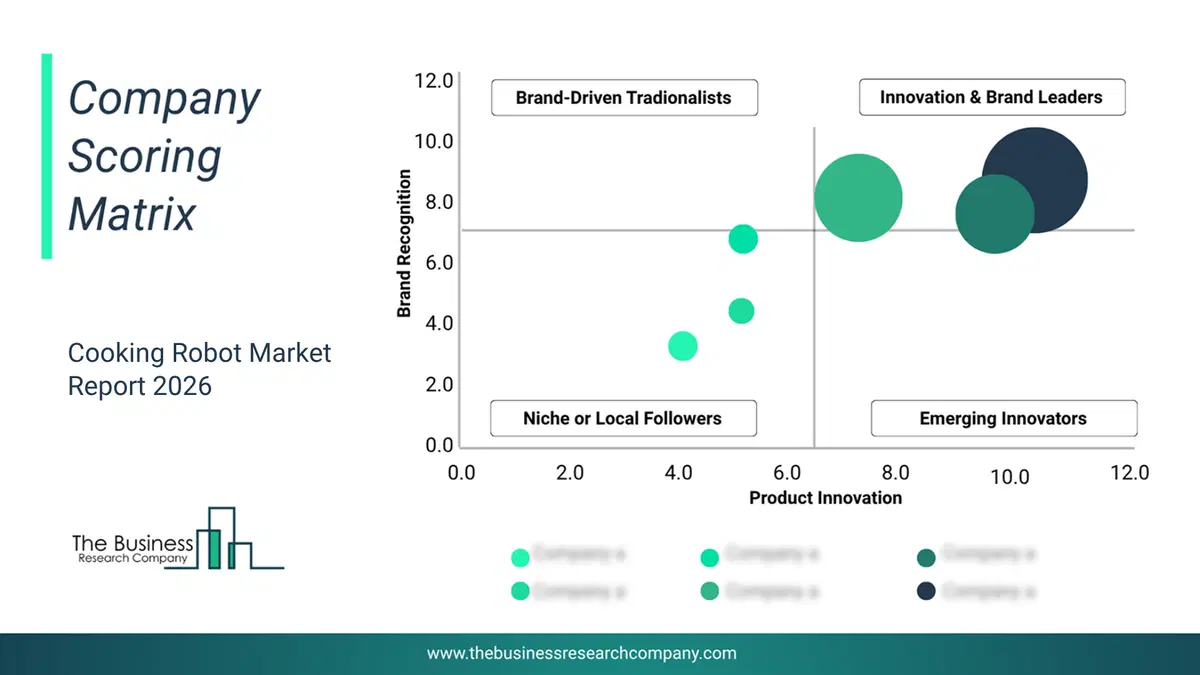
This chart maps companies by product innovation and brand strength, with bubble size indicating relative revenue, helping identify market leaders, challengers, and niche players. This is an illustrative chart; the full report provides a complete and accurate competitive analysis.
Global Cooking Robot Market Trends and Insights
Major companies operating in the cooking‑robot market are focusing on technological advancements, such as AI‑powered countertop robotic chefs, to meet the rising demand for convenience, time‑saving meal preparation, and consistent quality in both home and commercial kitchens. AI‑powered countertop robotic chefs are compact kitchen appliances that use computer vision, sensors, and recipe automation algorithms to replicate cooking processes such as stirring, heating, and ingredient addition thereby reducing manual labor compared to traditional cooking on stoves or with simple appliances. For instance, in May 2025, Posha, a US-based kitchen‑robotics startup formerly known as Nymble, launched its flagship product Posha kitchen robot, an innovative countertop cooking robot designed for home kitchens. Posha’s robot integrates a camera, ingredient hoppers, a spice carousel, an induction cooktop and automated stirring and heating controls to cook a wide variety of meals once users load prepped ingredients users simply pick a recipe, load items, and the robot dispenses ingredients, adjusts heat, stirs, and delivers a cooked meal with minimal supervision. Its advantages over traditional cooking include automated temperature control, precise timing, reduced manual involvement, and convenience cutting down cooking time dramatically while enabling consistent results. This trend reflects broader market drivers such as busy lifestyles, increasing demand for convenience, and growth in smart‑kitchen adoption.What Are Latest Mergers And Acquisitions In The Cooking Robot Market?
In August 2023, Circus SE, a Germany-based food-tech company, acquired Aitme GmbH for an undisclosed amount. This acquisition enables Circus to leverage advanced kitchen robotics technology, integrating it into its micro-kitchen hubs. Aitme's cooking robot is renowned for its capability of efficiently and precisely executing complex preparation tasks, thereby reducing cooking durations and minimizing food waste. Aitme GmbH is a Germany-based robotic manufacturer engaged in the hospitality cooking robot business.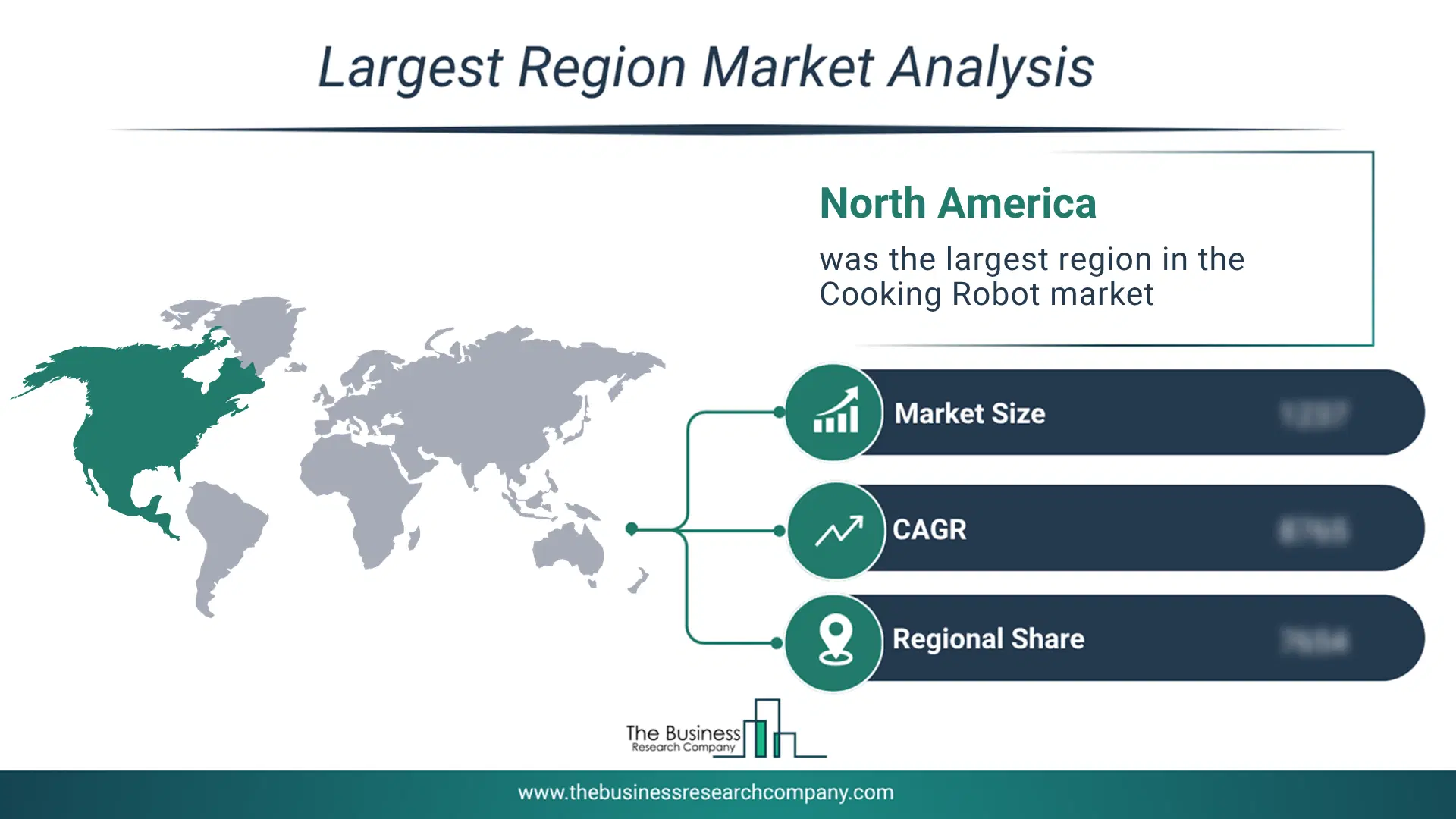
Regional Outlook
North America was the largest region in the cooking robot market in 2025. Asia-Pacific is expected to be the fastest-growing region in the forecast period. The regions covered in this market report are Asia-Pacific, South East Asia, Western Europe, Eastern Europe, North America, South America, Middle East, Africa The countries covered in this market report are Australia, Brazil, China, France, Germany, India, Indonesia, Japan, Taiwan, Russia, South Korea, UK, USA, Canada, Italy, Spain.What Defines the Cooking Robot Market?
The cooking robot market consists of revenues earned by entities providing services such as automated meal preparation, precision cooking, ingredient handling, food plating, and kitchen assistance. The market value includes the value of related goods sold by the service provider or included within the service offering. A cooking robot market also includes sales of products such as robotic kitchen appliances, automated cooking systems, food preparation robots, robotic arms for cooking, and AI-powered kitchen assistants. Values in this market are ‘factory gate’ values, that is, the value of goods sold by the manufacturers or creators of the goods, whether to other entities (including downstream manufacturers, wholesalers, distributors, and retailers) or directly to end customers. The value of goods in this market includes related services sold by the creators of the goods.How is Market Value Defined and Measured?
The market value is defined as the revenues that enterprises gain from the sale of goods and/or services within the specified market and geography through sales, grants, or donations in terms of the currency (in USD unless otherwise specified). The revenues for a specified geography are consumption values that are revenues generated by organizations in the specified geography within the market, irrespective of where they are produced. It does not include revenues from resales along the supply chain, either further along the supply chain or as part of other products.
This chart presents market attractiveness based on a quantitative evaluation of growth, competition, strategic alignment, and risk, offering a clear view of opportunity areas for decision-making. This chart is for illustrative purposes; the full report contains the complete analysis.

This chart highlights the Total Addressable Market (TAM) by estimating the maximum revenue opportunity using an assumption-driven approach, supporting strategic planning and opportunity sizing across markets. The chart is illustrative; the full report provides a more comprehensive analysis.
What Key Data and Analysis Are Included in the Cooking Robot Market Report 2026?
The cooking robot market research report is one of a series of new reports from The Business Research Company that provides market statistics, including industry global market size, regional shares, competitors with the market share, detailed market segments, market trends and opportunities, and any further data you may need to thrive in the cooking robot industry. The market research report delivers a complete perspective of everything you need, with an in-depth analysis of the current and future state of the industry.Cooking Robot Market Report Forecast Analysis
| Report Attribute | Details |
|---|---|
| Market Size Value In 2026 | $4.8 billion |
| Revenue Forecast In 2030 | $7.86 billion |
| Growth Rate | CAGR of 13.1% from 2026 to 2030 |
| Base Year For Estimation | 2025 |
| Actual Estimates/Historical Data | 2020-2025 |
| Forecast Period | 2026 - 2030 |
| Market Representation | Revenue in USD Billion and CAGR from 2026 to 2030 |
| Segments Covered | Robot Type, Application, End-User |
| Regional Scope | Asia-Pacific, Western Europe, Eastern Europe, North America, South America, Middle East, Africa |
| Key Companies Profiled | Moley Robotics Ltd., Miso Robotics Inc., Nala Robotics Inc., Chowbotics Ltd., Picnic Works, Inc., SavorEat Ltd., Dexai Robotics Inc., Briggo, Inc., Truebird Inc., Karakuri Ltd., Kitchen Robotics Ltd., Chefee Robotics Inc., Bear Robotics Inc., Spyce Foods, LLC, Creator Global Inc., Cafe X Technologies, Inc., Makr Shakr S.r.l., Rozum Robotics Food Solutions, Milkit Ltd., Sally Robotics Inc., Coffee Bar Robotics, Euphotic Labs Pvt. Ltd., Wobot AI Pvt. Ltd., Soft Robotics Kitchen Systems, RoboChef Systems Inc. |
| Customization Scope | Request for Customization |
| Pricing And Purchase Options | Explore Purchase Options |