
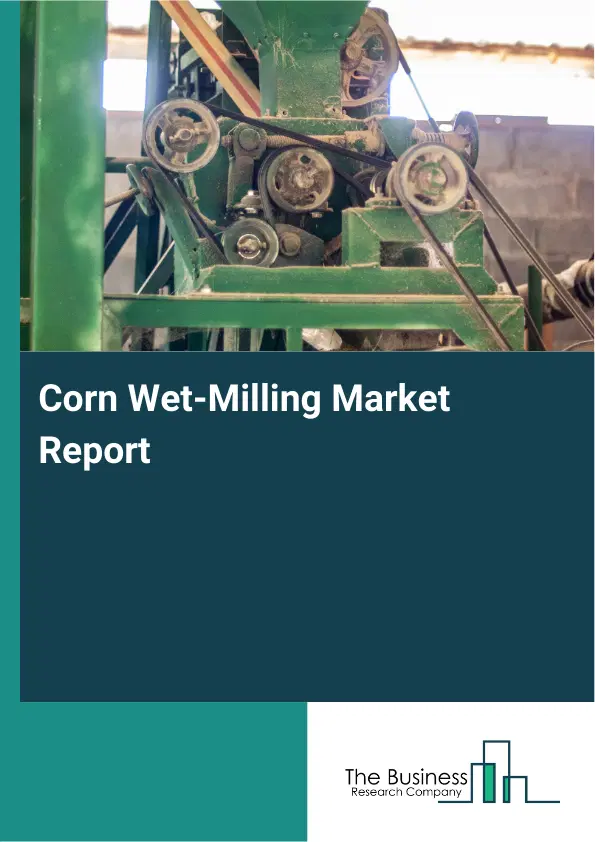
Corn Wet-Milling Market Report 2026
Global Outlook – By Source (Dent Corn, Waxy Corn), By Equipment (Milling Equipment, Steeping Equipment, Centrifuge Systems, Washing And Filtration Systems, Other Equipment), By End-product (Starch, Sweetener, Corn Gluten Meal And Gluten Feed, Other End-Products) – Market Size, Trends, Strategies, and Forecast to 2030
Corn Wet-Milling Market Overview
• Corn Wet-Milling market size has reached to $83.64 billion in 2025 • Expected to grow to $108.85 billion in 2030 at a compound annual growth rate (CAGR) of 5.4% • Growth Driver: Growing Demand For Corn-Based Products Drives Market Expansion • Market Trend: Advancements in Clean-Label Functional Starches in the Corn Wet-Milling Industry • North America was the largest region and fastest growing region.What Is Covered Under Corn Wet-Milling Market?
Corn wet-milling is a process of physical separation of corn into proteins, starches, oil, and fiber using water and specialized machinery. In this process, the corn kernels are submerged in steep tanks, which are big tanks filled with diluted aqueous sulfur dioxide solution. The kernel is then softened and treated to remove the germ, which is then processed again to remove the highly valuable maize oil. The main sources of corn wet-milling are dent corn and waxy corn. Dent corn refers to a kind of corn which has kernels that ripen and has a dent at the top. The dent corn is used as the base ingredient for cornmeal flour, tortillas, corn chips, and taco shells. The various equipment used in corn wet milling is milling equipment, steeping equipment, centrifuge systems, washing and filtration systems, and others. The end-products include starch, sweetener, ethanol, corn gluten meal and gluten feed, and others.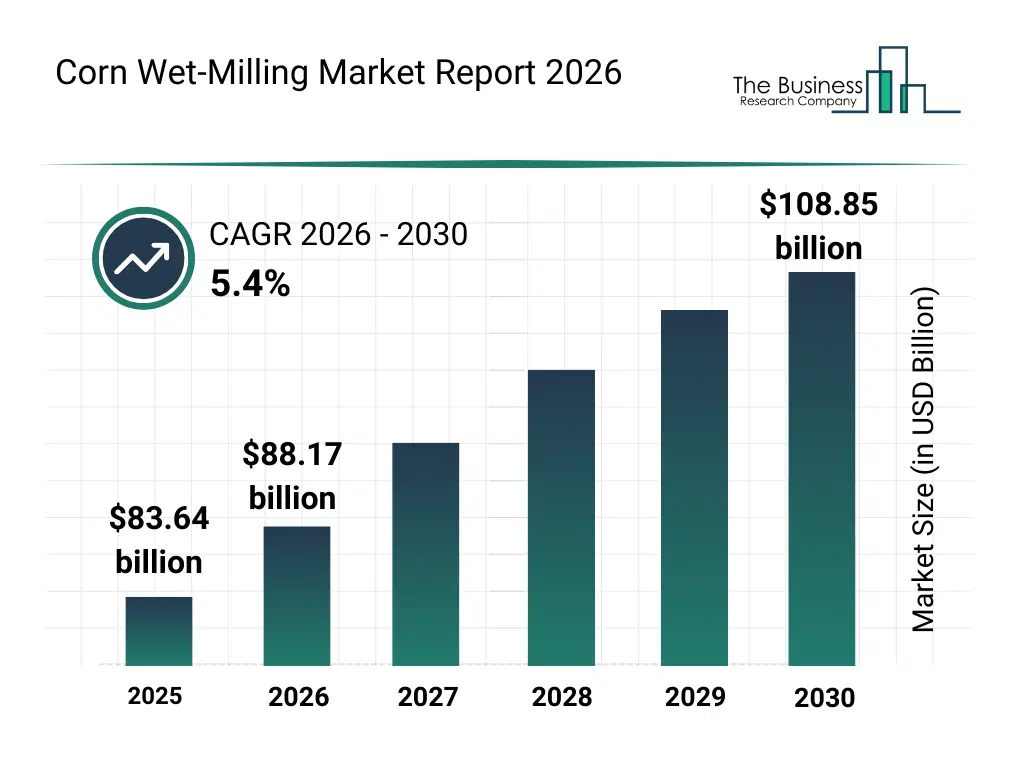
What Is The Corn Wet-Milling Market Size and Share 2026?
The corn wet-milling market size has grown strongly in recent years. It will grow from $83.64 billion in 2025 to $88.17 billion in 2026 at a compound annual growth rate (CAGR) of 5.4%. The growth in the historic period can be attributed to expansion of food and beverage processing industries, growth in animal feed production, rising demand for corn-derived sweeteners, increased ethanol blending mandates, availability of large-scale wet-milling facilities.What Is The Corn Wet-Milling Market Growth Forecast?
The corn wet-milling market size is expected to see strong growth in the next few years. It will grow to $108.85 billion in 2030 at a compound annual growth rate (CAGR) of 5.4%. The growth in the forecast period can be attributed to increasing demand for bio-based chemicals, rising focus on sustainable starch production, expansion of industrial fermentation applications, growing investments in processing efficiency, increasing adoption of advanced separation technologies. Major trends in the forecast period include improved efficiency in corn fractionation processes, rising adoption of automated steeping and milling systems, growing demand for high-purity starch and sweeteners, expansion of ethanol and bio-based byproducts production, enhanced focus on water and energy optimization.Tariff Impact On Corn Wet-Milling Market
Tariffs are significantly impacting the corn wet-milling market by increasing the cost of imported milling machinery, centrifuge systems, filtration units, and processing chemicals used in large-scale wet-milling operations. These higher costs are particularly affecting starch, sweetener, and ethanol production facilities in North America, Europe, and parts of Asia-Pacific that rely on specialized imported equipment. As a result, capital expenditure requirements and operational costs have increased, affecting profit margins. However, tariffs are also encouraging domestic manufacturing of processing equipment, localization of spare parts supply, and investment in process optimization technologies that reduce long-term import dependence.
Global Corn Wet-Milling Market Segmentation
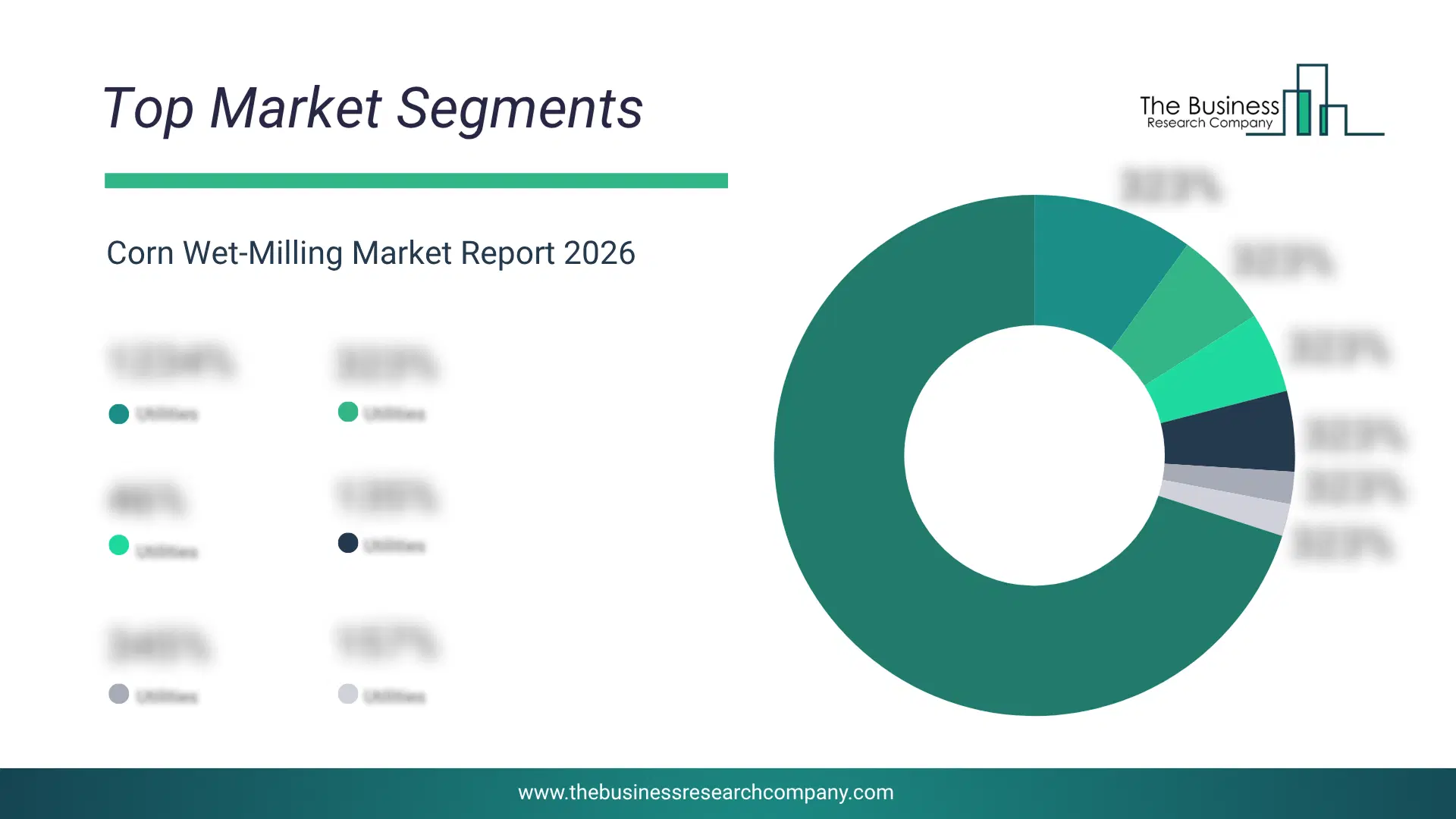
1) By Source: Dent Corn, Waxy Corn 2) By Equipment: Milling Equipment, Steeping Equipment, Centrifuge Systems, Washing And Filtration Systems, Other Equipment 3) By End-product: Starch, Sweetener, Corn Gluten Meal And Gluten Feed, Other End-Products Subsegments: 1) By Dent Corn: Field Corn, Yellow Dent Corn, White Dent Corn 2) By Waxy Corn: High-Amylose Waxy Corn, Low-Amylose Waxy CornWhat Is The Driver Of The Corn Wet-Milling Market?
The rising demand for corn-based products is boosting the growth of the corn wet-milling market going forward. Corn-based products refer to items made of corn such as corn flakes, and flours. The increasing demand for corn-based products increases demand for corn-wet milling as it improves the purity of the product. For instance, in February 2024, according to the International Grains Council (IGC), a London-based intergovernmental organization global corn consumption was 1,177 million tons in 2022/23 and corn production was 1,156 million tons in the 2022/23. Therefore, rising demand for corn-based products will drive the growth of the corn wet-milling industry.Key Players In The Global Corn Wet-Milling Market
Major companies operating in the corn wet-milling market are Archer Daniels Midland Company, Cargill Incorporated, Ingredion Incorporated, Tate & Lyle PLC, Roquette Frères SA, Grain Processing Corporation, Agrana Beteiligungs-AG, China Agri-Industries Holding Limited, Global Bio-Chem Technology Group Company Limited, National Starch LLC, Penford Corporation, Cereal Ingredients Inc., LifeLine Foods LLC, Bunge Limited, The Andersons Inc., Flint Hills Resources LP, Valero Energy Corporation, GreenField Specialty Alcohols Inc., Pacific Ethanol Inc., Green Plains Inc., Roquette America Inc., Ingredion Mexico S.A. de C.V.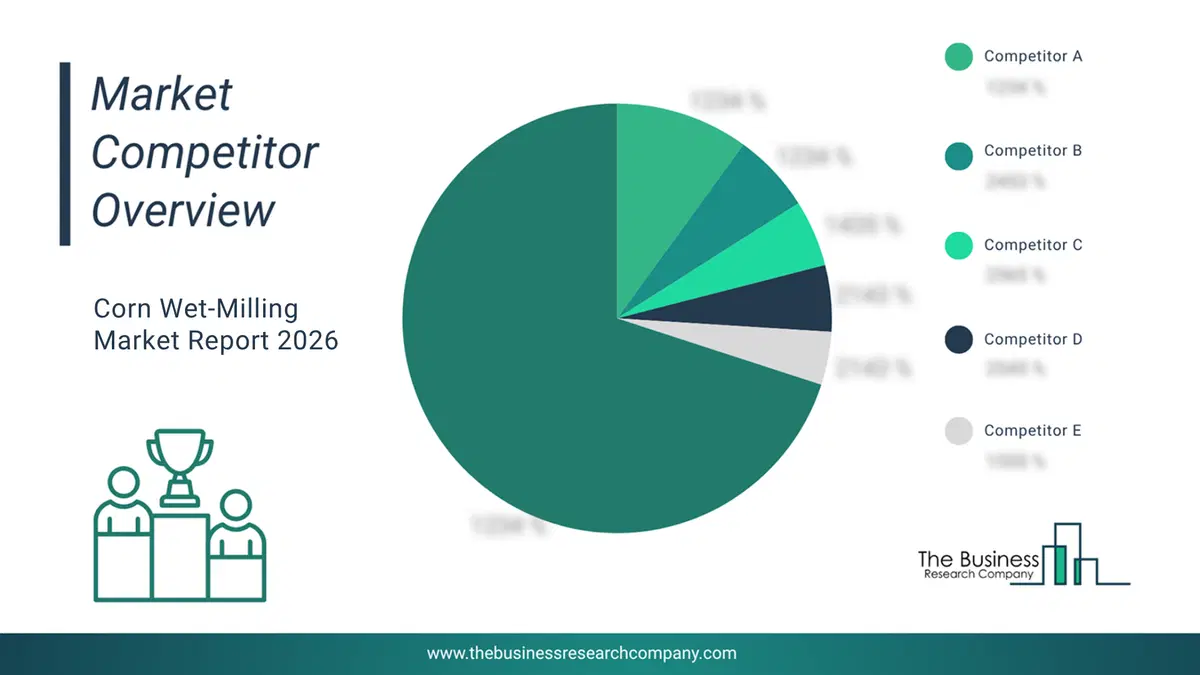
This chart is for illustrative purposes; the full report includes a detailed competitor analysis and comprehensive overview of the top 10 companies in the market.
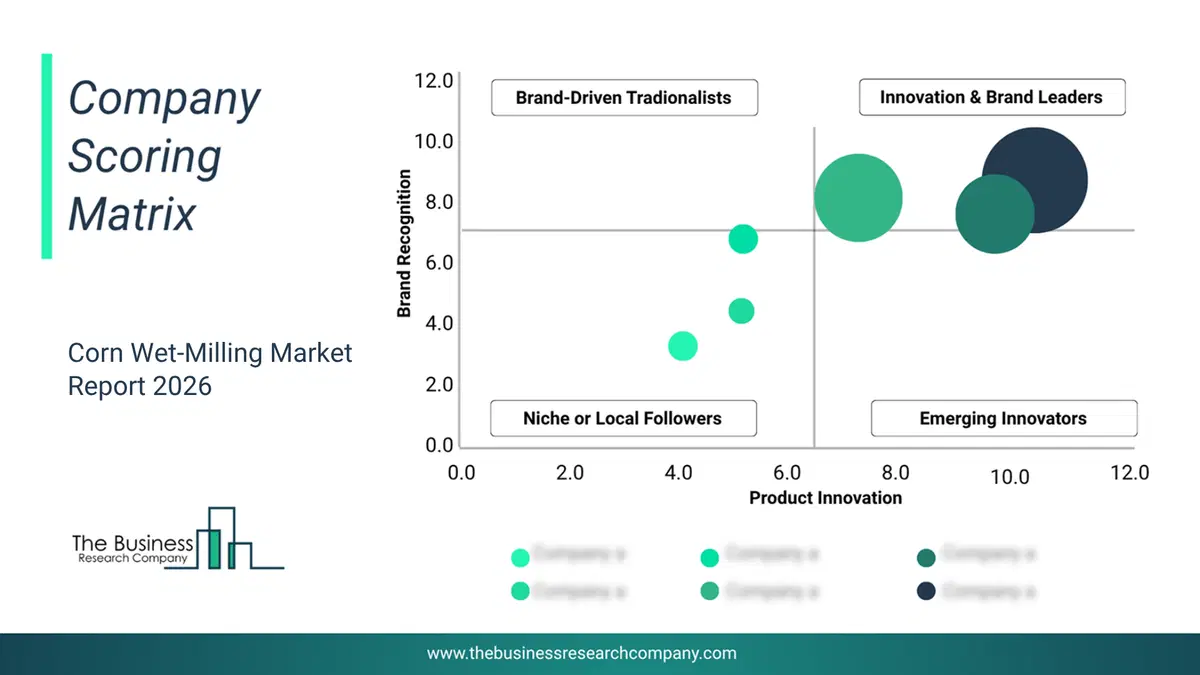
This chart maps companies by product innovation and brand strength, with bubble size indicating relative revenue, helping identify market leaders, challengers, and niche players. This is an illustrative chart; the full report provides a complete and accurate competitive analysis.
Global Corn Wet-Milling Market Trends and Insights
Major companies operating in the corn wet-milling market are focusing on technological advancements, such as clean-label functional native starches, to meet the rising demand for natural, label-friendly food ingredients and increased use of corn-derived starch in processed foods, clean-label dairy/alternative-dairy products, and plant-based applications. Clean-label functional native starch refers to starch extracted and processed from corn that is non-GMO, minimally modified, and suitable to be declared simply as “corn starch” (or “corn flour”) on ingredient labels unlike traditional modified starches, which often require more chemical or physical alteration to gain enhanced functional properties like thickening, gelling, or stabilizing under heat and freeze/thaw cycles. For instance, in February 2024, Ingredion Incorporated, a US-based specialty-ingredients company, launched NOVATION Indulge 2940, an innovative clean-label, non-GMO functional native corn starch designed to deliver desirable gelling and mouthfeel for dairy, alternative-dairy desserts, puddings and other applications. This starch is composed of corn-derived native starch granules (without heavy chemical modification), yet engineered through proprietary processing to provide gel strength, viscosity, and texture comparable to modified starches enabling food formulators to replace additives like gelatin or hydrocolloids. Its unique features include clean-label declaration, improved texture and mouthfeel, reliable supply and cost stability, and suitability for plant-based/clean-label formulations. Applications include yogurts, puddings, vegan cheeses, dairy desserts, sauces, and other products seeking clean, recognizable ingredient lists.What Are Latest Mergers And Acquisitions In The Corn Wet-Milling Market?
In March 2025, Cargill Inc., a US-based food processing company, partnered with Saatvik Agro Processors to expand its manufacturing footprint in India and secure a reliable, locally-based supply of starch derivatives to meet rising demand from domestic food industries. Saatvik Agro Processors is an India-based manufacturer that built and now operates a corn-milling facility producing starch derivatives for uses in confectionery, dairy, infant formula and other food applications.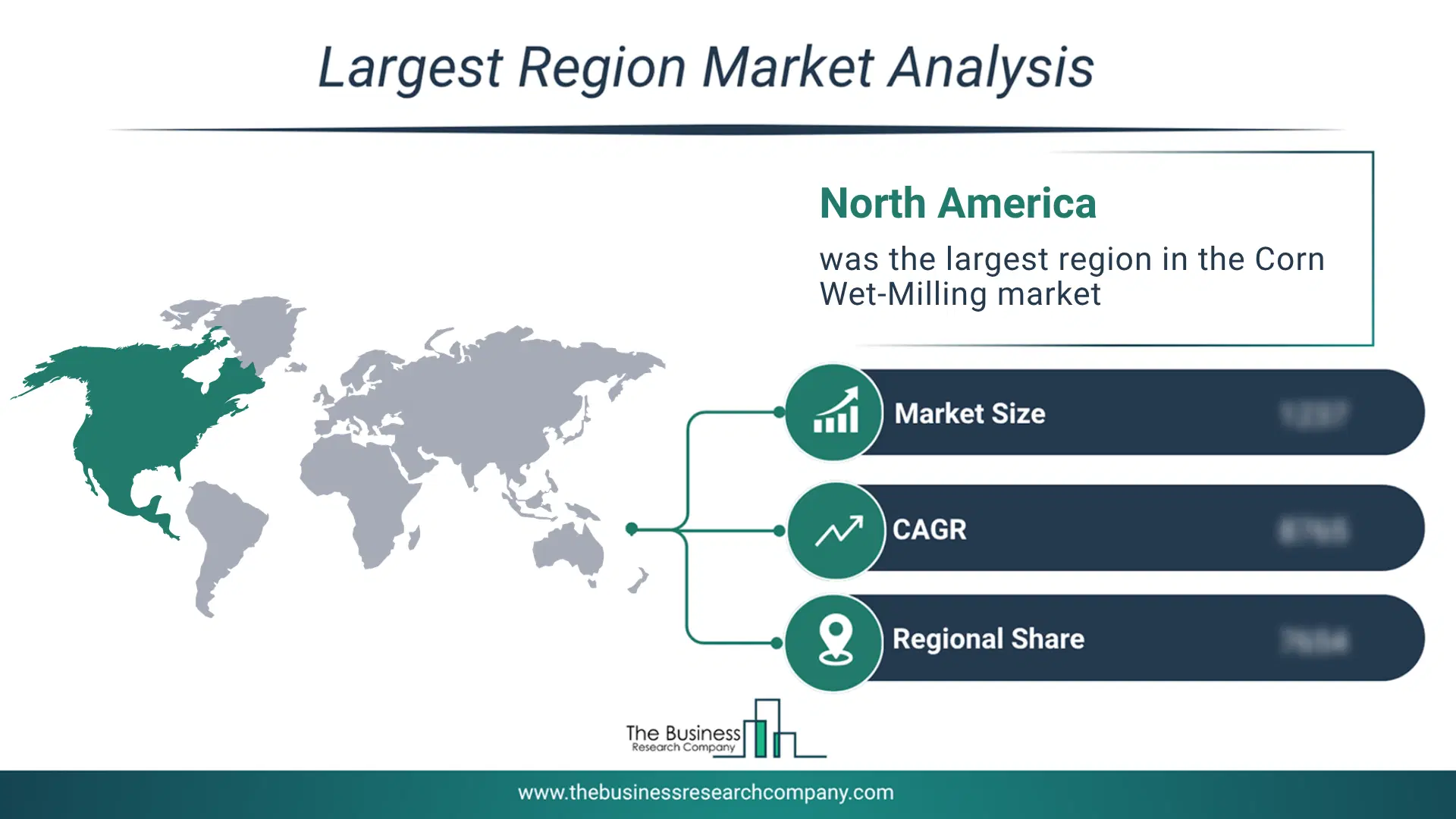
Regional Outlook
North America was the largest region in the corn wet-milling market share in 2025. North America is expected to be the fastest-growing region in the forecast period. The regions covered in this market report are Asia-Pacific, South East Asia, Western Europe, Eastern Europe, North America, South America, Middle East, Africa The countries covered in this market report are Australia, Brazil, China, France, Germany, India, Indonesia, Japan, Taiwan, Russia, South Korea, UK, USA, Canada, Italy, Spain.What Defines the Corn Wet-Milling Market?
The corn wet-milling market consists of sales of heating and cooling systems, dryers, and utility equipment. Values in this market are ‘factory gate’ values, that is the value of goods sold by the manufacturers or creators of the goods, whether to other entities (including downstream manufacturers, wholesalers, distributors, and retailers) or directly to end customers. The value of goods in this market includes related services sold by the creators of the goods.How is Market Value Defined and Measured?
The market value is defined as the revenues that enterprises gain from the sale of goods and/or services within the specified market and geography through sales, grants, or donations in terms of the currency (in USD unless otherwise specified). The revenues for a specified geography are consumption values that are revenues generated by organizations in the specified geography within the market, irrespective of where they are produced. It does not include revenues from resales along the supply chain, either further along the supply chain or as part of other products.
This chart presents market attractiveness based on a quantitative evaluation of growth, competition, strategic alignment, and risk, offering a clear view of opportunity areas for decision-making. This chart is for illustrative purposes; the full report contains the complete analysis.

This chart highlights the Total Addressable Market (TAM) by estimating the maximum revenue opportunity using an assumption-driven approach, supporting strategic planning and opportunity sizing across markets. The chart is illustrative; the full report provides a more comprehensive analysis.
What Key Data and Analysis Are Included in the Corn Wet-Milling Market Report 2026?
The corn wet-milling market research report is one of a series of new reports from The Business Research Company that provides market statistics, including industry global market size, regional shares, competitors with the market share, detailed market segments, market trends and opportunities, and any further data you may need to thrive in the corn wet-milling industry. The market research report delivers a complete perspective of everything you need, with an in-depth analysis of the current and future state of the industry.Corn Wet Milling Market Report Forecast Analysis
| Report Attribute | Details |
|---|---|
| Market Size Value In 2026 | $88.17 billion |
| Revenue Forecast In 2030 | $108.85 billion |
| Base Year For Estimation | 2025 |
| Actual Estimates/Historical Data | 2020-2025 |
| Forecast Period | 2026 - 2030 |
| Market Representation | Revenue in USD Billion and CAGR from 2026 to 2030 |
| Segments Covered | Source, Equipment, End-product |
| Regional Scope | Asia-Pacific, Western Europe, Eastern Europe, North America, South America, Middle East, Africa |
| Key Companies Profiled | Archer Daniels Midland Company, Cargill Incorporated, Ingredion Incorporated, Tate & Lyle PLC, Roquette Frères SA, Grain Processing Corporation, Agrana Beteiligungs-AG, China Agri-Industries Holding Limited, Global Bio-Chem Technology Group Company Limited, National Starch LLC, Penford Corporation, Cereal Ingredients Inc., LifeLine Foods LLC, Bunge Limited, The Andersons Inc., Flint Hills Resources LP, Valero Energy Corporation, GreenField Specialty Alcohols Inc., Pacific Ethanol Inc., Green Plains Inc., Roquette America Inc., Ingredion Mexico S.A. de C.V. |
| Customization Scope | Request for Customization |
| Pricing And Purchase Options | Explore Purchase Options |