
Counter-Drone Defense Systems Market Report 2026
Global Outlook – By Component ( Hardware, Software, Services), By Types ( Fixed Drone Defense Equipment, Mobile Drone Defense Equipment), By Application ( Military, Civilian, Other Applications), By End Use ( Government And Defense Agencies, Law Enforcement Agencies, Airports And Transportation Authorities, Industrial And Energy Facilities, Event Management Organizations) – Market Size, Trends, Strategies, and Forecast to 2030
Counter-Drone Defense Systems Market Overview
• Counter-Drone Defense Systems market size has reached to $2.9 billion in 2025 • Expected to grow to $7.52 billion in 2030 at a compound annual growth rate (CAGR) of 21.1% • Growth Driver: Surge In Drone-Based Security Threats Fueling The Growth Of The Market Due To Rising Unauthorized Drone Usage And Increasing Criminal And Surveillance Incidents • Market Trend: Advancements In Artificial Intelligence (AI) Enhance Threat Detection And Response Efficiency In Counter-Drone Defense Systems • North America was the largest region in 2025 and Asia-Pacific is the fastest growing region.What Is Covered Under Counter-Drone Defense Systems Market?
Counter-drone defense systems are advanced solutions that identify, monitor, and neutralize unauthorized or hostile unmanned aerial vehicles (UAVs) within secured airspace. Their primary purpose is to protect military installations, critical infrastructure, and civilian areas by preventing activities such as surveillance, smuggling, and drone-based attacks. The main components of counter-drone defense systems include hardware, software, and services. Hardware refers to physical detection, tracking, and neutralization equipment used to identify and counter unauthorized drones in restricted airspace. They are developed using technologies such as radar-based systems, radio frequency-based systems, electro-optical and infrared systems, acoustic systems, electronic countermeasure systems, and directed energy systems. They find application in military, civilian, and others, serving end use including government and defense agencies, law enforcement agencies, airports and transportation authorities, industrial and energy facilities, and event management organizations.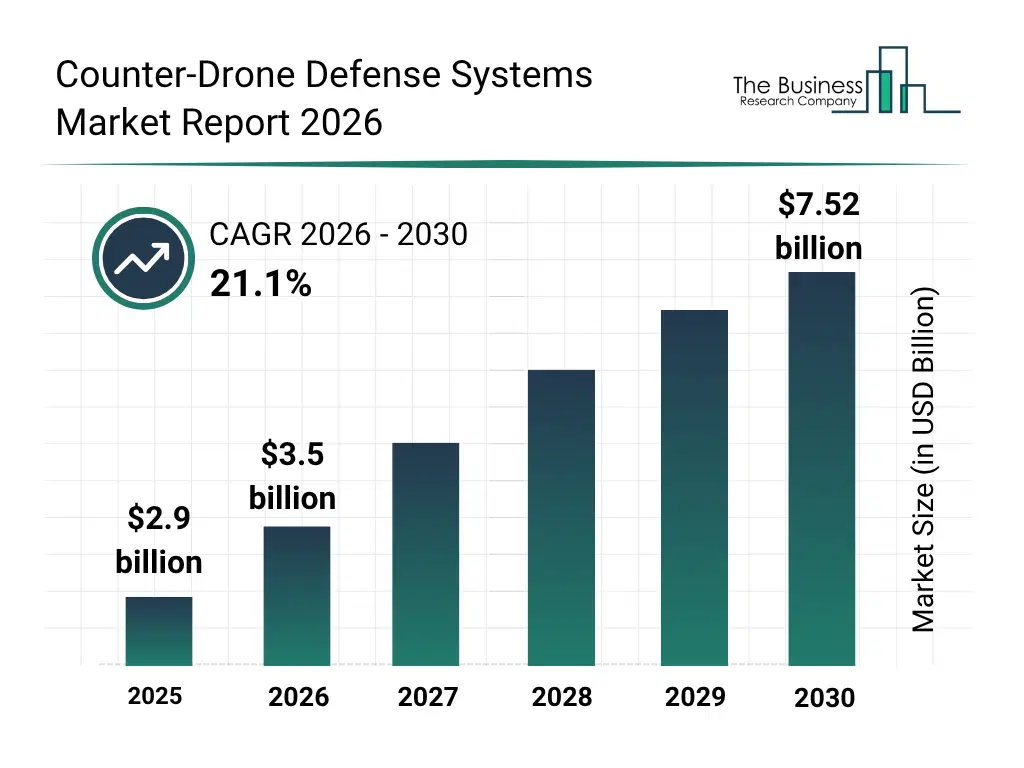
What Is The Counter-Drone Defense Systems Market Size and Share 2026?
The counter-drone defense systems market size has grown exponentially in recent years. It will grow from $2.9 billion in 2025 to $3.5 billion in 2026 at a compound annual growth rate (CAGR) of 20.8%. The growth in the historic period can be attributed to traditional reliance on manual monitoring and radar-based detection systems, rising incidents of unauthorized drone incursions in military and civilian airspace, increasing defense investments in radar and surveillance technologies, growth in terrorism and asymmetric aerial threats, expansion of airport and critical infrastructure security requirements.What Is The Counter-Drone Defense Systems Market Growth Forecast?
The counter-drone defense systems market size is expected to see exponential growth in the next few years. It will grow to $7.52 billion in 2030 at a compound annual growth rate (CAGR) of 21.1%. The growth in the forecast period can be attributed to increasing adoption of Ai-enabled autonomous threat detection systems, rising demand for integrated multi-layer air defense solutions, growth in smart city and urban security infrastructure development, expansion of defense modernization programs globally, increasing use of real-time data analytics for airspace monitoring and response systems. Major trends in the forecast period include increasing deployment of Ai-powered autonomous drone detection and neutralization systems, growing integration of multi-sensor fusion technologies for real-time airspace monitoring, rising adoption of RF-based electronic warfare and jamming solutions for threat mitigation, expansion of mobile and rapidly deployable counter-drone defense platforms, increasing use of interceptor drones and directed energy systems for advanced airspace protection.
Global Counter-Drone Defense Systems Market Segmentation
1) By Component: Hardware, Software, Services 2) By Types: Fixed Drone Defense Equipment, Mobile Drone Defense Equipment 3) By Application: Military, Civilian, Other Applications 4) By End Use: Government And Defense Agencies, Law Enforcement Agencies, Airports And Transportation Authorities, Industrial And Energy Facilities, Event Management Organizations Subsegments: 1) By Hardware: Radar Systems, Radio Frequency Jamming Systems, Electro Optical Infrared Sensors, Acoustic Detection Sensors, Command And Control Systems, Interceptor Drones, Kinetic Interception Systems, Directed Energy Weapon Systems 2) By Software: Detection And Tracking Software, Signal Processing Software, Threat Analysis Software, Artificial Intelligence Based Identification Software, Airspace Management Software 3) By Services: Installation And Integration Services, Maintenance And Support Services, Training Services, Consulting Services, Managed Security ServicesWhat Is The Driver Of The Counter-Drone Defense Systems Market?
The increasing drone-based security threats are expected to propel the growth of the counter-drone defense systems market going forward. Drone-based security threats involve the use of unmanned aerial systems to carry out surveillance, interference, or attacks, endangering military operations, critical infrastructure, and public safety. The rise in drone-based security threats is driven by the easy availability and low cost of commercial drones, enabling even low-skilled actors to modify and deploy them for surveillance or attacks. Counter-drone defense systems support drone-based security threats by providing advanced detection, tracking, and neutralization capabilities that help safeguard sensitive areas and maintain operational security. For instance, in August 2024, according to the National Counter Terrorism Security Office, a UK-based government organization, over 6,000 drone-related incidents were recorded by police in 2023, with approximately 11 percent classified as criminal offenses, highlighting a significant rise in drone-based security threats. Therefore, the increasing drone-based security threats are driving the growth of the counter-drone defense systems industry.Key Players In The Global Counter-Drone Defense Systems Market
Major companies operating in the counter-drone defense systems market are RTX Corporation, Lockheed Martin Corporation, Airbus Defence and Space, Northrop Grumman Corporation, BAE Systems plc, L3Harris Technologies, Thales Group, Leonardo S.p.A. (including Leonardo DRS), Rheinmetall AG, Elbit Systems Ltd., CACI International Inc, Israel Aerospace Industries Ltd., Moog Inc., Saab AB, Rafael Advanced Defense Systems Ltd., Anduril Industries Inc., Rohde & Schwarz GmbH & Co. KG, Motorola Solutions, DroneShield Limited, SRC Inc., Epirus Inc., Fortem Technologies Inc., Aaronia AG, CERBAIR SAS, Blighter Surveillance Systems Ltd., OpenWorks Engineering Ltd.Global Counter-Drone Defense Systems Market Trends and Insights
Major companies operating in the counter-drone defense systems market are focusing on developing advanced solutions, such as AI-driven command-and-control platforms, to improve real-time threat detection, enable faster decision-making, and ensure comprehensive drone threat mitigation. AI-driven command-and-control platforms refer to integrated systems that utilize artificial intelligence to autonomously detect, track, identify, and coordinate responses against unauthorized drones across the entire counter-drone kill chain. For instance, in July 2023, Dedrone, a US-based airspace security company, launched DedroneTracker.AI, an AI-powered command-and-control platform designed to provide end-to-end counter-drone capabilities. The platform integrates multiple sensor inputs and leverages advanced machine learning algorithms to deliver accurate drone detection, classification, and tracking. It enables security operators to respond more efficiently to aerial threats while enhancing situational awareness and operational effectiveness.What Are Latest Mergers And Acquisitions In The Counter-Drone Defense Systems Market?
In October 2024, Axon, a US-based public safety technology company, acquired Dedrone for an undisclosed amount. With this acquisition, Axon aims to enhance its drone as a first responder (DFR) capabilities and strengthen its position in public safety and national security by integrating Dedrone’s AI-powered airspace awareness and counter-drone technologies, enabling real-time detection, tracking, and mitigation of unauthorized drones. Dedrone is a US-based airspace awareness and security company specializing in counter-drone defense systems to protect critical infrastructure, public spaces, and defense operations from drone-related threats.Regional Outlook
North America was the largest region in the counter-drone defense systems market in 2025. Asia-Pacific is expected to be the fastest-growing region in the forecast period.The regions covered in this market report are Asia-Pacific, South East Asia, Western Europe, Eastern Europe, North America, South America, Middle East, Africa. The countries covered in this market report are Australia, Brazil, China, France, Germany, India, Indonesia, Japan, Taiwan, Russia, South Korea, UK, USA, Canada, Italy, Spain.What Defines the Counter-Drone Defense Systems Market?
The counter-drone defense systems market consists of revenues earned by entities by providing services such as threat intelligence analysis, airspace risk assessment, system integration and deployment, and operator training and simulation. The market value includes the value of related goods sold by the service provider or included within the service offering. The counter-drone defense systems market also includes sales of radar systems, radio frequency detectors, electro-optical cameras, infrared cameras, acoustic sensors, drone detection sensors, signal jammers, GPS jammers, RF jammers, laser weapons, high-power microwave systems, and interceptor drones. Values in this market are ‘factory gate’ values, that is, the value of goods sold by the manufacturers or creators of the goods, whether to other entities (including downstream manufacturers, wholesalers, distributors, and retailers) or directly to end customers. The value of goods in this market includes related services sold by the creators of the goods.How is Market Value Defined and Measured?
The market value is defined as the revenues that enterprises gain from the sale of goods and/or services within the specified market and geography through sales, grants, or donations in terms of the currency (in USD unless otherwise specified). The revenues for a specified geography are consumption values that are revenues generated by organizations in the specified geography within the market, irrespective of where they are produced. It does not include revenues from resales along the supply chain, either further along the supply chain or as part of other products.What Key Data and Analysis Are Included in the Counter-Drone Defense Systems Market Report 2026?
The counter-drone defense systems market research report is one of a series of new reports from The Business Research Company that provides counter-drone defense systems market statistics, including counter-drone defense systems industry global market size, regional shares, competitors with a counter-drone defense systems market share, detailed counter-drone defense systems market segments, market trends and opportunities, and any further data you may need to thrive in the counter-drone defense systems industry. This counter-drone defense systems market research report delivers a complete perspective of everything you need, with an in-depth analysis of the current and future scenario of the industry.Counter-Drone Defense Systems Market Report Forecast Analysis
| Report Attribute | Details |
|---|---|
| Market Size Value In 2026 | $3.5 billion |
| Revenue Forecast In 2030 | $7.52 billion |
| Growth Rate | CAGR of 21.1% from 2026 to 2030 |
| Base Year For Estimation | 2025 |
| Actual Estimates/Historical Data | 2020-2025 |
| Forecast Period | 2026 - 2030 |
| Market Representation | Revenue in USD Billion and CAGR from 2026 to 2030 |
| Segments Covered | Component, Types, Application, End Use |
| Regional Scope | Asia-Pacific, Western Europe, Eastern Europe, North America, South America, Middle East, Africa |
| Country Scope | The countries covered in the counter-drone defense systems market report are Australia, Brazil, China, France, Germany, India, Indonesia, Japan, Taiwan, Russia, South Korea, UK, USA, Canada, Italy, Spain. |
| Key Companies Profiled | RTX Corporation, Lockheed Martin Corporation, Airbus Defence and Space, Northrop Grumman Corporation, BAE Systems plc, L3Harris Technologies, Thales Group, Leonardo S.p.A. (including Leonardo DRS), Rheinmetall AG, Elbit Systems Ltd., CACI International Inc, Israel Aerospace Industries Ltd., Moog Inc., Saab AB, Rafael Advanced Defense Systems Ltd., Anduril Industries Inc., Rohde & Schwarz GmbH & Co. KG, Motorola Solutions, DroneShield Limited, SRC Inc., Epirus Inc., Fortem Technologies Inc., Aaronia AG, CERBAIR SAS, Blighter Surveillance Systems Ltd., OpenWorks Engineering Ltd. |
| Customization Scope | Request for Customization |
| Pricing And Purchase Options | Explore Purchase Options |