
Counter Unmanned Aerial Vehicle (UAV) Defense System Market Report 2026
Global Outlook – By Type (Detection Systems, Detection And Disruption Systems), By Component (Hardware, Software, Services, Integration Solutions, Maintenance And Support), By End User (Government And Military Agencies, Private Security Firms, Corporate Entities, Agricultural Businesses, Research Institutions) – Market Size, Trends, Strategies, and Forecast to 2030
Counter Unmanned Aerial Vehicle (UAV) Defense System Market Overview
• Counter Unmanned Aerial Vehicle (UAV) Defense System market size has reached to $2.46 billion in 2025 • Expected to grow to $6.38 billion in 2030 at a compound annual growth rate (CAGR) of 21% • Growth Driver: The Surge In Defense Security Investments The Growth Of The Market Due To Heightened Geopolitical Tensions And Rising Demand For Aerial Threat Protection • Market Trend: Lockheed Martin Introduces Scalable Counter-UAV System With Advanced Layered Defense Architecture • North America was the largest region in 2025 and Asia-Pacific is the fastest growing region.What Is Covered Under Counter Unmanned Aerial Vehicle (UAV) Defense System Market?
A counter unmanned aerial vehicle (UAV) defense system is a technology designed to detect, track, and neutralize unauthorized or hostile drones. It uses a combination of sensors, radar, electronic jamming, and kinetic measures to prevent UAVs from entering restricted airspace or carrying out malicious activities. These systems are crucial for protecting critical infrastructure, military sites, and public events from potential drone threats. The main types of the counter unmanned aerial vehicle (UAV) defense system include detection systems and detection and disruption systems. Detection systems refer to technologies and equipment designed to identify, track, and monitor unauthorized or hostile UAVs in a designated airspace, often using radar, radio frequency, optical, or acoustic sensors to ensure timely threat recognition. The various components include hardware, software, services, integration solutions, and maintenance and support, and they are used by several end-users such as government and military agencies, private security firms, corporate entities, agricultural businesses, and research institutions.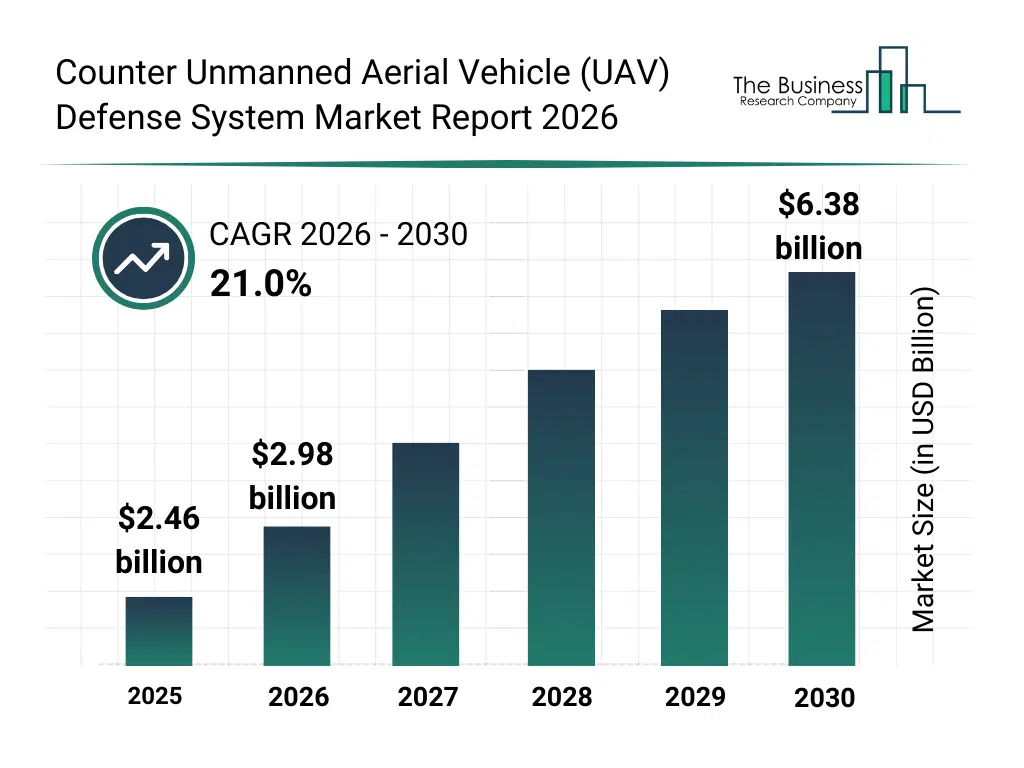
What Is The Counter Unmanned Aerial Vehicle (UAV) Defense System Market Size and Share 2026?
The counter unmanned aerial vehicle (UAV) defense system market size has grown exponentially in recent years. It will grow from $2.46 billion in 2025 to $2.98 billion in 2026 at a compound annual growth rate (CAGR) of 21.1%. The growth in the historic period can be attributed to increasing incidents of unauthorized drone incursions prompting early adoption of counter-uav systems, deployment of rf-based detection and jamming solutions to protect military bases, expansion of radar and electro-optical sensor integration for improved drone identification, rising security needs at critical infrastructure sites leading to procurement of counter-drone technologies, initial development of kinetic interceptors to address high-risk hostile drone scenarios.What Is The Counter Unmanned Aerial Vehicle (UAV) Defense System Market Growth Forecast?
The counter unmanned aerial vehicle (UAV) defense system market size is expected to see exponential growth in the next few years. It will grow to $6.38 billion in 2030 at a compound annual growth rate (CAGR) of 21.0%. The growth in the forecast period can be attributed to growing demand for AI-enabled autonomous detection and tracking capabilities, increasing use of multi-layered counter-uav systems combining radar, rf, optical, and kinetic measures, rising adoption of laser-based neutralization solutions for precision threat elimination, expansion of counter-drone protection for public events, airports, and commercial facilities, development of portable and rapid-deployment counter-uav units to support field and emergency operations. Major trends in the forecast period include growing demand for portable and rapidly deployable counter-uav units, increasing adoption of multi-layered detection and neutralization architectures, rising integration of kinetic and non-kinetic neutralization mechanisms, expansion of counter-uav protection for large public events and vip security, increased use of long-range detection systems for perimeter and border protection.
Global Counter Unmanned Aerial Vehicle (UAV) Defense System Market Segmentation
1) By Type: Detection Systems, Detection And Disruption Systems 2) By Component: Hardware, Software, Services, Integration Solutions, Maintenance And Support 3) By End User: Government And Military Agencies, Private Security Firms, Corporate Entities, Agricultural Businesses, Research Institutions Subsegments: 1) By Detection Systems: Radar-Based Systems: Radio Frequency (RF) Detection Systems, Electro-optical And Infrared (EO/IR) Systems, Acoustic Detection Systems, Passive Surveillance Systems 2) By Detection And Disruption Systems: Jamming Systems, GNSS (GPS) Spoofing Systems, Directed Energy Weapons, Drone Capture Systems, Integrated Multi-Sensor Counter–Unmanned Aerial System SolutionsWhat Is Driver Of The Counter Unmanned Aerial Vehicle (UAV) Defense System Market?
The growing defense security investments are expected to propel the growth of the counter unmanned aerial vehicle (UAV) defense system market going forward. Defense security investments refer to the allocation of financial resources by governments or private entities to develop, enhance, and maintain military capabilities, technologies, and infrastructure for national security and defense purposes. The growing defense security investments are primarily driven by increasing geopolitical tensions, which compel nations to strengthen military capabilities and ensure national security. Counter unmanned aerial vehicle (UAV) defense systems enhance defense security investments by providing critical protection against aerial threats, thereby strengthening national security infrastructure and justifying advanced technological funding. For instance, in February 2025, according to the International Institute for Strategic Studies (IISS), a UK-based international research institute, in 2024, global defense spending surged to a record high of $2.46 trillion, marking a 7.4% increase from the $2.24 trillion spent in 2023. Therefore, the growing defense security investments are driving the growth of the counter unmanned aerial vehicle (UAV) defense system industry.Key Players In The Global Counter Unmanned Aerial Vehicle (UAV) Defense System Market
Major companies operating in the counter unmanned aerial vehicle (UAV) defense system market are Raytheon Technologies Corporation, The Boeing Company, Lockheed Martin Corporation, General Dynamics Corporation, Northrop Grumman Corporation, BAE Systems plc, Thales S.A., Leonardo SpA, Textron Inc., Airbus Defence and Space GmbH, Elbit Systems Ltd., Israel Aerospace Industries Ltd., Saab AB, Rohde And Schwarz GmbH And Co. KG, Baykar Teknoloji A.S, Anduril Industries Inc., Kratos Defense And Security Solutions Inc., UVision Air Ltd., Blighter Surveillance Systems Ltd., ZALA Aero Group LLC, KVERTUS LLC
This chart is for illustrative purposes; the full report includes a detailed competitor analysis and comprehensive overview of the top 10 companies in the market.
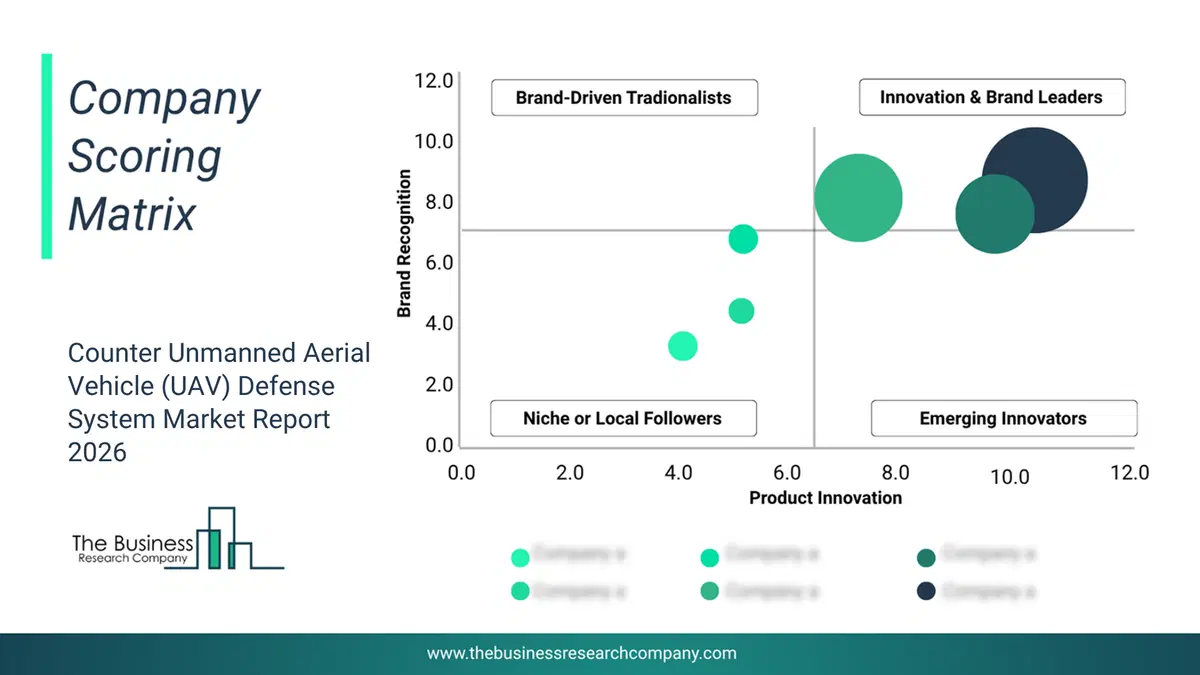
This chart maps companies by product innovation and brand strength, with bubble size indicating relative revenue, helping identify market leaders, challengers, and niche players. This is an illustrative chart; the full report provides a complete and accurate competitive analysis.
Global Counter Unmanned Aerial Vehicle (UAV) Defense System Market Trends and Insights
Major companies operating in the counter unmanned aerial vehicle (UAV) defense system market are focusing on developing advanced technologies, such as layered defense architecture, to enhance detection, tracking, and neutralization of drone threats. A layered defense architecture is a defense strategy that uses multiple layers of sensors, interceptors, and effectors at different ranges and altitudes to detect, track, and neutralize threats such as unmanned aerial vehicles (UAVs). For instance, in February 2025, Lockheed Martin Corporation, a US-based aerospace and defense company, introduced a scalable solution for counter-unmanned aerial systems. The system integrates multiple sensor types, including radar, electro-optical/infrared (EO/IR), and radio frequency (RF) detection, to provide enhanced situational awareness. It combines both kinetic and non-kinetic effectors, such as electronic warfare capabilities and directed energy systems, to offer flexible engagement options across various operational settings. Adaptable for fixed, mobile, or expeditionary use, the platform supports a wide range of mission profiles. Its open architecture allows seamless integration with existing command and control systems, enabling real-time data fusion and collaborative threat response while ensuring easy deployment and future scalability.What Are Latest Mergers And Acquisitions In The Counter Unmanned Aerial Vehicle (UAV) Defense System Market? Aerovironment Acquires Bluehalo To Expand Capabilities In Counter-UAS And Advanced Defense Technologies
In May 2025, AeroVironment Inc., a US-based defense contractor company, acquired BlueHalo LLC for $4.1 billion. With this acquisition, AeroVironment aims to expand its capabilities in counter-unmanned aerial systems and integrated defense solutions by leveraging BlueHalo's advanced technologies in directed energy, RF detection, and layered defense architecture. BlueHalo LLC is a US-based company that offers Counter-Unmanned Aerial Vehicle (C-UAV) Defense Systems.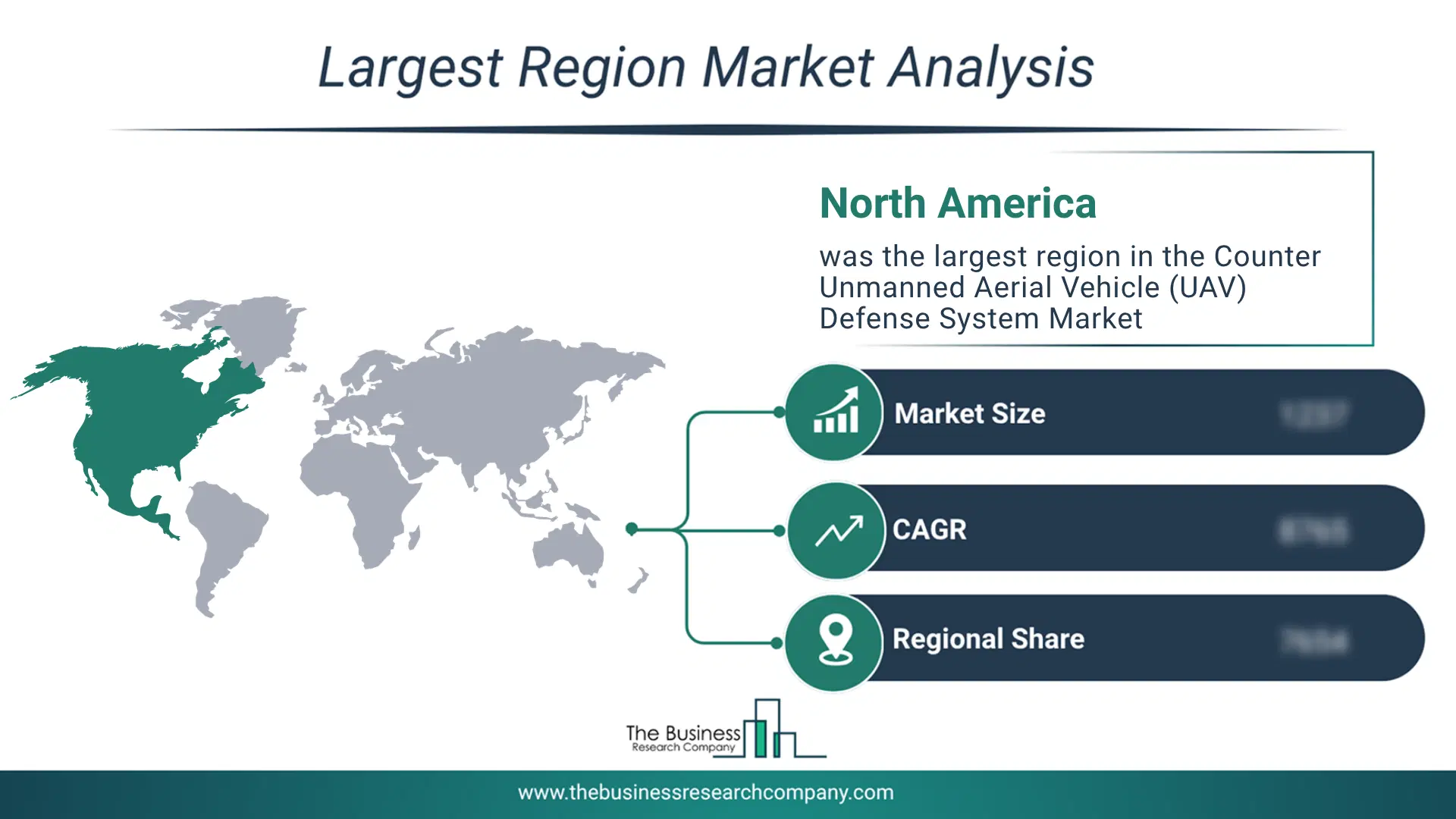
Regional Insights
North America was the largest region in the counter unmanned aerial vehicle (UAV) defense system market in 2025. Asia-Pacific is expected to be the fastest-growing region in the forecast period. The regions covered in this market report are Asia-Pacific, South East Asia, Western Europe, Eastern Europe, North America, South America, Middle East, Africa. The countries covered in this market report are Australia, Brazil, China, France, Germany, India, Indonesia, Japan, Taiwan, Russia, South Korea, UK, USA, Canada, Italy, SpainWhat Defines the Counter Unmanned Aerial Vehicle (UAV) Defense System Market?
The counter unmanned aerial vehicle (UAV) defense system market consists of revenues earned by entities by providing services such as detection, tracking, identification, and neutralization. The market value includes the value of related goods sold by the service provider or included within the service offering. The counter unmanned aerial vehicle (UAV) defense system market also includes sales of radar detection systems, radio frequency (RF) jammers, laser-based defense systems, electro-optical systems, and kinetic interceptors. Values in this market are ‘factory gate’ values, that is the value of goods sold by the manufacturers or creators of the goods, whether to other entities (including downstream manufacturers, wholesalers, distributors and retailers) or directly to end customers. The value of goods in this market includes related services sold by the creators of the goods.How is Market Value Defined and Measured?
The market value is defined as the revenues that enterprises gain from the sale of goods and/or services within the specified market and geography through sales, grants, or donations in terms of the currency (in USD unless otherwise specified). The revenues for a specified geography are consumption values that are revenues generated by organizations in the specified geography within the market, irrespective of where they are produced. It does not include revenues from resales along the supply chain, either further along the supply chain or as part of other products.
This chart presents market attractiveness based on a quantitative evaluation of growth, competition, strategic alignment, and risk, offering a clear view of opportunity areas for decision-making. This chart is for illustrative purposes; the full report contains the complete analysis.

This chart highlights the Total Addressable Market (TAM) by estimating the maximum revenue opportunity using an assumption-driven approach, supporting strategic planning and opportunity sizing across markets. The chart is illustrative; the full report provides a more comprehensive analysis.
What Key Data and Analysis Are Included in the Counter Unmanned Aerial Vehicle (UAV) Defense System Market Report 2026?
The counter unmanned aerial vehicle (uav) defense system market research report is one of a series of new reports from The Business Research Company that provides market statistics, including industry global market size, regional shares, competitors with the market share, detailed market segments, market trends and opportunities, and any further data you may need to thrive in the counter unmanned aerial vehicle (uav) defense system industry. The market research report delivers a complete perspective of everything you need, with an in-depth analysis of the current and future state of the industry.Counter Unmanned Aerial Vehicle (UAV) Defense System Market Report Forecast Analysis
| Report Attribute | Details |
|---|---|
| Market Size Value In 2026 | $2.98 billion |
| Revenue Forecast In 2030 | $6.38 billion |
| Growth Rate | CAGR of 21% from 2026 to 2030 |
| Base Year For Estimation | 2025 |
| Actual Estimates/Historical Data | 2020-2025 |
| Forecast Period | 2026 - 2030 |
| Market Representation | Revenue in USD Billion and CAGR from 2026 to 2030 |
| Segments Covered | Type, Component, End User |
| Regional Scope | Asia-Pacific, Western Europe, Eastern Europe, North America, South America, Middle East, Africa |
| Country Scope | The countries covered in the counter unmanned aerial vehicle (uav) defense system market report are Australia, Brazil, China, France, Germany, India, Indonesia, Japan, Taiwan, Russia, South Korea, UK, USA, Canada, Italy, Spain |
| Key Companies Profiled | Raytheon Technologies Corporation, The Boeing Company, Lockheed Martin Corporation, General Dynamics Corporation, Northrop Grumman Corporation, BAE Systems plc, Thales S.A., Leonardo SpA, Textron Inc., Airbus Defence and Space GmbH, Elbit Systems Ltd., Israel Aerospace Industries Ltd., Saab AB, Rohde And Schwarz GmbH And Co. KG, Baykar Teknoloji A.Ş, Anduril Industries Inc., Kratos Defense And Security Solutions Inc., UVision Air Ltd., Blighter Surveillance Systems Ltd., ZALA Aero Group LLC, KVERTUS LLC |
| Customization Scope | Request for Customization |
| Pricing And Purchase Options | Explore Purchase Options |