
Counter Unmanned Aerial Vehicle (UAV) Technologies Market Report 2026
Global Outlook – By Type (Detection Systems, Tracking And Identification Systems, Jamming And Spoofing Systems, Directed Energy Systems, Kinetic Interceptor Systems), By Technology (Laser Systems, Kinetic Systems, Electronic Systems), By System Range (Short Range, Medium Range, Long Range), By Application (Defense, Commercial, Homeland Security) – Market Size, Trends, Strategies, and Forecast to 2030
Counter Unmanned Aerial Vehicle (UAV) Technologies Market Overview
• Counter Unmanned Aerial Vehicle (UAV) Technologies market size has reached to $1.82 billion in 2025 • Expected to grow to $3.36 billion in 2030 at a compound annual growth rate (CAGR) of 13% • Growth Driver: Increasing Security Threats Is Fueling The Growth Of The Market Due To Rising Unauthorized Drone Activities And Operational Risks • Market Trend: Mobile AI-Enabled Counter-UAV Systems Transform Threat Response Capabilities • North America was the largest region in 2025 and Asia-Pacific is the fastest growing region.Market Gains By 2030 – Top Opportunities By Segment
Market Gain identifies the most promising market opportunities by highlighting the segments or products expected to generate the highest incremental revenue growth over the next five years.
What Is Covered Under Counter Unmanned Aerial Vehicle (UAV) Technologies Market?
Counter unmanned aerial vehicle (UAV) technologies are systems designed to detect, track, and neutralize unauthorized or hostile drones. They use a combination of sensors, radar, radio frequency jammers, and directed-energy tools to identify and disable UAVs in real time. These technologies enhance security and safety by preventing drones from entering restricted airspace or interfering with critical operations. The main types of the counter unmanned aerial vehicle (UAV) technologies include detection systems, tracking and identification systems, jamming and spoofing systems, directed energy systems, and kinetic interceptor systems. Detection systems refer to equipment and technologies designed to sense, identify, and monitor unauthorized or hostile UAVs using radar, radio frequency, optical, or acoustic sensors, providing real-time awareness of potential aerial threats. The different technologies include laser systems, kinetic systems, and electronic systems. The system ranges include short range, medium range, and long range, and they are used by several applications such as defense, commercial, and homeland security.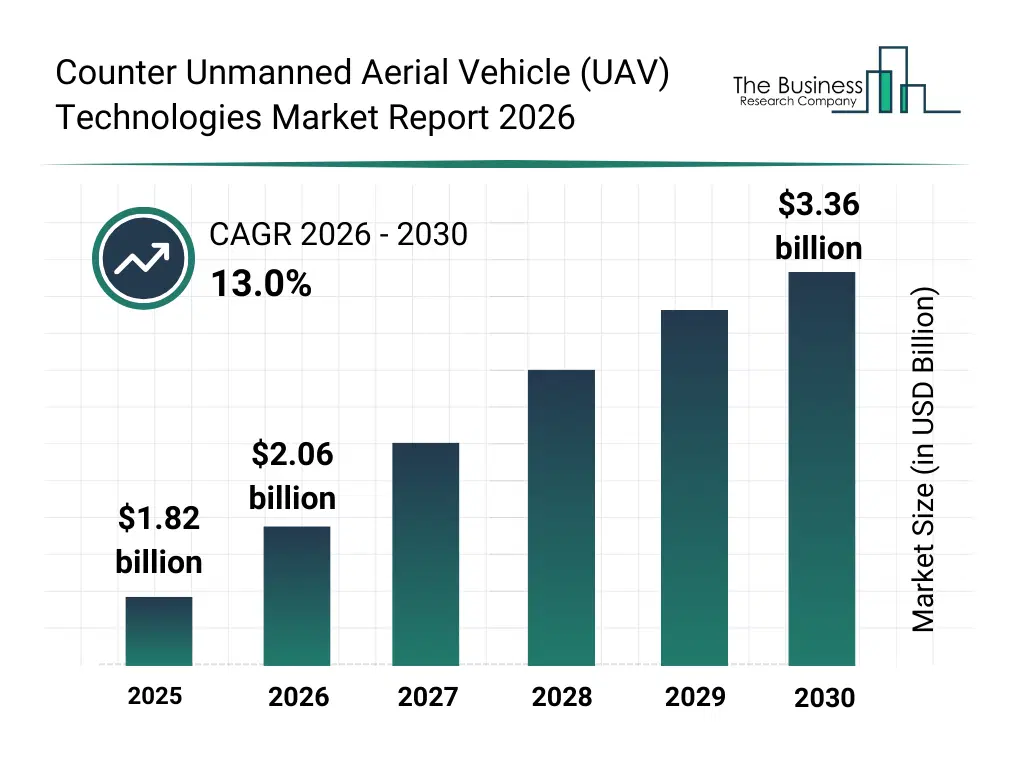
What Is The Counter Unmanned Aerial Vehicle (UAV) Technologies Market Size and Share 2026?
The counter unmanned aerial vehicle (UAV) technologies market size has grown rapidly in recent years. It will grow from $1.82 billion in 2025 to $2.06 billion in 2026 at a compound annual growth rate (CAGR) of 13.3%. The growth in the historic period can be attributed to rising threats from unauthorized drones, adoption of radar and rf jamming systems, deployment in critical infrastructure protection, growth in defense security programs, integration with surveillance networks.What Is The Counter Unmanned Aerial Vehicle (UAV) Technologies Market Growth Forecast?
The counter unmanned aerial vehicle (UAV) technologies market size is expected to see rapid growth in the next few years. It will grow to $3.36 billion in 2030 at a compound annual growth rate (CAGR) of 13.0%. The growth in the forecast period can be attributed to development of ai-driven threat detection, growth in kinetic and directed-energy neutralization, expansion in commercial and urban defense applications, integration with smart airspace management systems, adoption of multi-layered c-uav solutions. Major trends in the forecast period include increasing adoption of multi-layered counter-drone defense systems, growing demand for long-range drone detection and tracking solutions, expansion of portable and rapid-deployment anti-drone units, rising need for counter-uav protection in critical infrastructure, integration of counter-drone solutions with existing security and surveillance networks.
Global Counter Unmanned Aerial Vehicle (UAV) Technologies Market Segmentation
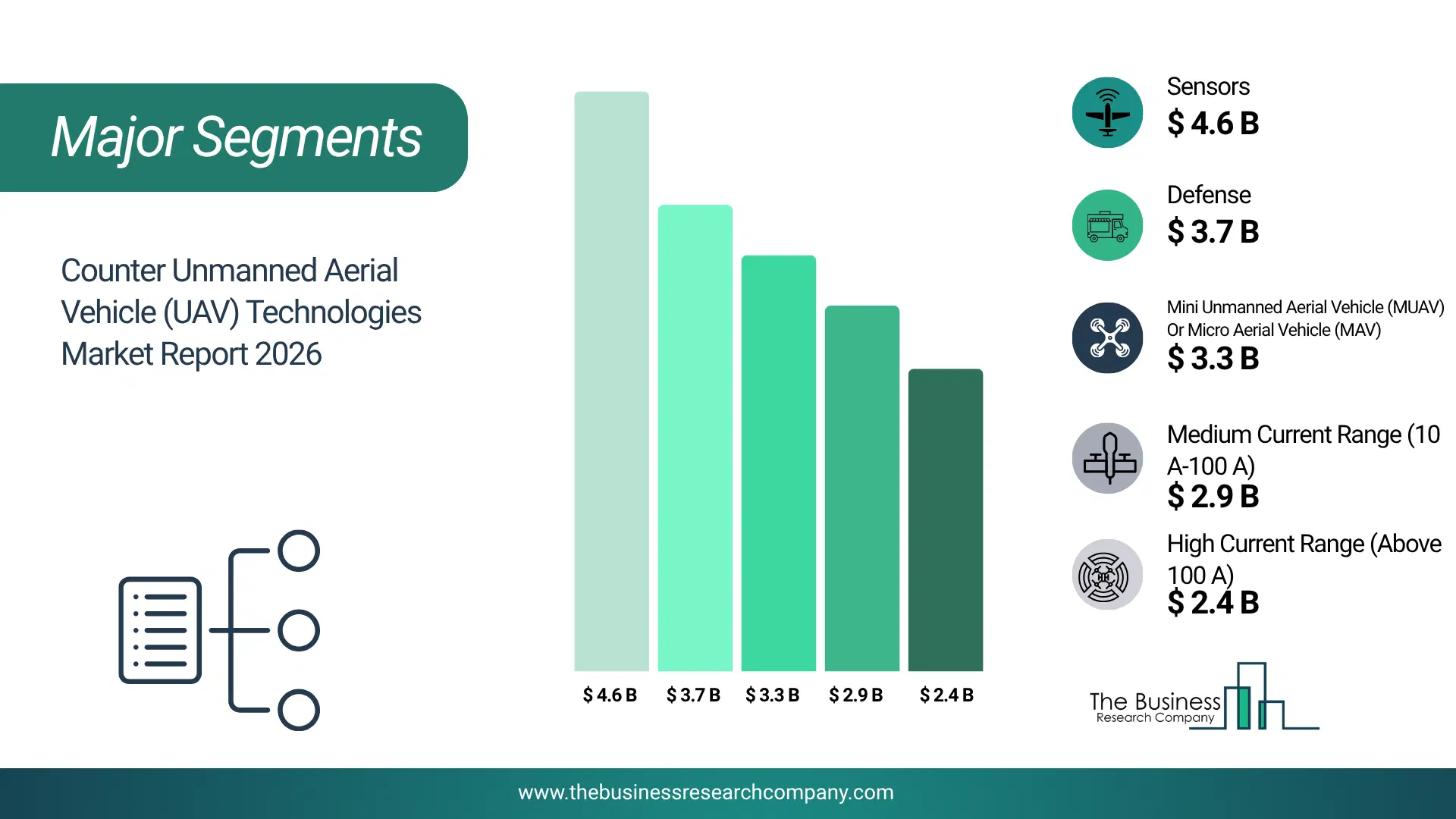
1) By Type: Detection Systems, Tracking And Identification Systems, Jamming And Spoofing Systems, Directed Energy Systems, Kinetic Interceptor Systems 2) By Technology: Laser Systems, Kinetic Systems, Electronic Systems 3) By System Range: Short Range, Medium Range, Long Range 4) By Application: Defense, Commercial, Homeland Security Subsegments: 1) By Detection Systems: Radar-Based Detection Systems, RF (Radio Frequency) Detection Systems, Acoustic Detection Systems, Electro-Optical/Infrared (EO/IR) Detection Systems, Multi-Sensor Detection Systems, Passive Sensor Detection Systems, AI-Based Detection Platforms 2) By Tracking And Identification Systems: Automatic Target Recognition (ATR) Systems, AI/ML-Based Tracking Systems, EO/IR Tracking Systems, RF Fingerprinting Systems, Sensor Fusion Tracking Systems, Long-Range Tracking Systems, 3D Mapping And Geolocation Tracking Systems 3) By Jamming And Spoofing Systems: RF Communication Jammers, GPS/GNSS Jammers, Directional Jamming Systems, Omnidirectional Jamming Systems, Protocol Spoofing Systems, Drone Takeover Systems, Portable/Man-Portable Jamming Devices 4) By Directed Energy Systems: High-Energy Laser (HEL) Systems, High-Power Microwave (HPM) Systems, Millimeter-Wave Directed Energy Systems, Tethered Laser Platforms, Vehicle-Mounted Directed Energy Systems 5) By Kinetic Interceptor Systems: Net Guns (Handheld or Vehicle-Mounted), Anti-Drone Drones, Projectile-Based Interceptors, Net-Firing Anti-Drone Launchers, Bird-of-Prey–Style Interception Systems, Autonomous Swarm Counter-Drone Interceptors The top segments in the counter unmanned aerial vehicle (uav) technologies market will be: • Electronic Systems will reach $4619.31 Million by 2030. • Mini Unmanned Aerial Vehicle (MUAV) Or Micro Aerial Vehicle (MAV) will reach $3316.37 Million by 2030. • Defense will reach $3703.86 Million by 2030. • Medium Current Range (10 A-100 A) will reach $2986.41 Million by 2030. • High Current Range (Above 100 A) will reach $2449.19 Million by 2030.What Is Driver Of The Counter Unmanned Aerial Vehicle (UAV) Technologies Market?
The increasing security threats are expected to propel the growth of the counter unmanned aerial vehicle (UAV) technologies market going forward. Security threats are potential dangers or risks that can harm people, assets, systems, or information, compromising safety, privacy, or operational integrity. The rise of security threats is due to the growing use of unauthorized drones and malicious aerial activities that challenge safety, disrupt operations, and require rapid detection and mitigation to protect people, assets, and critical infrastructure. Counter unmanned aerial vehicle (UAV) technologies support mitigating security threats by detecting, tracking, and neutralizing unauthorized drones, protecting critical infrastructure and public spaces from potential attacks or disruptions. For instance, in July 2025, according to BlackRock Inc., a US-based investment and technology company, Israel experienced major cyberattacks, with market attention shifting from -0.28% in September 2022 to +1.08% in November 2023, marking an overall increase of 1.36 percentage points. Therefore, the increasing security threats are driving the growth of the counter unmanned aerial vehicle (UAV) technologies industry.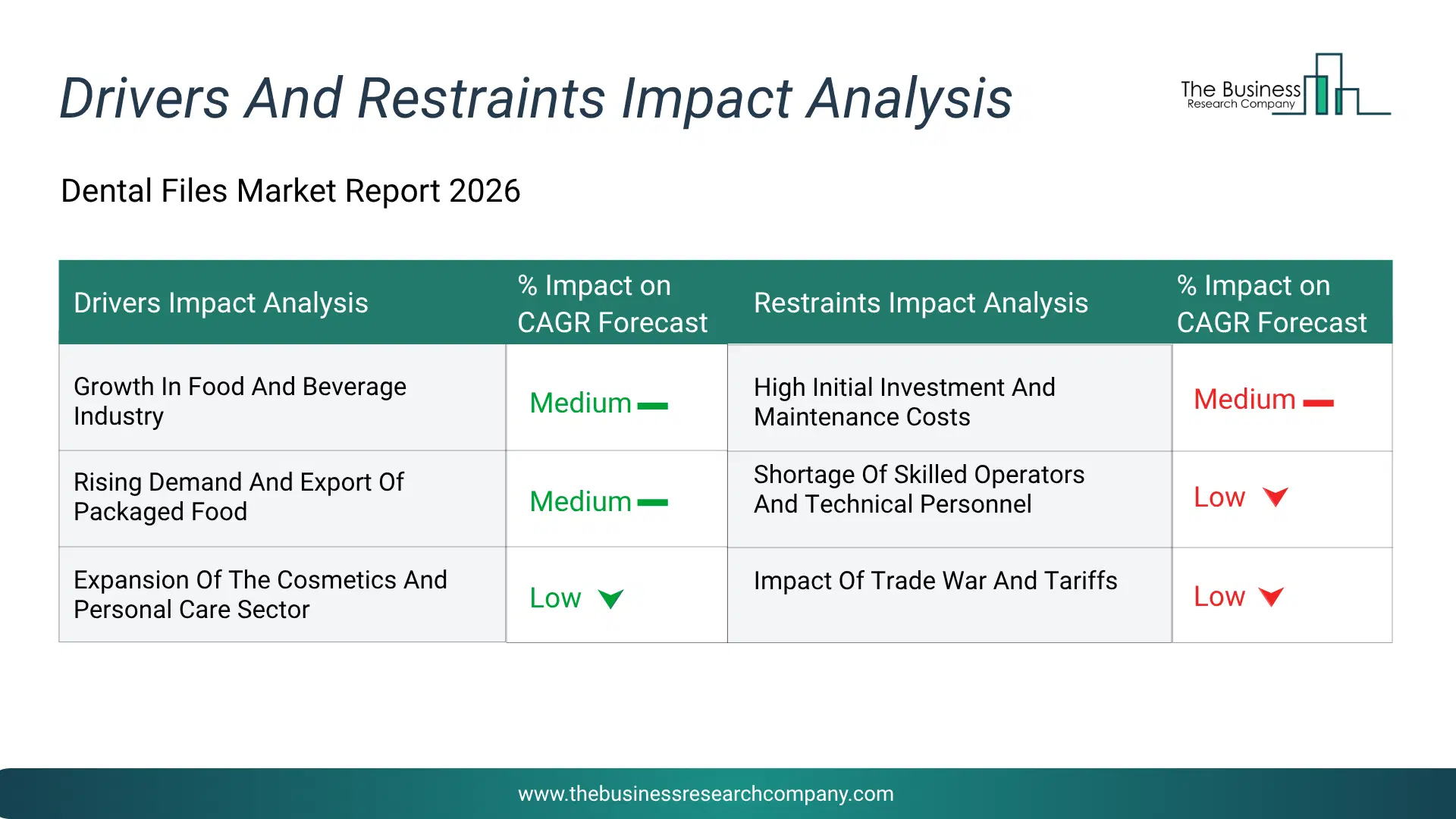
Infographic Chart Showing Key Market Drivers Analysis And Restraints For Counter Unmanned Aerial Vehicle (Uav) Technologies Market
The chart presents an impact analysis of key drivers and restraints, quantifying their relative influence on the market's growth rate and helping assess the balance between growth enablers and limiting factors. This chart offers a high-level perspective; the full report contains more detailed insights.
How Will The Drivers Impact Growth In The Global Counter-Unmanned Aerial Vehicle (C-UAV) Technologies Market?
• Rise In Airspace Security Risk Awareness (Medium) – During the forecast period, the rise in airspace security risk awareness will become a key driver of growth in the counter-unmanned aerial vehicle (c-uav) technologies market by 2030. increasing incidents of unauthorized uavs entering restricted zones such as airports, military bases and critical infrastructure have highlighted vulnerabilities in national and corporate airspace management, creating an urgent need for effective detection and mitigation systems. these risks require sophisticated surveillance, automated threat response and integrated security solutions to prevent potential safety and security breaches, with counter-uav technologies providing critical real-time monitoring and neutralization capabilities. as governments, defense agencies and critical infrastructure operators respond to the growing threat of drone incursions, the demand for advanced detection sensors, electronic countermeasures and rapid response systems significantly increases, thereby driving the development and deployment of counter-manned aerial vehicle technologies. as a result, rise in airspace security risk awareness is anticipated to contributing to a 2.0% annual growth in the market. • Heightened Public Safety Concerns (Medium) – During the forecast period, the heightened public safety concerns will emerge as a major factor driving the expansion of the counter-unmanned aerial vehicle (c-uav) technologies market by 2030. growing awareness of potential threats from unauthorized drones in crowded urban areas, public events and critical infrastructure has created an urgent need for effective surveillance and neutralization systems. these safety concerns require advanced monitoring, automated threat response and reliable mitigation measures, with counter-uav technologies providing critical capabilities to detect, track and neutralize rogue drones in real time. as governments and security agencies respond to the increasing emphasis on protecting civilians and infrastructure, the demand for robust detection sensors, electronic countermeasures and rapid intervention systems significantly increases, thereby driving the development and deployment of counter-manned aerial vehicle technologies. consequently, the heightened public safety concerns is projected to contributing to a 1.8% annual growth in the market. • Rise In Development Of Autonomous And Semi Autonomous Systems (Medium) – During the forecast period, the rise in development of autonomous and semi autonomous systems will serve as a key growth catalyst for the counter-unmanned aerial vehicle (c-uav) technologies market by 2030. increasing deployment of drones with advanced autonomous navigation and operational capabilities has amplified the need for systems that can detect, identify and neutralize such sophisticated threats. these autonomous systems require counter-uav solutions capable of adaptive response, real-time tracking and integration with broader security networks to prevent unauthorized or malicious use. as defense agencies and critical infrastructure operators integrate more autonomous drones into their operations, the demand for advanced counter-uav solutions with intelligent interception capabilities significantly increases, thereby driving the development and deployment of counter-manned aerial vehicle technologies. therefore, rise in development of autonomous and semi autonomous systems is projected to supporting to a 1.3% annual growth in the market. • Increasing Defense Budgets (Low) – During the forecast period, increasing defense budgets will propel the adoption of counter-manned aerial vehicle (UAV) technologies. Rising allocations for national defense and security have provided governments and armed forces with the resources to invest in advanced detection, tracking and neutralization systems for UAV threats. These budget increases enable the development and procurement of sophisticated counter-UAV technologies that integrate electronic warfare, sensor fusion and rapid response capabilities to safeguard critical infrastructure and military assets. As defense spending continues to grow, the availability of funding for research, development and deployment of counter-UAV systems significantly increases, thereby driving the advancement and operational readiness of counter-manned aerial vehicle technologies. The increasing defense budgets growth contribution during the forecast period in 2025 is 0.5%.How Will The Restraints Impact Growth In The Global Counter-Unmanned Aerial Vehicle (C-UAV) Technologies Market?
• Lack Of Standardized Protocols And Interoperability (Medium) – During the forecast period, lack of standardized protocols and interoperability in counter manned aerial vehicle (uav) technologies are restricting the seamless integration and coordinated operation of defense and security systems. many organizations deploying counter-uav solutions face substantial technical and procedural challenges in ensuring that detection, tracking and neutralization systems from multiple vendors can communicate effectively and operate in unison. these interoperability limitations, including inconsistent data formats, incompatible command-and-control interfaces and varied communication protocols, can strain operational efficiency and delay system deployment. from a strategic standpoint, the absence of universal standards can make it difficult for defense agencies and security operators to justify multi-vendor investments or scale joint operations, particularly when coordinating across different regions or allied forces. as a result, many organizations may postpone or limit multi-system integration initiatives to manage compatibility risks and operational uncertainties, thereby restricting the full operational potential of counter-uav solutions. growth affected by lack of standardized protocols and interoperability across regions during the forecast period in 2025 is -2.0%. • Limited Awareness And Technical Expertise (Medium) – During the forecast period, limited awareness and technical expertise in counter manned aerial vehicle (uav) technologies are restricting the effective adoption and deployment of advanced defense and security systems. many organizations responsible for safeguarding sensitive areas face substantial operational and procedural challenges related to understanding multi-sensor integration, electronic warfare capabilities and interoperable command-and-control systems. these mandatory technical competencies, including proper threat assessment, system calibration and response coordination, can strain organizational resources and delay the implementation of counter-uav measures. from a capacity standpoint, these knowledge and skill gaps can make it difficult for small and medium-sized defense units or security agencies to justify investing in complex counter-uav systems, particularly when navigating training, certification and operational readiness requirements. as a result, many organizations may postpone or limit the deployment of counter-uav technologies to manage technical risk and ensure effective system utilization, thereby restricting the broader adoption and operational effectiveness of these solutions. growth affected by limited awareness and technical expertise across regions during the forecast period in 2025 is -1.0% • Impact of Trade War and Tariff (Medium) – During the forecast period, trade wars and tariffs are restricting the timely procurement and deployment of counter manned aerial vehicle (uav) technologies by increasing costs and creating supply chain uncertainties. many organizations relying on advanced sensors, electronic warfare components and integrated counter-uav systems face substantial financial and logistical challenges when critical parts are sourced internationally and subjected to import duties or export restrictions. these trade-related barriers, including fluctuating tariffs, export controls and import delays, can strain budgets and disrupt project timelines. from a procurement standpoint, such uncertainties can make it difficult for defense agencies and security organizations to plan acquisitions or maintain consistent system upgrades, particularly when relying on cross-border suppliers. as a result, many organizations may postpone or reduce procurement activities to mitigate financial and supply chain risks, thereby limiting the deployment and operational readiness of counter-uav solutions. growth affected by trade war and tariffs across regions during the forecast period in 2025 is -0.3%.Key Players In The Global Counter Unmanned Aerial Vehicle (UAV) Technologies Market
Major companies operating in the counter unmanned aerial vehicle (UAV) technologies market are Raytheon Technologies Corporation Inc., Lockheed Martin Corporation Inc., Northrop Grumman Corporation Inc., Honeywell International Inc., L3Harris Technologies Inc., Rheinmetall AG Inc., CACI International Inc., Battelle Inc., Elbit Systems Ltd., Israel Aerospace Industries Ltd., Saab AB Inc., Rohde & Schwarz India Pvt. Ltd., Thales Group Inc., SRC Inc., Zen Technologies Ltd., Robin Radar Systems Ltd., Adani Defence & Aerospace Ltd., DroneShield Ltd., Aaronia AG Ltd., Drone Defence Services Ltd., METIS Aerospace Ltd., AUDS (Anti-UAV Defence System) Ltd., Paras Aerospace Pvt. Ltd.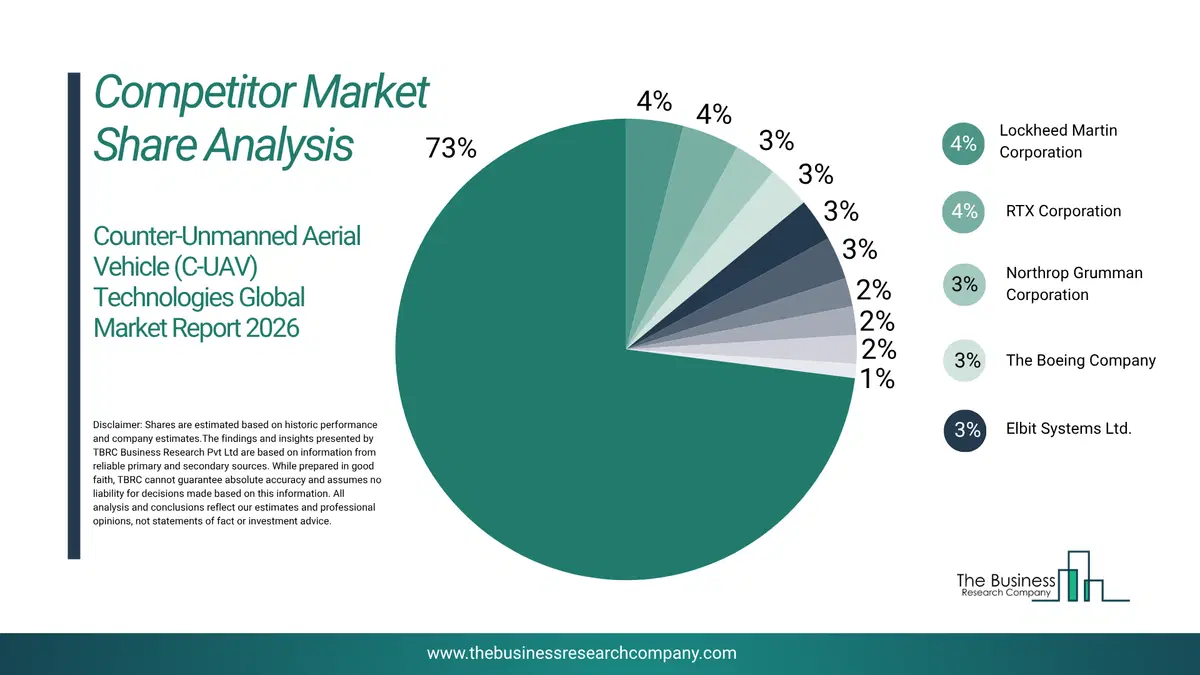
This chart is for illustrative purposes; the full report includes a detailed competitor analysis and comprehensive overview of the top 10 companies in the market.
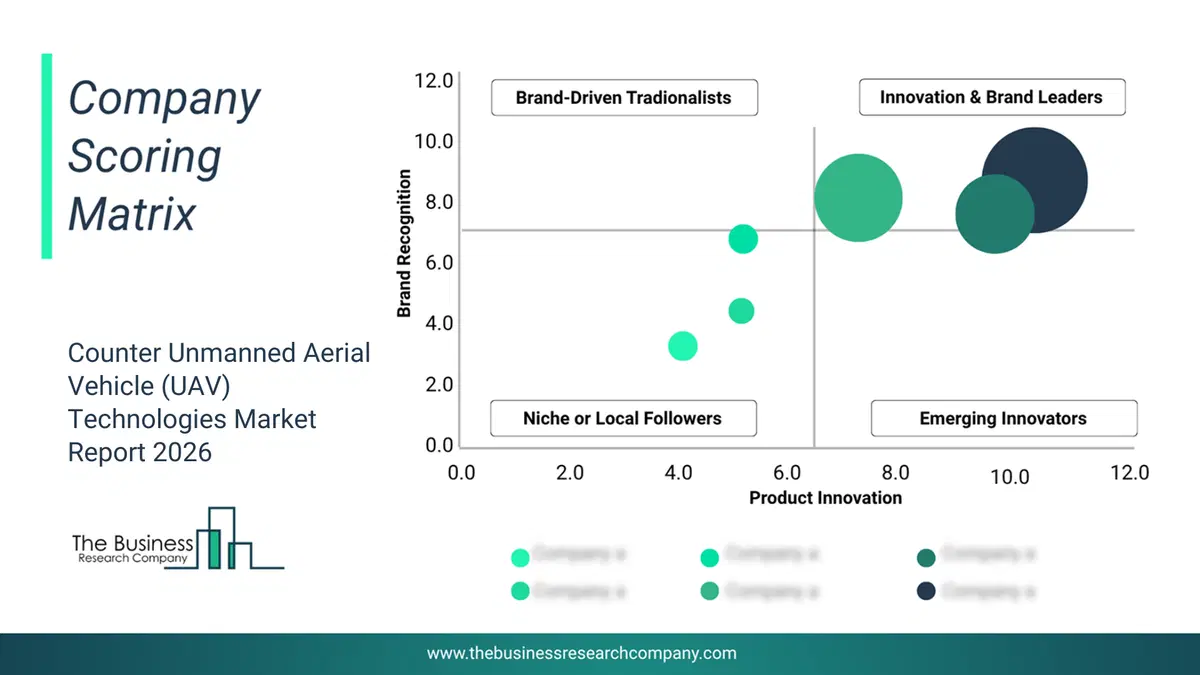
This chart maps companies by product innovation and brand strength, with bubble size indicating relative revenue, helping identify market leaders, challengers, and niche players. This is an illustrative chart; the full report provides a complete and accurate competitive analysis.
Global Counter Unmanned Aerial Vehicle (UAV) Technologies Market Trends and Insights
Major companies operating in the counter unmanned aerial vehicle (UAV) technologies market are focusing on developing innovative solutions, such as fully mobile AI-enabled counter-drone platforms, to meet the rising demand for rapid-threat detection, autonomous interception, and continuous protection of critical infrastructure against evolving aerial threats. Mobile counter-UAV systems integrate advanced sensors, artificial intelligence, and multi-layer neutralization capabilities, offering far greater flexibility and real-time response compared with fixed or semi-static counter-drone setups that require stationary deployment. For instance, in November 2025, Indrajaal Drone Defence, an India-based defense technology company specializing in AI-powered counter-drone and autonomous security systems, introduced India’s first fully mobile, AI-enabled Anti-Drone Patrol Vehicle (ADPV), the Indrajaal Ranger, in Hyderabad to address rising cross-border drone incursions linked to smuggling and security threats. Built on an all-terrain 4×4 platform and powered by the company’s SkyOS autonomy engine, the Ranger provides on-the-move drone detection up to 10 km using RF analytics, protocol intelligence, and computer vision. It supports real-time patrolling, autonomous threat evaluation, and multiple neutralization methods including GNSS spoofing, cyber takeover, soft-kill jamming, and kinetic interceptor drones while operating without stopping. By creating mobile “security domes” for borders, urban centers, airports, and critical infrastructure, the system has gained strong endorsement from defense officials and received ARDTC certification for nationwide deployment.What Are Latest Mergers And Acquisitions In The Counter Unmanned Aerial Vehicle (UAV) Technologies Market? Axon Acquires Dedrone To Strengthen Airspace Security Solutions
In October 2024, Axon Enterprise Inc., a US-based technology company, acquired Dedrone for $400 million. Through this acquisition, Axon aims to enhance its product portfolio in drone detection, tracking, and mitigation while expanding its airspace security offerings to defense, critical infrastructure, and public safety sectors. Dedrone Holdings Inc is a US-based company that provides comprehensive, artificial intelligence (AI) or machine learning (ML)-powered airspace security solutions, specializing in counter unmanned aerial vehicle (C-UAS) or counter-drone technologies.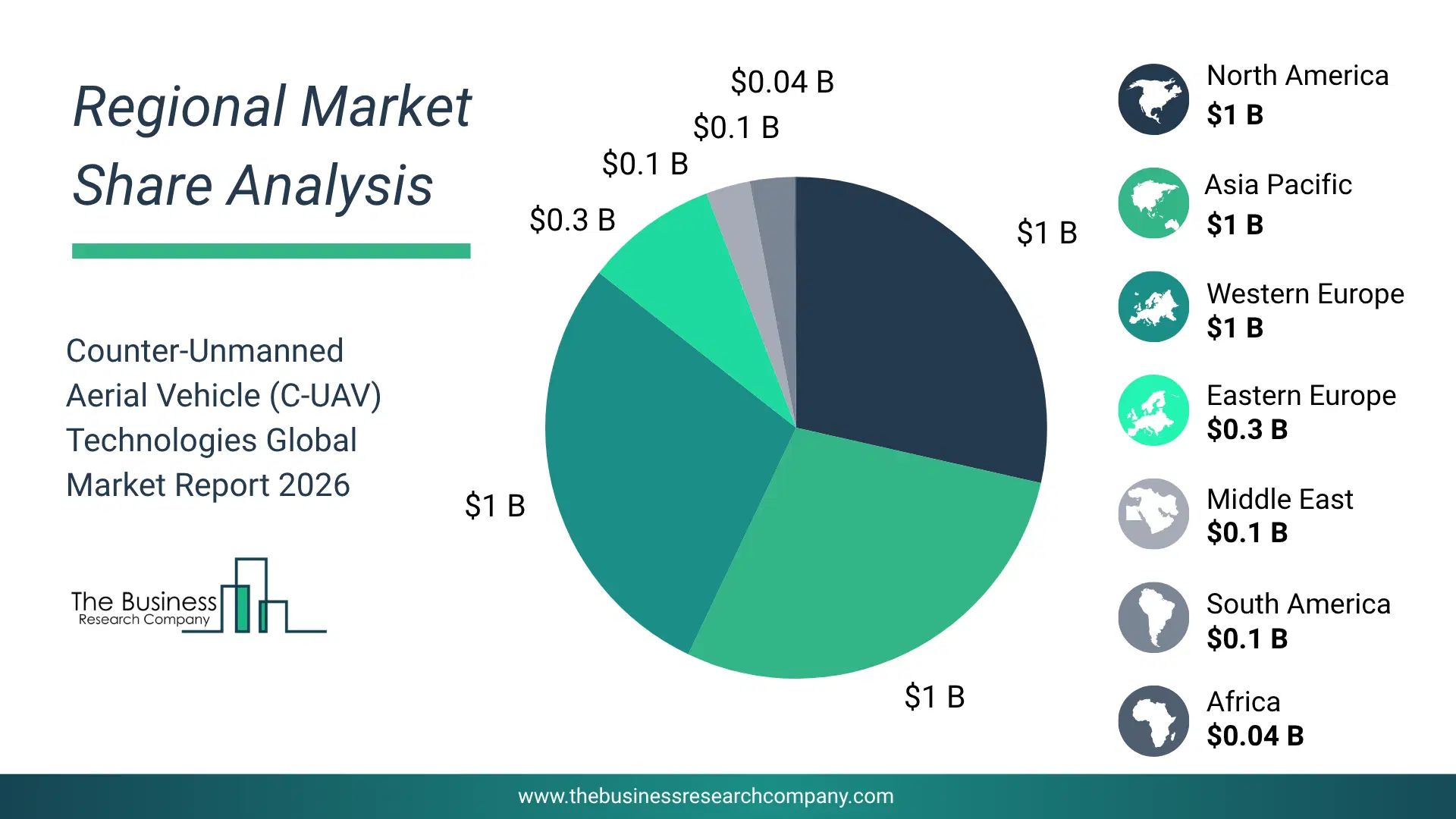
Regional Insights
North America was the largest region in the counter unmanned aerial vehicle (UAV) technologies market in 2025. Asia-Pacific is expected to be the fastest-growing region in the forecast period. The regions covered in this market report are Asia-Pacific, South East Asia, Western Europe, Eastern Europe, North America, South America, Middle East, Africa. The countries covered in this market report are Australia, Brazil, China, France, Germany, India, Indonesia, Japan, Taiwan, Russia, South Korea, UK, USA, Canada, Italy, SpainWhat Defines the Counter Unmanned Aerial Vehicle (UAV) Technologies Market?
The counter unmanned aerial vehicle (UAV) technologies market consists of revenues earned by entities by providing services such as drone detection, drone tracking, threat assessment, jamming services, drone neutralization, surveillance and monitoring, cybersecurity solutions, risk management, and training and consultancy. The counter unmanned aerial vehicle (UAV) technologies market also consists of sales of radio frequency jammers, global positioning system jammers, radar systems, directed energy weapons, net guns, drone capture drones, anti-drone drones, and signal detectors. Values in this market are ‘factory gate’ values, that is, the value of goods sold by the manufacturers or creators of the goods, whether to other entities (including downstream manufacturers, wholesalers, distributors, and retailers) or directly to end customers. The value of goods in this market includes related services sold by the creators of the goods.How is Market Value Defined and Measured?
The market value is defined as the revenues that enterprises gain from the sale of goods and/or services within the specified market and geography through sales, grants, or donations in terms of the currency (in USD unless otherwise specified). The revenues for a specified geography are consumption values that are revenues generated by organizations in the specified geography within the market, irrespective of where they are produced. It does not include revenues from resales along the supply chain, either further along the supply chain or as part of other products.
This chart presents market attractiveness based on a quantitative evaluation of growth, competition, strategic alignment, and risk, offering a clear view of opportunity areas for decision-making. This chart is for illustrative purposes; the full report contains the complete analysis.

This chart highlights the Total Addressable Market (TAM) by estimating the maximum revenue opportunity using an assumption-driven approach, supporting strategic planning and opportunity sizing across markets. The chart is illustrative; the full report provides a more comprehensive analysis.
What Key Data and Analysis Are Included in the Counter Unmanned Aerial Vehicle (UAV) Technologies Market Report 2026?
The counter unmanned aerial vehicle (uav) technologies market research report is one of a series of new reports from The Business Research Company that provides market statistics, including industry global market size, regional shares, competitors with the market share, detailed market segments, market trends and opportunities, and any further data you may need to thrive in the counter unmanned aerial vehicle (uav) technologies industry. The market research report delivers a complete perspective of everything you need, with an in-depth analysis of the current and future state of the industry.Counter Unmanned Aerial Vehicle (UAV) Technologies Market Report Forecast Analysis
| Report Attribute | Details |
|---|---|
| Market Size Value In 2026 | $2.06 billion |
| Revenue Forecast In 2030 | $3.36 billion |
| Growth Rate | CAGR of 13.3% from 2026 to 2030 |
| Base Year For Estimation | 2025 |
| Actual Estimates/Historical Data | 2020-2025 |
| Forecast Period | 2026 - 2030 - 2035 |
| Market Representation | Revenue in USD Billion and CAGR from 2026 to 2030 |
| Segments Covered | Type, Technology, System Range, Application |
| Regional Scope | Asia-Pacific, Western Europe, Eastern Europe, North America, South America, Middle East, Africa |
| Country Scope | The countries covered in the report are Australia, Brazil, China, France, Germany, India, Indonesia, Japan, Taiwan, Russia, South Korea, UK, USA, Canada, Italy, Spain. |
| Key Companies Profiled | Raytheon Technologies Corporation Inc., Lockheed Martin Corporation Inc., Northrop Grumman Corporation Inc., Honeywell International Inc., L3Harris Technologies Inc., Rheinmetall AG Inc., CACI International Inc., Battelle Inc., Elbit Systems Ltd., Israel Aerospace Industries Ltd., Saab AB Inc., Rohde & Schwarz India Pvt. Ltd., Thales Group Inc., SRC Inc., Zen Technologies Ltd., Robin Radar Systems Ltd., Adani Defence & Aerospace Ltd., DroneShield Ltd., Aaronia AG Ltd., Drone Defence Services Ltd., METIS Aerospace Ltd., AUDS (Anti-UAV Defence System) Ltd., Paras Aerospace Pvt. Ltd. |
| Customization Scope | Request for Customization |
| Pricing And Purchase Options | Explore Purchase Options |