
Crack Free Concrete Market Report 2026
Global Outlook – By Type (Conventional Aggregate, Lightweight Aggregate, Other Types), By Mix Design (Shrinkage Reducing Admixtures, Shrinkage Compensating Cement), By Reinforcement (Carbon Nano Fibers, Asphalt, Rubber, Other Reinforcements), By Application (Industrial, Construction, Other Applications) – Market Size, Trends, Strategies, and Forecast to 2030
Crack Free Concrete Market Overview
• Crack Free Concrete market size has reached to $147.74 billion in 2025 • Expected to grow to $197.46 billion in 2030 at a compound annual growth rate (CAGR) of 6.1% • Growth Driver: Construction Boom Fuels Surge In Crack-Free Concrete Market • Market Trend: Pioneering Crack-Free Concrete Solutions Transforming The Construction Landscape • North America was the largest region in 2025.What Is Covered Under Crack Free Concrete Market?
Crack-free concrete refers to concrete produced with an expanding agent, provided enough wet curing is performed. It is commonly used on industrial floors without wet curing and with control joints. The main types of crack-free concrete are conventional aggregate, lightweight aggregate, and others. Conventional aggregates are inert granular components like sand, gravel, or crushed stone, in addition to water and Portland cement, in a block of concrete. The various types of by-mix designs are involved, including shrinkage-reducing admixtures and shrinkage-compensating cement, with several types of reinforcement included, such as carbon nanofibers, asphalt, Rubber, and others. These are used for several applications, including industrial, construction, and others.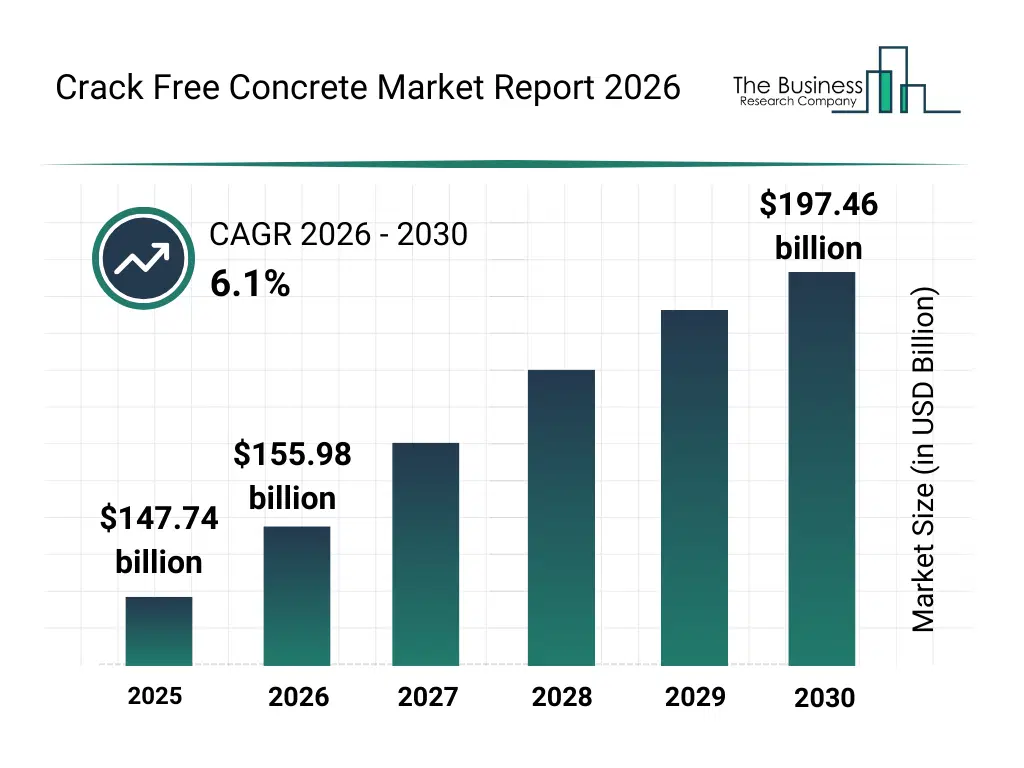
What Is The Crack Free Concrete Market Size and Share 2026?
The crack free concrete market size has grown strongly in recent years. It will grow from $147.74 billion in 2025 to $155.98 billion in 2026 at a compound annual growth rate (CAGR) of 5.6%. The growth in the historic period can be attributed to growing reliance on traditional concrete mixes, early adoption of shrinkage-compensating formulations, increased demand for industrial flooring durability, rising use of natural and crushed stone aggregates, development of basic resin injection repair techniques.What Is The Crack Free Concrete Market Growth Forecast?
The crack free concrete market size is expected to see strong growth in the next few years. It will grow to $197.46 billion in 2030 at a compound annual growth rate (CAGR) of 6.1%. The growth in the forecast period can be attributed to expanding use of advanced reinforcement materials like carbon nano fibers, rising adoption of high-performance specialty aggregates, growth in demand for crack-free concrete for large-scale industrial projects, increasing development of innovative admixture technologies, wider application of resin injection systems in modern construction. Major trends in the forecast period include increasing use of shrinkage-reducing and compensating concrete mix designs, growing adoption of lightweight and specialty aggregates for crack-free applications, rising demand for advanced resin injection solutions in industrial flooring, expansion of carbon nano fiber and rubber reinforcement usage, higher utilization of crack-free concrete in rapid and large-scale construction projects.
Global Crack Free Concrete Market Segmentation
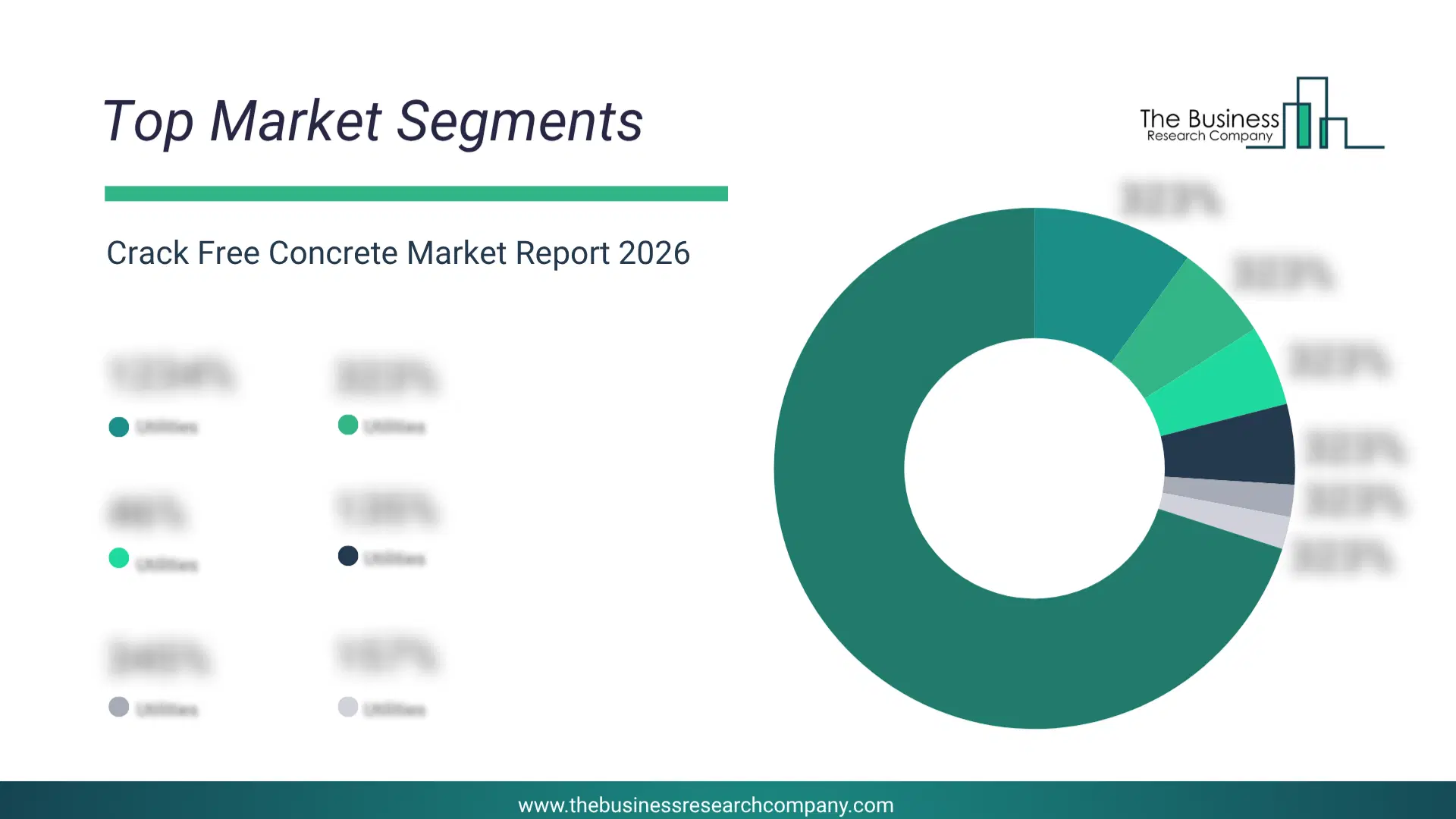
1) By Type: Conventional Aggregate, Lightweight Aggregate, Other Types 2) By Mix Design: Shrinkage Reducing Admixtures, Shrinkage Compensating Cement 3) By Reinforcement: Carbon Nano Fibers, Asphalt, Rubber, Other Reinforcements 4) By Application: Industrial, Construction, Other Applications Subsegments: 1) By Conventional Aggregate: Natural Aggregates, Crushed Stone Aggregates 2) By Lightweight Aggregate: Expanded Clay Aggregates, Expanded Polystyrene (EPS) Aggregates, Pumice Aggregates 3) By Other Types: Recycled Aggregates, Specialty Aggregates, High-Performance AggregatesWhat Is The Driver Of The Crack Free Concrete Market?
The growing construction industry is expected to propel the growth of the crack-free concrete market going forward. Construction refers to constructing, changing, repairing, renovating, enhancing, or destroying an infrastructure establishment, including any general framework, public structure, or other enhancements to real property. The rise in construction work is boosting the crack-free concrete market as it is used to build substantial buildings, including bridges, dams, canals, highways, warehouses, and factories. For instance, in February 2025, according to the Office for National Statistics (ONS), a UK-based government department, construction output is estimated to have risen by 0.5% in the fourth quarter (October to December) of 2024 compared with the third quarter (July to September) of 2024, driven entirely by a 1.2% increase in new work. Therefore, the growing construction industry is driving the crack-free concrete market.Key Players In The Global Crack Free Concrete Market
Major companies operating in the crack free concrete market are BASF SE, Dow Chemical Company, Holcim, CRH Concrete A/S, HeidelbergCement, Cemex S.A.B. de C.V., Sika AG, Vulcan Materials Company, MDU Resources Group Inc., RPM International, Martin Marietta Materials, Votorantim Cimentos, Mapei S.p.A., W. R. Grace & Co.-Conn., Charah Solutions Inc., The Euclid Chemical Company, Xypex Chemical Corporation, Kryton International, Penetron International, Oscrete Construction Products, CarbonBuilt, Fosroc, Akzo Nobel N.V., Hycrete Inc., GCP Applied Technologies, Ameron International Co., Buzzi Unicem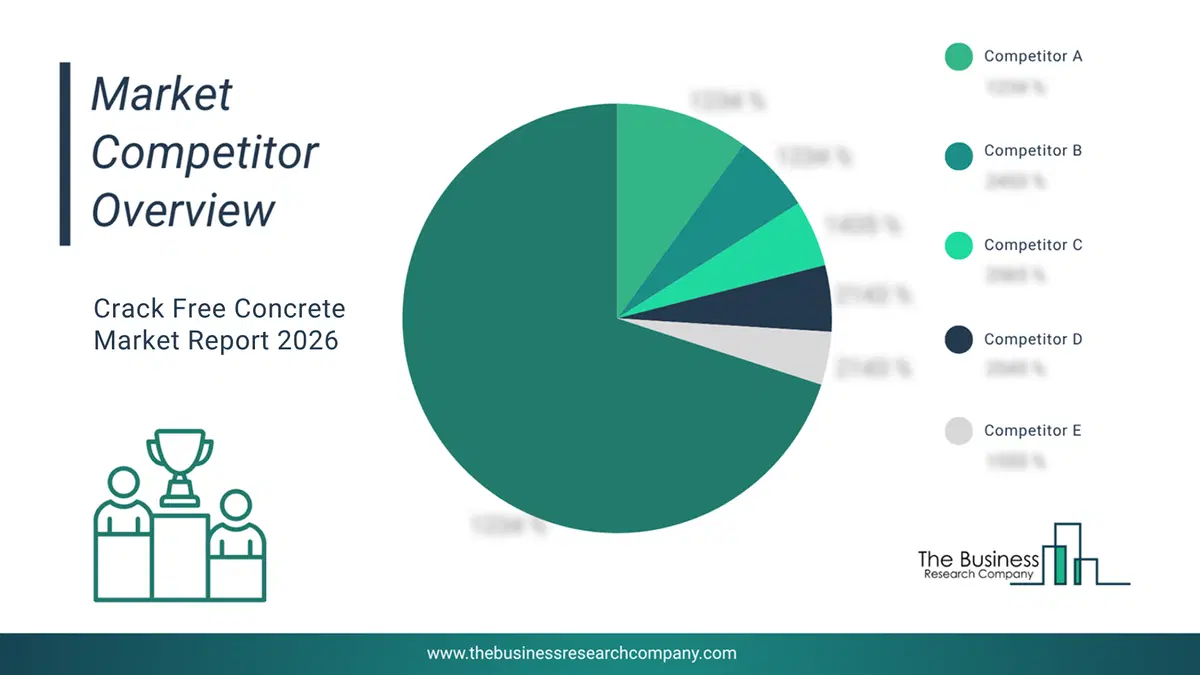
This chart is for illustrative purposes; the full report includes a detailed competitor analysis and comprehensive overview of the top 10 companies in the market.
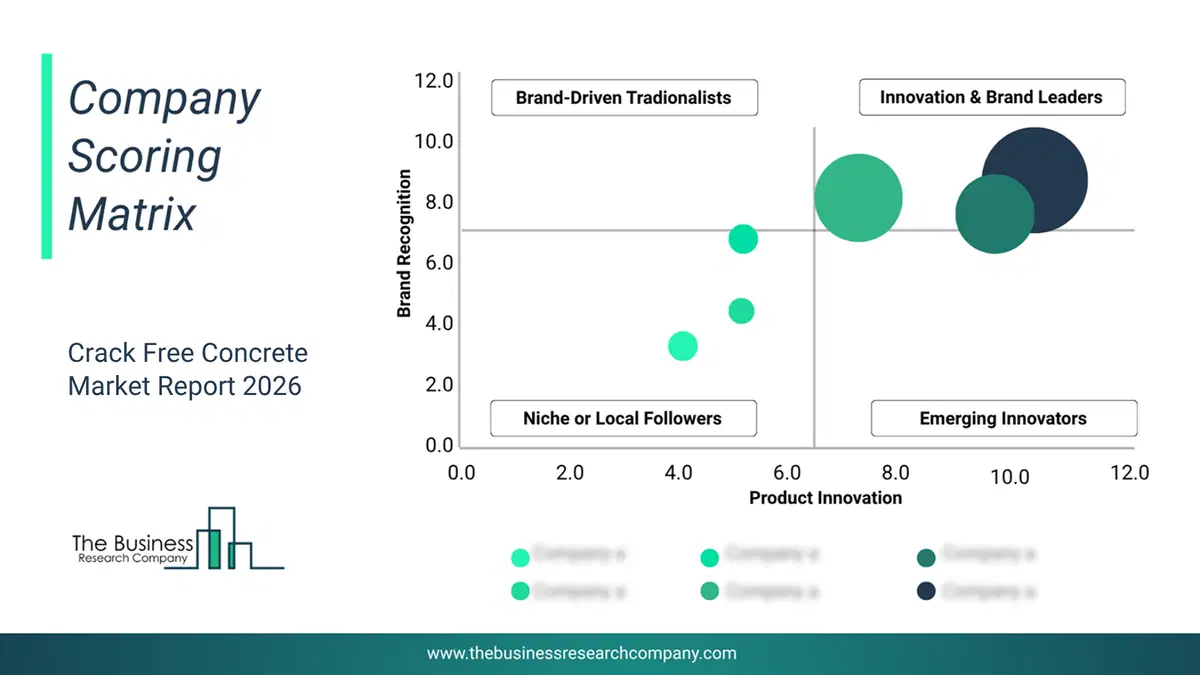
This chart maps companies by product innovation and brand strength, with bubble size indicating relative revenue, helping identify market leaders, challengers, and niche players. This is an illustrative chart; the full report provides a complete and accurate competitive analysis.
Global Crack Free Concrete Market Trends and Insights
Major companies operating in the crack free concrete market are focusing on developing innovative solutions, such as fibre reinforced cement compositions, to meet the rising demand for longer lasting, low maintenance infrastructure in the face of expanding urbanization, heavy infrastructure investment, and stricter building codes. Fibre reinforced cement compositions incorporate microscopic fibres (such as synthetic or steel fibres) embedded within the cement matrix to control micro crack formation, reduce shrinkage and permeability, and enhance toughness and durability compared with traditional plain or OPC based concretes, which are more prone to crack propagation under stress or thermal movement. For instance, in September 2023, Nuvoco Vistas, an India-based cement company, launched Duraguard Microfibre fiber reinforced cement. This cement's clinker contains 48-52% tricalcium silicate and low tricalcium aluminate, which enhances its performance compared to ordinary Portland cement (OPC). It incorporates electrostatically precipitated dry fly ash, contributing to improved bonding and crack resistance. The cement offers greater strength and durability while reducing permeability, making it more resilient in various applications. Additionally, it provides a smoother surface finish, ideal for high-quality construction projects.What Are Latest Mergers And Acquisitions In The Crack Free Concrete Market?
In May 2023, Sika, a Switzerland-based chemicals company, acquired MBCC Group for an undisclosed amount. Sika sought to enhance its presence in the concrete construction market by acquiring MBCC Group's expertise and product portfolio. The acquisition emphasized innovation and sustainability as key areas of focus. MBCC Group is a Germany-based company that manufactures products that contribute to crack-free concrete.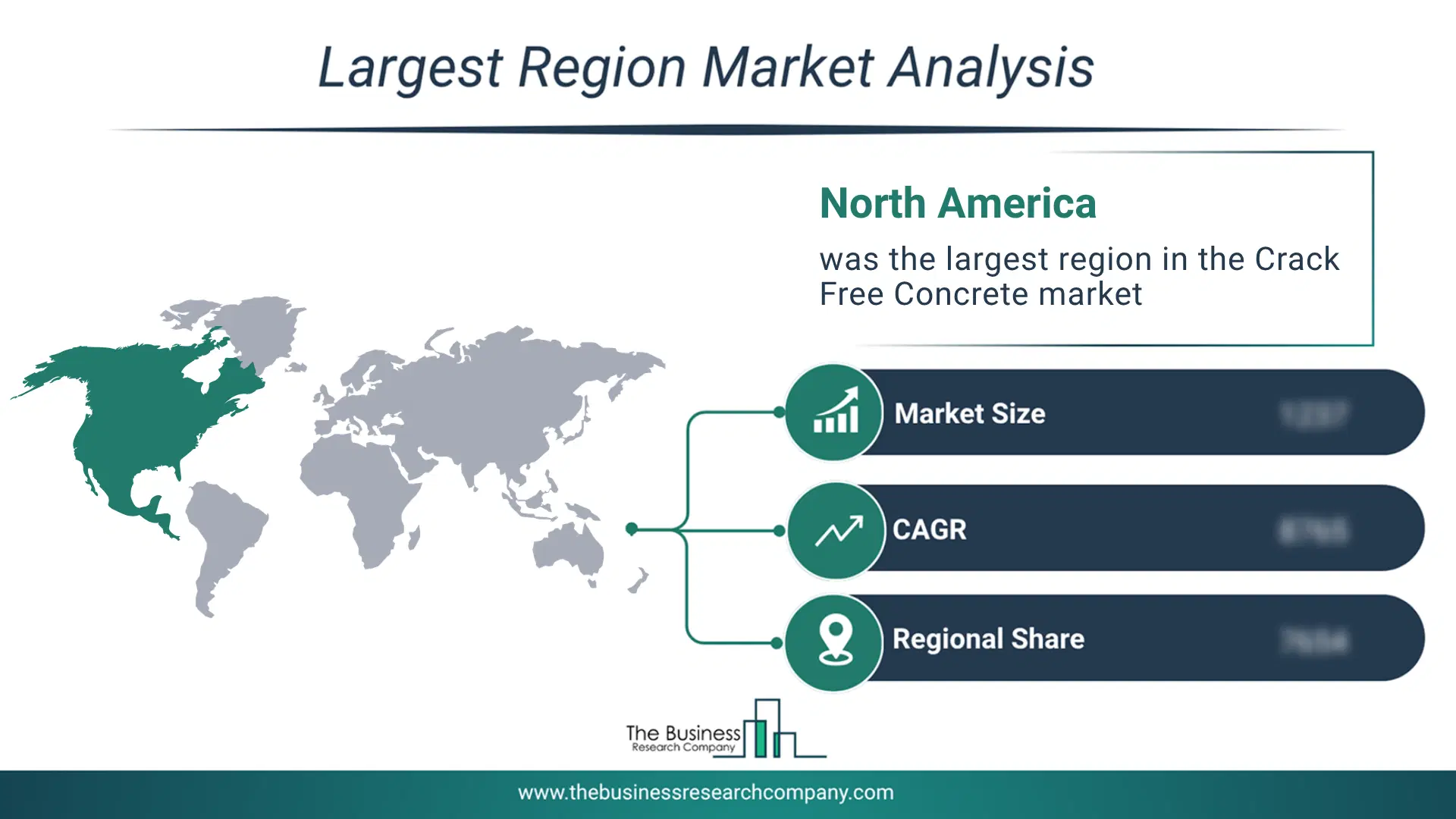
Regional Insights
North America was the largest region in the crack-free concrete market in 2025. The regions covered in this market report are Asia-Pacific, South East Asia, Western Europe, Eastern Europe, North America, South America, Middle East, Africa. The countries covered in this market report are Australia, Brazil, China, France, Germany, India, Indonesia, Japan, Taiwan, Russia, South Korea, UK, USA, Canada, Italy, Spain.What Defines the Crack Free Concrete Market?
The crack-free concrete market consists of sales of epoxy resin injected, polyurethane injected, and acrylate resin injected crack-free concretes. Values in this market are ‘factory gate’ values, that is the value of goods sold by the manufacturers or creators of the goods, whether to other entities (including downstream manufacturers, wholesalers, distributors and retailers) or directly to end customers. The value of goods in this market includes related services sold by the creators of the goods.How is Market Value Defined and Measured?
The market value is defined as the revenues that enterprises gain from the sale of goods and/or services within the specified market and geography through sales, grants, or donations in terms of the currency (in USD unless otherwise specified). The revenues for a specified geography are consumption values that are revenues generated by organizations in the specified geography within the market, irrespective of where they are produced. It does not include revenues from resales along the supply chain, either further along the supply chain or as part of other products.
This chart presents market attractiveness based on a quantitative evaluation of growth, competition, strategic alignment, and risk, offering a clear view of opportunity areas for decision-making. This chart is for illustrative purposes; the full report contains the complete analysis.

This chart highlights the Total Addressable Market (TAM) by estimating the maximum revenue opportunity using an assumption-driven approach, supporting strategic planning and opportunity sizing across markets. The chart is illustrative; the full report provides a more comprehensive analysis.
What Key Data and Analysis Are Included in theCrack Free Concrete Market Report 2026?
The crack free concrete market research report is one of a series of new reports from The Business Research Company that provides market statistics, including industry global market size, regional shares, competitors with the market share, detailed market segments, market trends and opportunities, and any further data you may need to thrive in the crack free concrete industry. The market research report delivers a complete perspective of everything you need, with an in-depth analysis of the current and future state of the industry.Crack Free Concrete Market Report Forecast Analysis
| Report Attribute | Details |
|---|---|
| Market Size Value In 2026 | $155.98 billion |
| Revenue Forecast In 2030 | $197.46 billion |
| Growth Rate | CAGR of 5.6% from 2026 to 2030 |
| Base Year For Estimation | 2025 |
| Actual Estimates/Historical Data | 2020-2025 |
| Forecast Period | 2026 - 2030 |
| Market Representation | Revenue in USD Billion and CAGR from 2026 to 2030 |
| Segments Covered | Type, Mix Design, Reinforcement, Application |
| Regional Scope | Asia-Pacific, Western Europe, Eastern Europe, North America, South America, Middle East, Africa |
| Country Scope | The countries covered in this market report are Australia, Brazil, China, France, Germany, India, Indonesia, Japan, Taiwan, Russia, South Korea, UK, USA, Canada, Italy, Spain |
| Key Companies Profiled | BASF SE, Dow Chemical Company, Holcim, CRH Concrete A/S, HeidelbergCement, Cemex S.A.B. de C.V., Sika AG, Vulcan Materials Company, MDU Resources Group Inc., RPM International, Martin Marietta Materials, Votorantim Cimentos, Mapei S.p.A., W. R. Grace & Co.-Conn., Charah Solutions Inc., The Euclid Chemical Company, Xypex Chemical Corporation, Kryton International, Penetron International, Oscrete Construction Products, CarbonBuilt, Fosroc, Akzo Nobel N.V., Hycrete Inc., GCP Applied Technologies, Ameron International Co., Buzzi Unicem |
| Customization Scope | Request for Customization |
| Pricing And Purchase Options | Explore Purchase Options |