
Crane Rail Market Report 2026
Global Outlook – By Product (Heavy Crane Rails, Light Crane Rails, Head-Hardened Crane Rails, Quenched & Tempered Crane Rails, Standard Crane Rails), By Material (Carbon Steel, Alloy Steel, Heat-Treated Steel), By Weight Carrying Capacity (Below 70 Kg/M Rail, 70 To 90 Kg/M Rail, 90 To 120 Kg/M Rail, Above 120 Kg/M Rail), By Application (Industrial Sector, Marine Sector, Logistic Sector, Mining Sector, Other Applications) – Market Size, Trends, Strategies, and Forecast to 2030
Crane Rail Market Overview
• Crane Rail market size has reached to $58.98 billion in 2025 • Expected to grow to $88.07 billion in 2030 at a compound annual growth rate (CAGR) of 8.5% • Growth Driver: Growth Of The Crane Rail Market Driven By Expanding Construction Industry • Market Trend: Advanced High-Strength Alloy Rail Technologies Driving Greater Load Capacity And Operational Durability • Asia-Pacific was the largest region and fastest growing region.What Is Covered Under Crane Rail Market?
A crane rail is a crane system of high-strength steel specifically built for use in projects for bridge building, regular maintenance, and tunneling. It is commonly employed in commercial and construction settings where big objects must be lifted and moved. The main products of crane rail are gantry cranes, overhead cranes, AS/RS systems, portal cranes, stacker or reclaimer cranes, stadium roofs, and rail-mounted tower cranes. Gantry cranes refer to large, powerful cranes designed with a large steel frame, or gantry, which spans an area and provides stability for the crane, which is used in industrial and shipping settings to lift and move heavy loads. They are made of steel, aluminum, and others with carrying capacities of below 70 kg/m rail, 70 to 90 kg/m rail, 90 to 120 kg/m rail, and above 120 kg/m rail weight, used for the industrial sector, marine sector, logistic sector, mining sector, and others.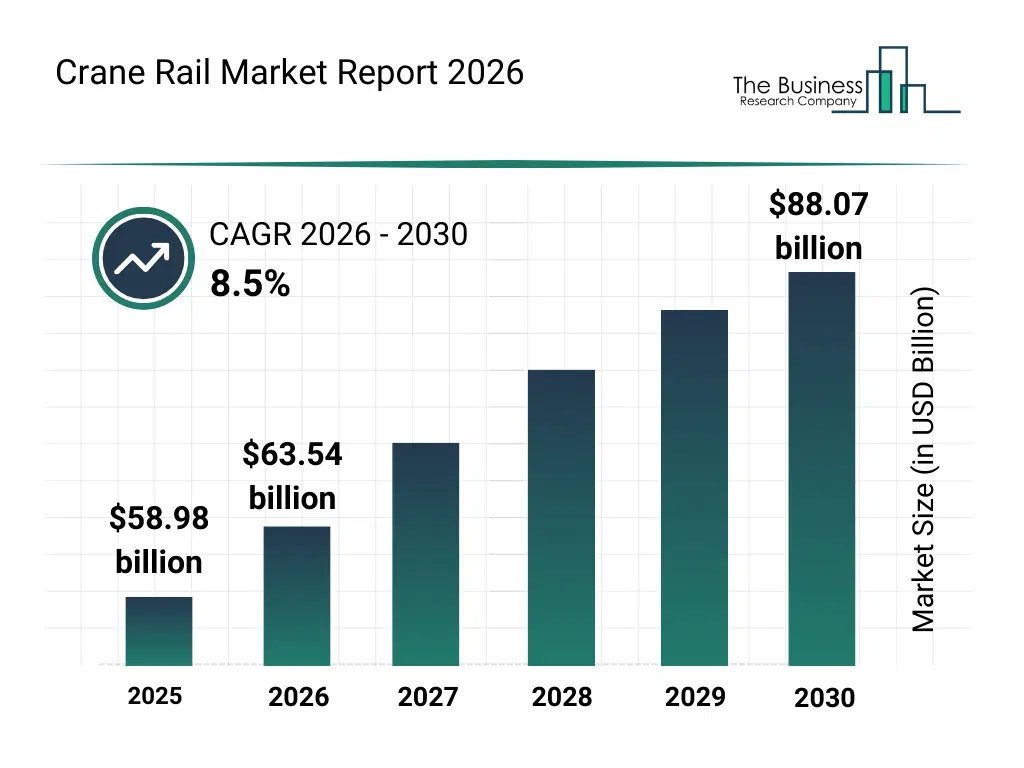
What Is The Crane Rail Market Size and Share 2026?
The crane rail market size has grown strongly in recent years. It will grow from $58.98 billion in 2025 to $63.54 billion in 2026 at a compound annual growth rate (CAGR) of 7.7%. The growth in the historic period can be attributed to infrastructure expansion in industrial and logistics sectors, growth of heavy material handling operations, rising use of gantry and overhead cranes, availability of standardized rail profiles, increasing investments in port infrastructure.What Is The Crane Rail Market Growth Forecast?
The crane rail market size is expected to see strong growth in the next few years. It will grow to $88.07 billion in 2030 at a compound annual growth rate (CAGR) of 8.5%. The growth in the forecast period can be attributed to expansion of smart port development projects, rising demand for automated material handling systems, growth in mining and tunneling activities, increasing use of high-capacity cranes, focus on long-life rail solutions. Major trends in the forecast period include increasing use of high-strength steel crane rails, rising demand for heavy load-bearing rail systems, expansion of rail-mounted crane infrastructure, growing adoption in mining and port applications, enhanced focus on rail durability and safety.Tariff Impact On Crane Rail Market
Tariffs are significantly impacting the crane rail market by increasing the cost of imported high-strength steel rails, alloy materials, precision-machined rail sections, and related fastening components used in heavy-duty crane systems. Industrial, marine, and mining applications in regions such as Asia-Pacific, Europe, and North America are most affected due to their reliance on imported specialty steel and fabricated rail products. These tariffs are raising overall project costs, delaying infrastructure timelines, and increasing procurement complexity for large-scale construction and port development projects. However, tariffs are also encouraging domestic steel production, regional rail manufacturing investments, and the development of alternative rail materials that enhance long-term supply security.
Global Crane Rail Market Segmentation
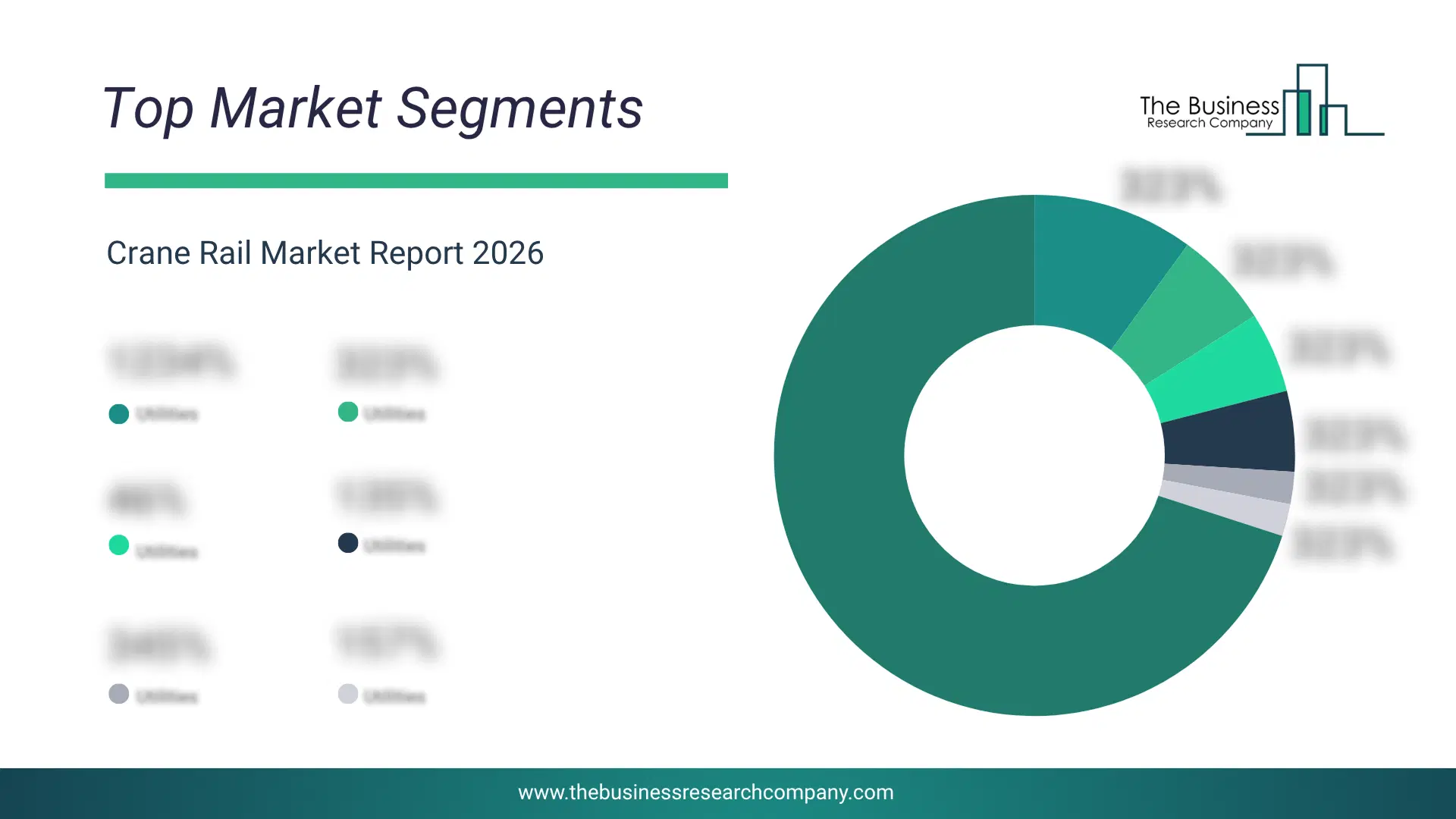
1) By Product: Heavy Crane Rails, Light Crane Rails, Head-Hardened Crane Rails, Quenched & Tempered Crane Rails, Standard Crane Rails 2) By Material: Carbon Steel, Alloy Steel, Heat-Treated Steel 3) By Weight Carrying Capacity: Below 70 Kg/M Rail, 70 To 90 Kg/M Rail, 90 To 120 Kg/M Rail, Above 120 Kg/M Rail 4) By Application: Industrial Sector, Marine Sector, Logistic Sector, Mining Sector, Other Applications Subsegments: 1) By Heavy Crane Rails: Rails For Gantry Cranes, Ship-To-Shore Cranes, Stacker-Reclaimers 2) By Light Crane Rails: Rails Designed For Workshop Cranes, Light Industrial Cranes 3) By Head-Hardened Crane Rails: High-Wear Resistance Rails Suitable For High-Load And High-Cycle Operations 4) By Quenched And Tempered Crane Rails: High-Strength Rails Engineered For Extreme Load And High-Impact Operating Conditions 5) By Standard Crane Rails: Conventional Crane Rails Used For General Crane Movement And Handling ApplicationsWhat Is The Driver Of The Crane Rail Market?
The increasing construction industry is expected to drive the growth of the crane rail market forward. The construction industry refers to a wide range of activities related to the planning, design, development, construction, renovation, and maintenance of physical structures and infrastructure. Crane rails are extensively used in the construction industry to provide a stable, versatile, and efficient platform for crane operation. They enhance safety, improve productivity, and facilitate the safe and efficient movement of heavy materials. For instance, in May 2024, according to the Office for National Statistics, a UK-based independent producer of official statistics, construction new orders rose by 15.9% to $1,908 million (£1,436 million) in Q1 2024 compared to Q4 2023. This increase was primarily driven by a 27.9% rise in private commercial new work, amounting to $930 million (£700 million), and a 43.8% jump in public other new work, totaling $712.2 million (£536 million). Therefore, the increasing construction industry is expected to propel the growth of the crane rail industry.Key Players In The Global Crane Rail Market
Major companies operating in the crane rail market are EVRAZ plc, ArcelorMittal S.A., Steel Authority of India Limited, Nippon Steel & Sumitomo Metal Corporation, British Steel Corporation plc, Jindal Steel & Power Ltd., Metinvest Holding Company LLC, China Baowu Steel Group Co. Ltd., HBIS Group Co. Ltd., POSCO, JFE Holdings Inc., Tata Steel Limited, Nucor Corporation, Hyundai Steel Company, Voestalpine AG, SSAB AB, Gerdau S.A., Steel Dynamics Inc., Maanshan Iron and Steel Company Limited, Celsa Group, Hebei Iron and Steel Group Co. Ltd.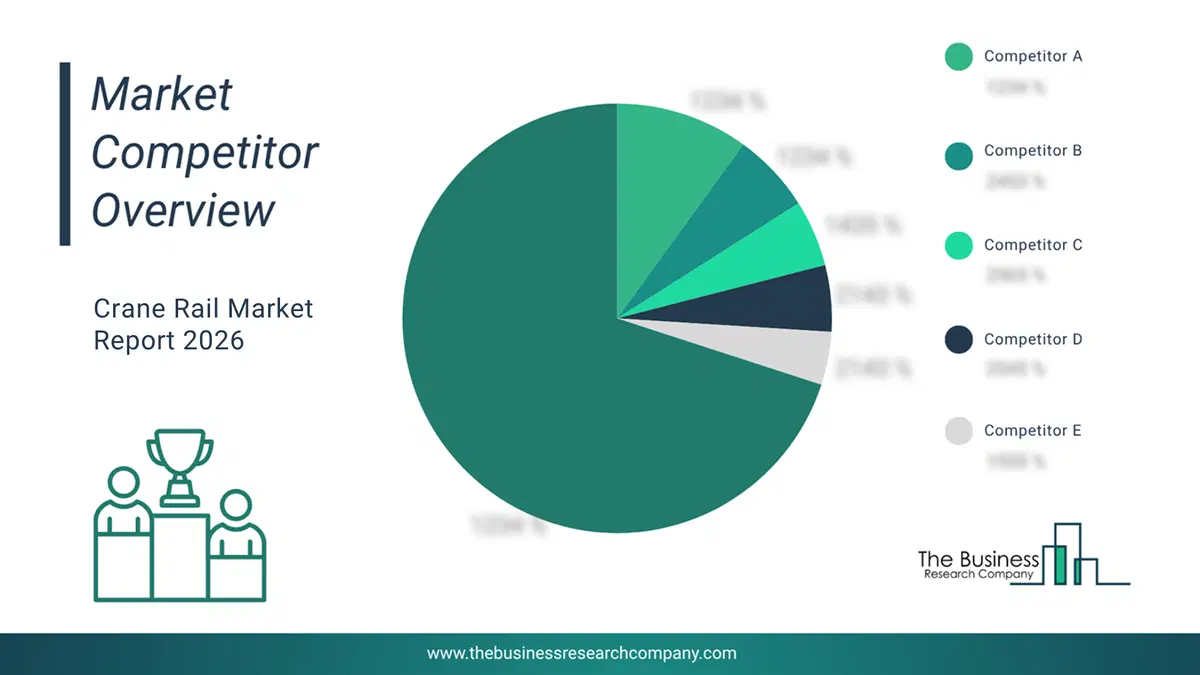
This chart is for illustrative purposes; the full report includes a detailed competitor analysis and comprehensive overview of the top 10 companies in the market.
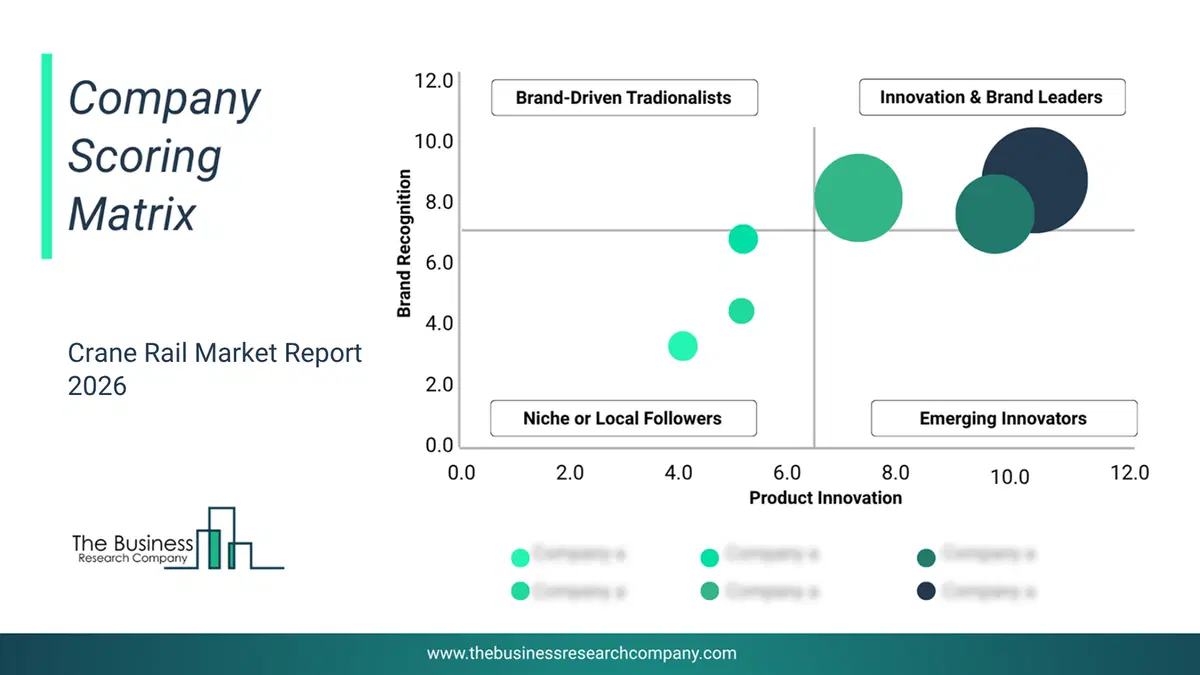
This chart maps companies by product innovation and brand strength, with bubble size indicating relative revenue, helping identify market leaders, challengers, and niche players. This is an illustrative chart; the full report provides a complete and accurate competitive analysis.
Global Crane Rail Market Trends and Insights
Major companies operating in the crane rail market are focusing on technological advancements, such as high‑strength alloy rails with improved metallurgical grades (e.g. upgraded steel compositions like the R340 crane rail) to meet the rising demand for heavier‑load industrial cranes, intensive port/shipyard operations, and large-scale infrastructure expansion in logistics, mining and manufacturing sectors across Asia‑Pacific, Europe, and North America. The R340 crane rail refers to a steel rail manufactured with a customized alloy composition and a specially optimized rolling and air‑cooling process that increases hardness, wear resistance and mechanical strength compared to traditional rails. This enhanced metallurgical profile extends rail service life considerably under heavy‑load conditions, resulting in lower maintenance frequency and reduced total cost of ownership. For instance, in June 2024, ArcelorMittal, a Luxembourg‑based steel‑production company, launched the R340 crane rail an advanced, heavy‑duty rail grade engineered for demanding crane applications. The R340 rail combines a proprietary micro‑alloyed steel composition with optimized rolling and cooling, delivering superior wear performance under accelerated wear tests, benchmarked against conventional crane rails, thereby offering a notably extended service life for heavy‑load crane operations. Its unique features encompass improved hardness and fatigue resistance, predictable wear characteristics, and compatibility with heavy overhead and gantry cranes handling large loads and continuous cycles. Typical applications include port container handling cranes, shipyard cranes, heavy industrial overhead cranes, and large warehouses, where durable, long‑lasting crane rails are critical for safety, reliability and cost‑effective operation.What Are Latest Mergers And Acquisitions In The Crane Rail Market?
In June 2023, Konecranes, is a Finland based company, acquired the industrial crane service operations of Norway’s Munck Cranes AS. Through this acquisition, Konecranes gains access to a sizable installed base of Munck industrial cranes through this acquisition, as well as new clients and expansion prospects for its Industrial Service and Equipment business unit. Munck Cranes AS is a Norway-based industrial crane and crane service provider.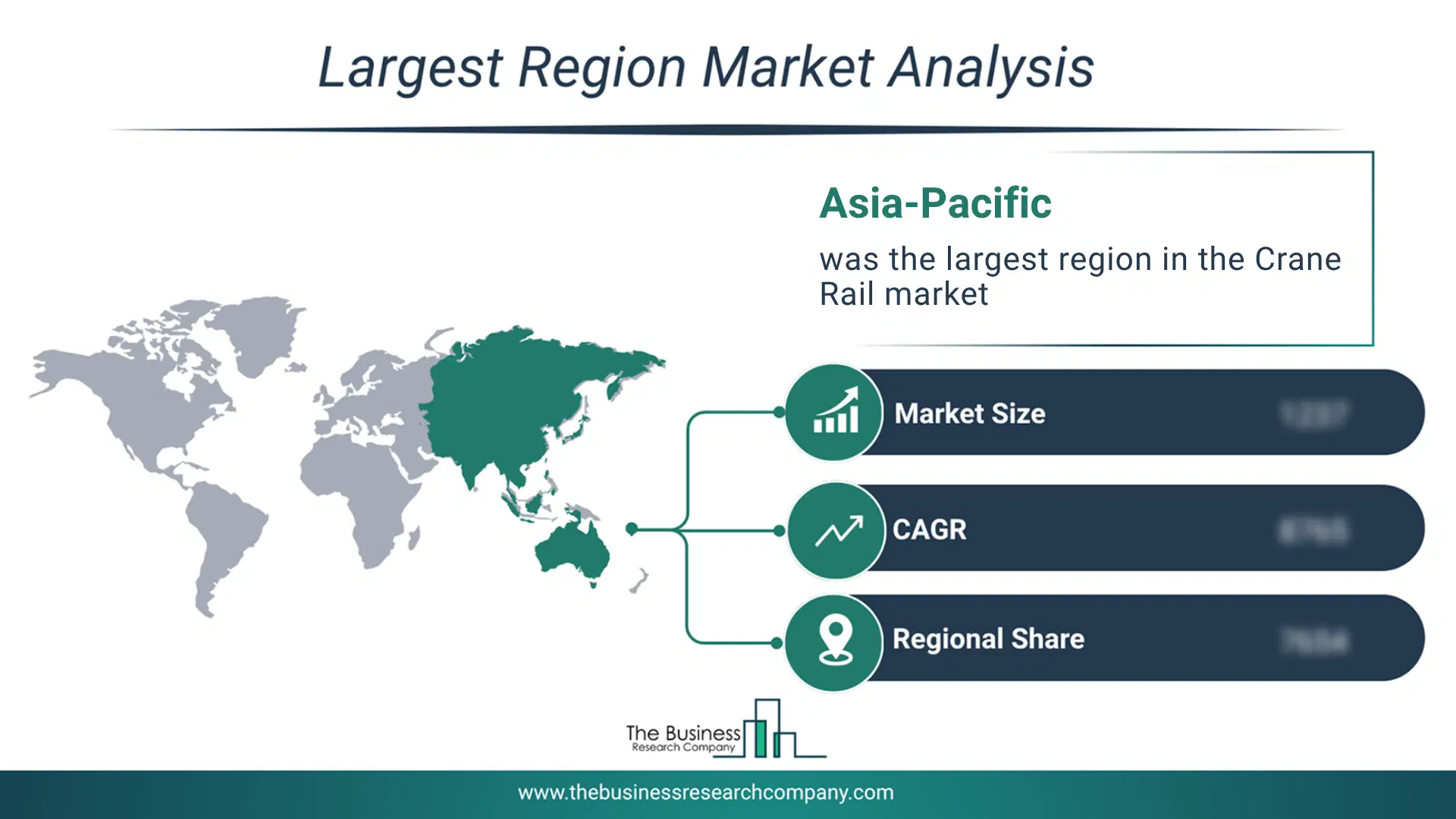
Regional Outlook
Asia-Pacific was the largest region in the crane rail market in 2025. Asia-Pacific is expected to be the fastest-growing region in the global crane rail market during the forecast period. The regions covered in this market report are Asia-Pacific, South East Asia, Western Europe, Eastern Europe, North America, South America, Middle East, Africa The countries covered in this market report are Australia, Brazil, China, France, Germany, India, Indonesia, Japan, Taiwan, Russia, South Korea, UK, USA, Canada, Italy, Spain.What Defines the Crane Rail Market?
The crane rail market consists of sales of light crane rails, heavy crane rails, and specialized crane rails. Values in this market are ‘factory gate’ values, that is the value of goods sold by the manufacturers or creators of the goods, whether to other entities (including downstream manufacturers, wholesalers, distributors, and retailers) or directly to end customers. The value of goods in this market includes related services sold by the creators of the goods.How is Market Value Defined and Measured?
The market value is defined as the revenues that enterprises gain from the sale of goods and/or services within the specified market and geography through sales, grants, or donations in terms of the currency (in USD unless otherwise specified). The revenues for a specified geography are consumption values that are revenues generated by organizations in the specified geography within the market, irrespective of where they are produced. It does not include revenues from resales along the supply chain, either further along the supply chain or as part of other products.
This chart presents market attractiveness based on a quantitative evaluation of growth, competition, strategic alignment, and risk, offering a clear view of opportunity areas for decision-making. This chart is for illustrative purposes; the full report contains the complete analysis.

This chart highlights the Total Addressable Market (TAM) by estimating the maximum revenue opportunity using an assumption-driven approach, supporting strategic planning and opportunity sizing across markets. The chart is illustrative; the full report provides a more comprehensive analysis.
What Key Data and Analysis Are Included in the Crane Rail Market Report 2026?
The crane rail market research report is one of a series of new reports from The Business Research Company that provides market statistics, including industry global market size, regional shares, competitors with the market share, detailed market segments, market trends and opportunities, and any further data you may need to thrive in the crane rail industry. The market research report delivers a complete perspective of everything you need, with an in-depth analysis of the current and future state of the industry.Crane Rail Market Report Forecast Analysis
| Report Attribute | Details |
|---|---|
| Market Size Value In 2026 | $63.54 billion |
| Revenue Forecast In 2030 | $88.07 billion |
| Growth Rate | CAGR of 8.5% from 2026 to 2030 |
| Base Year For Estimation | 2025 |
| Actual Estimates/Historical Data | 2020-2025 |
| Forecast Period | 2026 - 2030 |
| Market Representation | Revenue in USD Billion and CAGR from 2026 to 2030 |
| Segments Covered | Product, Material, Weight Carrying Capacity, Application |
| Regional Scope | Asia-Pacific, Western Europe, Eastern Europe, North America, South America, Middle East, Africa |
| Key Companies Profiled | EVRAZ plc, ArcelorMittal S.A., Steel Authority of India Limited, Nippon Steel & Sumitomo Metal Corporation, British Steel Corporation plc, Jindal Steel & Power Ltd., Metinvest Holding Company LLC, China Baowu Steel Group Co. Ltd., HBIS Group Co. Ltd., POSCO, JFE Holdings Inc., Tata Steel Limited, Nucor Corporation, Hyundai Steel Company, Voestalpine AG, SSAB AB, Gerdau S.A., Steel Dynamics Inc., Maanshan Iron and Steel Company Limited, Celsa Group, Hebei Iron and Steel Group Co. Ltd. |
| Customization Scope | Request for Customization |
| Pricing And Purchase Options | Explore Purchase Options |