

CRISPR Gene Editing Market Report 2026
Global Outlook – By Type (CRISPR-Associated Nuclease (Cas Nuclease), Guide Ribonucleic Acid (RNA), Deoxyribonucleic Acid (DNA) Ligase, Restriction Endonuclease, Other Types), By Services (Design Tools, Plasmid And Vector, CRISPR-Associated Protein 9 (Cas9) And Guide Ribonucleic Acid (g-RNA), Delivery System Products, Other Services), By Technology (CRISPR Or Cas9, Zinc Finger Nucleases, Other Technologies), By Application (Agricultural, Biomedical, Industrial, Genome Engineering, Disease Models, Functional Genomics, Other Applications), By End User (Academic Institutes And Research Centers, Biotechnology Companies, Contract Research Organizations (CROs), Pharmaceutical And Biopharmaceutical Companies) - Market Size, Trends, Strategies, and Forecast to 2030
CRISPR Gene Editing Market Overview
• CRISPR Gene Editing market size has reached to $4.03 billion in 2025 • Expected to grow to $8.61 billion in 2030 at a compound annual growth rate (CAGR) of 16.3% • Growth Driver: Genetic Disorder Prevalence Fuels The CRISPR Gene Editing Market Growth • Market Trend: Innovative Gene Therapy Advancements Drive Growth in the CRISPR Gene Editing Market • North America was the largest region in 2025 and Asia-Pacific is the fastest growing region.What Is Covered Under CRISPR Gene Editing Market?
Clustered regularly interspaced short palindromic repeats (CRISPR) gene editing is a revolutionary biotechnology tool that enables precise modifications to the DNA of living organisms. This technology utilizes a natural defense mechanism found in bacteria, where sequences of DNA, known as CRISPR, are used to identify and cut specific genetic sequences. CRISPR gene editing allows for the addition, removal, or alteration of genetic material, making it a powerful technique for research, therapeutic applications, and potential treatments for genetic disorders. The main types of CRISPR gene editing include CRISPR-associated nuclease (cas nuclease), guide ribonucleic acid (RNA), deoxyribonucleic acid (DNA) ligase, restriction endonuclease, and others. CRISPR-Associated Nuclease, also known as Cas Nuclease, is a protein that functions as a molecular scissors, cutting specific DNA sequences targeted by CRISPR. This part focuses on the creation and use of Cas proteins for precise gene editing, with prospective applications in industries such as agriculture, medicine, and biotechnology. It provides various services, such as design tools, plasmid and vector, CRISPR-associated protein 9 (cas9) and guide ribonucleic acid (g-RNA), delivery system products, and others. It also provides several technologies, including clustered regularly interspaced short palindromic repeats CRISPR or cas9, zinc finger nucleases, and others for various applications such as agricultural, biomedical, industrial, genome engineering, disease models, functional genomics, and others. These are used by several end users, including academic institutes and research centers, biotechnology companies, contract research organizations (CROS), and pharmaceutical and biopharmaceutical companies.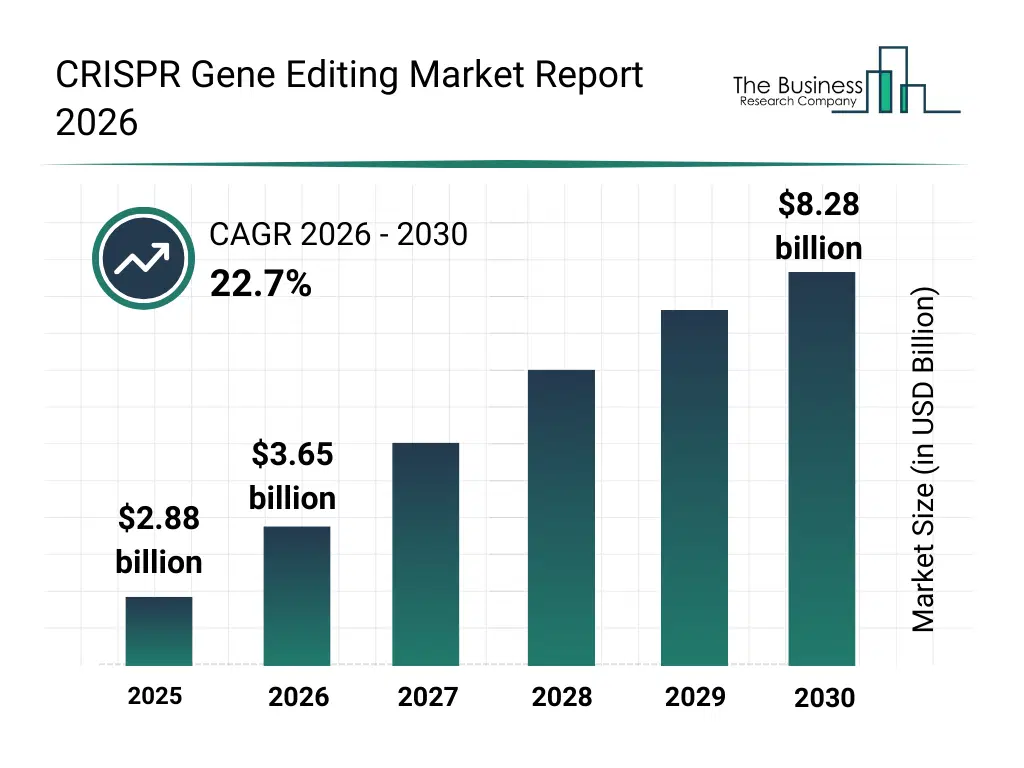
What Is The CRISPR Gene Editing Market Size and Share 2026?
The CRISPR gene editing market size has grown rapidly in recent years. It will grow from $4.03 billion in 2025 to $4.7 billion in 2026 at a compound annual growth rate (CAGR) of 16.7%. The growth in the historic period can be attributed to need for precise gene modification tools, limitations of earlier gene editing technologies, growth of genomics research, academic adoption, funding for genetic research.What Is The CRISPR Gene Editing Market Growth Forecast?
The crispr gene editing market size is expected to see rapid growth in the next few years. It will grow to $8.61 billion in 2030 at a compound annual growth rate (CAGR) of 16.3%. The growth in the forecast period can be attributed to approval of gene editing therapies, expansion of precision medicine, agricultural biotechnology growth, regulatory framework development, technological refinement of crispr systems. Major trends in the forecast period include rising clinical gene therapy research, expansion of agricultural gene editing, growth of functional genomics studies, advancements in delivery technologies, increasing focus on ethical and regulatory compliance.

Global CRISPR Gene Editing Market Segmentation
2) By Services: Design Tools, Plasmid And Vector, CRISPR-Associated Protein 9 (Cas9) And Guide Ribonucleic Acid (g-RNA), Delivery System Products, Other Services 3) By Technology: CRISPR Or Cas9, Zinc Finger Nucleases, Other Technologies 4) By Application: Agricultural, Biomedical, Industrial, Genome Engineering, Disease Models, Functional Genomics, Other Applications 5) By End User: Academic Institutes And Research Centers, Biotechnology Companies, Contract Research Organizations (CROs), Pharmaceutical And Biopharmaceutical Companies Subsegments: 1) By CRISPR-Associated Nuclease (Cas Nuclease): Cas9, Cas12, Cas13 2) By Guide Ribonucleic Acid (RNA): Single-Guide RNA (sgRNA), Dual-Guide RNA, Synthetic Guide RNA 3) By Deoxyribonucleic Acid (DNA) Ligase: T4 DNA Ligase, E. Coli DNA Ligase 4) By Restriction Endonuclease: Type II Restriction Enzymes, Type I And III Restriction Enzymes 5) By Other Types: CRISPR Delivery Systems, CRISPR Plasmids, CRISPR-Based Diagnostic ToolsWhat Is The Driver Of The CRISPR Gene Editing Market?
The increasing prevalence of genetic disorders is expected to propel the growth of the CRISPR gene editing market going forward. A genetic disorder is a health problem caused by genome abnormalities, which include mutations in a single gene (monogenic), multiple genes (polygenic), or chromosomal abnormalities. The prevalence of genetic disorders is increasing due to genetic mutations, aging populations, and consanguineous marriage. CRISPR gene editing significantly aids in managing genetic disorders by providing precise and targeted modifications to the DNA. Further, scientists use CRISPR to identify and correct specific mutations causing genetic disorders, restore normal function, and alleviate disease symptoms, as seen in conditions such as cystic fibrosis and sickle cell anaemia. For instance, in October 2025, according to the Cystic Fibrosis Trust, a UK-based charity dedicated to supporting people with cystic fibrosis, in 2024, there were 164 new diagnoses of cystic fibrosis (CF), with 123 of these identified through newborn screening. By the end of 2024, there were 11,381 individuals registered with CF. Therefore, the increasing prevalence of genetic disorders is driving the growth of the CRISPR gene editing industry.Key Players In The Global CRISPR Gene Editing Market
Major companies operating in the crispr gene editing market are Crispr Therapeutics, Thermo Fisher Scientific, Intellia Therapeutics, Horizon Discovery, Synthego Corporation, Integrated DNA Technology (Danaher), Editas Medicine, GenScript, Agilent Technologies, New England Biolabs, CSIR-Institute of Genomics & Integrative Biology (IGIB), Strand Life Sciences Pvt. Ltd., Bio Palette Co. Ltd., Churchi Genome Engineering and Therapeutic Research Center, Beam Therapeutics Inc., Eurofins Genomics India, Setsurotech Co. Ltd., Merck Japan, Institut Pasteur, CureVac, Cellectis, BiovelocITA S.r.l., Evotec A.G., SNIPR Biome, Oxford Genetics, ERS Genomics, Alia Therapeutics, Solvo, BioTalentum, BIOCAD, BioVendor, Research & Diagnostic Products, Contipro, Lonza Biotec, Sotio, Selvita, BioVentures Institute Ltd, Sigma-Aldrich, Poseida Therapeutics, NanoCellect Biomedical, Sherlock Biosciences, Repare Therapeutics, Inscripta Inc., Santa Cruz Biotechnology, Caribou Biosciences Inc., Egenesis Inc., Homology Medicines, System Biosciences, Takara Bio USA Inc., Inari Agriculture Inc., Precision BioSciences, Cell Microsystems Inc., GeneCopoeia Inc., Merck KGaA, Origene Technologies Inc., Pluristem Therapeutics Inc.
This chart is for illustrative purposes; the full report includes a detailed competitor analysis and comprehensive overview of the top 10 companies in the market.

This chart maps companies by product innovation and brand strength, with bubble size indicating relative revenue, helping identify market leaders, challengers, and niche players. This is an illustrative chart; the full report provides a complete and accurate competitive analysis.
Global CRISPR Gene Editing Market Trends and Insights
Major companies operating in the CRISPR gene editing market are focusing on developing innovative products such as gene therapy to meet larger customer bases, more sales, and increase revenue. Gene therapy is a medical technique that uses genes to treat, prevent, or cure diseases and disorders. For instance, in December 2023, the US Food and Drug Administration (FDA), a US-based federal agency approved Casgevy, a cell-based gene therapy, for the treatment of sickle cell disease. Casgevy therapy utilizes CRISPR/Cas9, a type of genome editing technology. Hematopoietic stem cells are modified using CRISPR/Cas9 technology.What Are Latest Mergers And Acquisitions In The CRISPR Gene Editing Market?
In April 2024, Cellistic, a Belgium-based cell therapy platform provider, acquired Artisan Bio for an undisclosed amount. Through this acquisition, Cellistic aims to enhance its gene and cell therapy development capabilities by integrating Artisan Bio’s STAR-CRISPR Cas-12 gene-editing platform, enabling higher-precision genome modifications and advanced engineered cell therapy solutions. Artisan Bio is a US-based biotechnology company specializing in next-generation CRISPR gene-editing technologies.
Regional Outlook
North America was the largest region in the CRISPR gene editing market in 2025. Asia-Pacific is expected to be the fastest-growing region in the forecast period. The regions covered in this market report are Asia-Pacific, South East Asia, Western Europe, Eastern Europe, North America, South America, Middle East, Africa. The countries covered in this market report are Australia, Brazil, China, France, Germany, India, Indonesia, Japan, Taiwan, Russia, South Korea, UK, USA, Canada, Italy, Spain.What Defines the CRISPR Gene Editing Market?
The CRISPR gene editing market includes of revenues earned by entities by providing services such as gRNA design and vector construction, cell line and engineering, screening services, drug development services, and gene therapy. The market value includes the value of related goods sold by the service provider or included within the service offering. The CRISPR gene editing market also includes sales of gene editing vectors, laboratory equipment, kits and enzymes, libraries, design tools, antibodies, bioinformatics tools, and cell culture equipment. Values in this market are ‘factory gate’ values, that is the value of goods sold by the manufacturers or creators of the goods, whether to other entities (including downstream manufacturers, wholesalers, distributors and retailers) or directly to end customers. The value of goods in this market includes related services sold by the creators of the goods.How is Market Value Defined and Measured?
The market value is defined as the revenues that enterprises gain from the sale of goods and/or services within the specified market and geography through sales, grants, or donations in terms of the currency (in USD unless otherwise specified). The revenues for a specified geography are consumption values that are revenues generated by organizations in the specified geography within the market, irrespective of where they are produced. It does not include revenues from resales along the supply chain, either further along the supply chain or as part of other products.
This chart presents market attractiveness based on a quantitative evaluation of growth, competition, strategic alignment, and risk, offering a clear view of opportunity areas for decision-making. This chart is for illustrative purposes; the full report contains the complete analysis.

This chart highlights the Total Addressable Market (TAM) by estimating the maximum revenue opportunity using an assumption-driven approach, supporting strategic planning and opportunity sizing across markets. The chart is illustrative; the full report provides a more comprehensive analysis.
What Key Data and Analysis Are Included in the CRISPR Gene Editing Market Report 2026?
The crispr gene editing market research report is one of a series of new reports from The Business Research Company that provides market statistics, including industry global market size, regional shares, competitors with the market share, detailed market segments, market trends and opportunities, and any further data you may need to thrive in the crispr gene editing industry. The market research report delivers a complete perspective of everything you need, with an in-depth analysis of the current and future state of the industry.CRISPR Gene Editing Market Report Forecast Analysis
| Report Attribute | Details |
|---|---|
| Market Size Value In 2026 | $4.7 billion |
| Revenue Forecast In 2030 | $8.61 billion |
| Growth Rate | CAGR of 16.3% from 2026 to 2030 |
| Base Year For Estimation | 2025 |
| Actual Estimates/Historical Data | 2020-2025 |
| Forecast Period | 2026 - 2030 |
| Market Representation | Revenue in USD Billion and CAGR from 2026 to 2030 |
| Segments Covered | Type, Services, Technology, Application, End User |
| Regional Scope | Asia-Pacific, Western Europe, Eastern Europe, North America, South America, Middle East, Africa |
| Country Scope | The countries covered in the report are Australia, Brazil, China, France, Germany, India, Indonesia, Japan, Taiwan, Russia, South Korea, UK, USA, Canada, Italy, Spain. |
| Key Companies Profiled | Crispr Therapeutics, Thermo Fisher Scientific, Intellia Therapeutics, Horizon Discovery, Synthego Corporation, Integrated DNA Technology (Danaher), Editas Medicine, GenScript, Agilent Technologies, New England Biolabs, CSIR-Institute of Genomics & Integrative Biology (IGIB), Strand Life Sciences Pvt. Ltd., Bio Palette Co. Ltd., Churchi Genome Engineering and Therapeutic Research Center, Beam Therapeutics Inc., Eurofins Genomics India, Setsurotech Co. Ltd., Merck Japan, Institut Pasteur, CureVac, Cellectis, BiovelocITA S.r.l., Evotec A.G., SNIPR Biome, Oxford Genetics, ERS Genomics, Alia Therapeutics, Solvo, BioTalentum, BIOCAD, BioVendor, Research & Diagnostic Products, Contipro, Lonza Biotec, Sotio, Selvita, BioVentures Institute Ltd, Sigma-Aldrich, Poseida Therapeutics, NanoCellect Biomedical, Sherlock Biosciences, Repare Therapeutics, Inscripta Inc., Santa Cruz Biotechnology, Caribou Biosciences Inc., Egenesis Inc., Homology Medicines, System Biosciences, Takara Bio USA Inc., Inari Agriculture Inc., Precision BioSciences, Cell Microsystems Inc., GeneCopoeia Inc., Merck KGaA, Origene Technologies Inc., Pluristem Therapeutics Inc. |
| Customization Scope | Request for Customization |
| Pricing And Purchase Options | Explore Purchase Options |