
Critical Care Antiarrhythmic Drugs Market Report 2026
Global Outlook – By Type (Sodium Channel Blockers, Potassium Channel Blockers, Other Types), By Disease Type (Ventricular Arrhythmias, Supraventricular Arrhythmias), By Application (Hospitals, Other Applications) – Market Size, Trends, Strategies, and Forecast to 2030
Critical Care Antiarrhythmic Drugs Market Overview
• Critical Care Antiarrhythmic Drugs market size has reached to $1.06 billion in 2025 • Expected to grow to $1.39 billion in 2030 at a compound annual growth rate (CAGR) of 5.3% • Growth Driver: Growing Demand For Critical Care Antiarrhythmic Drugs Amid Rising Cardiovascular Disease Prevalence • Market Trend: Ultra‑Short‑Acting, Highly Selective Beta‑1 Blockers Offer Rapid Heart Rate Control With Minimal Side Effects In Critically Ill Patients • North America was the largest region in 2025 and Europe is the fastest growing region.What Is Covered Under Critical Care Antiarrhythmic Drugs Market?
Critical care antiarrhythmic drugs are medications used to treat life-threatening cardiac arrhythmias, such as ventricular fibrillation and ventricular tachycardia, in critical care settings. These drugs are administered intravenously and act rapidly to restore normal heart rhythm and prevent cardiac arrest. They are essential in emergencies and in intensive care units to stabilize patients with severe cardiac rhythm disturbances. The main types of critical care antiarrhythmic drugs are beta blockers, calcium channel blockers, sodium channel blockers, potassium channel blockers, and others. Beta-blockers are medications that work by blocking the effects of adrenaline, reducing heart rate and blood pressure. The diseases include ventricular arrhythmias, supraventricular arrhythmias, and others and it is used in various applications such as hospitals, clinics, ambulatory centers, and others.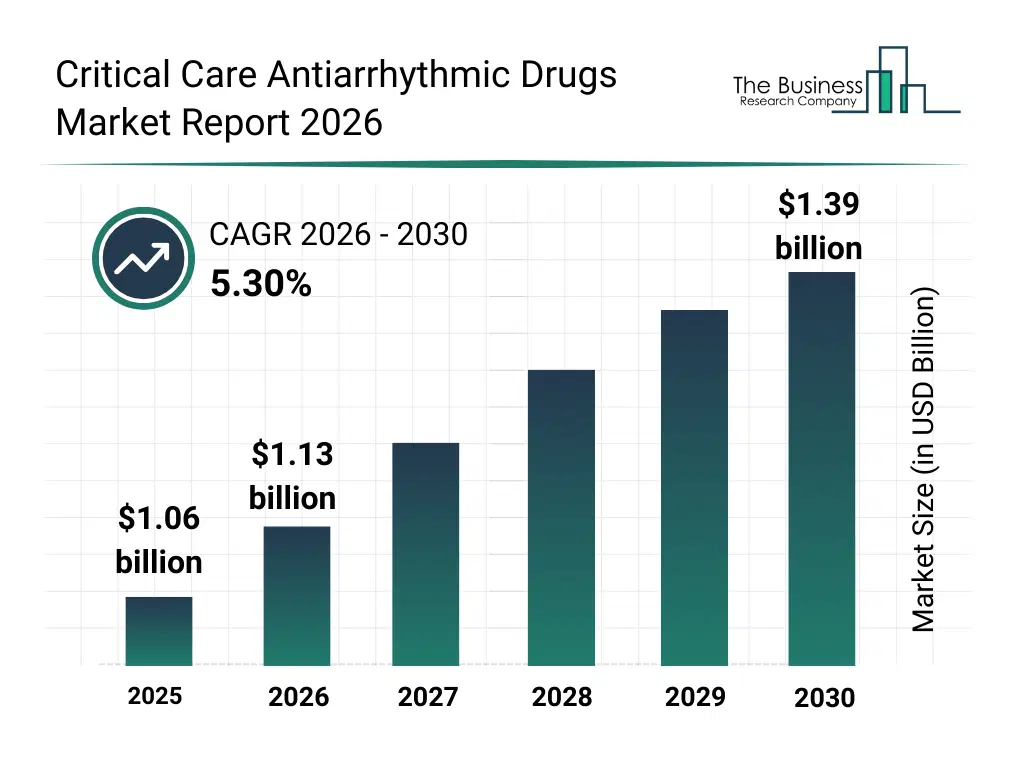
What Is The Critical Care Antiarrhythmic Drugs Market Size and Share 2026?
The critical care antiarrhythmic drugs market size has grown strongly in recent years. It will grow from $1.06 billion in 2025 to $1.13 billion in 2026 at a compound annual growth rate (CAGR) of 5.9%. The growth in the historic period can be attributed to high incidence of acute cardiac arrhythmias, established role of antiarrhythmic drugs in intensive care units, expansion of emergency cardiac care services, availability of proven intravenous drug formulations, growth in hospital-based critical care infrastructure.What Is The Critical Care Antiarrhythmic Drugs Market Growth Forecast?
The critical care antiarrhythmic drugs market size is expected to see strong growth in the next few years. It will grow to $1.39 billion in 2030 at a compound annual growth rate (CAGR) of 5.3%. The growth in the forecast period can be attributed to rising prevalence of cardiovascular diseases, increasing aging population with cardiac risk factors, expansion of intensive care and emergency services, growing focus on early arrhythmia intervention, demand for rapid stabilization therapies in critical care. Major trends in the forecast period include rising use of rapid-acting intravenous antiarrhythmic drugs, growing dependence on evidence-based protocols in critical care settings, increased use of combination therapy for severe arrhythmias, expansion of antiarrhythmic drug use in emergency cardiac care, steady demand for established and generic critical care antiarrhythmics.
Global Critical Care Antiarrhythmic Drugs Market Segmentation
1) By Type: Sodium Channel Blockers, Potassium Channel Blockers, Other Types 2) By Disease Type: Ventricular Arrhythmias, Supraventricular Arrhythmias 3) By Application: Hospitals, Other Applications Subsegments: 1) By Sodium Channel Blockers: Class I Antiarrhythmic Drugs, Class Ia Antiarrhythmics, Class Ib Antiarrhythmics, Class Ic Antiarrhythmics 2) By Potassium Channel Blockers: Class Iii Antiarrhythmic Drugs 3) By Other Types: Adenosine, Magnesium Sulfate, Other Experimental Or Off-Label DrugsWhat Is The Driver Of The Critical Care Antiarrhythmic Drugs Market?
The increasing prevalence of cardiovascular disease is expected to propel the growth of the critical care antiarrhythmic drugs market going forward. Cardiovascular disease refers to conditions that affect the heart and blood vessels, leading to serious complications such as arrhythmias, heart attacks, and strokes. The prevalence of cardiovascular disease is rising due to sedentary lifestyles, unhealthy dietary habits, smoking, and increasing rates of obesity and hypertension. The critical care antiarrhythmic drugs market supports cardiac emergency care by restoring normal heart rhythm and preventing cardiac arrest in patients experiencing severe arrhythmias. For instance, in 2023, according to the World Heart Federation, a Switzerland-based non-governmental organization, global deaths from cardiovascular disease are projected to reach 0.0222 billion by 2030 and 0.0323 billion by 2050, indicating a rapidly increasing global CVD burden. Therefore, the increasing prevalence of cardiovascular disease is driving the growth of the critical care antiarrhythmic drugs industry.Key Players In The Global Critical Care Antiarrhythmic Drugs Market
Major companies operating in the critical care antiarrhythmic drugs market are Pfizer Inc., F. Hoffmann-La Roche Ltd., Bayer AG, Sanofi S.A., Bristol Myers Squibb, Novartis AG, Viatris Inc., Teva Pharmaceutical Industries Ltd., Baxter International Inc., Fresenius Kabi AG, Sun Pharmaceutical Industries Ltd., Aurobindo Pharma Limited, Dr. Reddy's Laboratories Ltd., Hikma Pharmaceuticals Plc, Amneal Pharmaceuticals Inc., Lupin Pharmaceutical Limited, Biocon Limited, Glenmark Pharmaceuticals Limited, Torrent Pharmaceuticals Ltd., Alembic Pharmaceuticals Ltd., Upsher-Smith Laboratories LLC., Mayne Pharma International Pty Ltd., Zydus Cadila Healthcare Limited, Amomed Pharma GmbH
This chart is for illustrative purposes; the full report includes a detailed competitor analysis and comprehensive overview of the top 10 companies in the market.
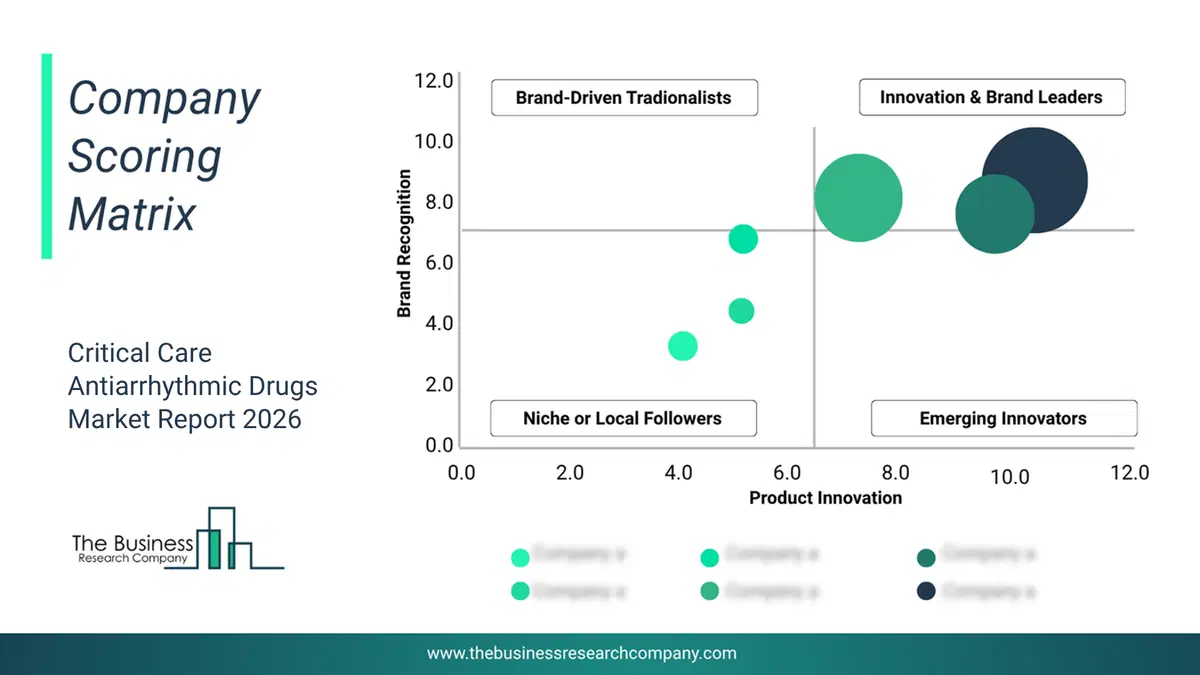
This chart maps companies by product innovation and brand strength, with bubble size indicating relative revenue, helping identify market leaders, challengers, and niche players. This is an illustrative chart; the full report provides a complete and accurate competitive analysis.
Global Critical Care Antiarrhythmic Drugs Market Trends and Insights
Major companies in the critical care antiarrhythmic drugs market are focusing on developing ultra‑short‑acting, highly selective beta‑1 blocker therapies to improve heart rate control and reduce adverse effects in critically ill patients. Ultra‑short‑acting, highly selective beta‑1 blocker therapies are medications that quickly reduce heart rate by specifically targeting beta‑1 receptors in the heart, with effects that wear off rapidly after administration. For instance, in November 2024, AOP Orphan Pharmaceuticals GmbH, an Austria-based pharmaceutical company, received U.S. FDA approval for Rapiblyk (landiolol), designed for rapid ventricular rate reduction in adults with supraventricular tachycardia (such as atrial fibrillation and atrial flutter) in critical care. Rapiblyk is formulated as a lyophilized powder for intravenous injection (280 mg vial), and upon reconstitution is infused at a dose range of 9.3–74.6 µg/kg/min; its ultra-short half-life allows heart rate reduction of 40–90% within ~10 minutes, with minimal impact on blood pressure, making it especially useful in ICU, emergency department, perioperative, and cardiac surgical settings. Its fast onset and offset, together with high β₁/β₂ selectivity (≈ 255:1), distinguish it from conventional beta-blockers, ensuring effective rate control without long-lasting systemic effects.What Are Latest Mergers And Acquisitions In The Critical Care Antiarrhythmic Drugs Market?
In August 2025, Aurobindo Pharma Limited, an India-based pharmaceutical manufacturing company, acquired Lannett for $250 million. With this acquisition, Aurobindo aims to strengthen its US footprint and support its 'reshoring' strategy by expanding domestic manufacturing capabilities and ensuring a stable supply of essential medications. Lannett Company Inc. is a US-based pharmaceutical company that specializes in developing critical care antiarrhythmic drugs.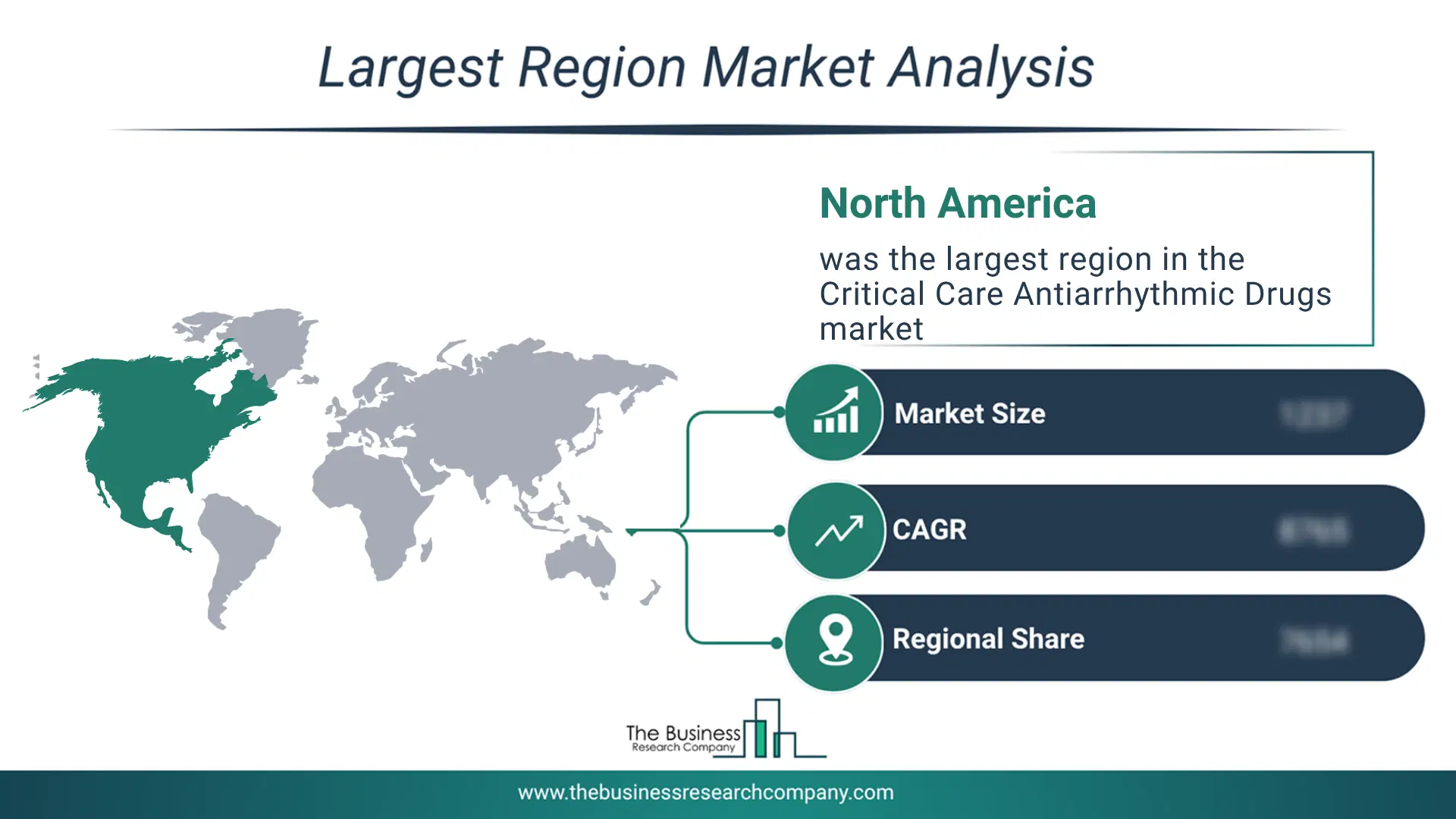
Regional Insights
North America was the largest region in the critical care antiarrhythmic drugs market in 2025. Europe is expected to be the fastest-growing region in the forecast period. The regions covered in this market report are Asia-Pacific, South East Asia, Western Europe, Eastern Europe, North America, South America, Middle East, Africa. The countries covered in this market report are Australia, Brazil, China, France, Germany, India, Indonesia, Japan, Taiwan, Russia, South Korea, UK, USA, Canada, Italy, Spain.What Defines the Critical Care Antiarrhythmic Drugs Market?
The critical care antiarrhythmic drugs market consists of sales of drugs such as amiodarone, lidocaine, and procainamide. Values in this market are ‘factory gate’ values, that is the value of goods sold by the manufacturers or creators of the goods, whether to other entities (including downstream manufacturers, wholesalers, distributors, and retailers) or directly to end customers. The value of goods in this market includes related services sold by the creators of the goods.How is Market Value Defined and Measured?
The market value is defined as the revenues that enterprises gain from the sale of goods and/or services within the specified market and geography through sales, grants, or donations in terms of the currency (in USD unless otherwise specified). The revenues for a specified geography are consumption values that are revenues generated by organizations in the specified geography within the market, irrespective of where they are produced. It does not include revenues from resales along the supply chain, either further along the supply chain or as part of other products.
This chart presents market attractiveness based on a quantitative evaluation of growth, competition, strategic alignment, and risk, offering a clear view of opportunity areas for decision-making. This chart is for illustrative purposes; the full report contains the complete analysis.

This chart highlights the Total Addressable Market (TAM) by estimating the maximum revenue opportunity using an assumption-driven approach, supporting strategic planning and opportunity sizing across markets. The chart is illustrative; the full report provides a more comprehensive analysis.
What Key Data and Analysis Are Included in the Critical Care Antiarrhythmic Drugs Market Report 2026?
The critical care antiarrhythmic drugs market research report is one of a series of new reports from The Business Research Company that provides market statistics, including industry global market size, regional shares, competitors with the market share, detailed market segments, market trends and opportunities, and any further data you may need to thrive in the critical care antiarrhythmic drugs industry. The market research report delivers a complete perspective of everything you need, with an in-depth analysis of the current and future state of the industry.Critical Care Antiarrhythmic Drugs Market Report Forecast Analysis
| Report Attribute | Details |
|---|---|
| Market Size Value In 2026 | $1.13 billion |
| Revenue Forecast In 2030 | $1.39 billion |
| Growth Rate | CAGR of 5.9% from 2026 to 2030 |
| Base Year For Estimation | 2025 |
| Actual Estimates/Historical Data | 2020-2025 |
| Forecast Period | 2026 - 2030 |
| Market Representation | Revenue in USD Billion and CAGR from 2026 to 2030 |
| Segments Covered | Type, Disease Type, Application |
| Regional Scope | Asia-Pacific, Western Europe, Eastern Europe, North America, South America, Middle East, Africa |
| Country Scope | The countries covered in the report are Australia, Brazil, China, France, Germany, India, Indonesia, Japan, Taiwan, Russia, South Korea, UK, USA, Canada, Italy, Spain. |
| Key Companies Profiled | Pfizer Inc., F. Hoffmann-La Roche Ltd., Bayer AG, Sanofi S.A., Bristol Myers Squibb, Novartis AG, Viatris Inc., Teva Pharmaceutical Industries Ltd., Baxter International Inc., Fresenius Kabi AG, Sun Pharmaceutical Industries Ltd., Aurobindo Pharma Limited, Dr. Reddy's Laboratories Ltd., Hikma Pharmaceuticals Plc, Amneal Pharmaceuticals Inc., Lupin Pharmaceutical Limited, Biocon Limited, Glenmark Pharmaceuticals Limited, Torrent Pharmaceuticals Ltd., Alembic Pharmaceuticals Ltd., Upsher-Smith Laboratories LLC., Mayne Pharma International Pty Ltd., Zydus Cadila Healthcare Limited, Amomed Pharma GmbH |
| Customization Scope | Request for Customization |
| Pricing And Purchase Options | Explore Purchase Options |