
Contact Us
  Search
The Business Research Company Logo
Crop Micronutrients Global Market Opportunities And Strategies To 2035
Published :July 2026
Pages :388
Format :PDF
Delivery Time :2-3 Business Days
Why 2-3 days? We update the report with the latest data and news before delivery. Let us know if you need us to expedite.
Report Price :$4,490.00

Crop Micronutrients Global Market Opportunities And Strategies To 2035

By Type (Zinc, Boron, Iron, Manganese, Molybdenum, Copper, Other Types), By Crop Type (Cereals And Grains, Fruits And Vegetables, Oilseeds And Pulses, Other Crop), By Application (Fertigation, Soil, Foliar, Other Applications), And By Region, Opportunities And Strategies – Global Forecast To 2035

Crop Micronutrients Market Definition

Crop micronutrients are essential mineral elements required by plants in very small quantities for proper growth, development, and productivity. These nutrients include zinc, boron, iron, manganese, copper, molybdenum, chlorine, and nickel. The primary purpose of crop micronutrients is to improve plant health, enhance nutrient uptake efficiency, increase crop yield and quality, and prevent nutrient deficiency disorders that can negatively affect agricultural productivity. The crop micronutrients market covered in this report includes revenues generated by entities (organizations, private companies and partnerships) through the production, formulation, distribution, and supply of micronutrient-based agricultural inputs and related crop nutrition solutions. The market includes income from the sale of standalone micronutrient fertilizers, chelated micronutrients, micronutrient blends, fortified crop nutrition products, and precision nutrient management solutions used to address micronutrient deficiencies and improve crop productivity.
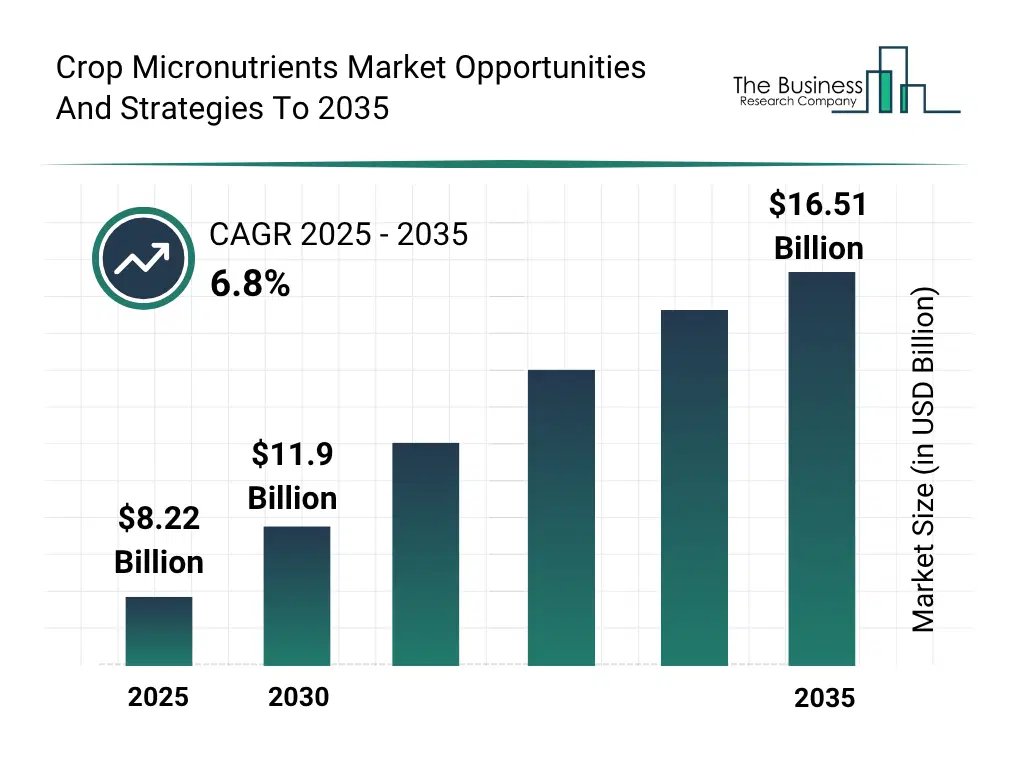
Crop Micronutrients Global Market Opportunities And Strategies To 2035 Market Size and growth rate 2026 to 2030: Graph

Crop Micronutrients Market Size

The global crop micronutrients market reached a value of nearly $8,219.8 million in 2025, having grown at a compound annual growth rate (CAGR) of 8.4% since 2020. The market is expected to grow from $8,219.8 million in 2025 to $11,901.9 million in 2030 at a rate of 7.7%. The market is then expected to grow at a CAGR of 6.8% from 2030 and reach $16,508.4 million in 2035. Growth in the historic period resulted from growing uses of precision agriculture practices, climate change and environmental stress on crops, increasing government programs promoting balanced fertilization and increasing focus on nutrient-rich food production. Factors that negatively affected growth in the historic period were high cost of micronutrient fertilizers and regulatory restrictions on fertilizer usage and composition. Going forward, rising food demand globally, growth in cereals and grains cultivation, increasing focus on improving soil nutrient balance and increasing demand for high-yield crops will drive the growth. Factors that could hinder the growth of the crop micronutrients market in the future include limited farmer awareness and education, limited adoption among small and marginal farmers and impact of trade wars and tariffs.
Research Expert

Book your 30 minutes free consultation with our research experts

Crop Micronutrients Market Segmentation

The crop micronutrients market is segmented by type, by crop type and by application.

By Type –
The crop micronutrients market is segmented by type into:
    • a) Zinc
    • b) Boron
    • c) Iron
    • d) Manganese
    • e) Molybdenum
    • f) Copper
    • g) Other Types
The zinc market was the largest segment of the crop micronutrients market segmented by type, accounting for 33.6% or $2,758.6 million of the total in 2025. Going forward, the zinc segment is expected to be the fastest-growing segment in the crop micronutrients market segmented by type, at a CAGR of 8.5% during 2025-2030.

By Crop Type –
The crop micronutrients market is segmented by crop type into:
  1. a) Cereals And Grains
  2. b) Fruits And Vegetables
  3. c) Oilseeds And Pulses
  4. d) Other Crop
  5. The cereals and grains market was the largest segment of the crop micronutrients market segmented by crop type, accounting for 47.4% or $3,894.0 million of the total in 2025. Going forward, the fruits and vegetables segment is expected to be the fastest-growing segment in the crop micronutrients market segmented by crop type, at a CAGR of 8.8% during 2025-2030.

    By Application –
    The crop micronutrients market is segmented by application into:
      • a) Fertigation
      • b) Soil
      • c) Foliar
      • d) Other Applications
    The soil market was the largest segment of the crop micronutrients market segmented by application, accounting for 43.6% or $3,585.7 million of the total in 2025. Going forward, the fertigation segment is expected to be the fastest-growing segment in the crop micronutrients market segmented by application, at a CAGR of 9.5% during 2025-2030.

    By Geography - The crop micronutrients market is segmented by geography into:
        o Asia Pacific
        • China
        • India
        • Japan
        • Australia
        • South Korea
        o South East Asia
        • Indonesia
        o North America
        • USA
        • Canada
        o South America
        • Brazil
        o Western Europe
        • France
        • Germany
        • UK
        • Italy
        • Spain
        o Eastern Europe
        • Russia
        o Middle East
        o Africa
    Asia Pacific was the largest region in the crop micronutrients market, accounting for 39.8% or $3,271.7 million of the total in 2025. It was followed by North America, Western Europe and then the other regions. Going forward, the fastest-growing regions in the crop micronutrients market will be Asia Pacific and Western Europe where growth will be at CAGRs of 8.3% and 7.8% respectively. These will be followed by South America and North America where the markets are expected to grow at CAGRs of 7.2% and 7.0% respectively.

Crop Micronutrients Market Drivers

The key drivers of the crop micronutrients market include: Rising Food Demand Globally During the forecast period, the rising food demand globally is expected to propel the growth of the crop micronutrients market. Rapid population growth, changing dietary preferences and increasing pressure on agricultural productivity are encouraging farmers to improve crop yield and quality. Crop micronutrients such as zinc, boron, iron and manganese play a vital role in enhancing plant growth, nutrient absorption and resistance to environmental stress. As arable land availability continues to decline, farmers are increasingly adopting advanced agricultural inputs to maximize output from existing farmland. In addition, growing awareness regarding soil nutrient deficiencies and sustainable farming practices is further supporting the demand for crop micronutrients worldwide. The rising food demand globally growth contribution during the forecast period in 2026 is 1.8%.

Crop Micronutrients Market Restraints

The key restraints on the crop micronutrients market include: Limited Farmer Awareness And Education Limited farmer awareness and education is expected to hinder the growth of the crop micronutrients market in forecast period. In many developing and rural agricultural regions, farmers lack adequate knowledge regarding the benefits, application methods and long-term impact of micronutrients on crop productivity and soil health. As a result, many growers continue to rely heavily on traditional fertilizers while overlooking micronutrient deficiencies in soil. Insufficient access to agricultural extension services, technical guidance and soil testing facilities further restricts adoption rates. Additionally, misconceptions about the cost-effectiveness of micronutrient products may discourage farmers from investing in them. This limited awareness is expected to slow market penetration and reduce overall demand for crop micronutrients. Growth affected by the limited farmer awareness and education during the forecast period in 2026 is -2.0%.

Crop Micronutrients Market Competitive Landscape

Major Competitors are:

  • BASF SE
  • Yara International ASA
  • Nutrien Ltd.
  • The Mosaic Company
  • ICL Group
  • Other Competitors Include:

  • Corteva Agriscience Inc.
  • Syngenta AG
  • Haifa Group
  • Coromandel International Ltd.
  • EuroChem Group
  • FMC Corporation
  • K+S Aktiengesellschaft
  • Nufarm Ltd.
  • Hebei Monband Water Soluble Fertilizer Co. Ltd.
  • Sinochem Group
  • Kingenta Ecological Engineering Group Co., Ltd.
  • Qingdao JingLing Ocean Technology Co., Ltd.
  • Shandong Liaherd Chemical Industry
  • Chubu Ecotec Co., Ltd.
  • Ac-Planta Inc.
  • Asahi Agria Co., Ltd.
  • Nagase ChemteX Corporation
  • Nousbo Co., Ltd.
  • Korea Bio Chemical Co., Ltd.
  • Biomé's E&A
  • CH Biotech (CH Biotech R&D Co., Ltd.)
  • Sinon Corporation
  • Taiwan Fertilizer Co., Ltd. (TFC)
  • B&M International Biotech
  • Sunlead Chemical (Sundat Group)
  • PT Pupuk Indonesia
  • Thai Central Chemical PCL
  • PT Petrokimia Gresik
  • Compass Minerals International Inc.
  • Helena Agri-Enterprises LLC
  • Verdesian Life Sciences LLC
  • Sociedad Química y Minera de S.A. (SQM)
  • Brandt Consolidated Inc.
  • AgroLiquid
  • Loveland Products Inc.
  • OMEX Agriculture
  • Bionema
  • Ceradis B.V.
  • Bayer AG
  • Valagro S.p.A.
  • Micromix Plant Health Limited
  • Compo Expert GmbH
  • Nouryon
  • Fertiberia, S.A.
  • Sulboro
  • UPL Ltd.
  • ADOB
  • Grupa Azoty S.A.
  • PhosAgro
  • Sapec Agro Business
  • SABIC Agri-Nutrients
  • Mapco Fertilizer Industries FZE
  • Union Chemicals Co.
  • Omnia Holdings Limited
  • OCP Group
  • Foskor Pty Ltd.
  • Dangote Fertilizer Limited
  • Need data on a specific region in this market?

    Opportunities And Recommendations In The Crop Micronutrients Market

    Opportunities – The top opportunities in the crop micronutrients market segmented by type will arise in the zinc segment, which will gain $1,398.8 million of global annual sales by 2030. The top opportunities in the crop micronutrients market segmented by crop type will arise in the cereals and grains segment, which will gain $1,549.2 million of global annual sales by 2030. The top opportunities in the crop micronutrients market segmented by application will arise in the soil segment, which will gain $1,386.8 million of global annual sales by 2030. The crop micronutrients market size will gain the most in China at $757.6 million. Recommendations- To take advantage of the opportunities, The Business Research Company recommends the crop micronutrients companies to focus on expanding domestic production and supply chain resilience, focus on sustainable nutrient efficiency and soil health innovation, focus on expanding advanced foliar nutrient solutions, focus on advancing chelated micronutrient technologies, focus on expanding solutions for fruits and vegetables crops, expand in emerging markets, continue to focus on developed markets, focus on value-based and segment-specific pricing strategies, focus on demonstrating agronomic value through education and field validation, focus on expanding digital and targeted farmer engagement programs, focus on expanding fertigation-based micronutrient solutions.
    Chat with us