

Crossover Vehicles Market Report 2026
Global Outlook – By Vehicle Size (Subcompact Crossover, Compact Crossover, Midsize Crossover, Full-Size Crossover), By Drive Type (Front-Wheel Drive, Rear-Wheel Drive, All-Wheel Drive, Four-Wheel Drive), By Propulsion Type (Petrol, Diesel, Hybrid, Electric), By Sales Channel (Authorized Dealers, Independent Dealers, Online Sales Platforms), By Application (Personal Use, Commercial Or Fleet Use) – Market Size, Trends, Strategies, and Forecast to 2030
Crossover Vehicles Market Overview
• Crossover Vehicles market size has reached to $749.7 billion in 2025 • Expected to grow to $1172.4 billion in 2030 at a compound annual growth rate (CAGR) of 9.3% • Growth Driver: Increasing Demand For Fuel-Efficient Vehicles Fueling The Growth Of The Market Due To Rising Consumer Focus On Lower Fuel Costs • Market Trend: Innovations In Electrified Powertrain Systems Supporting Longer Driving Range And Smarter Mobility Solutions • North America was the largest region in 2025 and Asia-Pacific is the fastest growing region.What Is Covered Under Crossover Vehicles Market?
The crossover vehicles are passenger automobiles built on a unibody platform that combines the comfort and handling characteristics of a car with the elevated seating position and utility of a sport utility vehicle. They are designed for everyday driving while offering flexible cargo space and improved ride comfort. Crossovers typically prioritize fuel efficiency, maneuverability, and urban practicality over heavy off-road capability. The main vehicle sizes of crossover vehicles include subcompact crossover, compact crossover, midsize crossover, and full-size crossover. Subcompact crossovers refer to smaller crossover vehicles that combine the elevated driving position and utility of sport utility vehicles with the compact dimensions and maneuverability of smaller passenger vehicles. These vehicles are available with front-wheel drive, rear-wheel drive, all-wheel drive, and four-wheel drive, and use petrol, diesel, hybrid, and electric propulsion. They are sold through authorized dealers, independent dealers, and online sales platforms, and find application in personal use and commercial or fleet use.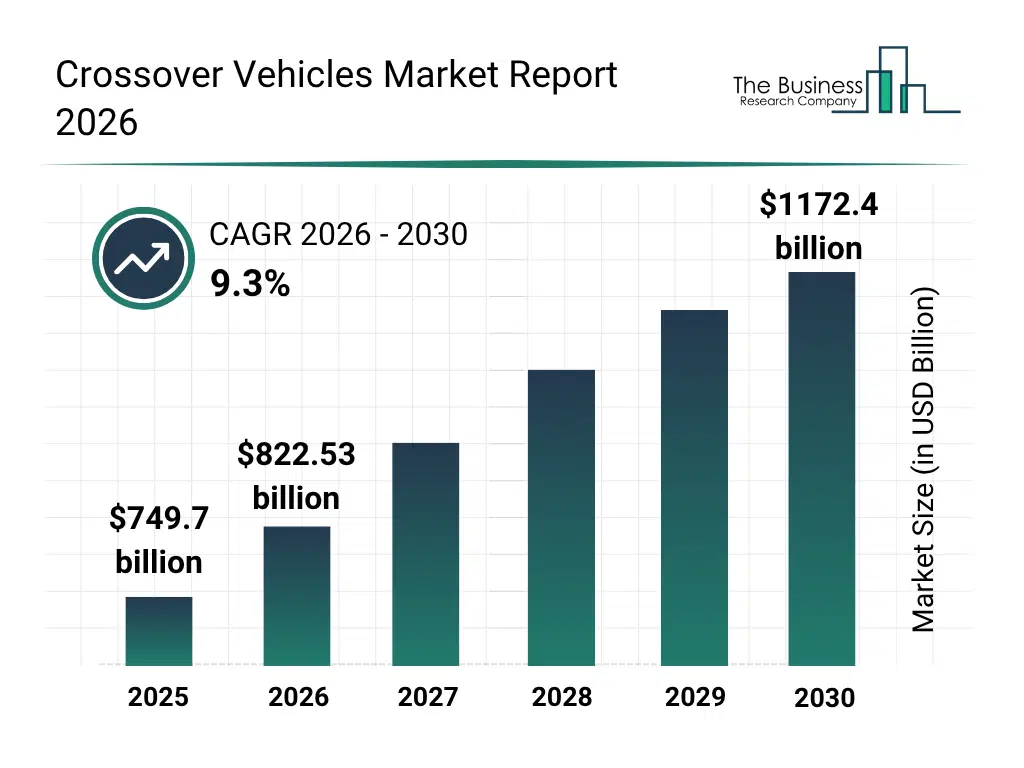
What Is The Crossover Vehicles Market Size and Share 2026?
The crossover vehicles market size has grown strongly in recent years. It will grow from $749.7 billion in 2025 to $822.53 billion in 2026 at a compound annual growth rate (CAGR) of 9.7%. The growth in the historic period can be attributed to urbanization and rising urban vehicle ownership, growing consumer preference for SUV-like styling, increasing demand for fuel-efficient passenger vehicles, expansion of road infrastructure, rising household disposable incomes.What Is The Crossover Vehicles Market Growth Forecast?
The crossover vehicles market size is expected to see strong growth in the next few years. It will grow to $1172.4 billion in 2030 at a compound annual growth rate (CAGR) of 9.3%. The growth in the forecast period can be attributed to increasing demand for affordable family mobility, growing preference for versatile passenger vehicles, rising demand for improved ride comfort and maneuverability, expansion of crossover model portfolios, increasing adoption of crossover vehicles in emerging markets. Major trends in the forecast period include rising demand for compact and subcompact crossover vehicles, increasing preference for elevated seating and flexible cargo space, growing adoption of all-wheel drive crossover configurations, increasing availability of crossover vehicles across multiple vehicle sizes, expanding use of crossovers for commercial and fleet applications.Tariff Impact On Crossover Vehicles Market
Tariffs are impacting the crossover vehicles market by increasing the cost of imported automotive components, powertrain systems, electronics, batteries, and raw materials used in crossover vehicle production. This is raising vehicle manufacturing and retail costs, particularly for electric, hybrid, and technology-intensive crossovers, with import-dependent regions such as North America, Europe, and Asia-Pacific being more exposed. Component-intensive segments such as electric and hybrid crossovers are most affected due to dependencies on batteries, semiconductors, and specialized automotive components. However, tariffs are also encouraging local vehicle assembly, regional component sourcing, supplier diversification, and investment in domestic automotive manufacturing capacity, strengthening long-term supply chain resilience.
Global Crossover Vehicles Market Segmentation
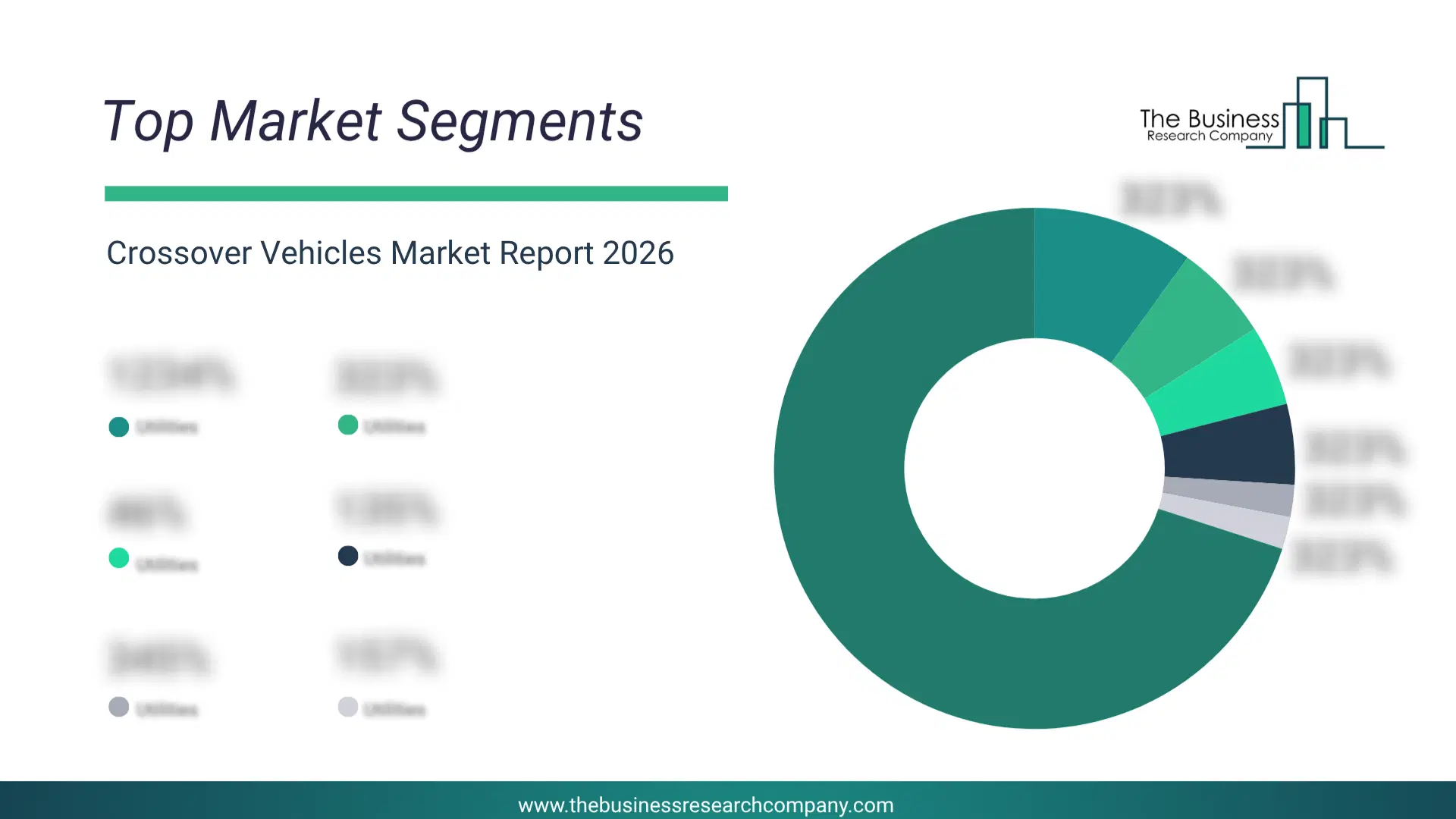
1) By Vehicle Size: Subcompact Crossover, Compact Crossover, Midsize Crossover, Full-Size Crossover 2) By Drive Type: Front-Wheel Drive, Rear-Wheel Drive, All-Wheel Drive, Four-Wheel Drive 3) By Propulsion Type: Petrol, Diesel, Hybrid, Electric 4) By Sales Channel: Authorized Dealers, Independent Dealers, Online Sales Platforms 5) By Application: Personal Use, Commercial Or Fleet Use Subsegments: 1) By Subcompact Crossover: Gasoline Subcompact Crossover, Diesel Subcompact Crossover, Hybrid Subcompact Crossover, Plug-In Hybrid Subcompact Crossover, Battery Electric Subcompact Crossover 2) By Compact Crossover: Gasoline Compact Crossover, Diesel Compact Crossover, Hybrid Compact Crossover, Plug-In Hybrid Compact Crossover, Battery Electric Compact Crossover 3) By Midsize Crossover: Gasoline Midsize Crossover, Diesel Midsize Crossover, Hybrid Midsize Crossover, Plug-In Hybrid Midsize Crossover, Battery Electric Midsize Crossover 4) By Full-Size Crossover: Gasoline Full-Size Crossover, Diesel Full-Size Crossover, Hybrid Full-Size Crossover, Plug-In Hybrid Full-Size Crossover, Battery Electric Full-Size CrossoverWhat Is The Driver Of The Crossover Vehicles Market?
The increasing demand for fuel-efficient vehicles is expected to propel the growth of the crossover vehicle market going forward. Fuel-efficient vehicles are automobiles that consume less fuel to travel a given distance through efficient powertrains, lightweight construction, and advanced energy management technologies. The demand for fuel-efficient vehicles is increasing due to consumers wanting to reduce fuel expenses as fuel prices and daily commuting costs continue to influence vehicle purchasing decisions. Fuel-efficient vehicles help crossover vehicles by increasing the adoption of compact and lightweight crossover models that deliver better fuel economy while meeting consumer demand for practicality and comfort. For instance, in April 2026, according to the United States Energy Information Administration (EIA), a US-based government agency, vehicle miles traveled increased by 1.2% in 2025 compared with 2024, while estimated vehicle fleet fuel economy, measured in miles per gallon, improved by 1.9% during the same period, indicating the growing importance of fuel efficiency as vehicle use increases. Therefore, the increasing demand for fuel-efficient vehicles is driving the growth of the crossover vehicle industry.Key Players In The Global Crossover Vehicles Market
Major companies operating in the crossover vehicles market are Toyota Motor Corporation, Volkswagen AG, Hyundai Motor Company, General Motors Company, Ford Motor Company, Stellantis N.V., Tesla Inc., Honda Motor Co. Ltd., Nissan Motor Co. Ltd., BYD Company Limited, Mercedes-Benz Group AG, Bayerische Motoren Werke AG, Renault S.A., Geely Automobile Holdings Limited, Tata Motors Limited, Great Wall Motor Company Limited, Changan Automobile Co. Ltd., Chery Automobile Co. Ltd., Mahindra & Mahindra Limited, Mazda Motor Corporation, Subaru Corporation, Suzuki Motor Corporation, Mitsubishi Motors Corporation, Kia Corporation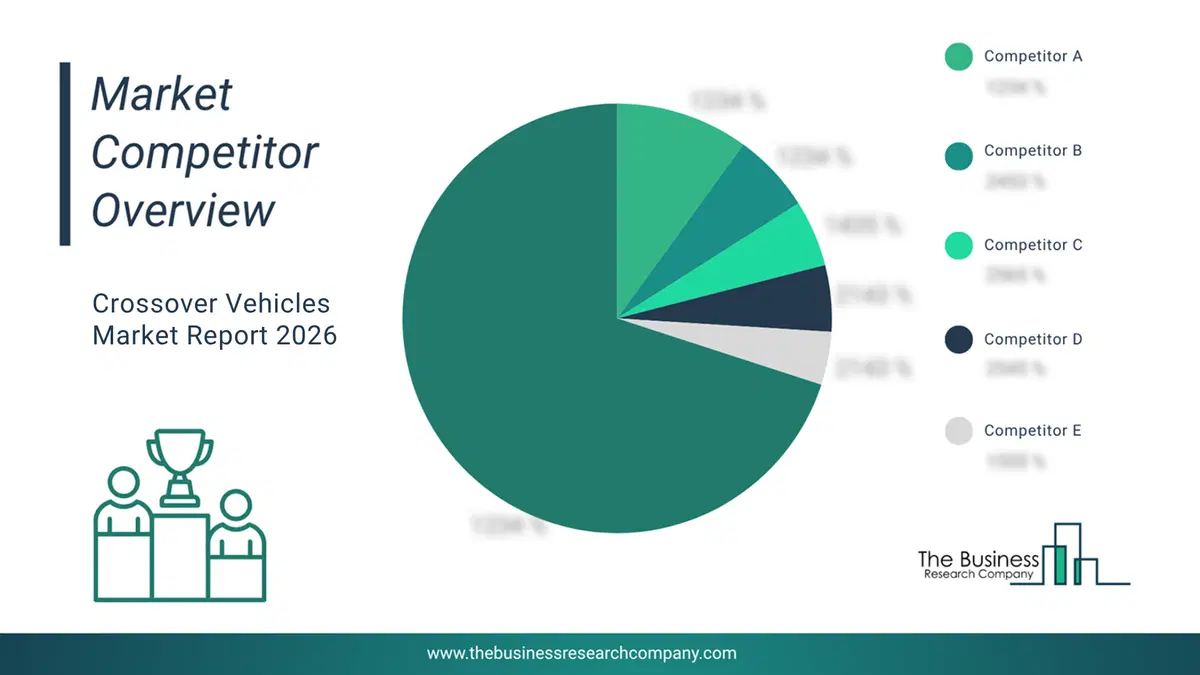
This chart is for illustrative purposes; the full report includes a detailed competitor analysis and comprehensive overview of the top 10 companies in the market.
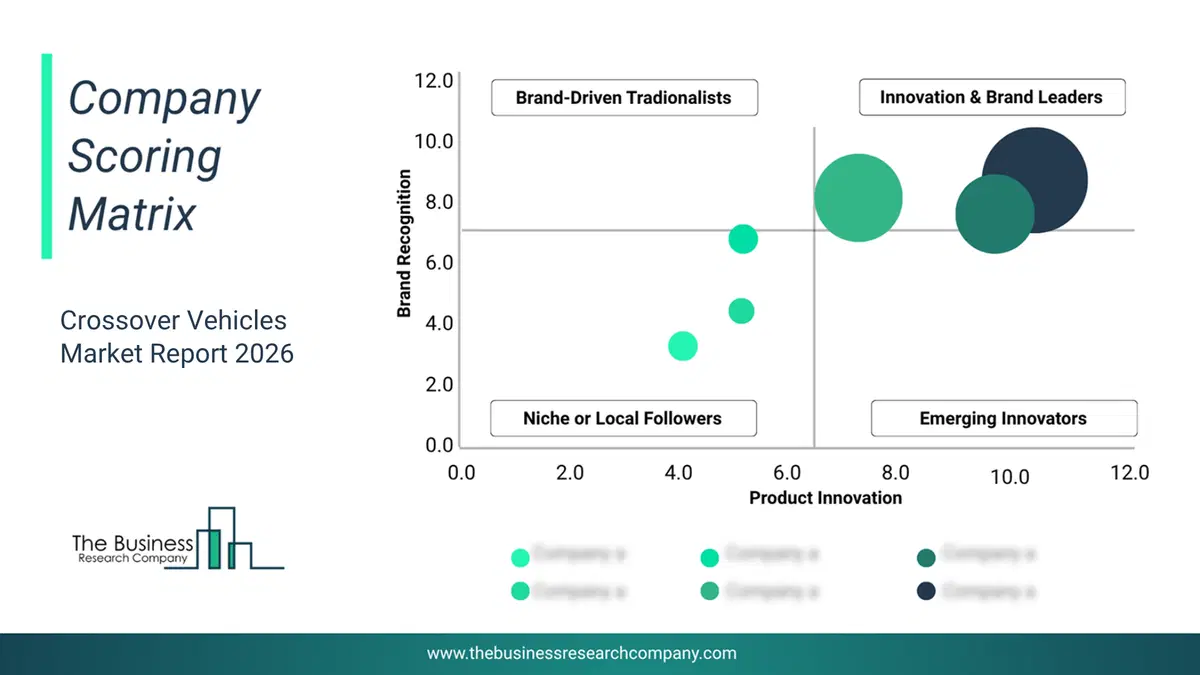
This chart maps companies by product innovation and brand strength, with bubble size indicating relative revenue, helping identify market leaders, challengers, and niche players. This is an illustrative chart; the full report provides a complete and accurate competitive analysis.
Global Crossover Vehicles Market Trends and Insights
Major companies operating in the crossover vehicle market are focusing on technological advancements in vehicle features, such as extended-range electric vehicles (EREVs), to improve driving range, support connected mobility, and enhance vehicle versatility. Extended-range electric vehicle (EREV) technology is an electrified propulsion system that uses electric motors to drive the vehicle while a small internal combustion engine functions as a generator to recharge the battery, extending the driving range without directly powering the wheels. For instance, in July 2026, Xiaomi Corporation, a China-based consumer electronics and automotive company, unveiled the Sky Nomad SUV series to enhance its crossover vehicle portfolio and strengthen its presence in the family-oriented sport utility vehicle segment by offering spacious five- and seven-seat crossover models with advanced intelligent driving and connected vehicle technologies. The new EREV crossover lineup features a smart and spacious cabin designed as a multifunctional living space, an extended-range electric powertrain that combines battery-electric driving with an onboard range-extending generator, and intelligent connected vehicle technologies that enhance comfort and everyday usability.What Are Latest Mergers And Acquisitions In The Crossover Vehicles Market?
In July 2026, Ford Motor Company, a US-based automotive manufacturer, announced a strategic partnership with Geely Auto to manufacture and jointly develop vehicles at Ford’s Valencia plant in Spain. Through this partnership, Ford and Geely aim to jointly develop a new multi-energy crossover model for the European market while also manufacturing two Geely electric SUVs at the facility. Geely Auto is a China-based automotive company that manufactures passenger vehicles, including electric and hybrid SUVs and crossover vehicles.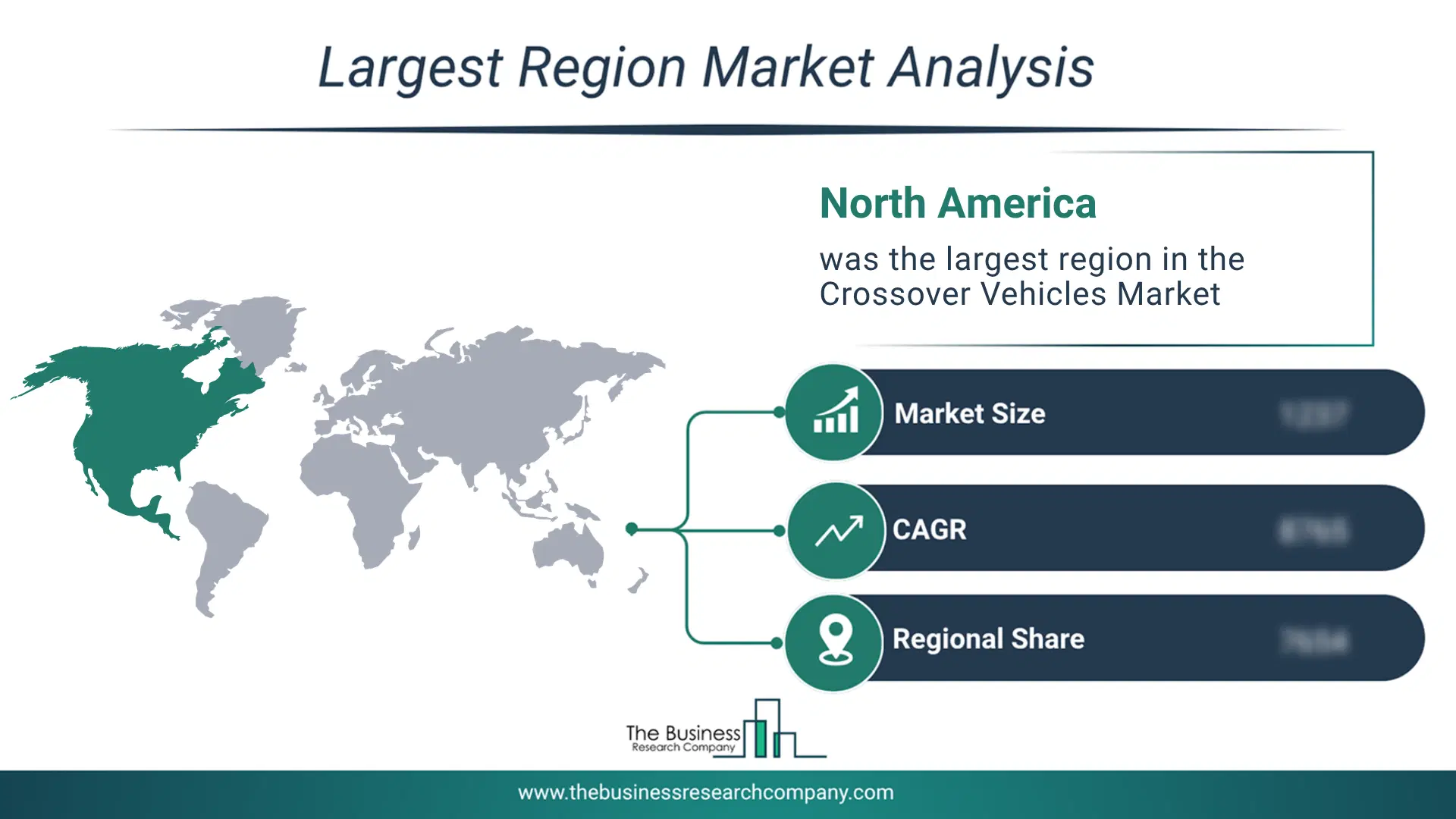
Regional Outlook
North America was the largest region in the crossover vehicles market in 2025. Asia-Pacific is expected to be the fastest-growing region in the forecast period. The regions covered in this market report are Asia-Pacific, South East Asia, Western Europe, Eastern Europe, North America, South America, Middle East, Africa. The countries covered in this market report are Australia, Brazil, China, France, Germany, India, Indonesia, Japan, Taiwan, Russia, South Korea, UK, USA, Canada, Italy, Spain.What Defines the Crossover Vehicles Market?
The crossover vehicles market consists of sales of crossover hatchbacks, crossover coupes, and crossover wagons. Values in this market are ‘factory gate’ values, that is the value of goods sold by the manufacturers or creators of the goods, whether to other entities (including downstream manufacturers, wholesalers, distributors and retailers) or directly to end customers. The value of goods in this market includes related services sold by the creators of the goods.How is Market Value Defined and Measured?
The market value is defined as the revenues that enterprises gain from the sale of goods and/or services within the specified market and geography through sales, grants, or donations in terms of the currency (in USD unless otherwise specified). The revenues for a specified geography are consumption values that are revenues generated by organizations in the specified geography within the market, irrespective of where they are produced. It does not include revenues from resales along the supply chain, either further along the supply chain or as part of other products.
This chart presents market attractiveness based on a quantitative evaluation of growth, competition, strategic alignment, and risk, offering a clear view of opportunity areas for decision-making. This chart is for illustrative purposes; the full report contains the complete analysis.

This chart highlights the Total Addressable Market (TAM) by estimating the maximum revenue opportunity using an assumption-driven approach, supporting strategic planning and opportunity sizing across markets. The chart is illustrative; the full report provides a more comprehensive analysis.
What Key Data and Analysis Are Included in the Crossover Vehicles Market Report 2026?
The crossover vehicles market research report is one of a series of new reports from The Business Research Company that provides market statistics, including industry global market size, regional shares, competitors with the market share, detailed market segments, market trends and opportunities, and any further data you may need to thrive in the crossover vehicles industry. The market research report delivers a complete perspective of everything you need, with an in-depth analysis of the current and future state of the industry.Crossover Vehicles Market Report Forecast Analysis
| Report Attribute | Details |
|---|---|
| Market Size Value In 2026 | $822.53 billion |
| Revenue Forecast In 2030 | $1172.4 billion |
| Growth Rate | CAGR of 9.3% from 2026 to 2030 |
| Base Year For Estimation | 2025 |
| Actual Estimates/Historical Data | 2020-2025 |
| Forecast Period | 2026 - 2030 |
| Market Representation | Revenue in USD Billion and CAGR from 2026 to 2030 |
| Segments Covered | Vehicle Size, Drive Type, Propulsion Type, Sales Channel, Application |
| Regional Scope | Asia-Pacific, Western Europe, Eastern Europe, North America, South America, Middle East, Africa |
| Country Scope | The countries covered in the report are Australia, Brazil, China, France, Germany, India, Indonesia, Japan, Taiwan, Russia, South Korea, UK, USA, Canada, Italy, Spain. |
| Key Companies Profiled | Toyota Motor Corporation, Volkswagen AG, Hyundai Motor Company, General Motors Company, Ford Motor Company, Stellantis N.V., Tesla Inc., Honda Motor Co. Ltd., Nissan Motor Co. Ltd., BYD Company Limited, Mercedes-Benz Group AG, Bayerische Motoren Werke AG, Renault S.A., Geely Automobile Holdings Limited, Tata Motors Limited, Great Wall Motor Company Limited, Changan Automobile Co. Ltd., Chery Automobile Co. Ltd., Mahindra & Mahindra Limited, Mazda Motor Corporation, Subaru Corporation, Suzuki Motor Corporation, Mitsubishi Motors Corporation, Kia Corporation |
| Customization Scope | Request for Customization |
| Pricing And Purchase Options | Explore Purchase Options |