

Curing Agent Market Report 2026
Global Outlook – By Type (Amine Based Curing Agents, Polyamide Curing Agents, Anhydride Curing Agents, Phenalkamine Curing Agents, Polymercaptan Curing Agents, Imidazole Curing Agents, Other Types), By Resin Type (Epoxy Resins, Polyurethane Resins, Polyester Resins, Vinyl Ester Resins, Other Resin Types), By Form (Liquid, Solid, Paste), By End Use Industry (Building And Construction, Automotive And Transportation, Aerospace And Defense, Electrical And Electronics, Marine, Wind Energy, Industrial Manufacturing, Oil And Gas, Other Industries) – Market Size, Trends, Strategies, and Forecast to 2030
Curing Agent Market Overview
• Curing Agent market size has reached to $4.87 billion in 2025 • Expected to grow to $7.09 billion in 2030 at a compound annual growth rate (CAGR) of 7.7% • Growth Driver: Expansion Of Construction Activities Driving The Market Growth Due To Rising Infrastructure And Nonresidential Development • Market Trend: Advanced Epoxy Curing Agent Innovations Improve Coating Performance And Accelerate Low Temperature Curing • North America was the largest region in 2025 and Asia-Pacific is the fastest growing region.What Is Covered Under Curing Agent Market?
A curing agent is a chemical compound used with epoxy resins, adhesives, coatings, and composites to trigger the curing process through a chemical reaction. It transforms liquid or semi-liquid materials into a hard, durable, and stable solid while enhancing mechanical strength, chemical and heat resistance, and long-term performance for industrial and construction applications. The main types of curing agent include amine based curing agents, polyamide curing agents, anhydride curing agents, phenalkamine curing agents, polymercaptan curing agents, imidazole curing agents, and other types. Amine based curing agents refer to chemical hardeners that react with resin systems, particularly epoxy resins, to initiate crosslinking and develop the desired mechanical, thermal, and chemical resistance properties. These curing agents are compatible with epoxy resins, polyurethane resins, polyester resins, vinyl ester resins, and other resin types. They are available in liquid, solid, and paste forms and are utilized by end use industries including building and construction, automotive and transportation, aerospace and defense, electrical and electronics, marine, wind energy, industrial manufacturing, oil and gas, and others.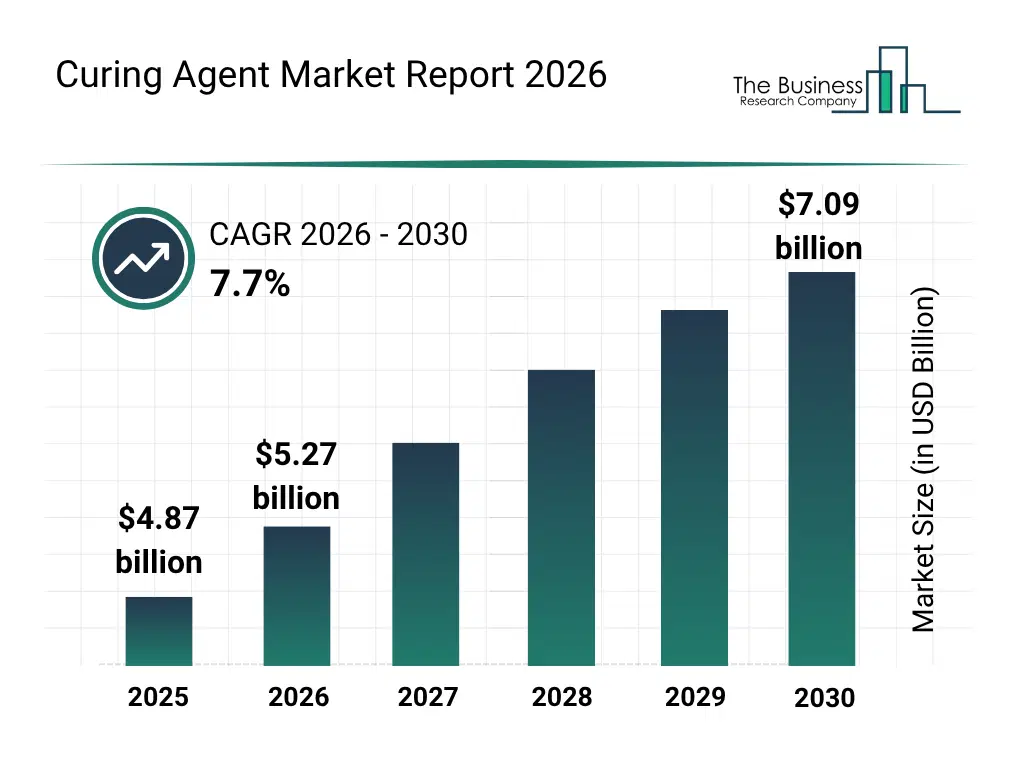
What Is The Curing Agent Market Size and Share 2026?
The curing agent market size has grown strongly in recent years. It will grow from $4.87 billion in 2025 to $5.27 billion in 2026 at a compound annual growth rate (CAGR) of 8.1%. The growth in the historic period can be attributed to increasing demand for epoxy based coatings and adhesives, growing construction and infrastructure development activities, rising automotive production and composite material usage, increasing adoption of durable industrial materials, growing expansion of chemical manufacturing industries.What Is The Curing Agent Market Growth Forecast?
The curing agent market size is expected to see strong growth in the next few years. It will grow to $7.09 billion in 2030 at a compound annual growth rate (CAGR) of 7.7%.The growth in the forecast period can be attributed to increasing demand for sustainable and bio based curing agents, growing adoption of advanced composite materials, rising use of high performance adhesives in electric vehicles, increasing development of specialty curing formulations, growing demand from renewable energy and aerospace applications. Major trends in the forecast period include increasing development of high performance curing agent formulations, growing demand for low temperature and fast curing solutions, rising adoption of bio based and environmentally friendly curing agents, increasing focus on enhanced chemical and thermal resistance properties, growing demand for customized curing agents for advanced composite applications.
Global Curing Agent Market Segmentation
2) By Resin Type: Epoxy Resins, Polyurethane Resins, Polyester Resins, Vinyl Ester Resins, Other Resin Types 3) By Form: Liquid, Solid, Paste 4) By End Use Industry: Building And Construction, Automotive And Transportation, Aerospace And Defense, Electrical And Electronics, Marine, Wind Energy, Industrial Manufacturing, Oil And Gas, Other Industries Subsegments: 1) By Amine Based Curing Agents: Aliphatic Amines, Cycloaliphatic Amines, Aromatic Amines, Modified Amines, Polyether Amines 2) By Polyamide Curing Agents: Dimer Acid Polyamides, Reactive Polyamides, Solvent Based Polyamides, Low Viscosity Polyamides, High Performance Polyamides 3) By Anhydride Curing Agents: Methyl Tetrahydrophthalic Anhydride, Hexahydrophthalic Anhydride, Methylnadic Anhydride, Phthalic Anhydride, Trimellitic Anhydride 4) By Phenalkamine Curing Agents: Cardanol Based Phenalkamines, Fast Cure Phenalkamines, Low Temperature Phenalkamines, High Solids Phenalkamines, Water Resistant Phenalkamines 5) By Polymercaptan Curing Agents: Liquid Polymercaptans, Modified Polymercaptans, Fast Cure Polymercaptans, Low Odor Polymercaptans, Flexible Polymercaptans 6) By Imidazole Curing Agents: Two Methyl Imidazole, Two Ethyl Four Methyl Imidazole, One Cyanoethyl Two Methyl Imidazole, Cationic Imidazole Derivatives, Latent Imidazole Curing Agents 7) By Other Types: Polyamine Adducts, Ketimine Curing Agents, Mannich Base Curing Agents, Lewis Acid Catalysts, Latent Curing AgentsWhat Is The Driver Of The Curing Agent Market?
The expansion of construction activities is expected to propel the growth of the curing agent market going forward. Construction activities refer to the processes involved in building, renovating, and maintaining infrastructure, residential, and nonresidential structures. The rising scale of construction is primarily driven by increased investments in nonresidential and infrastructure development, as governments and private entities direct significant capital toward new facilities, manufacturing plants, and public works projects, creating sustained demand across all phases of construction. The surge in construction activity directly increases the consumption of curing agents, as they are essential for ensuring the proper hardening and strength development of concrete used across diverse construction applications. For instance, in June 2025, according to Eurostat, a Luxembourg-based statistical office of the European Union, in April 2025, construction production rose by 3.0% in the euro area and by 2.5% in the EU compared with April 2024. Therefore, the expansion of construction activities is driving the growth of the curing agent industry.Key Players In The Global Curing Agent Market
Major companies operating in the curing agent market are Aditya Birla Chemicals, Anhui Xinyuan Chemical Co. Ltd., Arkema S.A., Atul Ltd., BASF SE, Cardolite Corporation, Cargill Bioindustrial, DIC Corporation, Evonik Industries AG, Huntsman Corporation, Kukdo Chemical Co. Ltd., LANXESS AG, Mitsubishi Chemical Group Corporation, Olin Corporation, Sinopec Baling Petrochemical Co. Ltd., Solvay SA, Westlake Epoxy
This chart is for illustrative purposes; the full report includes a detailed competitor analysis and comprehensive overview of the top 10 companies in the market.
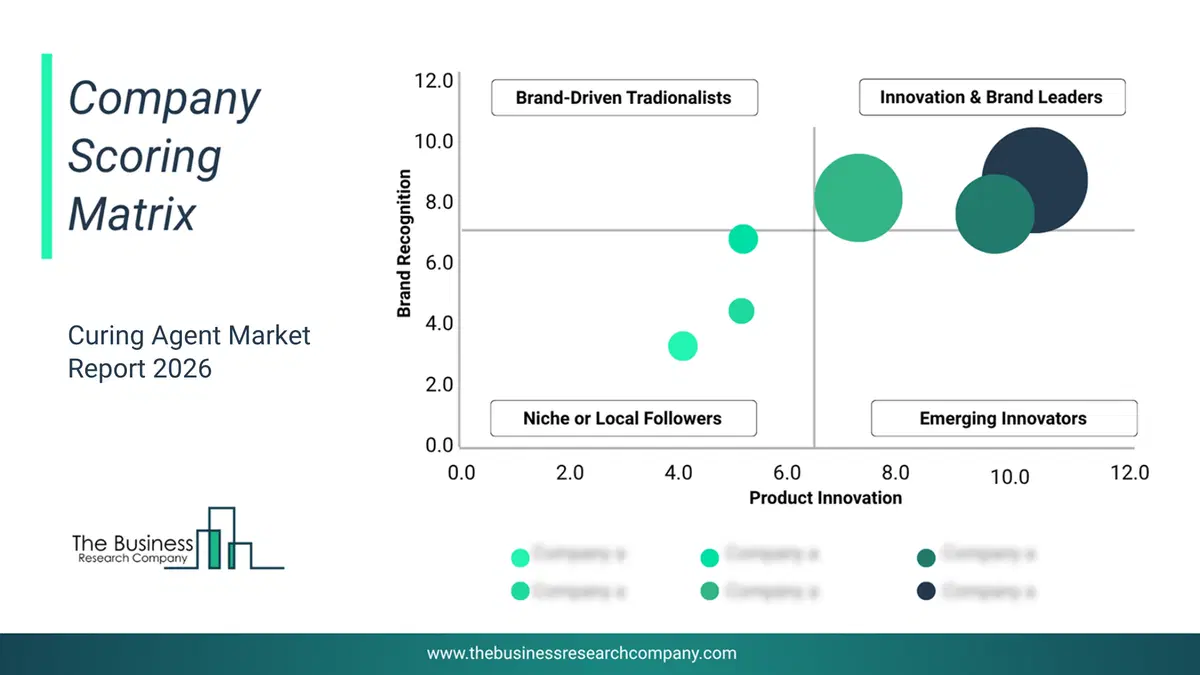
This chart maps companies by product innovation and brand strength, with bubble size indicating relative revenue, helping identify market leaders, challengers, and niche players. This is an illustrative chart; the full report provides a complete and accurate competitive analysis.
Global Curing Agent Market Trends and Insights
Major companies operating in the curing agent market are focusing on developing advanced products such as epoxy curing agents to enhance curing speed, improve coating durability, and enable reliable performance under challenging environmental conditions. Epoxy curing agents are chemical hardeners that react with epoxy resins to form durable, high-performance coatings with enhanced mechanical strength and chemical resistance. For instance, in April 2024, Evonik Industries AG, a Germany-based specialty chemicals company, launched Ancamine 2844, a novel epoxy curing agent designed for plural-component spray applications. The high functionality aliphatic amine hardener enables ultra-fast curing at temperatures as low as 5°C while delivering excellent chemical resistance, corrosion protection, and a superior surface finish in high humidity conditions. It enhances productivity and coating durability, making it well-suited for protective and marine coating applications.What Are Latest Mergers And Acquisitions In The Curing Agent Market?
In March 2025, BASF SE, a Germany-based chemical company, partnered with Sika to develop and commercialize Baxxodur EC 151, a new amine-based epoxy curing agent for sustainable flooring applications. Through this partnership, the companies aim to deliver high-performance, low-volatile organic compound (VOC) epoxy systems with faster curing, enhanced durability, and improved sustainability for the construction industry. Sika is a Switzerland-based manufacturer of curing agents (hardeners) for epoxy and polyurethane.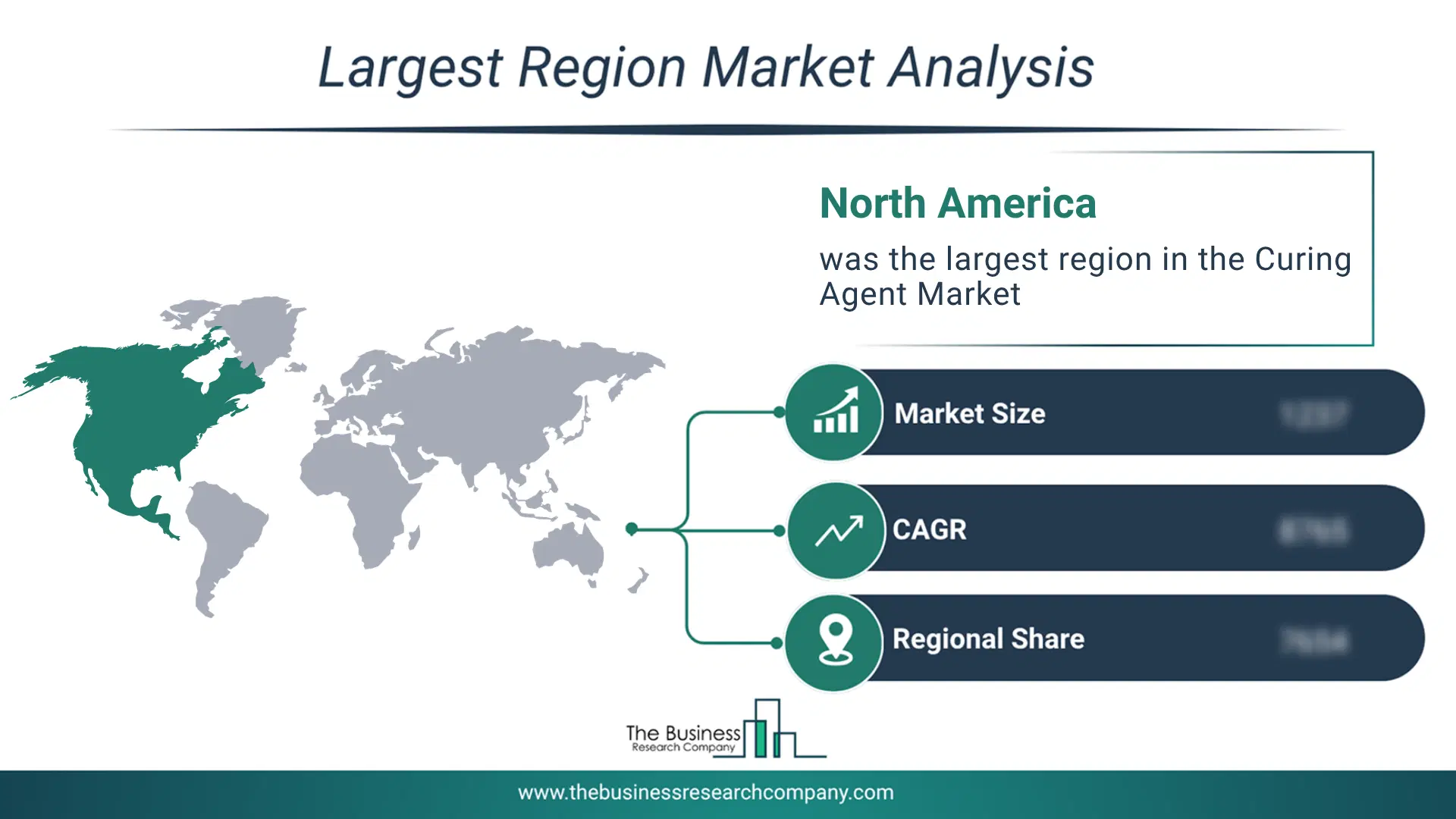
Regional Outlook/Insights
North America was the largest region in the curing agent market in 2025. Asia-Pacific is expected to be the fastest-growing region in the forecast period. The regions covered in this market report are Asia-Pacific, South East Asia, Western Europe, Eastern Europe, North America, South America, Middle East, Africa. The countries covered in this market report are Australia, Brazil, China, France, Germany, India, Indonesia, Japan, Taiwan, Russia, South Korea, UK, USA, Canada, Italy, Spain.What Defines the Curing Agent Market?
The curing agent market consists of sales of epoxy hardeners, resin curing systems, concrete curing compounds, and sealant curing formulations. Values in this market are ‘factory gate’ values, that is, the value of goods sold by the manufacturers or creators of the goods, whether to other entities (including downstream manufacturers, wholesalers, distributors, and retailers) or directly to end customers. The value of goods in this market includes related services sold by the creators of the goods.How is Market Value Defined and Measured?
The market value is defined as the revenues that enterprises gain from the sale of goods and/or services within the specified market and geography through sales, grants, or donations in terms of the currency (in USD unless otherwise specified). The revenues for a specified geography are consumption values that are revenues generated by organizations in the specified geography within the market, irrespective of where they are produced. It does not include revenues from resales along the supply chain, either further along the supply chain or as part of other products.
This chart presents market attractiveness based on a quantitative evaluation of growth, competition, strategic alignment, and risk, offering a clear view of opportunity areas for decision-making. This chart is for illustrative purposes; the full report contains the complete analysis.

This chart highlights the Total Addressable Market (TAM) by estimating the maximum revenue opportunity using an assumption-driven approach, supporting strategic planning and opportunity sizing across markets. The chart is illustrative; the full report provides a more comprehensive analysis.
What Key Data and Analysis Are Included in the Curing Agent Market Report 2026?
The curing agent market research report is one of a series of new reports from The Business Research Company that provides curing agent market statistics, including curing agent industry global market size, regional shares, competitors with a curing agent market share, detailed curing agent market segments, market trends and opportunities, and any further data you may need to thrive in the curing agent industry. This curing agent market research report delivers a complete perspective of everything you need, with an in-depth analysis of the current and future scenario of the industry.Curing Agent Market Report Forecast Analysis
| Report Attribute | Details |
|---|---|
| Market Size Value In 2026 | $5.27 billion |
| Revenue Forecast In 2030 | $7.09 billion |
| Growth Rate | CAGR of 7.7% from 2026 to 2030 |
| Base Year For Estimation | 2025 |
| Actual Estimates/Historical Data | 2020-2025 |
| Forecast Period | 2026 - 2030 |
| Market Representation | Revenue in USD Billion and CAGR from 2026 to 2030 |
| Segments Covered | Type, Resin Type, Form, End Use Industry |
| Regional Scope | Asia-Pacific, Western Europe, Eastern Europe, North America, South America, Middle East, Africa |
| Country Scope | The countries covered in the report are Australia, Brazil, China, France, Germany, India, Indonesia, Japan, Taiwan, Russia, South Korea, UK, USA, Canada, Italy, Spain. |
| Key Companies Profiled | Aditya Birla Chemicals, Anhui Xinyuan Chemical Co. Ltd., Arkema S.A., Atul Ltd., BASF SE, Cardolite Corporation, Cargill Bioindustrial, DIC Corporation, Evonik Industries AG, Huntsman Corporation, Kukdo Chemical Co. Ltd., LANXESS AG, Mitsubishi Chemical Group Corporation, Olin Corporation, Sinopec Baling Petrochemical Co. Ltd., Solvay SA, Westlake Epoxy |
| Customization Scope | Request for Customization |
| Pricing And Purchase Options | Explore Purchase Options |