
Customs Declaration Software Market Report 2026
Global Outlook – By Component (Software, Services), By Enterprise Size (Small And Medium Enterprises, Large Enterprises), By Deployment (On Premises, Cloud Based, Hybrid), By Application (Import Declaration, Export Declaration, Transit Declaration, Warehouse Declaration, Duty And Tax Calculation), By End User (Customs Brokers, Freight Forwarders, Importers And Exporters, Government Customs Authorities, Logistics Service Providers) – Market Size, Trends, Strategies, and Forecast to 2030
Customs Declaration Software Market Overview
• Customs Declaration Software market size has reached to $1.72 billion in 2025 • Expected to grow to $2.79 billion in 2030 at a compound annual growth rate (CAGR) of 10% • Growth Driver: Rising International Trade Volumes Driving The Market Growth Due To Globalization And Increasing Cross-Border Trade Efficiency Needs • Market Trend: Advancements In Automated Trade Interface Systems Enhance Efficiency And Digitalization In Customs Declaration Processes • North America was the largest region in 2025 and Asia-Pacific is the fastest growing region.What Is Covered Under Customs Declaration Software Market?
Customs declaration software is a digital solution used by importers, exporters, and logistics providers to electronically prepare, submit, and manage customs documentation required for international trade. It helps automate compliance checks, duty calculations, and data validation to ensure faster clearance of goods and reduced manual errors. The main components of customs declaration software include software and services. Software refers to digital solutions that automate the preparation, submission, and management of customs documentation and regulatory compliance processes. These solutions are designed for enterprise sizes including small and medium enterprises and large enterprises and are deployed through on premises, cloud based, and hybrid models. The various applications involved are import declaration, export declaration, transit declaration, warehouse declaration, and duty and tax calculation, and they are used by several end users such as customs brokers, freight forwarders, importers and exporters, government customs authorities, and logistics service providers.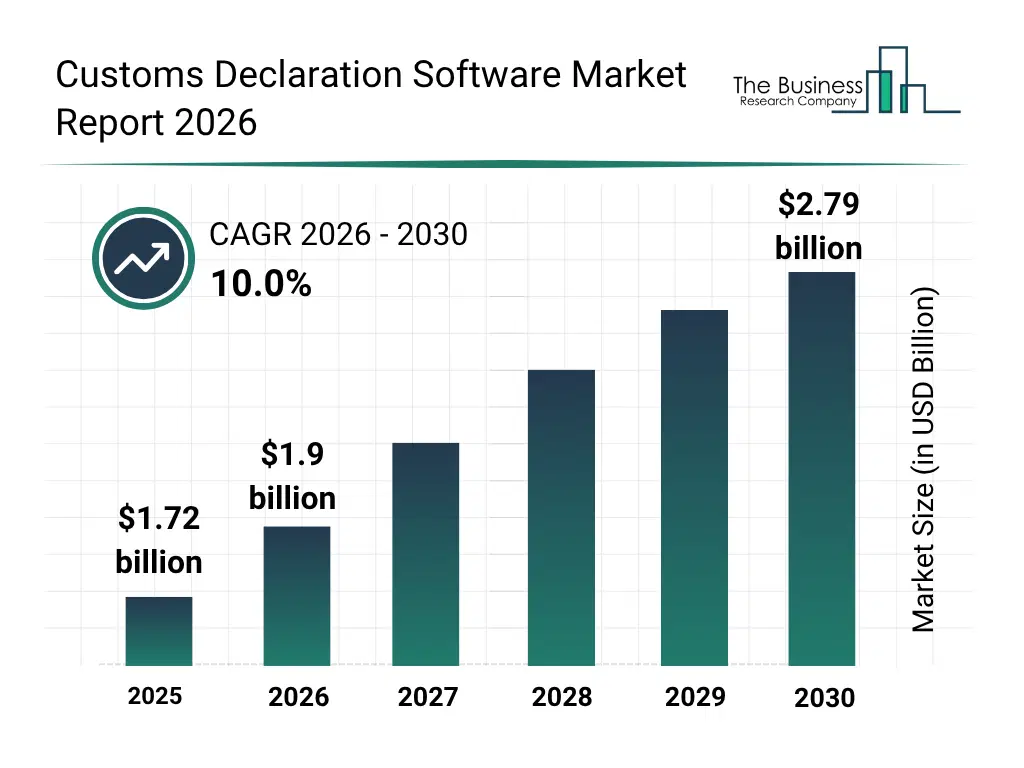
What Is The Customs Declaration Software Market Size and Share 2026?
The customs declaration software market size has grown rapidly in recent years. It will grow from $1.72 billion in 2025 to $1.9 billion in 2026 at a compound annual growth rate (CAGR) of 10.5%. The growth in the historic period can be attributed to growth in international trade activities, increasing complexity of customs regulations, rising adoption of electronic documentation systems, expansion of cross-border logistics operations, increasing demand for trade compliance management.What Is The Customs Declaration Software Market Growth Forecast?
The customs declaration software market size is expected to see rapid growth in the next few years. It will grow to $2.79 billion in 2030 at a compound annual growth rate (CAGR) of 10.0%. The growth in the forecast period can be attributed to growth of cloud-based customs platforms, increasing need for real-time trade visibility, rising adoption of digital trade ecosystems, growing demand for automated regulatory compliance solutions, expansion of global supply chain digitization. Major trends in the forecast period include increasing demand for automated customs documentation processing, rising focus on reducing customs clearance delays and errors, growing adoption of multi-country trade compliance management solutions, increasing integration of electronic documentation workflows, expansion of real-time customs reporting and monitoring capabilities.
Global Customs Declaration Software Market Segmentation
1) By Component: Software; Services 2) By Enterprise Size: Small And Medium Enterprises; Large Enterprises 3) By Deployment: On Premises; Cloud Based; Hybrid 4) By Application: Import Declaration; Export Declaration; Transit Declaration; Warehouse Declaration; Duty And Tax Calculation 5) By End User: Customs Brokers; Freight Forwarders; Importers And Exporters; Government Customs Authorities; Logistics Service Providers Subsegments: 1) By Software: Declaration Management Software; Trade Compliance Software; Document Management Software; Tariff Classification Software; Duty And Tax Calculation Software; Customs Brokerage Software; Risk Assessment Software; Reporting And Analytics Software 2) By Services: Consulting Services; Implementation Services; Integration Services; Training Services; Support And Maintenance Services; Managed ServicesWhat Is The Driver Of The Customs Declaration Software Market?
The rising international trade volumes are expected to propel the growth of the customs declaration software market going forward. International trade volumes refer to the total value or quantity of goods and services exchanged between countries through exports and imports over a specific period. International trade volumes are increasing due to globalization, which reduces trade barriers and improves connectivity, making the cross-border exchange of goods and services faster, cheaper, and more efficient. Customs declaration software helps increase international trade volumes by streamlining and automating import-export documentation and clearance processes, reducing delays, errors, and compliance costs, which makes cross-border trade faster and more efficient. For instance, in October 2023, according to the World Trade Organization (WTO), a Switzerland-based international body, the value of global merchandise trade experienced 0.8% growth in 2023, with an increase of 3.3% for 2024. Therefore, the increasing international trade volumes are driving the growth of the customs declaration software industry.Key Players In The Global Customs Declaration Software Market
Major companies operating in the customs declaration software market are SAP SE; Thomson Reuters Corporation; Oracle; E2open; WiseTech Global Limited; Infor; Blue Yonder; The Descartes Systems Group Inc.; QAD Precision Inc.; AEB SE; MIC Datenverarbeitung GmbH; Magaya Corporation; DAKOSY AG; KlearNow Corp.; Customs4trade NV; Format Software Service GmbH; Phlo Systems Ltd.; CustomsLink Ltd.; BorderConnect Inc.; Linbis Logistics Software LLC; iCustoms; Digicust; Customs Window Technologies Pvt. Ltd.Global Customs Declaration Software Market Trends and Insights
Major companies operating in the customs declaration software market are focusing on developing advanced digital customs solutions, such as automated trade interface systems, to improve trade compliance, streamline declaration filing, reduce clearance delays, and enhance stakeholder connectivity. Automated trade interface systems refer to technology-driven platforms that digitize customs documentation, payments, regulatory submissions, and communication between customs authorities and trade participants through a unified electronic interface. For instance, in January 2024, the Central Board of Indirect Taxes and Customs (CBIC), an India-based government organization, announced the development of Customs 2.0, a fully automated trade interface system designed to digitize customs processes and stakeholder services. The platform aims to automate payments, customs documentation, and trade-related interfaces, enabling faster processing, improved transparency, and enhanced ease of doing business through a seamless digital customs ecosystem.What Are Latest Mergers And Acquisitions In The Customs Declaration Software Market?
In March 2024, The Descartes Systems Group Inc., a Canada-based logistics and supply chain software company, acquired OCR Services Inc. for an undisclosed amount. Through this acquisition, Descartes aimed to strengthen its global trade compliance and customs-related software capabilities by integrating OCR’s export compliance solutions, product classification tools, and regulatory content into its trade intelligence portfolio. OCR Services Inc. is a US-based trade management software and compliance company that offers customs declaration software.Regional Outlook
North America was the largest region in the customs declaration software market in 2025. Asia-Pacific is expected to be the fastest-growing region in the forecast period. The regions covered in this market report are Asia-Pacific, South East Asia, Western Europe, Eastern Europe, North America, South America, Middle East, Africa. The countries covered in this market report are Australia, Brazil, China, France, Germany, India, Indonesia, Japan, Taiwan, Russia, South Korea, UK, USA, Canada, Italy, Spain.What Defines the Customs Declaration Software Market?
The customs declaration software market includes revenues earned by entities by providing services such as electronic submission of customs declarations, data verification and error detection, and risk assessment and customs audit support. The market value includes the value of related goods sold by the service provider or included within the service offering. Only goods and services traded between entities or sold to end consumers are included.How is Market Value Defined and Measured?
The market value is defined as the revenues that enterprises gain from the sale of goods and/or services within the specified market and geography through sales, grants, or donations in terms of the currency (in USD unless otherwise specified). The revenues for a specified geography are consumption values that are revenues generated by organizations in the specified geography within the market, irrespective of where they are produced. It does not include revenues from resales along the supply chain, either further along the supply chain or as part of other products.What Key Data and Analysis Are Included in the Customs Declaration Software Market Report 2026?
The customs declaration software market research report is one of a series of new reports from The Business Research Company that provides market statistics, including industry global market size, regional shares, competitors with the market share, detailed market segments, market trends and opportunities, and any further data you may need to thrive in the customs declaration software industry. The market research report delivers a complete perspective of everything you need, with an in-depth analysis of the current and future state of the industry.Customs Declaration Software Market Report Forecast Analysis
| Report Attribute | Details |
|---|---|
| Market Size Value In 2026 | $1.9 billion |
| Revenue Forecast In 2030 | $2.79 billion |
| Growth Rate | CAGR of 10% from 2026 to 2030 |
| Base Year For Estimation | 2025 |
| Actual Estimates/Historical Data | 2020-2025 |
| Forecast Period | 2026 - 2030 |
| Market Representation | Revenue in USD Billion and CAGR from 2026 to 2030 |
| Segments Covered | Component, Enterprise Size, Deployment, Application, End User |
| Regional Scope | Asia-Pacific, Western Europe, Eastern Europe, North America, South America, Middle East, Africa |
| Country Scope | The countries covered in the report are Australia, Brazil, China, France, Germany, India, ... |
| Key Companies Profiled | SAP SE; Thomson Reuters Corporation; Oracle; E2open; WiseTech Global Limited; Infor; Blue Yonder; The Descartes Systems Group Inc.; QAD Precision Inc.; AEB SE; MIC Datenverarbeitung GmbH; Magaya Corporation; DAKOSY AG; KlearNow Corp.; Customs4trade NV; Format Software Service GmbH; Phlo Systems Ltd.; CustomsLink Ltd.; BorderConnect Inc.; Linbis Logistics Software LLC; iCustoms; Digicust; Customs Window Technologies Pvt. Ltd. |
| Customization Scope | Request for Customization |
| Pricing And Purchase Options | Explore Purchase Options |