

Cyber Threat Intelligence Market Report 2026
Global Outlook – By Product (Software Product, Hardware Product), By Deployment (Cloud, On-Premise), By Application (Bank, Government, Enterprise, Other Applications) – Market Size, Trends, Strategies, and Forecast to 2030
Cyber Threat Intelligence Market Overview
• Cyber Threat Intelligence market size has reached to $14.11 billion in 2025 • Expected to grow to $34.02 billion in 2030 at a compound annual growth rate (CAGR) of 18.6% • Growth Driver: The Rise Of Cyber Threat Intelligence In The Face Of Sophisticated Attacks • Market Trend: Generative-AI Security Platforms Scale Threat Intelligence And Incident Response • North America was the largest region in 2025 and Asia-Pacific is the fastest growing region.What Is Covered Under Cyber Threat Intelligence Market?
Cyber threat intelligence refers to the process of collecting, analysis, and dissemination of data on potential cyber threats and vulnerabilities. It enables enterprises to understand the tactics, methods, and procedures utilized by cyber adversaries, allowing them to proactively defend against cyberattacks. The main products of cyber threat intelligence are software and hardware. Cyber threat intelligence software refers to tools designed to gather, analyze, and disseminate information about potential cybersecurity threats and vulnerabilities. The various types of deployment include cloud and on-premise for several applications, such as banking, government, enterprise, and others.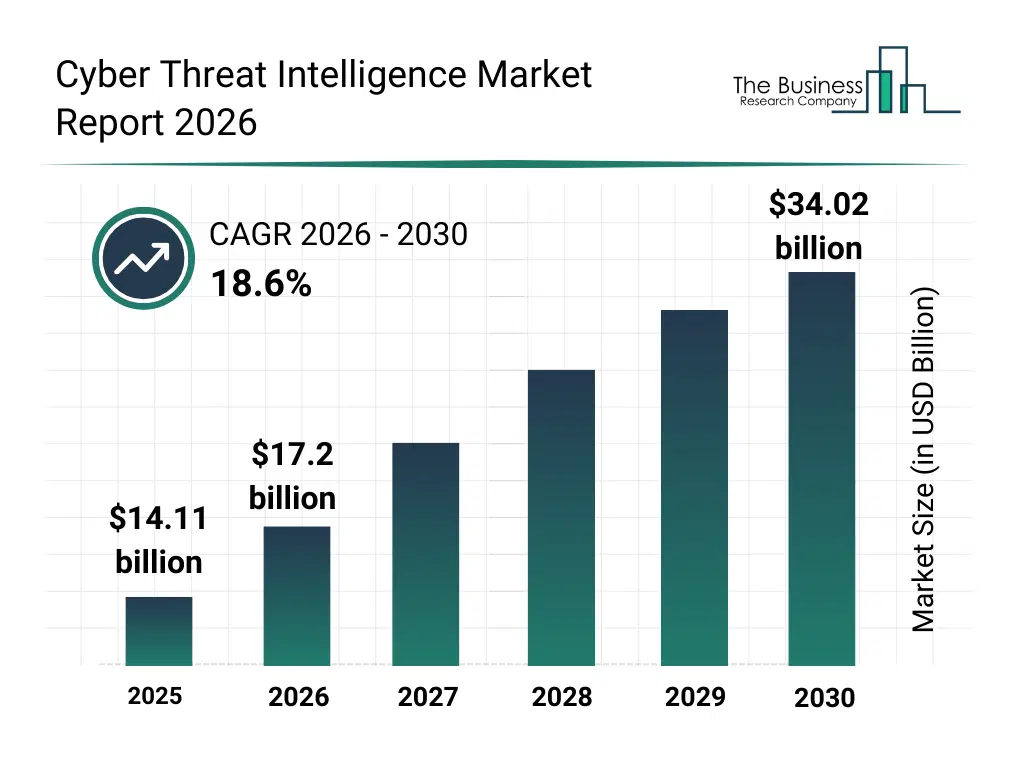
What Is The Cyber Threat Intelligence Market Size and Share 2026?
The cyber threat intelligence market size has grown exponentially in recent years. It will grow from $14.11 billion in 2025 to $17.2 billion in 2026 at a compound annual growth rate (CAGR) of 22.0%. The growth in the historic period can be attributed to increasing sophistication of cyber threats, adoption of siem and tips platforms, rising need for proactive security measures, growth of cloud deployment in enterprises, lack of in-house cybersecurity expertise.What Is The Cyber Threat Intelligence Market Growth Forecast?
The cyber threat intelligence market size is expected to see rapid growth in the next few years. It will grow to $34.02 billion in 2030 at a compound annual growth rate (CAGR) of 18.6%. The growth in the forecast period can be attributed to integration of AI and ml for threat prediction, expansion of cloud-based intelligence platforms, growing regulatory compliance requirements, increasing demand for automated incident response, development of collaborative threat intelligence networks. Major trends in the forecast period include advanced threat analytics, predictive cyberattack modeling, real-time threat intelligence sharing, incident response automation, proactive vulnerability assessment.
Global Cyber Threat Intelligence Market Segmentation
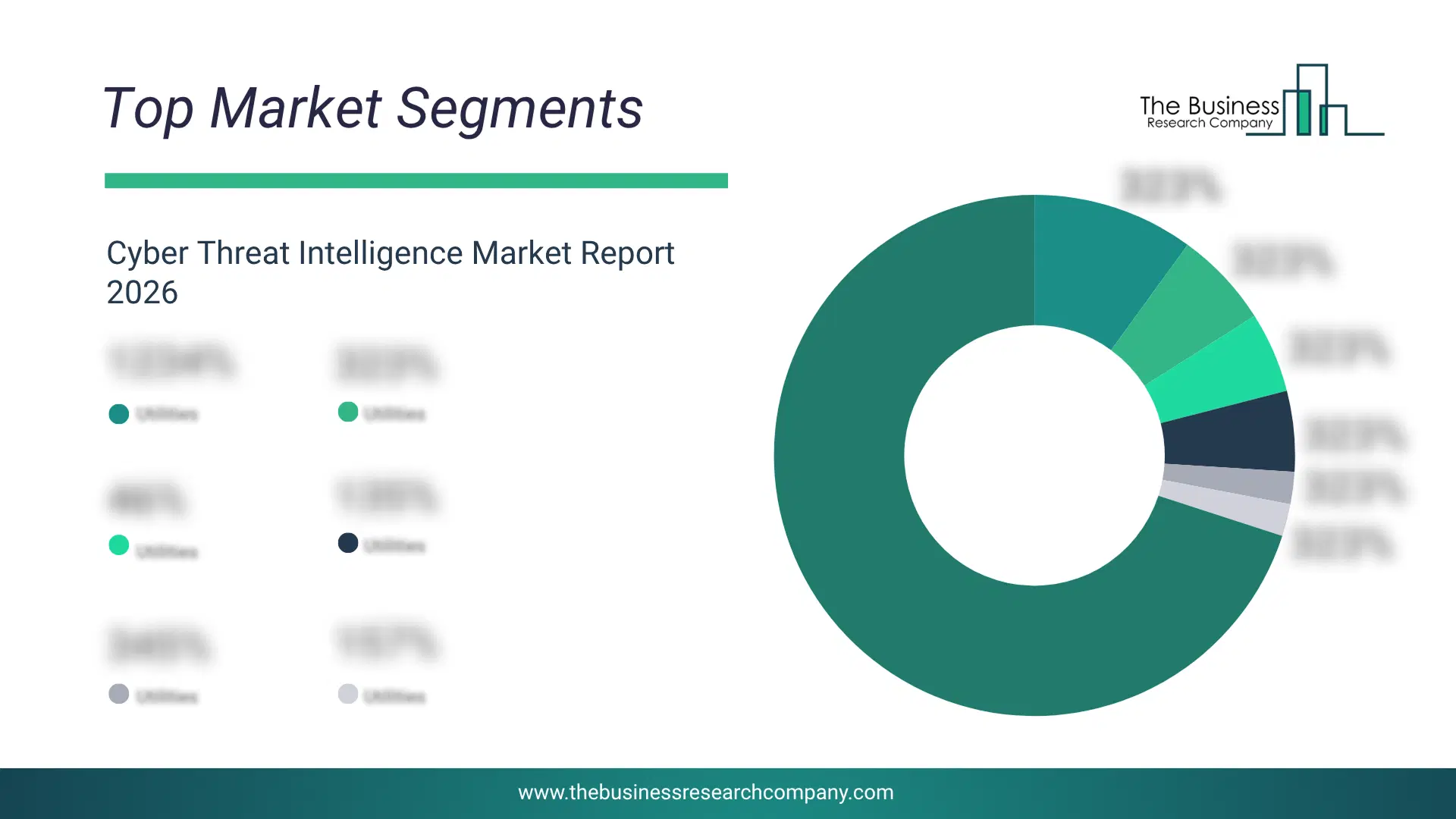
1) By Product: Software Product, Hardware Product 2) By Deployment: Cloud, On-Premise 3) By Application: Bank, Government, Enterprise, Other Applications Subsegments: 1) By Software Product: Threat Intelligence Platforms (Tips), Security Information And Event Management (SIEM) Systems, Antivirus And Anti-Malware Software 2) By Hardware Product: Network Security Appliances, Intrusion Detection Systems (IDS), FirewallsWhat Is The Driver Of The Cyber Threat Intelligence Market?
The rise in the number of sophisticated cyberattacks is expected to propel the growth of the cyber threat intelligence market going forward. Cyberattacks are hostile attempts to disable, damage, or gain unauthorized access to computer systems, networks, or digital devices. The rise in sophisticated cyberattacks can be attributed to advancing technology, increased connectivity, and the growing value of digital assets, prompting cybercriminals to develop more sophisticated methods to exploit vulnerabilities. Cyber threat intelligence (CTI) provides insights into the tactics, techniques, and procedures (TTPs) used by cyber adversaries, which is essential for defending against advanced threats. It also contributes to the increasing sophistication of cyberattacks, as threat actors leverage CTI to identify potential targets, understand their vulnerabilities, and tailor attacks for maximum impact and evasion of defenses. For instance, in October 2025, according to the Australian Signals Directorate, a Australia-based government agency, in FY2024–25, the Australian Signals Directorate’s (ASD) Australian Cyber Security Centre (ACSC) received over 42,500 calls to the Australian Cyber Security Hotline, marking a 16% rise from the previous year. Therefore, the rise in the number of sophisticated cyberattacks is driving the growth of the cyber threat intelligence industry.Key Players In The Global Cyber Threat Intelligence Market
Major companies operating in the cyber threat intelligence market are Dell Technologies Inc.; Siemens AG; International Business Machines Corporation; Cisco Systems Inc.; Broadcom Inc.; Honeywell International Inc.; Palo Alto Networks Inc.; Parsons Corporation; Optiv Security Inc.; Check Point Software Technologies Ltd.; Trend Micro Incorporated; CrowdStrike Holdings Inc.; FireEye Inc.; Kaspersky; Rapid7 Inc.; F-Secure Corporation; Webroot Inc.; Recorded Future Inc.; Sophos Group plc; Wurldtech Security Technologies; Lookingglass Cyber Solutions Inc.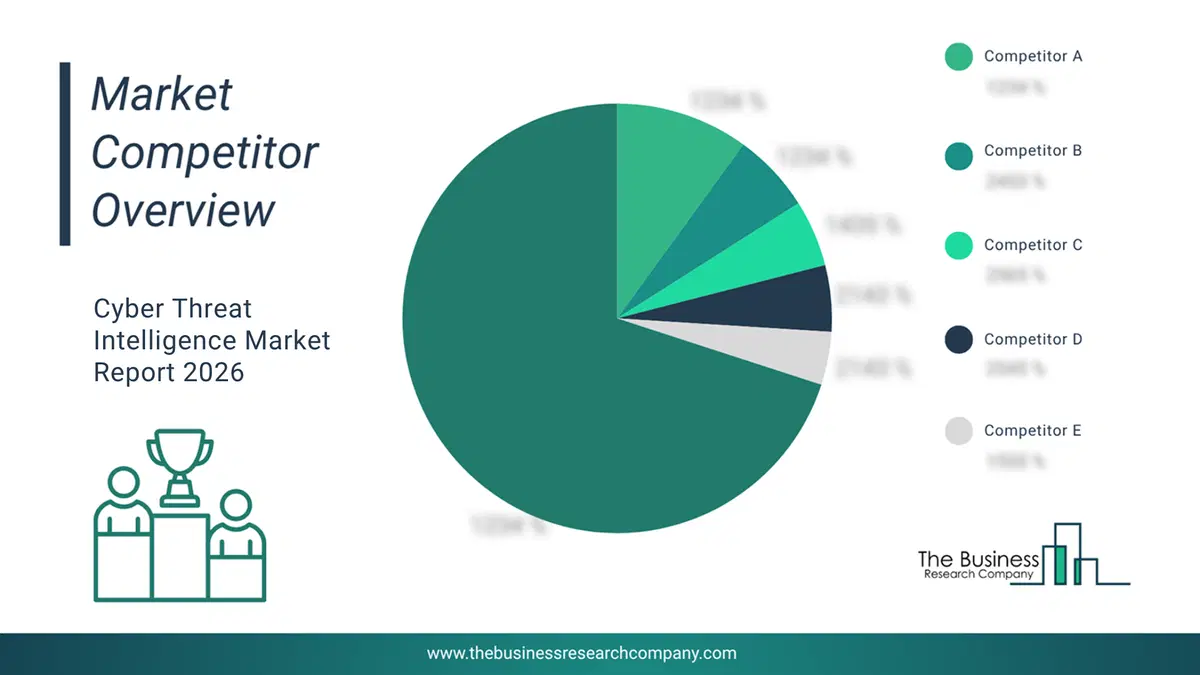
This chart is for illustrative purposes; the full report includes a detailed competitor analysis and comprehensive overview of the top 10 companies in the market.
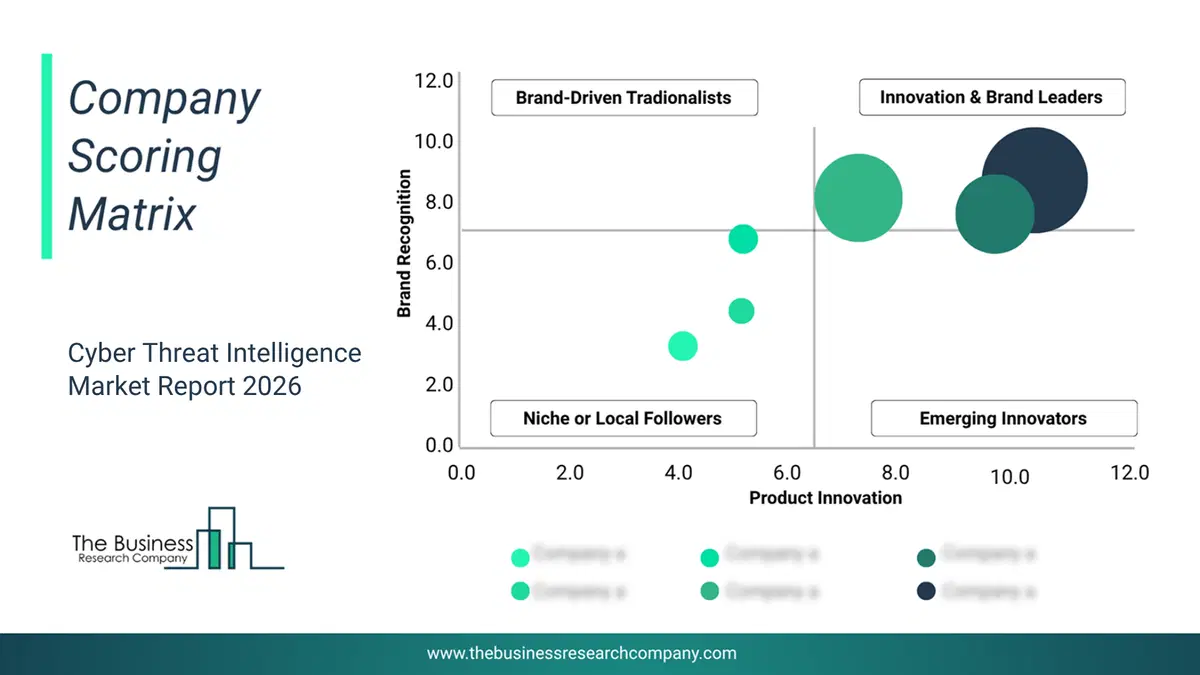
This chart maps companies by product innovation and brand strength, with bubble size indicating relative revenue, helping identify market leaders, challengers, and niche players. This is an illustrative chart; the full report provides a complete and accurate competitive analysis.
Global Cyber Threat Intelligence Market Trends and Insights
Major companies operating in the cyber threat intelligence market are focusing on generative-AI–powered security platforms, such as cloud-delivered AI copilots that combine threat-intelligence data, real-time telemetry, and automated response orchestration to help security teams detect, analyze, and remediate threats faster and at scale. Generative-AI security platforms refer to AI-driven suites that ingest malware data, vulnerability feeds, and behavioral threat indicators, perform automated threat analysis and contextual summarization, and support security workflows enabling organizations to overcome analyst overload and respond to complex cyber threats more effectively. For instance, in April 2023, Google LLC a US-based technology company, launched Google Cloud Security AI Workbench, a security-focused generative-AI platform powered by a specialized large language model (Sec-PaLM) combined with threat intelligence from Mandiant, offering capabilities such as malware and vulnerability analysis, natural-language querying of threat data, automated alert summarization, and integration via API to enable partner and enterprise threat-intelligence workflows. The platform is designed to help security teams accelerate threat detection and response by leveraging AI-driven insights and reducing manual analysis efforts. By combining Google’s cloud infrastructure with advanced generative AI and Mandiant’s threat intelligence, organizations can proactively identify and mitigate cybersecurity risks across complex IT environments.What Are Latest Mergers And Acquisitions In The Cyber Threat Intelligence Market?
In February 2023, Accenture PLC, an Ireland-based professional services company, acquired Morphus for an undisclosed amount. The acquisition aims to enhance Accenture's cybersecurity capabilities and expand its presence in Latin America. Morphus is a Brazil-based cyber threat intelligence services provider that specializes in advanced cybersecurity solutions, with a focus on attack detection and response.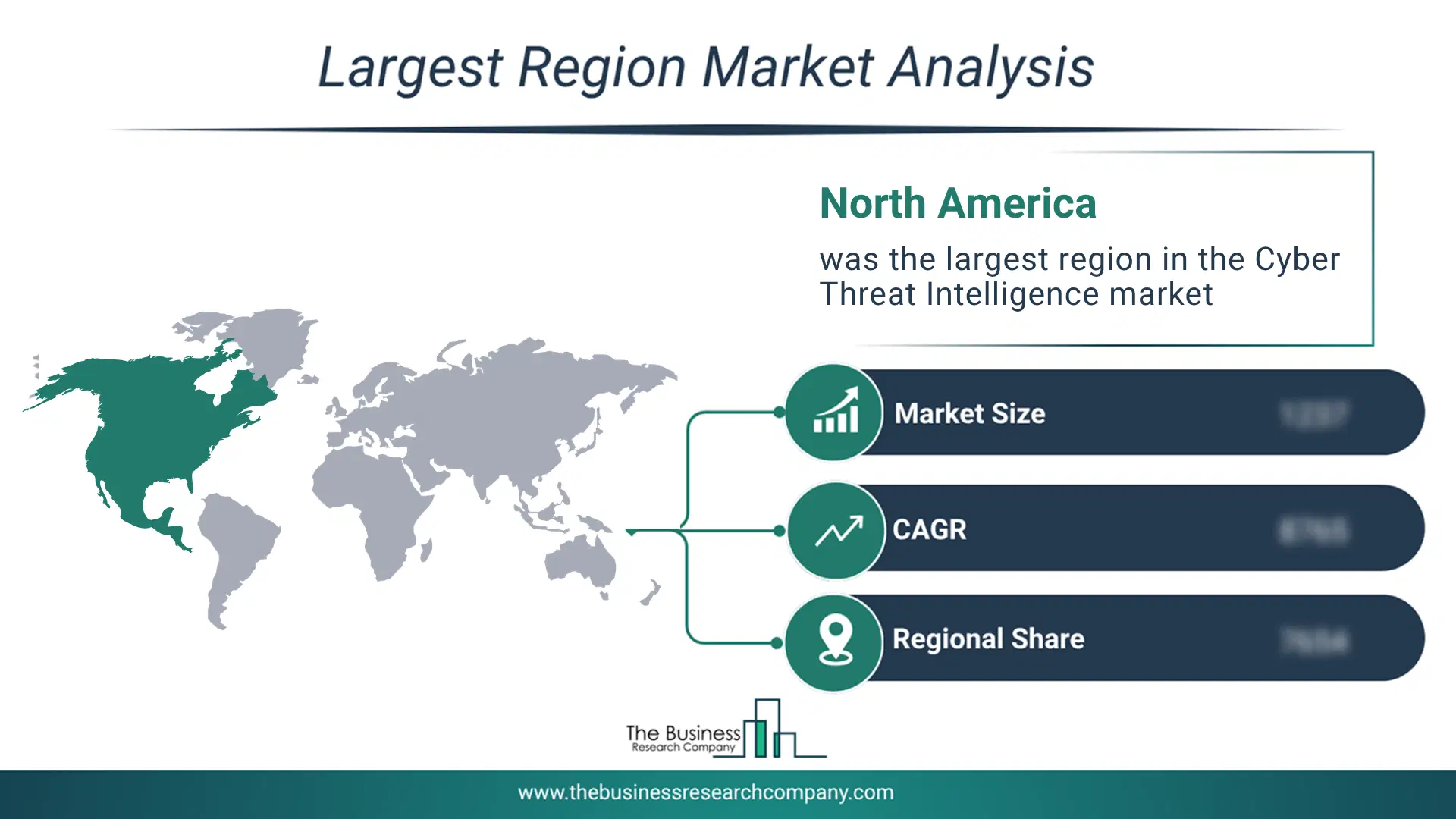
Regional Insights
North America was the largest region in the cyber threat intelligence market in 2025. Asia-Pacific is expected to be the fastest-growing region in the forecast period. The regions covered in this market report are Asia-Pacific, South East Asia, Western Europe, Eastern Europe, North America, South America, Middle East, Africa. The countries covered in this market report are Australia, Brazil, China, France, Germany, India, Indonesia, Japan, Taiwan, Russia, South Korea, UK, USA, Canada, Italy, SpainWhat Defines the Cyber Threat Intelligence Market?
The cyber threat intelligence market consists of revenues earned by entities providing services such as threat intelligence monitoring, threat hunting, and malware analysis. The market value includes the value of related goods sold by the service provider or included within the service offering. The cyber threat intelligence market also includes sales of servers, network appliances, and storage devices. Values in this market are ‘factory gate’ values, that is the value of goods sold by the manufacturers or creators of the goods, whether to other entities (including downstream manufacturers, wholesalers, distributors, and retailers) or directly to end customers. The value of goods in this market includes related services sold by the creators of the goods.How is Market Value Defined and Measured?
The market value is defined as the revenues that enterprises gain from the sale of goods and/or services within the specified market and geography through sales, grants, or donations in terms of the currency (in USD unless otherwise specified). The revenues for a specified geography are consumption values that are revenues generated by organizations in the specified geography within the market, irrespective of where they are produced. It does not include revenues from resales along the supply chain, either further along the supply chain or as part of other products.
This chart presents market attractiveness based on a quantitative evaluation of growth, competition, strategic alignment, and risk, offering a clear view of opportunity areas for decision-making. This chart is for illustrative purposes; the full report contains the complete analysis.

This chart highlights the Total Addressable Market (TAM) by estimating the maximum revenue opportunity using an assumption-driven approach, supporting strategic planning and opportunity sizing across markets. The chart is illustrative; the full report provides a more comprehensive analysis.
What Key Data and Analysis Are Included in the Cyber Threat Intelligence Market Report 2026?
The cyber threat intelligence market research report is one of a series of new reports from The Business Research Company that provides market statistics, including industry global market size, regional shares, competitors with the market share, detailed market segments, market trends and opportunities, and any further data you may need to thrive in the cyber threat intelligence industry. The market research report delivers a complete perspective of everything you need, with an in-depth analysis of the current and future state of the industry.Cyber Threat Intelligence Market Report Forecast Analysis
| Report Attribute | Details |
|---|---|
| Market Size Value In 2026 | $17.2 billion |
| Revenue Forecast In 2030 | $34.02 billion |
| Growth Rate | CAGR of 18.6% from 2026 to 2030 |
| Base Year For Estimation | 2025 |
| Actual Estimates/Historical Data | 2020-2025 |
| Forecast Period | 2026 - 2030 |
| Market Representation | Revenue in USD Billion and CAGR from 2026 to 2030 |
| Segments Covered | Product, Deployment, Application |
| Regional Scope | Asia-Pacific, Western Europe, Eastern Europe, North America, South America, Middle East, Africa |
| Country Scope | The Countries Covered In This Market Report Are Australia, Brazil, China, France, Germany, India, Indonesia, Japan, Taiwan, Russia, South Korea, Uk, Usa, Canada, Italy, Spain. |
| Key Companies Profiled | Dell Technologies Inc., Siemens AG, International Business Machines Corporation, Cisco Systems Inc., Broadcom Inc., Honeywell International Inc., Palo Alto Networks Inc., Parsons Corporation, Optiv Security Inc., Check Point Software Technologies Ltd., Trend Micro Incorporated, CrowdStrike Holdings Inc., FireEye Inc., Kaspersky, Rapid7 Inc., F-Secure Corporation, Webroot Inc., Recorded Future Inc., Sophos Group plc, Wurldtech Security Technologies, Lookingglass Cyber Solutions Inc. |
| Customization Scope | Request for Customization |
| Pricing And Purchase Options | Explore Purchase Options |