
Cybersecurity In Robotics Market Report 2026
Global Outlook – By Component (Software, Hardware, Services), By Deployment Type (On-Premises Solutions, Cloud-Based Systems, Hybrid Deployments), By Robot Type (Industrial Robots, Service Robots, Autonomous Mobile Robots, Collaborative Robots), By Solution (Authentication, Encryption, Denial Of Service Protection, Secure Communication, Risk And Vulnerability Management), By Industry Vertical (Manufacturing, Healthcare, Defense, Transportation, Energy And Utilities) – Market Size, Trends, Strategies, and Forecast to 2030
Cybersecurity In Robotics Market Overview
• Cybersecurity In Robotics market size has reached to $5.08 billion in 2025 • Expected to grow to $9.71 billion in 2030 at a compound annual growth rate (CAGR) of 13.8% • Growth Driver: Growing Exposure Of Industrial Robots To Cyber Threats And Attacks Driving The Growth Of The C Market Due To Rising Connectivity And Automation In Industrial Environments • Market Trend: Strengthening Autonomous Systems With Integrated Cybersecurity Frameworks, Resilient Encryption, And Real-Time Threat Protection • North America was the largest region in 2025 and Asia-Pacific is the fastest growing region.Market Gains By 2030 – Top Opportunities By Segment
Market Gain identifies the most promising market opportunities by highlighting the segments or products expected to generate the highest incremental revenue growth over the next five years.
What Is Covered Under Cybersecurity In Robotics Market?
Cyber-security in robotics refers to the practice of protecting robotic systems, their software, and communication networks from cyber threats, unauthorized access, and malicious attacks. It involves implementing measures such as encryption, secure authentication, intrusion detection, and real-time monitoring to safeguard the integrity, confidentiality, and availability of robotic operations. Ensuring robust cyber-security is critical for maintaining operational reliability, preventing data breaches, and mitigating risks associated with autonomous and connected robotic systems. The main components of cybersecurity in robotics include software, hardware, and services. Software refers to programs that protect robotic systems from cyber threats, hardware includes security-enabled devices and controllers, and services encompass consulting, monitoring, and maintenance of secure robotic operations. The deployment types include on-premises solutions, cloud-based systems, and hybrid deployments. The robot types include industrial robots, service robots, autonomous mobile robots, and collaborative robots. The solutions include authentication, encryption, denial of service protection, secure communication, and risk and vulnerability management, catering to key industry verticals such as manufacturing, healthcare, defense, transportation, and energy and utilities.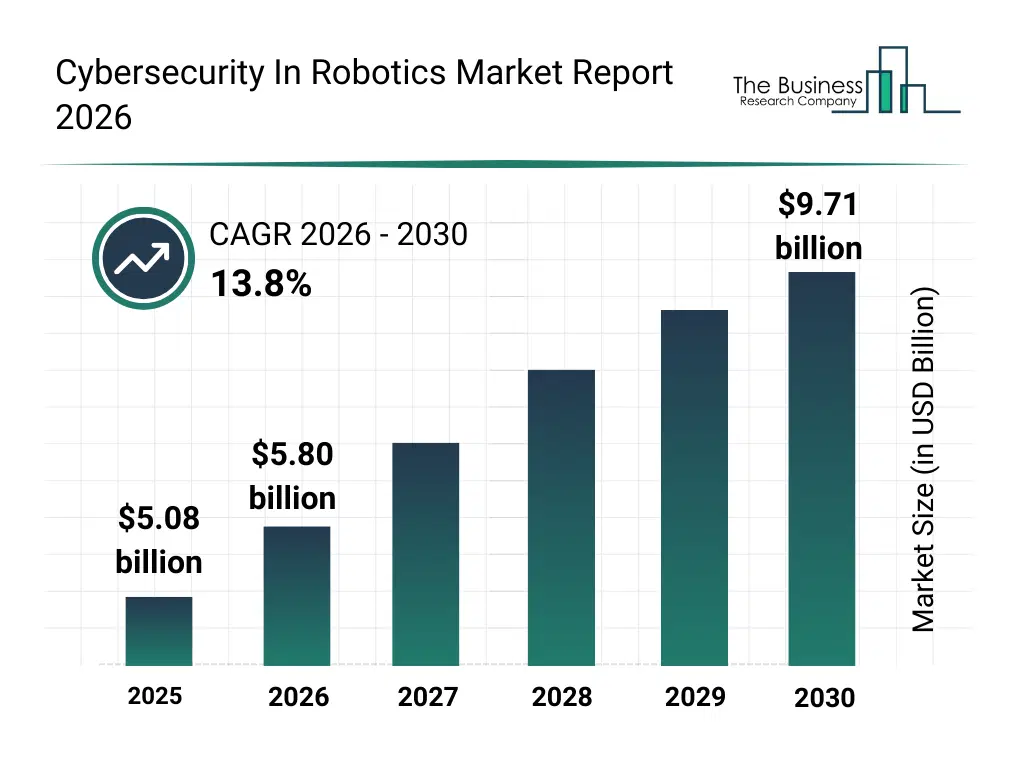
What Is The Cybersecurity In Robotics Market Size and Share 2026?
The cybersecurity in robotics market size has grown rapidly in recent years. It will grow from $5.08 billion in 2025 to $5.80 billion in 2026 at a compound annual growth rate (CAGR) of 14.1%. The growth in the historic period can be attributed to increasing adoption of connected robotics, growing integration of artificial intelligence in robotic systems, rising cyber threats targeting automated operations, expanding use of cloud-based robotic platforms, and growing need for secure industrial automation.What Is The Cybersecurity In Robotics Market Growth Forecast?
The cybersecurity in robotics market size is expected to see rapid growth in the next few years. It will grow to $9.71 billion in 2030 at a compound annual growth rate (CAGR) of 13.8%. The growth in the forecast period can be attributed to increasing investment in advanced robotic security solutions, rising deployment of autonomous mobile robots, growing compliance requirements for robotic cybersecurity, expanding utilization of robotics in critical industries, and increasing demand for secure human-robot interaction. Major trends in the forecast period include technology advancements in robotic threat detection, innovations in autonomous cybersecurity capabilities, developments in secure robotic communication systems, research and development in machine learning-based robotic protection, and technological advancements in encryption for robotic networks.
Global Cybersecurity In Robotics Market Segmentation
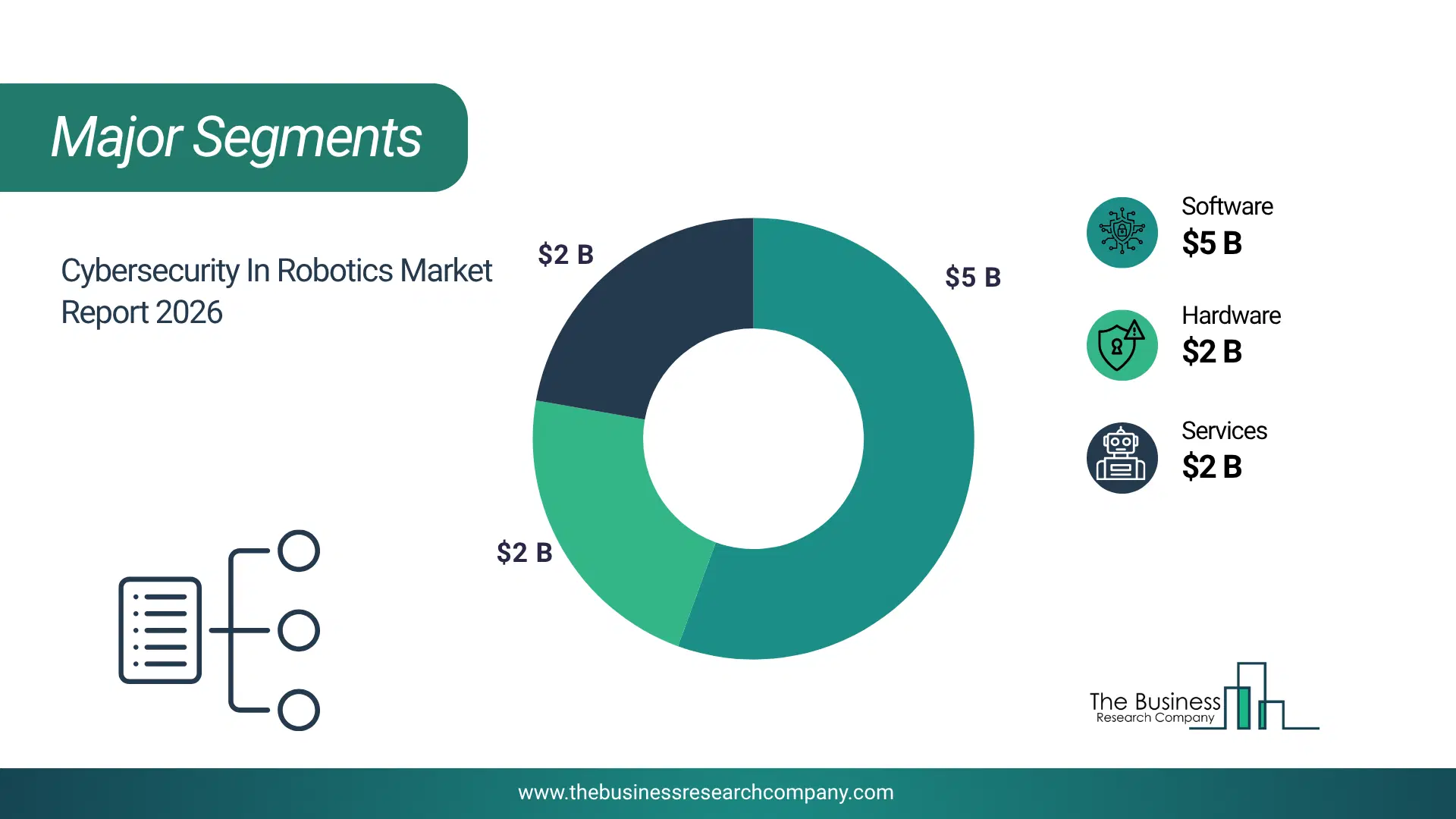
1) By Component: Software, Hardware, Services 2) By Deployment Type: On-Premises Solutions, Cloud-Based Systems, Hybrid Deployments 3) By Robot Type: Industrial Robots, Service Robots, Autonomous Mobile Robots, Collaborative Robots 4) By Solution: Authentication, Encryption, Denial Of Service Protection, Secure Communication, Risk And Vulnerability Management 5) By Industry Vertical: Manufacturing, Healthcare, Defense, Transportation, Energy And Utilities Subsegments: 1) By Software: Secure Operating Systems, Threat Detection Platforms, Encryption Management Tools, Identity Access Solutions 2) By Hardware: Secure Network Gateways, Robotic Control Units, Authentication Hardware Modules, Cybersecure Sensor Systems 3) By Services: Managed Security Services, Integration and Implementation Services, Consulting and Advisory Services, Training and Support Services The top segments in the cybersecurity in robotics market will be: • Software will reach $4.82 Billion by 2030. • Hardware will reach $2.33 Billion by 2030. • Services will reach $1.78 Billion by 2030.What Is The Driver Of The Cybersecurity In Robotics Market?
The growing exposure of industrial robots to cyber threats and attacks is expected to propel the growth of the cybersecurity in robotics market going forward. Cyber threats are malicious activities targeting robotic systems, including malware, ransomware, and unauthorized access attempts, that compromise the security, functionality, or safety of robots. The exposure of industrial robots to cyber threats and attacks is rising as factories, warehouses, and manufacturing facilities adopt highly connected and automated robotic systems that rely on networked controls and cloud platforms. Cybersecurity in robotics helps in mitigating cyber threats and attacks by safeguarding communication protocols, sensors, control systems, and cloud platforms, ensuring that robots operate safely, securely, and without disruption. For instance, in April 2025, according to Check Point Software Technologies, an Israel-based cybersecurity company, cyber attacks per organization increased by 47% in the first quarter, reaching an average of 1,925 weekly attacks, with industrial manufacturing facing 1,554 attacks, reflecting an increase of 63%. Therefore, the growing exposure of industrial robots to cyber threats and attacks is driving the growth of the cybersecurity in robotics industry.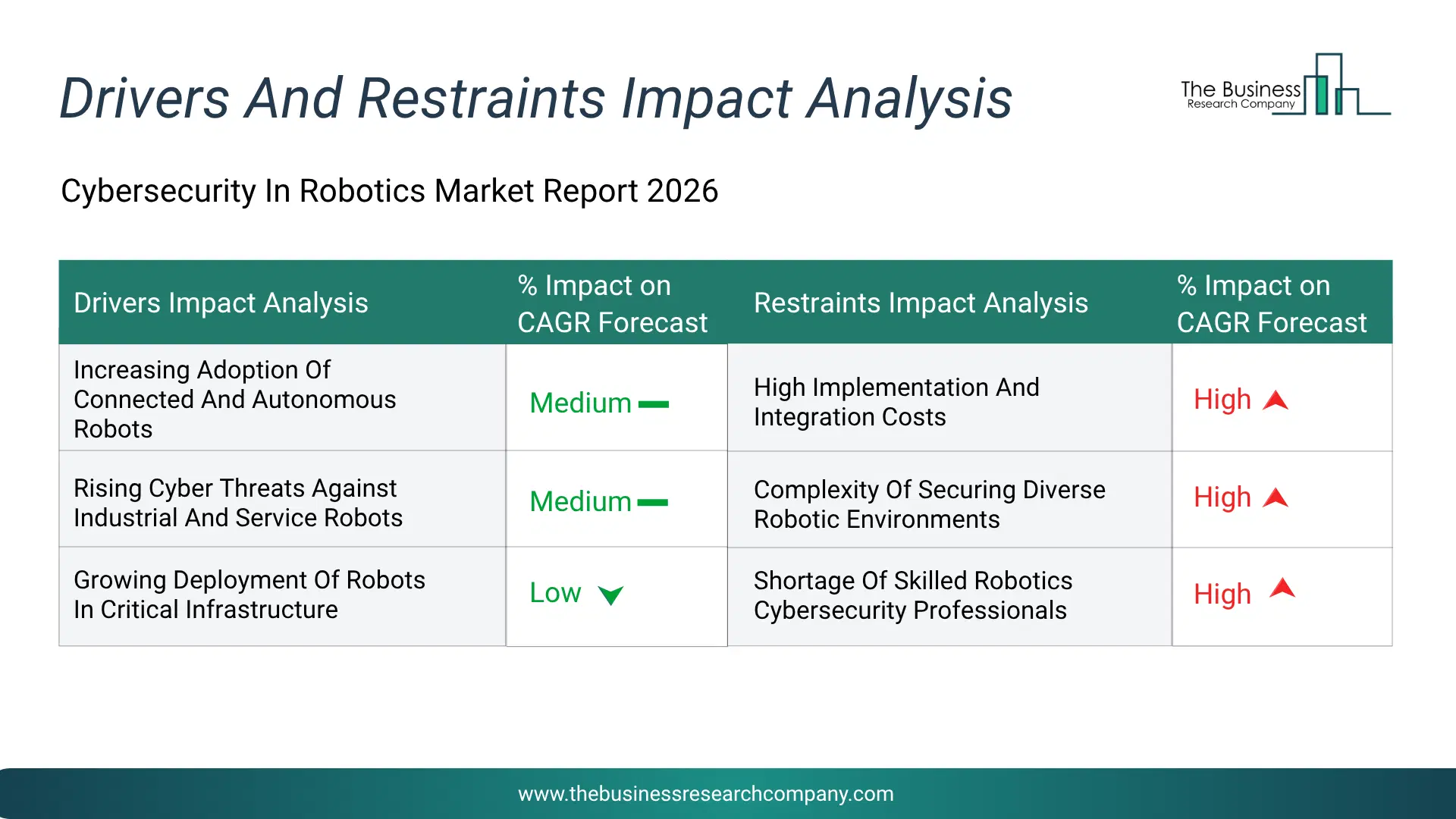
Infographic Chart Showing Key Market Drivers Analysis And Restraints For Cybersecurity In Robotics Market
The chart presents an impact analysis of key drivers and restraints, quantifying their relative influence on the market's growth rate and helping assess the balance between growth enablers and limiting factors. This chart offers a high-level perspective; the full report contains more detailed insights.
How Will The Drivers Impact Growth In The Global Cybersecurity In Robotics Market?
• Increasing Adoption Of Connected And Autonomous Robots (Medium) – During the forecast period, the increasing adoption of connected and autonomous robots is expected to become a key growth driver for the cybersecurity in robotics market by 2030. Enterprises are deploying intelligent robotic systems that continuously exchange data across cloud platforms, edge devices, and industrial networks to improve automation and operational efficiency. This higher level of connectivity expands the attack surface, creating greater demand for cybersecurity solutions that protect robotic identities, communications, and control systems. Organizations are increasingly implementing advanced security architectures to ensure uninterrupted robotic operations while minimizing cyber risks. This accelerating adoption of connected robotic ecosystems is strengthening demand for dedicated cybersecurity technologies. • Rising Cyber Threats Against Industrial And Service Robots (Medium) – During the forecast period, the rising cyber threats against industrial and service robots are expected to emerge as a major factor driving the expansion of the cybersecurity in robotics market by 2030. The growing frequency of ransomware attacks, unauthorized access attempts, and software vulnerabilities targeting robotic environments is encouraging organizations to strengthen cyber resilience. Businesses are expanding investments in threat intelligence, continuous security monitoring, and advanced protection platforms to safeguard robotic assets from evolving cyber risks. The increasing complexity of robotic software and connected infrastructures is further reinforcing the need for specialized cybersecurity solutions. • Growing Deployment Of Robots In Critical Infrastructure (Low) – During the forecast period, the growing deployment of robots in critical infrastructure is expected to act as a key growth catalyst for the cybersecurity in robotics market by 2030. Robotic systems are being increasingly utilized to support mission-critical operations across energy, utilities, healthcare, transportation, and defense sectors where system reliability is essential. Operators are prioritizing comprehensive cybersecurity strategies to maintain business continuity, strengthen operational resilience, and comply with evolving security regulations. The expanding use of robotics in high-value environments is creating sustained demand for solutions that secure critical robotic assets against sophisticated cyber incidents.How Will The Restraints Impact Growth In The Global Cybersecurity In Robotics Market?
• High Implementation And Integration Costs (Medium) – During the forecast period, the high implementation and integration costs act as a major restraint for the cyber-security in robotics market because securing robotic systems requires investments in specialized security software, encrypted communication modules, monitoring platforms, and system upgrades. Many organizations must also modify existing robotic infrastructure to support advanced cyber-security features, increasing deployment expenses. Small and medium-sized enterprises often face budget constraints that limit adoption of comprehensive robotic security solutions. Additional costs associated with training, maintenance, and compliance further raise the total investment required. These financial barriers can slow market penetration and delay security modernization initiatives. • Complexity Of Securing Diverse Robotic Environments (Medium) – During the forecast period, the complexity of securing diverse robotic environments acts as a significant restraint for the cyber-security in robotics market because robotic systems operate across different hardware platforms, operating systems, communication protocols, and application environments. Developing security solutions that work consistently across these diverse ecosystems is technically challenging and resource intensive. Organizations often struggle to maintain uniform security standards across mixed robotic fleets. Integration difficulties can increase deployment times and operational complexity. This challenge may discourage some companies from adopting advanced robotic cyber-security solutions. • Shortage Of Skilled Robotics Cybersecurity Professionals (Low) – During the forecast period, the shortage of skilled robotics cybersecurity professionals is expected to restrain the growth of the cyber-security in robotics market. Securing robotic systems requires multidisciplinary expertise in robotics, industrial automation, cybersecurity, artificial intelligence, and operational technology (OT). However, organizations across manufacturing, healthcare, logistics, and defense continue to face a shortage of professionals with the specialized skills needed to identify vulnerabilities, implement security controls, and respond to cyber threats targeting robotic environments. The limited availability of qualified personnel can delay the deployment of cybersecurity solutions, increase dependence on external service providers, and raise implementation and operational costs. In addition, inadequate expertise may result in ineffective security configurations, prolonged incident response times, and increased exposure to cyberattacks. Small and medium-sized enterprises are particularly affected due to limited access to specialized talent and constrained financial resources. Consequently, the shortage of skilled robotics cybersecurity professionals remains a significant restraint on the growth of the cyber-security in robotics market.Key Players In The Global Cybersecurity In Robotics Market
Major companies operating in the cybersecurity in robotics market are Siemens Aktiengesellschaft, Honeywell International Inc., Kaspersky Lab, Tenable Holdings Inc., Rapid7 Inc., Darktrace Ltd., Forcepoint LLC, Bitdefender LLC, Armis Inc., Forescout Technologies Inc., Claroty Ltd., OPSWAT Inc., Dragos Inc., Nozomi Networks Ltd., FORT Robotics Inc., Radiflow Ltd., Cynerio Ltd, Alias Robotics SL, MedCrypt Inc., Asimily Inc., Arxan Technologies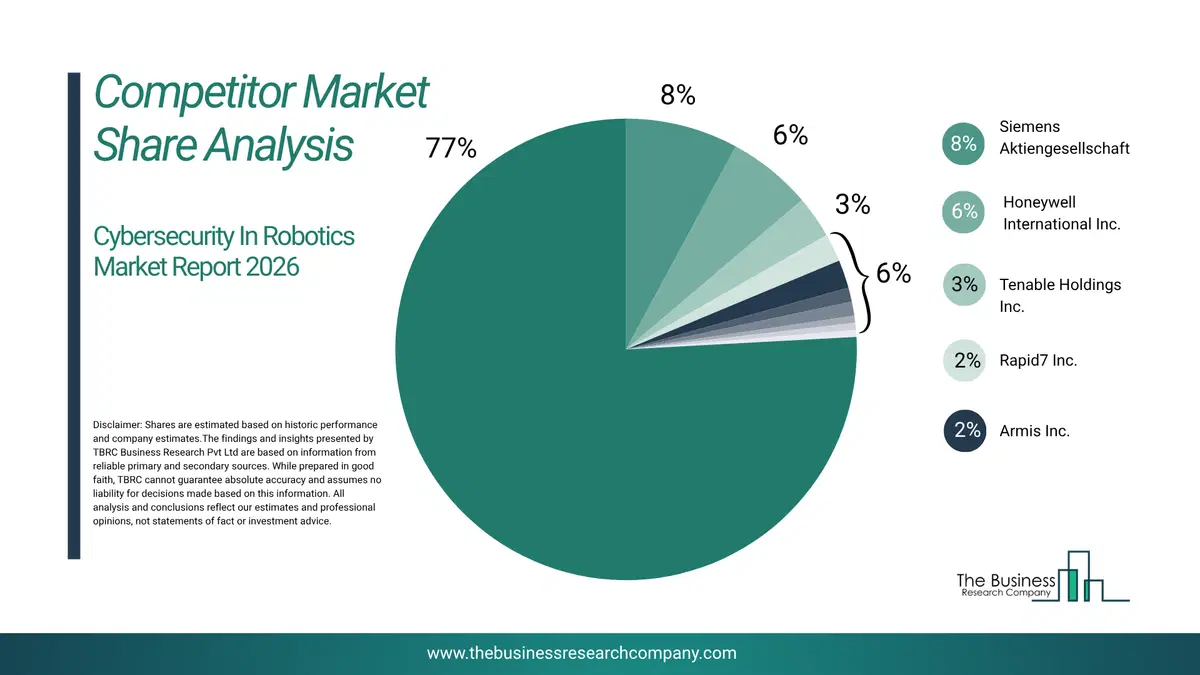
This chart is for illustrative purposes; the full report includes a detailed competitor analysis and comprehensive overview of the top 10 companies in the market.
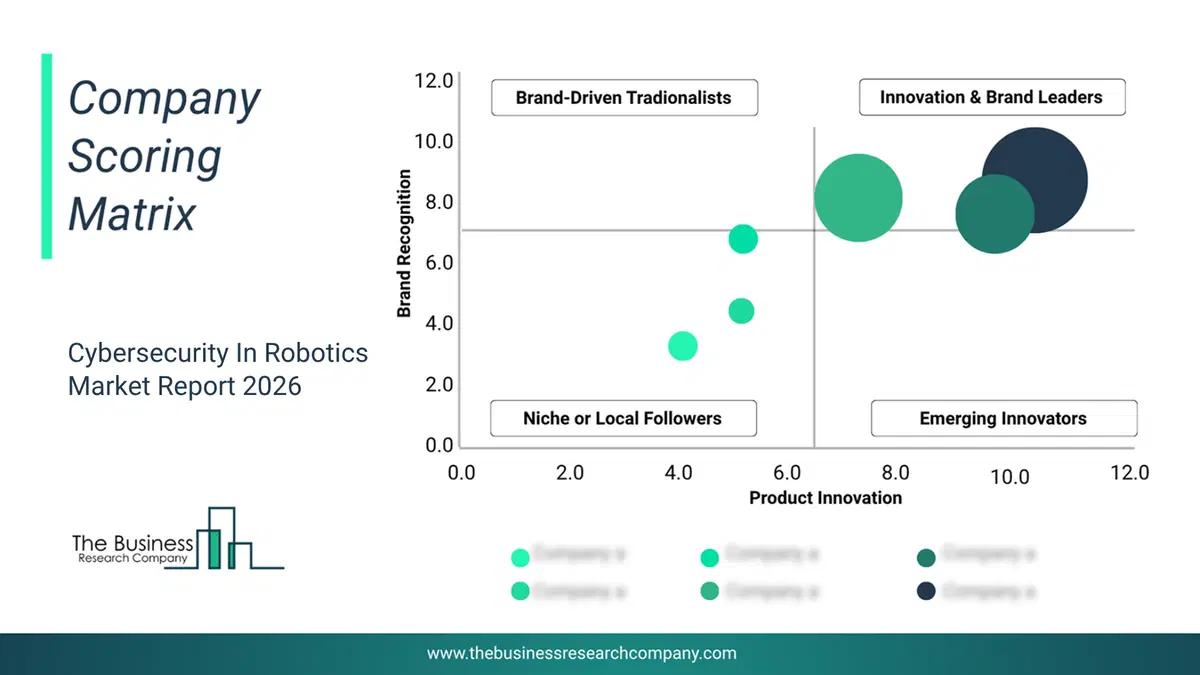
This chart maps companies by product innovation and brand strength, with bubble size indicating relative revenue, helping identify market leaders, challengers, and niche players. This is an illustrative chart; the full report provides a complete and accurate competitive analysis.
Global Cybersecurity In Robotics Market Trends and Insights
Major companies operating in the cybersecurity in robotics market are focusing on developing advanced protection technologies, such as immunity cybersecurity encryption software suites, to safeguard autonomous drones and robotic platforms against evolving cyber threats while ensuring operational integrity and data security. Immunity cybersecurity encryption software suites refer to comprehensive security toolsets that combine encryption, intrusion detection, and immunization capabilities designed specifically to protect autonomous systems from unauthorized access, manipulation, and signal interference. For instance, in October 2025, Mobilicom Ltd., an Israel-based provider of secured autonomy solutions, launched its Secured Autonomy cybersecurity framework, the industry’s first end-to-end cybersecurity platform tailored for autonomous drones and robotics. A core component of the framework is the ICE software suite, which delivers resilient encryption, real-time threat detection, secure communication channels, and hardware-agnostic protection layers to prevent cyber intrusions and ensure mission continuity.What Are Latest Mergers And Acquisitions In The Cybersecurity In Robotics Market?
In June 2024, Dean Drako, a US-based entrepreneur and founder of Eagle Eye Networks, acquired Cobalt AI for an undisclosed amount. With this acquisition, Drako aims to strengthen its portfolio in security automation by integrating Cobalt AI’s advanced AI-powered enterprise security automation and robotics-related technologies, enhancing capabilities across robotics, AI alarm filtering, and remote monitoring. Cobalt AI is a US-based provider of AI-enabled cybersecurity robot solutions and enterprise security automation systems.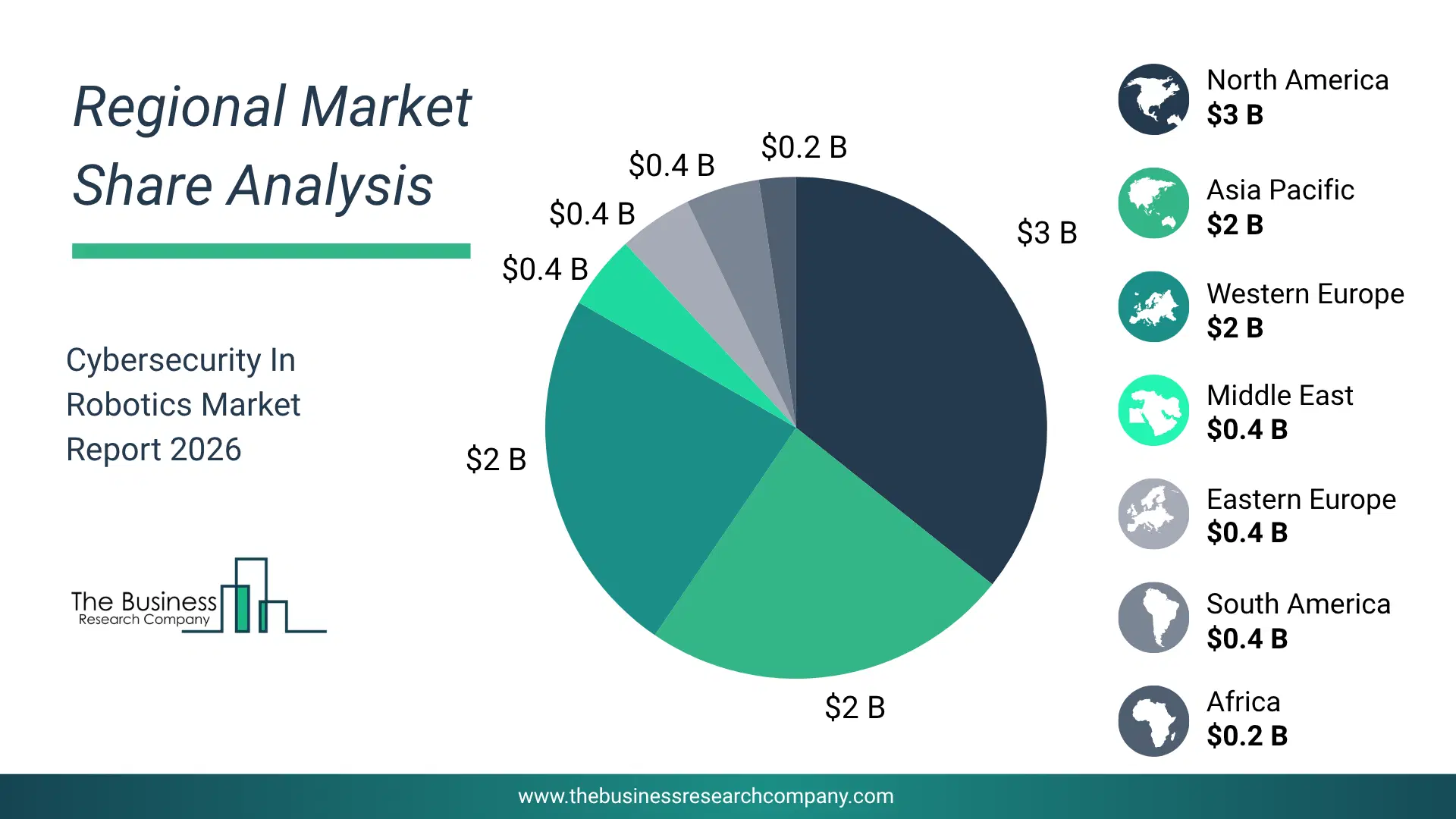
Regional Insights
North America was the largest region in the cybersecurity in robotics in 2025. Asia-Pacific is expected to be the fastest-growing region in the forecast period. The regions covered in this market report are Asia-Pacific, South East Asia, Western Europe, Eastern Europe, North America, South America, Middle East, Africa. The countries covered in this market report are Australia, Brazil, China, France, Germany, India, Indonesia, Japan, Taiwan, Russia, South Korea, UK, USA, Canada, Italy, Spain.What Defines the Cybersecurity In Robotics Market?
The cyber-security in robotics market consists of sales of products such as antivirus software for robots, endpoint protection platforms for robots, network firewalls for robot communications, intrusion detection systems for robotic networks, encrypted communication modules for robotic systems Values in this market are ‘factory gate’ values, that is the value of goods sold by the manufacturers or creators of the goods, whether to other entities (including downstream manufacturers, wholesalers, distributors and retailers) or directly to end customers. The value of goods in this market includes related services sold by the creators of the goods.How is Market Value Defined and Measured?
The market value is defined as the revenues that enterprises gain from the sale of goods and/or services within the specified market and geography through sales, grants, or donations in terms of the currency (in USD unless otherwise specified). The revenues for a specified geography are consumption values that are revenues generated by organizations in the specified geography within the market, irrespective of where they are produced. It does not include revenues from resales along the supply chain, either further along the supply chain or as part of other products.
This chart presents market attractiveness based on a quantitative evaluation of growth, competition, strategic alignment, and risk, offering a clear view of opportunity areas for decision-making. This chart is for illustrative purposes; the full report contains the complete analysis.

This chart highlights the Total Addressable Market (TAM) by estimating the maximum revenue opportunity using an assumption-driven approach, supporting strategic planning and opportunity sizing across markets. The chart is illustrative; the full report provides a more comprehensive analysis.
What Key Data and Analysis Are Included in the Cybersecurity In Robotics Market Report 2026?
The cybersecurity in robotics market research report is one of a series of new reports from The Business Research Company that provides market statistics, including industry global market size, regional shares, competitors with the market share, detailed market segments, market trends and opportunities, and any further data you may need to thrive in the cybersecurity in robotics industry. The market research report delivers a complete perspective of everything you need, with an in-depth analysis of the current and future state of the industry.Cybersecurity in Robotics Market Report Forecast Analysis
| Report Attribute | Details |
|---|---|
| Market Size Value In 2026 | $5.80 billion |
| Revenue Forecast In 2030 | $9.71 billion |
| Growth Rate | CAGR of 14.1% from 2026 to 2030 |
| Base Year For Estimation | 2025 |
| Actual Estimates/Historical Data | 2020-2025 |
| Forecast Period | 2026 - 2030 |
| Market Representation | Revenue in USD Billion and CAGR from 2026 to 2030 |
| Segments Covered | Component, Deployment Type, Robot Type, Solution, Industry Vertical |
| Regional Scope | Asia-Pacific, Western Europe, Eastern Europe, North America, South America, Middle East, Africa |
| Country Scope | The countries covered in the report are Australia, Brazil, China, France, Germany, India, Indonesia, Japan, Taiwan, Russia, South Korea, UK, USA, Canada, Italy, Spain. |
| Key Companies Profiled | Siemens Aktiengesellschaft, Honeywell International Inc., Kaspersky Lab, Tenable Holdings Inc., Rapid7 Inc., Darktrace Ltd., Forcepoint LLC, Bitdefender LLC, Armis Inc., Forescout Technologies Inc., Claroty Ltd., OPSWAT Inc., Dragos Inc., Nozomi Networks Ltd., FORT Robotics Inc., Radiflow Ltd., Cynerio Ltd, Alias Robotics SL, MedCrypt Inc., Asimily Inc., Arxan Technologies |
| Customization Scope | Request for Customization |
| Pricing And Purchase Options | Explore Purchase Options |