
Data Center Support Infrastructure Market Report 2026
Global Outlook – By Infrastructure ( Power Distribution Systems, Cooling Systems, Racks And Enclosures, Site And Facility Infrastructure, Security Systems), By Tier ( Tier I, Tier II, Tier III, Tier IV), By Enterprise Size ( Large Enterprise, Small And Medium Sized Enterprises), By Deployment Model ( On-Premises, Cloud), By End User ( Cloud Service Provider, Technology Provider, Telecom, Healthcare, Banking, Financial Services, And Insurance (BFSI), Retail And E-commerce, Entertainment And Media, Energy, Other End-Users) – Market Size, Trends, Strategies, and Forecast to 2030
Data Center Support Infrastructure Market Overview
• Data Center Support Infrastructure market size has reached to $62.03 billion in 2025 • Expected to grow to $109.02 billion in 2030 at a compound annual growth rate (CAGR) of 11.9% • Growth Driver: The Increasing Demand For Cloud Services Is Fueling The Growth Of The Market Due To Growing Reliance On Digital Transformation And Remote Operations • Market Trend: Advancement In Modular And Flexible Data Center Infrastructure Designs • North America was the largest region in 2025 and Asia-Pacific is the fastest growing region.What Is Covered Under Data Center Support Infrastructure Market?
Data center support infrastructure is the set of non-computing systems that surround and enable information technology equipment, including power supply and distribution, backup power, cooling and ventilation, physical racks and containment, cabling, environmental monitoring, fire detection and suppression, security, and control software. Its purpose is to keep the facility reliable, safe, and efficient by delivering clean power, removing heat, protecting the site, and giving operators continuous visibility and control so the information technology workload stays available. The main types of data center support infrastructure are power distribution systems, cooling systems, racks and enclosures, site and facility infrastructure, security systems. Power distribution systems are the collection of facilities and equipment that connect an electrical transmission system to end-user equipment, including substations, feeders, switches, protective devices, transformers and service connections that safely deliver usable voltage to loads. The various tiers include tier i, tier ii, tier iii, tier iv. These are used by various enterprise sizes such as large enterprise, small and medium sized enterprises and deployed through various deployment model such as on-premises, cloud. These are also used by various end users such as cloud service provider, technology provider, telecom, healthcare, banking, financial services, and insurance (BFSI), retail and e-commerce, entertainment and media, energy, other end-users.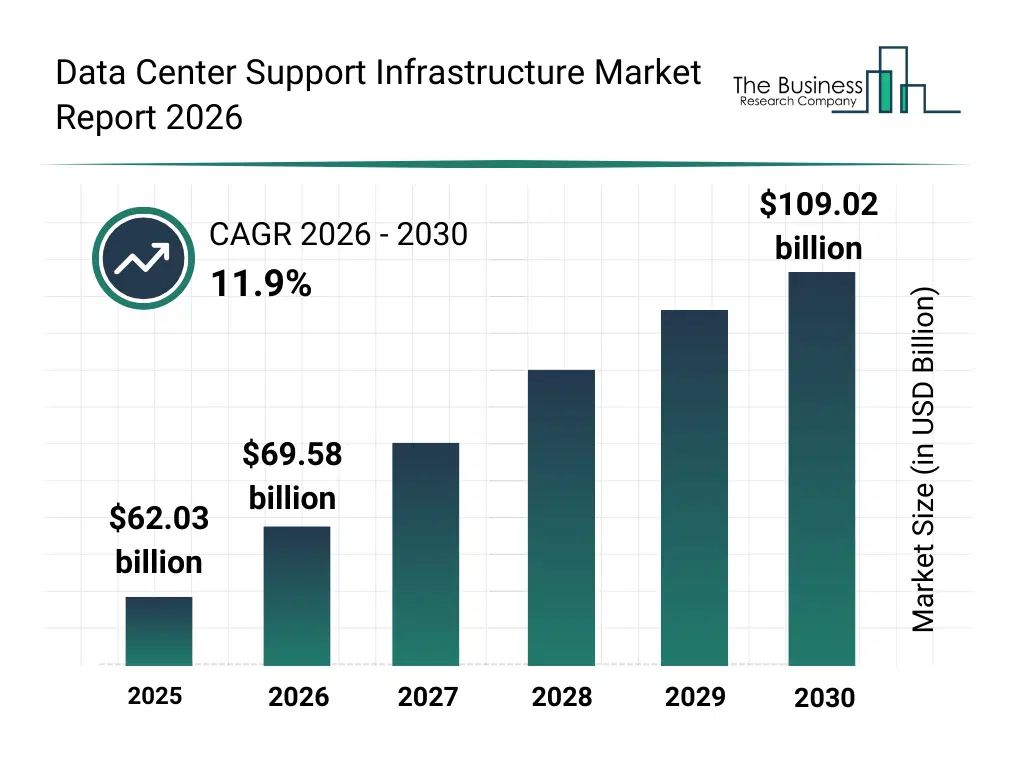
What Is The Data Center Support Infrastructure Market Size 2026 And Growth Rate?
The data center support infrastructure market size has grown rapidly in recent years. It will grow from $62.03 billion in 2025 to $69.58 billion in 2026 at a compound annual growth rate (CAGR) of 12.2%. The growth in the historic period can be attributed to growing data center adoption, expansion of enterprise it infrastructure, increasing demand for reliable power and cooling, rising number of tier ii and tier iii facilities, early adoption of structured cabling and access systems.What Is The Data Center Support Infrastructure Market Growth Forecast?
The data center support infrastructure market size is expected to see rapid growth in the next few years. It will grow to $109.02 billion in 2030 at a compound annual growth rate (CAGR) of 11.9%. The growth in the forecast period can be attributed to increasing cloud and colocation services, growth in energy-efficient and sustainable infrastructure, expansion of tier iii and tier iv facilities, rising demand for smart monitoring and management systems, integration of advanced security technologies. Major trends in the forecast period include adoption of energy-efficient cooling and power distribution systems, integration of smart monitoring and control systems for infrastructure, deployment of modular and scalable racks and enclosures, implementation of advanced security and surveillance systems, rising demand for resilient and high-tier data center infrastructure.
Global Data Center Support Infrastructure Market Segmentation
1) By Infrastructure: Power Distribution Systems, Cooling Systems, Racks And Enclosures, Site And Facility Infrastructure, Security Systems 2) By Tier: Tier I, Tier II, Tier III, Tier IV 3) By Enterprise Size: Large Enterprise, Small And Medium Sized Enterprises 4) By Deployment Model: On-Premises, Cloud 5) By End User: Cloud Service Provider, Technology Provider, Telecom, Healthcare, Banking, Financial Services, And Insurance (BFSI), Retail And E-commerce, Entertainment And Media, Energy, Other End-Users Subsegments: 1) By Power Distribution Systems: Medium Voltage Switchgear, Low Voltage Switchboards, Transformers, Automatic Transfer Switches, Static Transfer Switches 2) By Cooling Systems: Computer Room Air Conditioners, Computer Room Air Handlers, Chilled Water Plants, Direct Expansion Cooling Units, Cooling Towers, Adiabatic Dry Coolers 3) By Racks And Enclosures: Open Frame Racks, Enclosed Server Cabinets, Seismic Rated Cabinets, Wall Mount Cabinets, Network Equipment Racks 4) By Site And Facility Infrastructure: Raised Access Flooring Systems, Structured Cabling Systems, Fire Detection And Suppression Systems, Building Management And Control Systems, Water Treatment And Distribution Systems 5) By Security Systems: Physical Access Control Systems, Biometric Authentication Systems, Video Surveillance And Management Systems, Intrusion Detection And Alarm Systems, Perimeter Fencing And Barrier SystemsWhat Is The Driver Of The Data Center Support Infrastructure Market?
The increasing demand for cloud services are expected to propel the growth of the data center support infrastructure market going forward. Cloud services refer to a broad range of on-demand computing resources, applications, and storage solutions delivered over the internet, allowing individuals and organizations to access, manage, and process data without the need for physical infrastructure, while enabling scalability, flexibility, remote collaboration, and cost-efficiency. The surging demand for cloud services is driven by growing reliance on digital transformation and remote operations. Data center support infrastructure underpins cloud services by providing the essential power, cooling, networking, and security systems that ensure high availability, scalability, and reliable performance for cloud-based applications. For instance, in February 2025, according to Schneider Electric, a France-based French multinational company specializing in digital automation and energy management, the company reported FY 2024 revenues of €38.2 billion, marking an 8% organic growth compared to the previous year. Therefore, the increasing demand for cloud services are driving the data center support infrastructure industry.Key Players In The Global Data Center Support Infrastructure Market
Major companies operating in the data center support infrastructure market are Dell Technologies, Huawei, Siemens, Caterpillar, Cisco Systems, Schneider Electric, Honeywell, Cummins, ABB, Daikin, Hewlett Packard Enterprise (HPE), Eaton, Carrier, Trane, Delta Electronics, Danfoss, Legrand, Vertiv, nVent (Hubbell), Rittal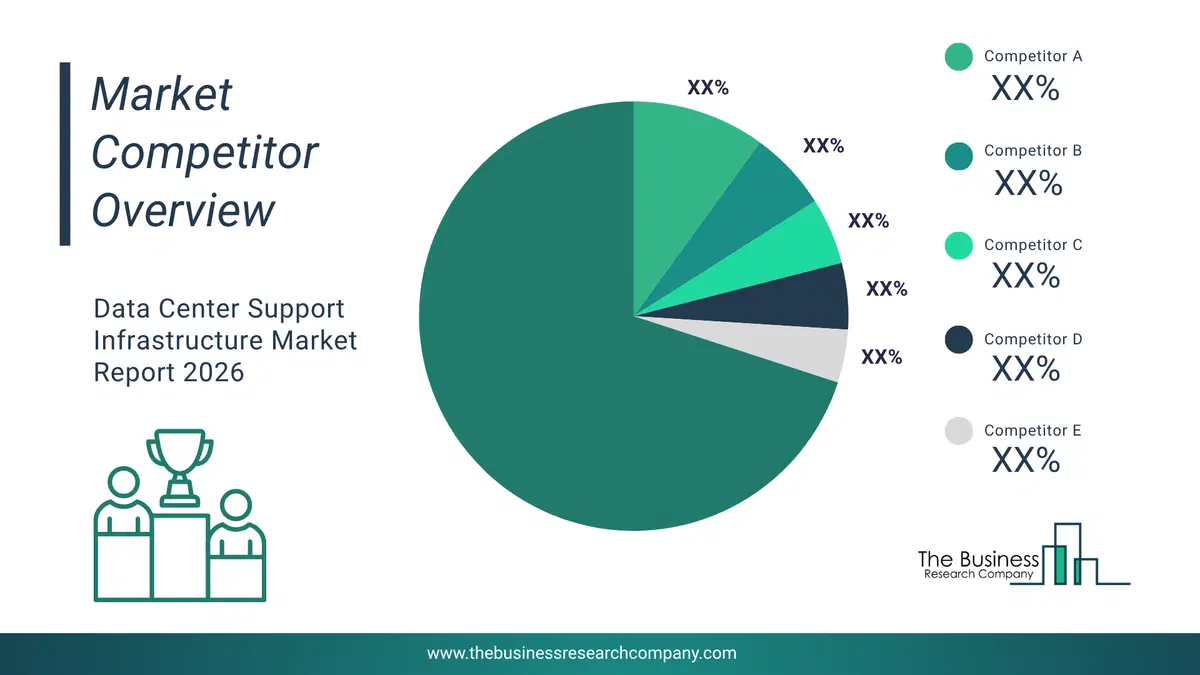
This chart is for illustrative purposes; the full report includes a detailed competitor analysis and comprehensive overview of the top 10 companies in the market.
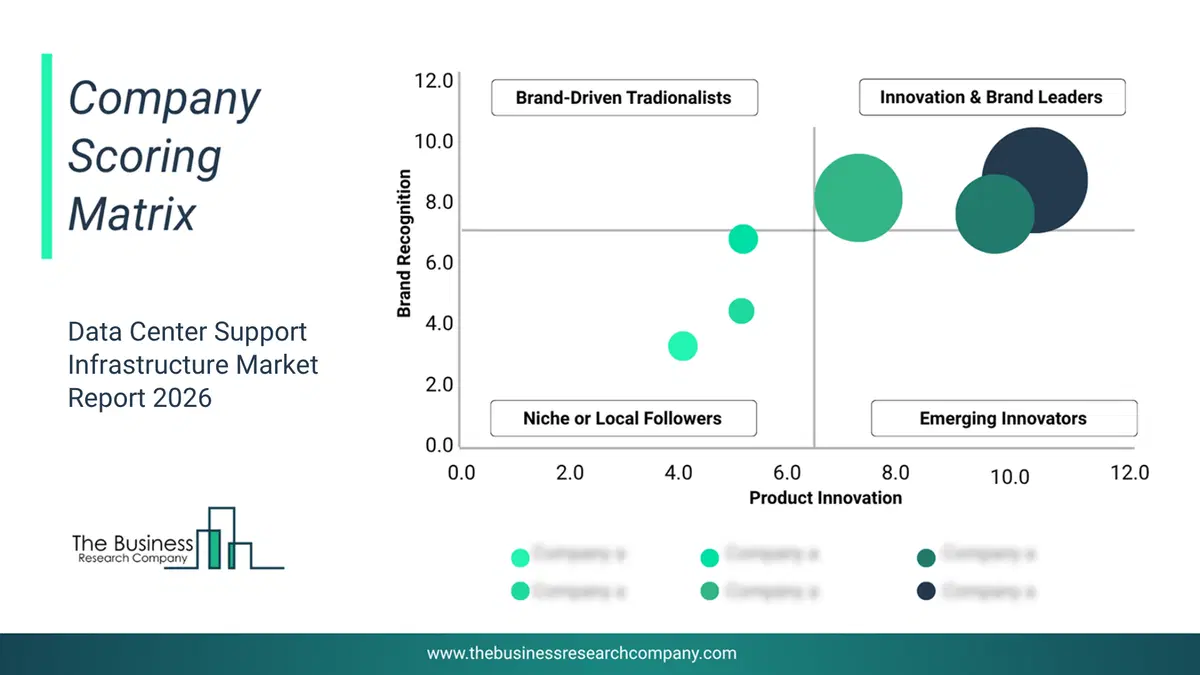
This chart maps companies by product innovation and brand strength, with bubble size indicating relative revenue, helping identify market leaders, challengers, and niche players. This is an illustrative chart; the full report provides a complete and accurate competitive analysis.
Global Data Center Support Infrastructure Market Trends and Insights
Major companies operating in data centre support infrastructure market are focusing on advancement in modular and flexible infrastructure designs advancement in modular and flexible infrastructure designs such as prefabricated data centre modules, scalable rack systems, containerized data centres, plug-and-play power and cooling units, and adaptable network and cabling architectures. Prefabricated data centre modules are pre-engineered, factory-built units that can be quickly deployed on-site to provide scalable computing, power, and cooling infrastructure. For instance, in Oct 2025, Fourier Cooling, a US-based company specializing in liquid cooling infrastructure for high-performance computing (HPC) and artificial intelligence (AI) data centers, launched its prefabricated data centre modules, which are liquid-cooled and designed for artificial intelligence (AI) and high-performance computing (hpc) workloads, supporting rack densities from 40kW to over 200kW, with cooling technologies such as immersion, direct-to-chip, and fan-wall systems. This launch also featured a cold plate container integrated with a chiller system delivering up to 500kW per container, establishing a new standard for scalable and efficient modular data centre solutions.What Are Latest Mergers And Acquisitions In The Data Center Support Infrastructure Market?
In October 2024, Schneider Electric, a France-based energy management and industrial automation company, acquired a 75 percent controlling interest in Motivair Corporation for an all-cash consideration of approximately 850 million United States dollars. With this acquisition, Schneider Electric aims to reinforce its leadership in data-center cooling by adding direct-to-chip liquid cooling and high-capacity thermal solutions to serve rapidly rising thermal loads from generative artificial intelligence and large language models, improving efficiency and sustainability across modern facilities. Motivair Corporation is a US-based provider of advanced liquid-cooling and thermal-management solutions for high-performance computing, offering coolant distribution units, rear door heat exchangers, cold plates, heat dissipation units, and chillers.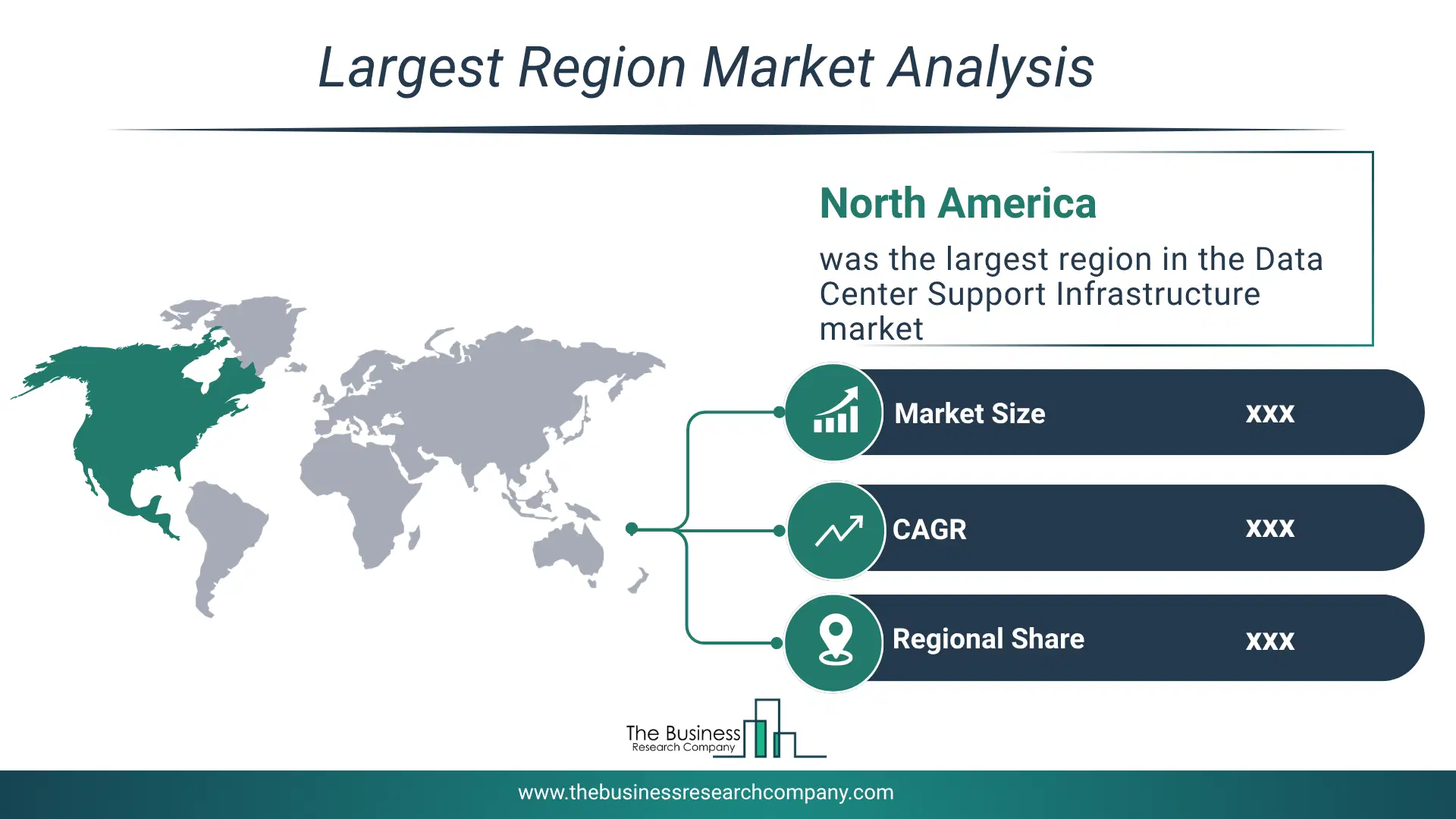
Regional Outlook
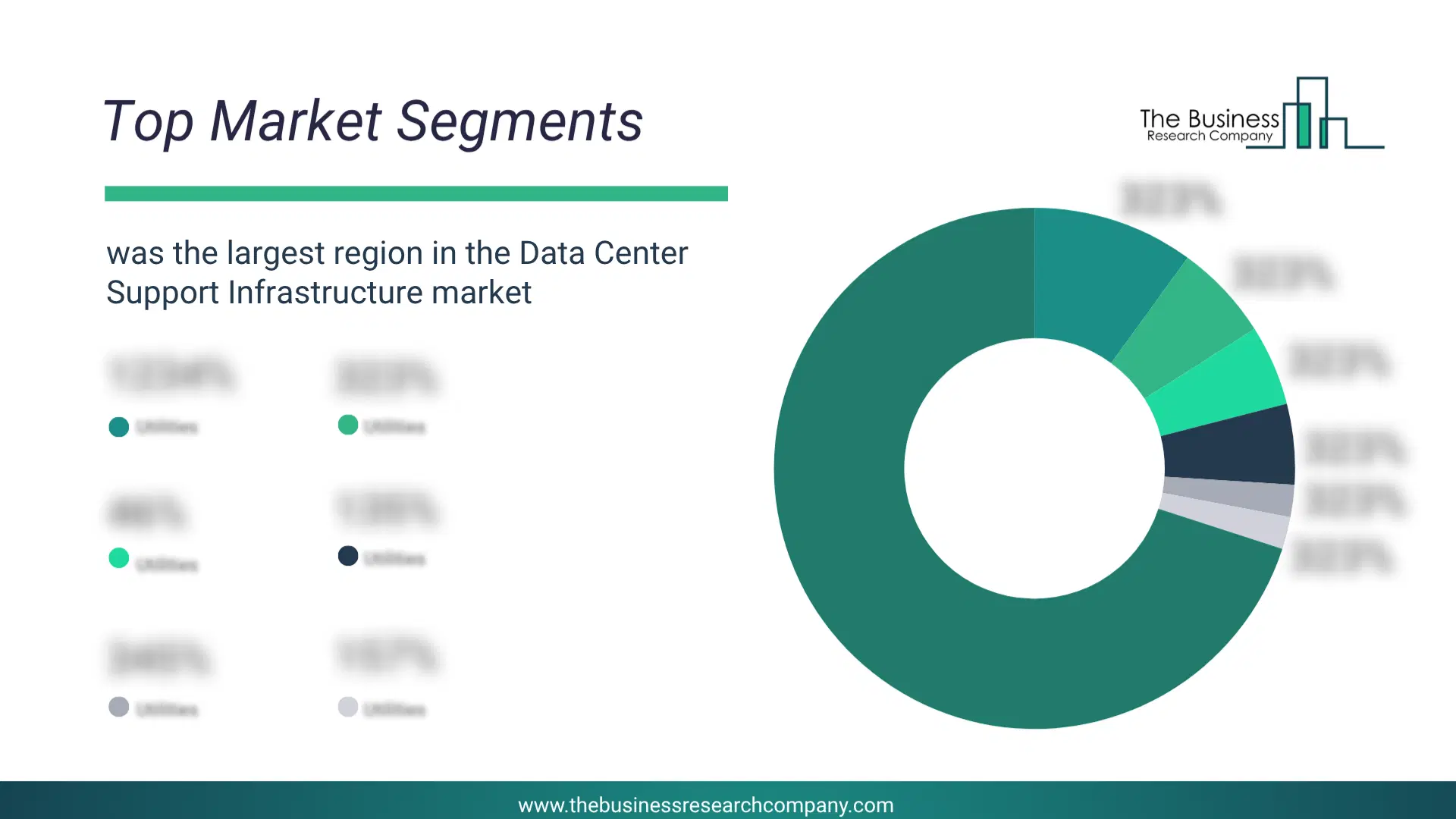
North America was the largest region in the data center support infrastructure market in 2025. Asia-Pacific is expected to be the fastest-growing region in the forecast period. The regions covered in this market report are Asia-Pacific, South East Asia, Western Europe, Eastern Europe, North America, South America, Middle East, Africa. The countries covered in this market report are Australia, Brazil, China, France, Germany, India, Indonesia, Japan, Taiwan, Russia, South Korea, UK, USA, Canada, Italy, Spain.What Defines the Data Center Support Infrastructure Market?
The data center support infrastructure market consists of sales of uninterruptible power supply systems, standby power generators, precision cooling and chiller systems, power distribution units and electrical switchgear, and server racks and aisle containment systems. Values in this market are ‘factory gate’ values, that is the value of goods sold by the manufacturers or creators of the goods, whether to other entities (including downstream manufacturers, wholesalers, distributors and retailers) or directly to end customers. The value of goods in this market includes related services sold by the creators of the goods.How is Market Value Defined and Measured?
The market value is defined as the revenues that enterprises gain from the sale of goods and/or services within the specified market and geography through sales, grants, or donations in terms of the currency (in USD unless otherwise specified). The revenues for a specified geography are consumption values that are revenues generated by organizations in the specified geography within the market, irrespective of where they are produced. It does not include revenues from resales along the supply chain, either further along the supply chain or as part of other products.
This chart presents market attractiveness based on a quantitative evaluation of growth, competition, strategic alignment, and risk, offering a clear view of opportunity areas for decision-making. This chart is for illustrative purposes; the full report contains the complete analysis.

This chart highlights the Total Addressable Market (TAM) by estimating the maximum revenue opportunity using an assumption-driven approach, supporting strategic planning and opportunity sizing across markets. The chart is illustrative; the full report provides a more comprehensive analysis.
What Key Data and Analysis Are Included in the Data Center Support Infrastructure Market Report 2026?
The data center support infrastructure market research report is one of a series of new reports from The Business Research Company that provides market statistics, including industry global market size, regional shares, competitors with the market share, detailed market segments, market trends and opportunities, and any further data you may need to thrive in the data center support infrastructure industry. The market research report delivers a complete perspective of everything you need, with an in-depth analysis of the current and future state of the industry.Data Center Support Infrastructure Market Report Forecast Analysis
| Report Attribute | Details |
|---|---|
| Market Size Value In 2026 | $69.58 billion |
| Revenue Forecast In 2030 | $109.02 billion |
| Growth Rate | CAGR of 11.9% from 2026 to 2030 |
| Base Year For Estimation | 2025 |
| Actual Estimates/Historical Data | 2020-2025 |
| Forecast Period | 2026 - 2030 |
| Market Representation | Revenue in USD Billion and CAGR from 2026 to 2030 |
| Segments Covered | Infrastructure, Tier, Enterprise Size, Deployment Model, End User |
| Regional Scope | Asia-Pacific, Western Europe, Eastern Europe, North America, South America, Middle East, Africa |
| Country Scope | The countries covered in the report are Australia, Brazil, China, France, Germany, India, Indonesia, Japan, Taiwan, Russia, South Korea, UK, USA, Canada, Italy, Spain. |
| Key Companies Profiled | Dell Technologies, Huawei, Siemens, Caterpillar, Cisco Systems, Schneider Electric, Honeywell, Cummins, ABB, Daikin, Hewlett Packard Enterprise (HPE), Eaton, Carrier, Trane, Delta Electronics, Danfoss, Legrand, Vertiv, nVent (Hubbell), Rittal |
| Customization Scope | Request for Customization |
| Pricing And Purchase Options | Explore Purchase Options |