
Data Lineage Tools Market Report 2026
Global Outlook – By Component (Software, Services), By Deployment Mode (On-Premises, Cloud), By Organization Size (Small And Medium Enterprises, Large Enterprises), By Application (Risk And Compliance Management, Data Governance, Data Migration, Incident Management, Other Applications), By End-User (Banking Financial Services And Insurance (BFSI), Healthcare, Information Technology And Telecommunications (IT), Retail And E-Commerce, Manufacturing, Government, Other End-Users) – Market Size, Trends, Strategies, and Forecast to 2030
Data Lineage Tools Market Overview
• Data Lineage Tools market size has reached to $1.72 billion in 2025 • Expected to grow to $4.73 billion in 2030 at a compound annual growth rate (CAGR) of 22.4% • Growth Driver: Rising Data Breaches Fueling The Growth Of The Market Due To Increasing Need For Rapid Exposure Identification • Market Trend: AI-Augmented Metadata Catalogs Enable End-to-End Lineage Tracking • North America was the largest region in 2025 and Asia-Pacific is the fastest growing region.Market Gains By 2030 – Top Opportunities By Segment
Market Gain identifies the most promising market opportunities by highlighting the segments or products expected to generate the highest incremental revenue growth over the next five years.
What Is Covered Under Data Lineage Tools Market?
Data lineage tools are software solutions that allow organizations to track, visualize, and analyze the flow of data across various systems, applications, and processes. It helps to ensure data accuracy, traceability, and compliance by showing the origin, transformation, and movement of data throughout its lifecycle. The main components of data lineage tools are software and services. Software refers to solutions that track, map, and visualize the flow of data across systems to ensure accuracy, compliance, and transparency. These tools are deployed through on-premises and cloud deployment modes. They are designed for organizations of different sizes, including small and medium enterprises and large enterprises, and are used across various applications, such as risk and compliance management, data governance, data migration, incident management, and other applications. They cater to multiple end-user industries, including banking, financial services and insurance (BFSI), healthcare, information technology and telecommunications (IT), retail and e-commerce, manufacturing, government, and other end-users.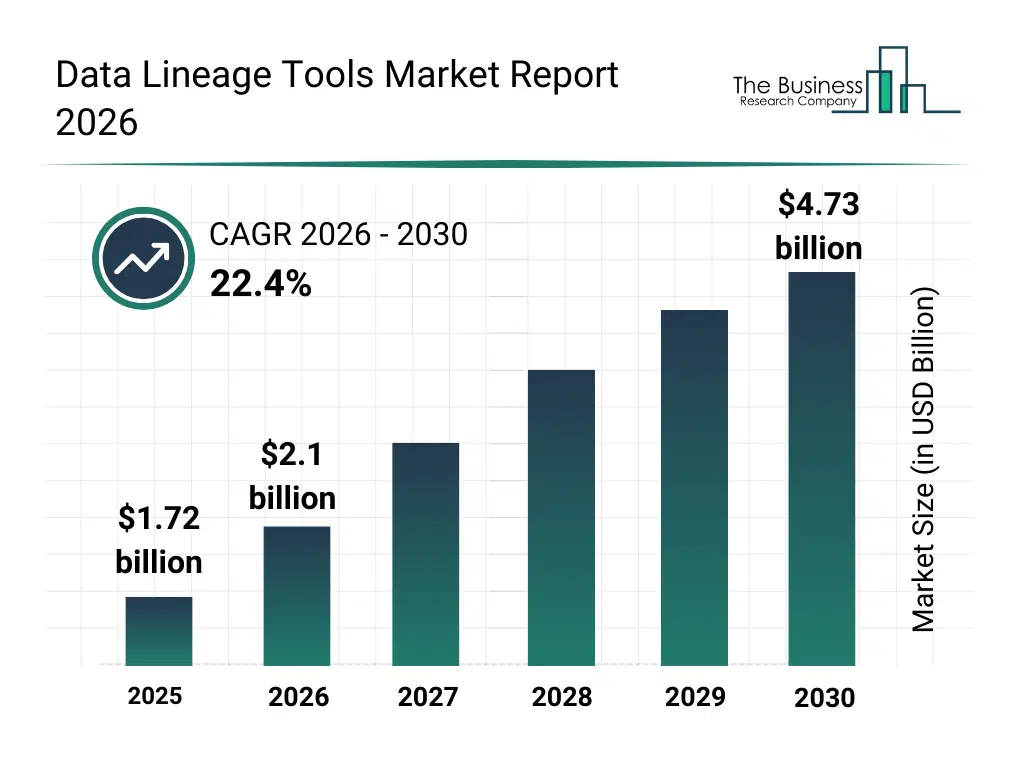
What Is The Data Lineage Tools Market Size and Share 2026?
The data lineage tools market size has grown exponentially in recent years. It will grow from $1.72 billion in 2025 to $2.1 billion in 2026 at a compound annual growth rate (CAGR) of 22.2%. The growth in the historic period can be attributed to growth in enterprise data complexity, early lineage tool adoption, regulatory compliance needs, analytics modernization, data integration expansion.What Is The Data Lineage Tools Market Growth Forecast?
The data lineage tools market size is expected to see exponential growth in the next few years. It will grow to $4.73 billion in 2030 at a compound annual growth rate (CAGR) of 22.4%. The growth in the forecast period can be attributed to ai-assisted lineage automation, real-time governance demand, hybrid data environments, scalable metadata platforms, stricter audit requirements. Major trends in the forecast period include end-to-end data flow mapping, automated impact and dependency analysis, metadata-driven lineage visualization, compliance-oriented data traceability, real-time lineage monitoring.
Global Data Lineage Tools Market Segmentation
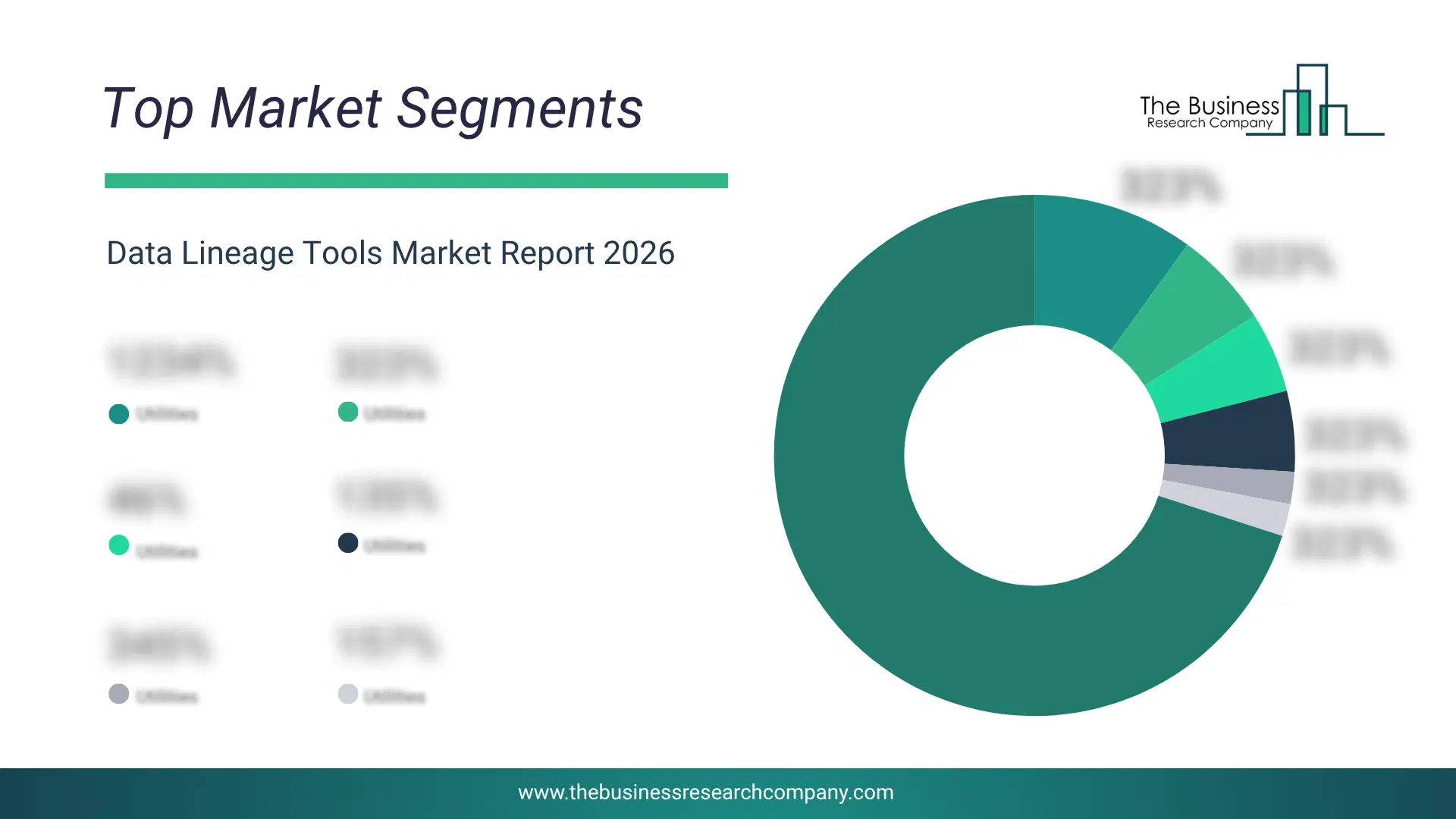
1) By Component: Software, Services 2) By Deployment Mode: On-Premises, Cloud 3) By Organization Size: Small And Medium Enterprises, Large Enterprises 4) By Application: Risk And Compliance Management, Data Governance, Data Migration, Incident Management, Other Applications 5) By End-User: Banking Financial Services And Insurance (BFSI), Healthcare, Information Technology And Telecommunications (IT), Retail And E-Commerce, Manufacturing, Government, Other End-Users Subsegments: 1) By Software: Data Discovery And Mapping, Metadata Management, Impact Analysis And Visualization, Data Governance And Compliance, Real-Time Lineage Tracking, Integration And Orchestration 2) By Services: Consulting And Advisory, Implementation And Deployment, Integration And Customization, Training And Knowledge Transfer, Support And Maintenance, Managed Services The top segments in the data lineage tools market will be: • Software will reach $3.61 Billion by 2030. • Services will reach $1.12 Billion by 2030.What Is The Driver Of The Data Lineage Tools Market?
The rising incidents of data breaches and security risks are expected to propel the growth of the data lineage tools market going forward. Data breaches and security risks refer to incidents or threats in which unauthorized parties access, steal, manipulate, or compromise sensitive data or systems, potentially causing financial, operational, or reputational harm to an organization. The increase in data breaches and security risks is largely due to the rapid expansion of digital assets and cloud-based systems, which has created a much larger attack surface for cybercriminals to exploit. Data lineage tools help in data breaches and security risks by mapping the flow of sensitive data across systems to quickly identify exposure points, trace unauthorized access paths, and accelerate containment and remediation efforts. For instance, in January 2024, IT Governance Ltd., a UK-based business-to-business service company, reported that data breach incidents rose to 9,478 in 2024, up from 2,814 in 2023. Additionally, the number of breached records soared to 35,900,145,035, compared to 8,214,886,660 in 2023. Therefore, the rising incidents of data breaches and security risks are driving the growth of the data lineage tools industry.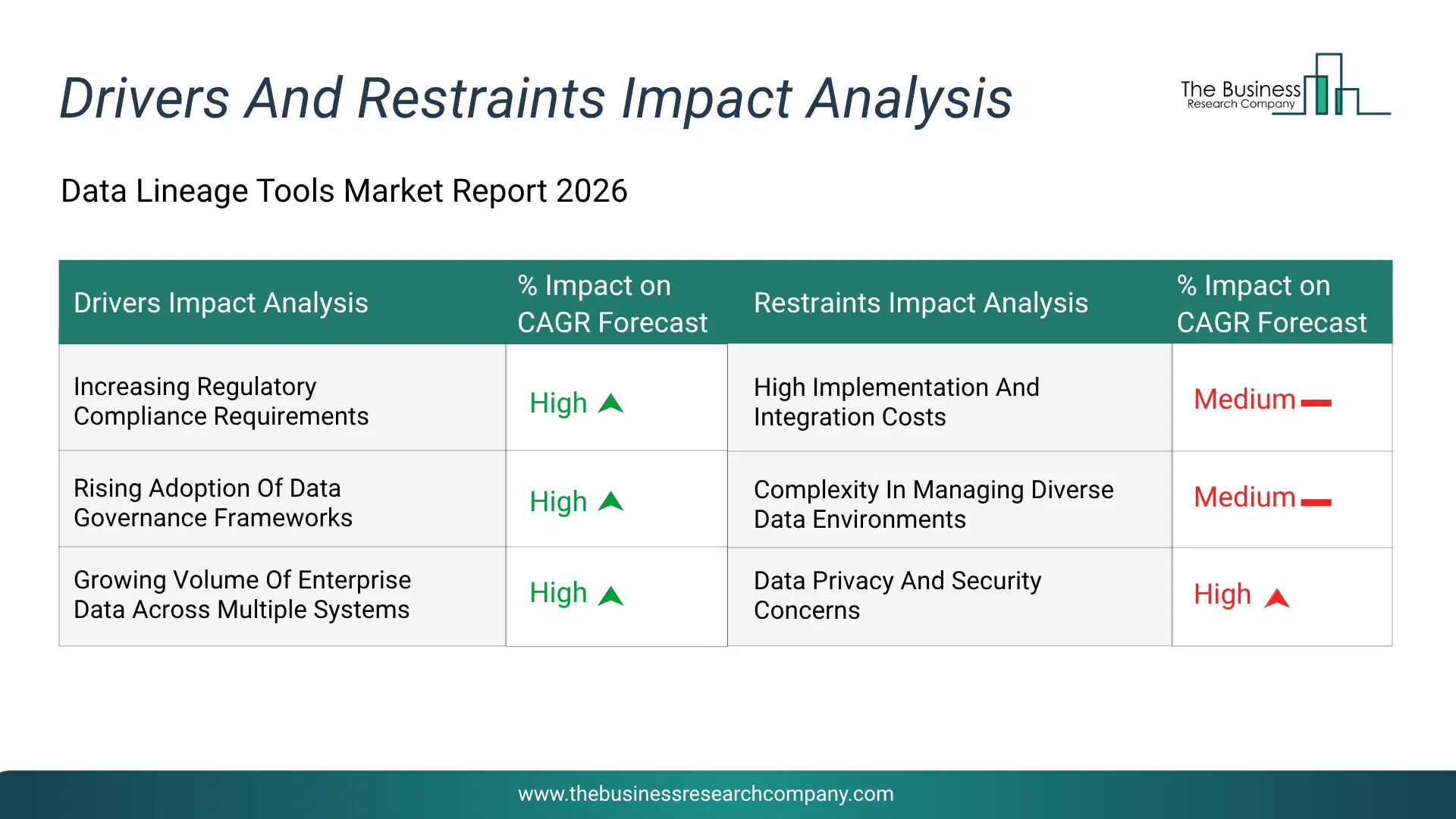
Infographic Chart Showing Key Market Drivers Analysis And Restraints For Data Lineage Tools Market
The chart presents an impact analysis of key drivers and restraints, quantifying their relative influence on the market's growth rate and helping assess the balance between growth enablers and limiting factors. This chart offers a high-level perspective; the full report contains more detailed insights.
How Will The Drivers Impact Growth In The Global Data Lineage Tools Market?
• Increasing Regulatory Compliance Requirements (High) – During the forecast period, the increasing regulatory compliance requirements are expected to become a key growth driver for the data lineage tools market by 2030. Organizations across industries are focusing on maintaining complete visibility into data origin, movement, and transformation processes to meet evolving regulatory standards. Data lineage platforms enable enterprises to improve audit readiness, enhance transparency, and ensure accurate documentation of data usage across business operations. The rising complexity of privacy regulations and industry-specific compliance obligations is encouraging companies to adopt advanced lineage solutions for stronger accountability and risk control. This increasing focus on regulatory-driven data transparency is reinforcing steady market expansion. • Rising Adoption Of Data Governance Frameworks (High) – During the forecast period, the rising adoption of data governance frameworks is expected to emerge as a major factor driving the expansion of the data lineage tools market by 2030. Enterprises are increasingly implementing structured governance models to manage growing data assets, improve information reliability, and support effective decision-making. Data lineage tools play a crucial role by enabling organizations to track data relationships, monitor changes, and maintain consistency across diverse systems. Growing enterprise focus on improving data ownership, accessibility, and lifecycle management is further accelerating the deployment of lineage technologies. As businesses continue to prioritize trusted and well-managed data environments, demand for these solutions is expected to increase. • Growing Volume Of Enterprise Data Across Multiple Systems (High) – During the forecast period, the growing volume of enterprise data across multiple systems is expected to act as a key growth catalyst for the data lineage tools market by 2030. The rapid expansion of digital platforms, cloud applications, and analytics environments is increasing the complexity of tracking and managing organizational data flows. Data lineage solutions help enterprises understand dependencies between systems, identify data inconsistencies, and improve operational visibility across connected infrastructures. Businesses are adopting automated lineage capabilities to manage large-scale datasets and support efficient data utilization. As enterprise data ecosystems become more complex globally, demand for advanced tracking and mapping solutions is expected to rise.How Will The Restraints Impact Growth In The Global Data Lineage Tools Market?
• High Implementation And Integration Costs (High) – During the forecast period, high implementation and integration costs is restraining the growth of the data lineage tools market because deploying these solutions often requires substantial financial and operational resources. Organizations must integrate lineage platforms with multiple databases, enterprise applications, and legacy systems, which can increase deployment complexity and expenses. Small and medium-sized enterprises may face difficulties allocating budgets for implementation, customization, and ongoing maintenance activities. The requirement for specialized personnel and extended deployment timelines further increases total operational costs. These financial barriers can limit adoption rates, particularly among organizations with constrained information technology spending capacities. • Complexity In Managing Diverse Data Environments (High) – During the forecast period, complexity in managing diverse data environments is limiting the adoption of data lineage tools due to the challenges associated with tracking data across fragmented and heterogeneous infrastructures. Many organizations operate with a combination of on-premise systems, cloud platforms, third-party applications, and legacy databases that lack standardized data management practices. Integrating lineage capabilities across such varied environments can create operational inefficiencies and visibility gaps. Businesses may encounter difficulties in maintaining consistent metadata and ensuring accurate mapping of data flows across all systems. These complexities can reduce implementation effectiveness and slow the overall adoption of data lineage solutions in large enterprises. • Data Privacy And Security Concerns (High) – During the forecast period, data privacy and security concerns act as a significant restraint on the data lineage tools market because these solutions provide visibility into data flows across critical enterprise systems, including sensitive business and customer information. Organizations are increasingly concerned about protecting metadata, preventing unauthorized access, and ensuring secure handling of confidential data throughout the data lifecycle. Compliance with evolving data protection regulations and industry-specific security standards requires continuous monitoring, robust access controls, and regular security assessments, increasing implementation complexity and operational costs. Concerns over potential data breaches and cyber threats may also discourage organizations from deploying cloud-based data lineage platforms, particularly in highly regulated sectors such as banking, healthcare, and government. Additionally, maintaining secure data governance frameworks across hybrid and multi-cloud environments presents ongoing challenges for enterprises. Consequently, data privacy and security concerns can restrain the growth of the data lineage tools market.Key Players In The Global Data Lineage Tools Market
Major companies operating in the data lineage tools market are Microsoft Corporation, Alibaba Group Holding Limited, International Business Machines Corporation, Oracle Corporation, SAP SE, Experian plc, Rocket Software Inc., Databricks Inc., Informatica Inc., Cloudera Inc., Qlik Technologies Inc., Collibra NV, Alation Inc., Ataccama Corporation, Actian Corporation, OvalEdge Inc., Atlan Inc., Solidatus Ltd., CloverDX Ltd., and Acryl Data Inc.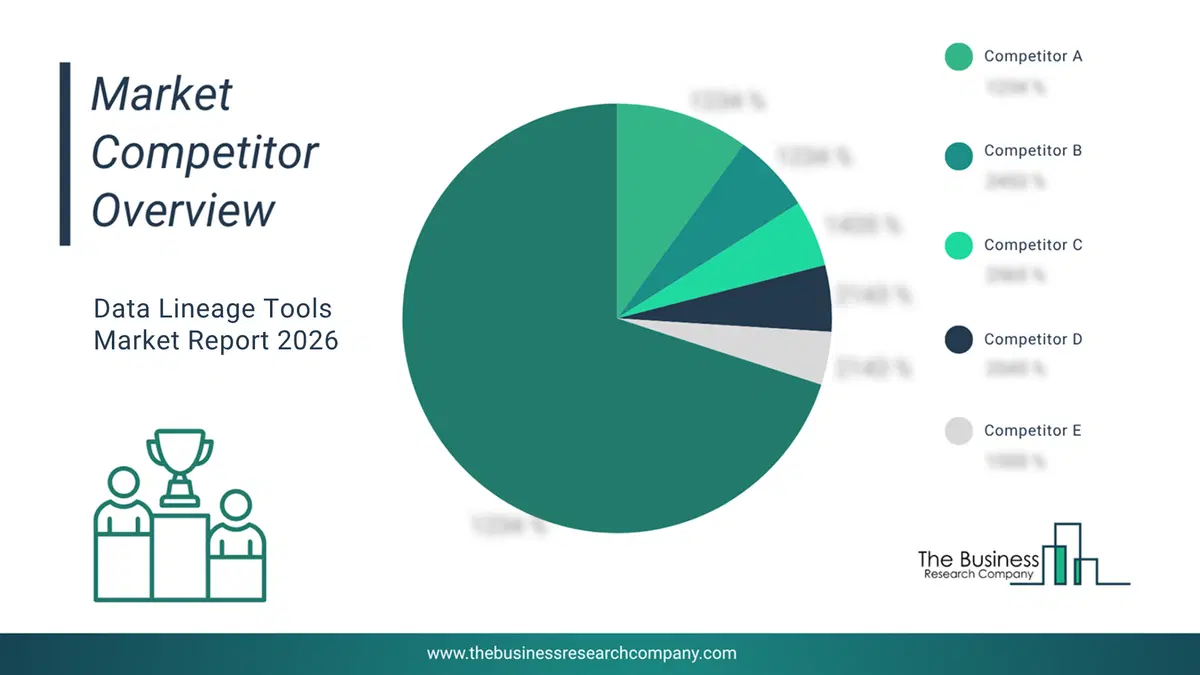
This chart is for illustrative purposes; the full report includes a detailed competitor analysis and comprehensive overview of the top 10 companies in the market.
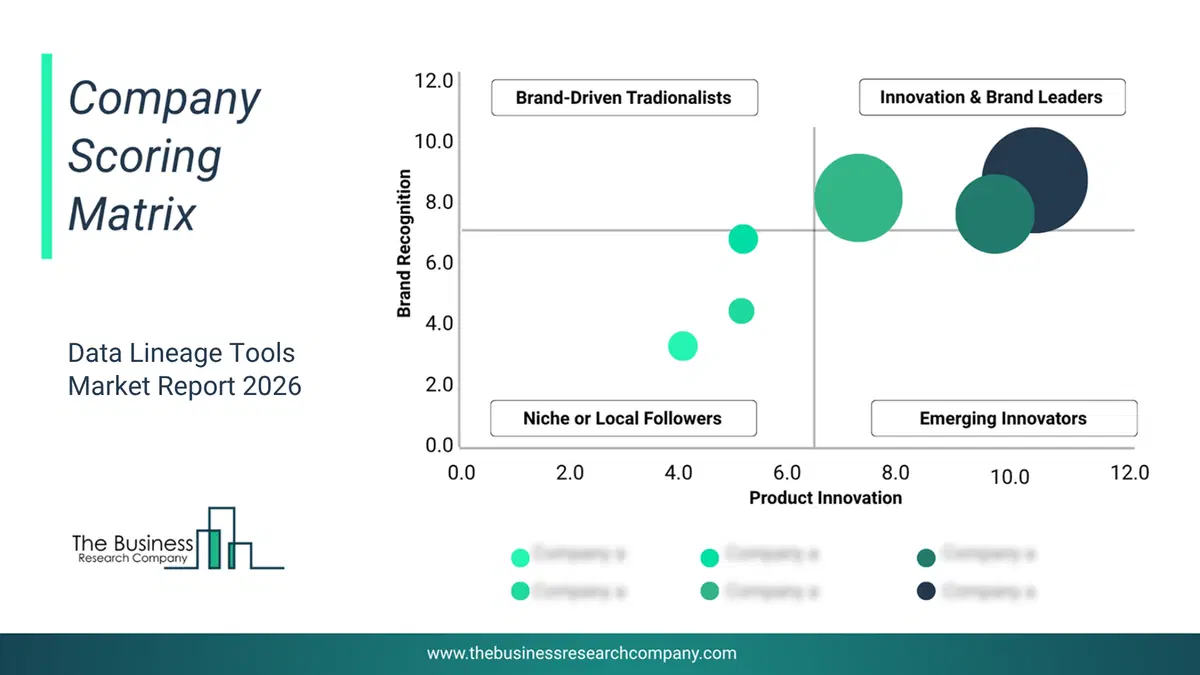
This chart maps companies by product innovation and brand strength, with bubble size indicating relative revenue, helping identify market leaders, challengers, and niche players. This is an illustrative chart; the full report provides a complete and accurate competitive analysis.
Global Data Lineage Tools Market Trends and Insights
Major companies operating in the data lineage tools market are focusing on product innovation, such as AI-augmented unified metadata catalog platforms, to enhance data discovery, automate lineage extraction, improve governance workflows, and enable more accurate analytics and regulatory compliance across complex enterprise data ecosystems. AI-augmented unified metadata catalog platforms are intelligent data management solutions that use artificial intelligence and machine learning to automatically discover, classify, enrich, and connect technical, business, and operational metadata across enterprise data ecosystems, enabling improved data governance, lineage visibility, and trusted data access. For instance, in June 2025, Matia, a US-based DataOps software company, launched the enhanced Unified Data Catalog, a metadata platform that delivers end-to-end data visibility and governance, offering operational lineage tracking with run history and error logs, deep dbt model parsing with rich metadata and lineage, and universal search across assets for rapid data discovery and trust building across teams.What Are Latest Mergers And Acquisitions In The Data Lineage Tools Market?
In June 2023, Bigeye, a US-based provider of a data observability platform that ensures data reliability through automated quality monitoring and pipeline visibility, acquired Data Advantage Group, Inc. for an undisclosed amount. With this acquisition, Bigeye aimed to integrate Data Advantage Group’s extensive data lineage and metadata capabilities to offer automated end-to-end lineage mapping across databases, ETL platforms, data lakes, warehouses, and BI tools, strengthening its observability and pipeline diagnostics offering. Data Advantage Group, Inc. is a US-based provider of comprehensive metadata collection and data lineage solutions through its MetaCenter platform.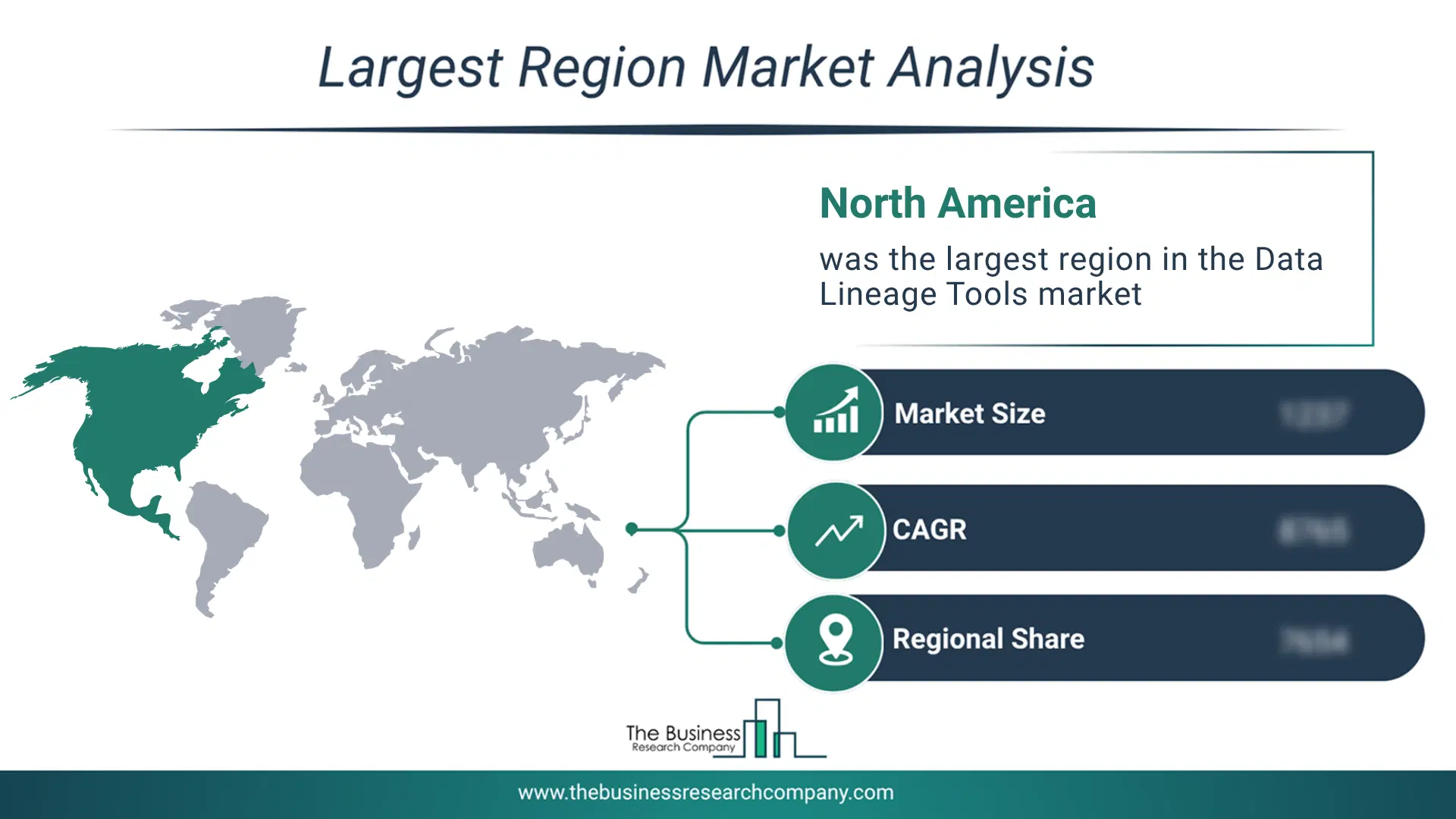
Regional Outlook
North America was the largest region in the data lineage tools market in 2025. Asia-Pacific is expected to be the fastest-growing region in the forecast period. The regions covered in this market report are Asia-Pacific, South East Asia, Western Europe, Eastern Europe, North America, South America, Middle East, Africa. The countries covered in this market report are Australia, Brazil, China, France, Germany, India, Indonesia, Japan, Taiwan, Russia, South Korea, UK, USA, Canada, Italy, Spain.What Defines the Data Lineage Tools Market?
The data lineage tools market includes revenues earned by entities through data flow tracking and mapping, impact and dependency analysis, metadata management, compliance and regulatory reporting, and integration with databases and analytics platforms. The market value includes the value of related goods sold by the service provider or included within the service offering. Only goods and services traded between entities or sold to end consumers are included.How is Market Value Defined and Measured?
The market value is defined as the revenues that enterprises gain from the sale of goods and/or services within the specified market and geography through sales, grants, or donations in terms of the currency (in USD unless otherwise specified). The revenues for a specified geography are consumption values that are revenues generated by organizations in the specified geography within the market, irrespective of where they are produced. It does not include revenues from resales along the supply chain, either further along the supply chain or as part of other products.
This chart presents market attractiveness based on a quantitative evaluation of growth, competition, strategic alignment, and risk, offering a clear view of opportunity areas for decision-making. This chart is for illustrative purposes; the full report contains the complete analysis.

This chart highlights the Total Addressable Market (TAM) by estimating the maximum revenue opportunity using an assumption-driven approach, supporting strategic planning and opportunity sizing across markets. The chart is illustrative; the full report provides a more comprehensive analysis.
What Key Data and Analysis Are Included in the Data Lineage Tools Market Report 2026?
The data lineage tools market research report is one of a series of new reports from The Business Research Company that provides market statistics, including industry global market size, regional shares, competitors with the market share, detailed market segments, market trends and opportunities, and any further data you may need to thrive in the data lineage tools industry. The market research report delivers a complete perspective of everything you need, with an in-depth analysis of the current and future state of the industry.Data Lineage Tools Market Report Forecast Analysis
| Report Attribute | Details |
|---|---|
| Market Size Value In 2026 | $2.1 billion |
| Revenue Forecast In 2030 | $4.73 billion |
| Growth Rate | CAGR of 22.2% from 2026 to 2030 |
| Base Year For Estimation | 2025 |
| Actual Estimates/Historical Data | 2020-2025 |
| Forecast Period | 2026 - 2030 |
| Market Representation | Revenue in USD Billion and CAGR from 2026 to 2030 |
| Segments Covered | Component, Deployment Mode, Organization Size, Application, End-User |
| Regional Scope | Asia-Pacific, Western Europe, Eastern Europe, North America, South America, Middle East, Africa |
| Country Scope | The countries covered in the report are Australia, Brazil, China, France, Germany, India, ... |
| Key Companies Profiled | Microsoft Corporation, Alibaba Group Holding Limited, International Business Machines Corporation, Oracle Corporation, SAP SE, Experian plc, Rocket Software Inc., Databricks Inc., Informatica Inc., Cloudera Inc., Qlik Technologies Inc., Collibra NV, Alation Inc., Ataccama Corporation, Actian Corporation, OvalEdge Inc., Atlan Inc., Solidatus Ltd., CloverDX Ltd., and Acryl Data Inc. |
| Customization Scope | Request for Customization |
| Pricing And Purchase Options | Explore Purchase Options |