
Data Localization Orchestration Market Report 2026
Global Outlook – By Component (Software, Hardware, Services), By Deployment Mode (Cloud-Based, On-Premises, Hybrid), By Organization Size (Small And Medium Enterprises, Large Enterprises), By Application (Data Governance, Compliance Management, Risk Management, Data Security, Other Applications), By End-User (Banking, Financial Services, And Insurance (BFSI), Healthcare, Information Technology and Telecommunications, Government, Retail, Other End-Users) – Market Size, Trends, Strategies, and Forecast to 2030
Data Localization Orchestration Market Overview
• Data Localization Orchestration market size has reached to $4.02 billion in 2025 • Expected to grow to $9.58 billion in 2030 at a compound annual growth rate (CAGR) of 19% • Growth Driver: Rising Adoption Of Automated Compliance And Real-Time Residency Orchestration Driving Growth Of The Market Due To Increasing Regulatory Complexity And Cross-Border Data Sovereignty Requirements • Market Trend: Advancement In Automated Compliance Orchestration Platforms Driving The Data Localization Orchestration Market • North America was the largest region in 2025 and Asia-Pacific is the fastest growing region.What Is Covered Under Data Localization Orchestration Market?
Data localization orchestration refers to the automated processes, platforms, and technologies that enable organizations to structure, manage, enforce, and monitor the residency, movement, and compliance of data within specific geographic or regulatory jurisdictions. It combines policy automation, workflow orchestration, and data governance to ensure that data storage, processing, and access adhere to local data protection laws, sovereignty mandates, and organizational compliance requirements. The main components of the data localization orchestration are software, hardware, and services. Software refers to solutions that manage, monitor, and enforce data residency and localization requirements across distributed IT environments. These solutions are deployed through cloud-based, on-premises, and hybrid deployment modes. They are designed for organizations of different sizes, including small and medium enterprises and large enterprises. The solutions are used across various applications, such as data governance, compliance management, risk management, data security, and other applications, and cater to multiple end-user industries, including banking, financial services, and insurance (BFSI), healthcare, information technology and telecommunications, government, retail, and other end-users.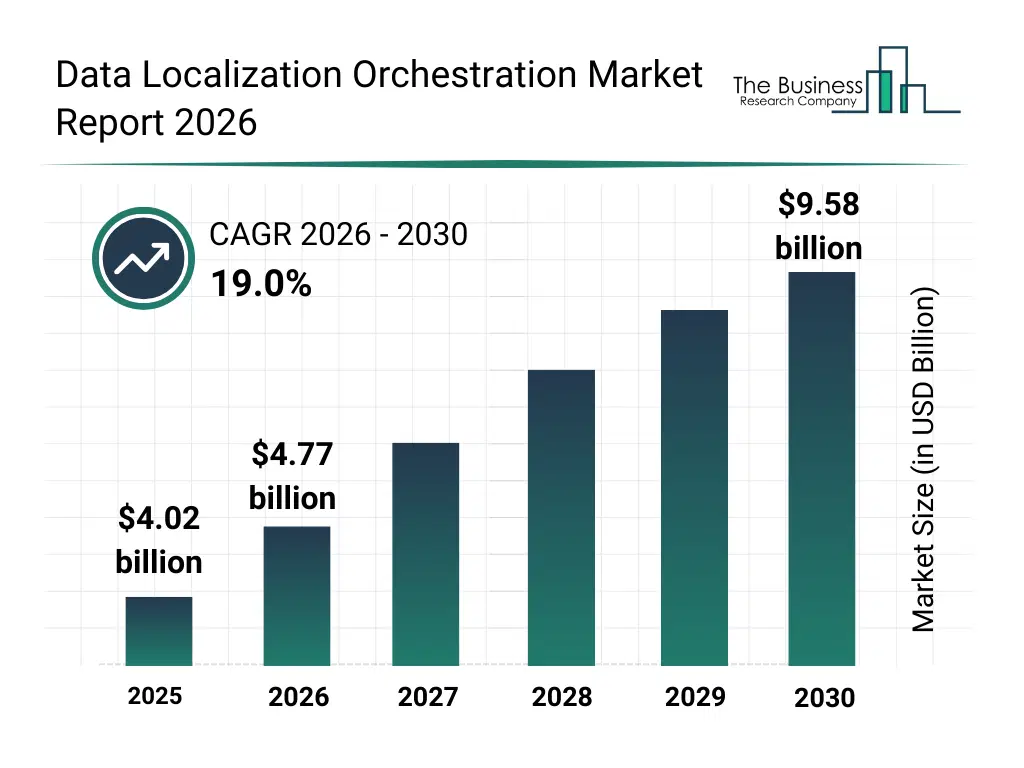
What Is The Data Localization Orchestration Market Size and Share 2026?
The data localization orchestration market size has grown rapidly in recent years. It will grow from $4.02 billion in 2025 to $4.77 billion in 2026 at a compound annual growth rate (CAGR) of 18.8%. The growth in the historic period can be attributed to rise in data sovereignty laws, early localization strategies, cross-border data risks, regulatory enforcement growth, cloud adoption.What Is The Data Localization Orchestration Market Growth Forecast?
The data localization orchestration market size is expected to see rapid growth in the next few years. It will grow to $9.58 billion in 2030 at a compound annual growth rate (CAGR) of 19.0%. The growth in the forecast period can be attributed to stricter localization mandates, geopolitical data restrictions, multi-region cloud expansion, automated compliance orchestration, zero trust architectures. Major trends in the forecast period include automated data residency enforcement, cross-border data flow orchestration, policy-driven localization workflows, sovereign cloud enablement, compliance-centric data routing.
Global Data Localization Orchestration Market Segmentation
1) By Component: Software, Hardware, Services 2) By Deployment Mode: Cloud-Based, On-Premises, Hybrid 3) By Organization Size: Small And Medium Enterprises, Large Enterprises 4) By Application: Data Governance, Compliance Management, Risk Management, Data Security, Other Applications 5) By End-User: Banking, Financial Services, And Insurance (BFSI), Healthcare, Information Technology and Telecommunications, Government, Retail, Other End-Users Subsegments: 1) By Software: Data Management Platforms, Compliance Monitoring Software, Data Encryption And Security Tools, Workflow Automation Software, Analytics and Reporting Software 2) By Hardware: Storage Servers, Networking Equipment, Security Appliances, Data Backup Systems, Edge Computing Devices 3) By Services: Implementation and Integration Services, Consulting and Advisory Services, Data Migration Services, Maintenance and Support Services, Compliance and Audit ServicesWhat Is The Driver Of The Data Localization Orchestration Market?
The rising data privacy concerns are expected to propel the growth of the data localization orchestration market going forward. Rising data privacy concerns refer to the increasing need to protect personal and sensitive information from unauthorized access, use, or disclosure, ensuring that individuals maintain control over their own data. These concerns are intensifying due to the growing number of high-profile data breaches and the expanding adoption of AI and IoT devices, which collect massive amounts of user information. Data localization orchestration supports this by automating the placement and management of data within specific geographic boundaries, ensuring compliance with local sovereignty laws while maintaining system performance. For instance, in January 2025, according to the Federal Trade Commission (FTC), a US-based government body, fraud reports totaled 2,600,678, reflecting a 1.1% increase from 2024, while total fraud losses surged to $12.5 billion, rising by more than $2 billion year-over-year. Therefore, the rising data privacy concerns are driving the growth of the data localization orchestration industry.Key Players In The Global Data Localization Orchestration Market
Major companies operating in the data localization orchestration market are Amazon Web Services (AWS) Inc., Google LLC, Microsoft Corporation, Dell Technologies Inc., Tencent Holdings Ltd., Hitachi Vantara LLC, IBM Corporation, Cisco Systems Inc., Oracle Corporation, SAP SE, Salesforce Inc., Hewlett Packard Enterprise (HPE), Infosys Limited, Capgemini SE, VMware Inc., Equinix Inc., NetApp Inc., Rackspace Technology Ltd., Snowflake Inc., Cloudera Inc., Akana, Alibaba Cloud, Sovereign Systems Inc.
This chart is for illustrative purposes; the full report includes a detailed competitor analysis and comprehensive overview of the top 10 companies in the market.
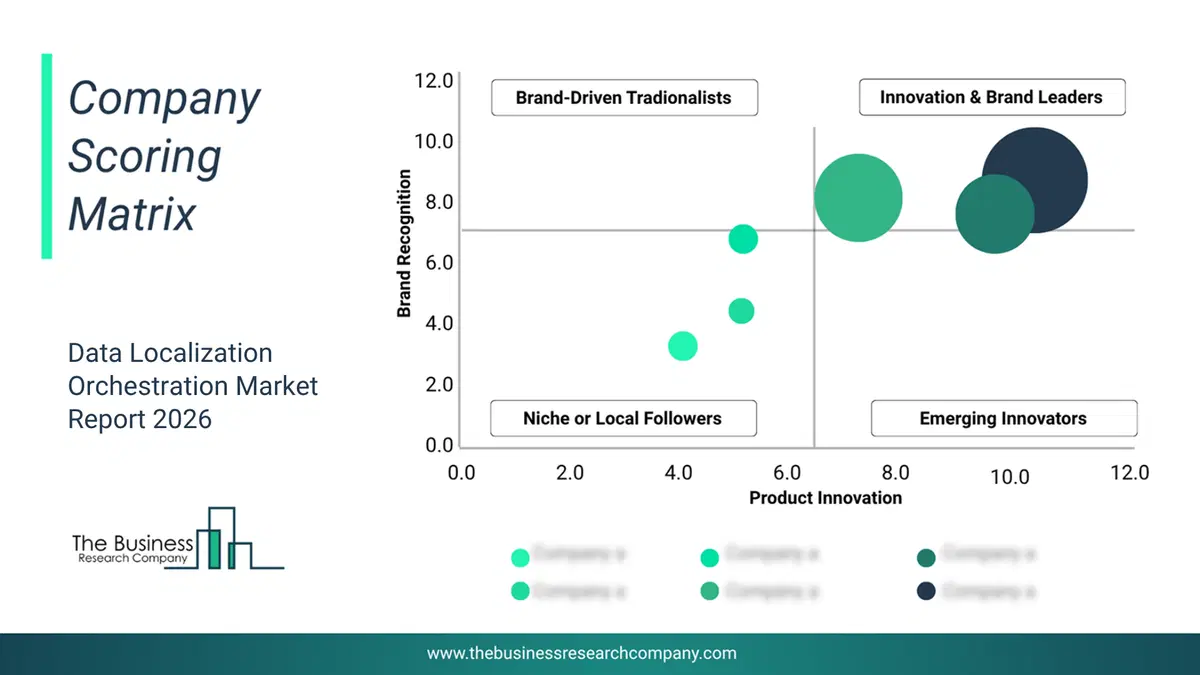
This chart maps companies by product innovation and brand strength, with bubble size indicating relative revenue, helping identify market leaders, challengers, and niche players. This is an illustrative chart; the full report provides a complete and accurate competitive analysis.
Global Data Localization Orchestration Market Trends and Insights
Major companies operating in the data localization orchestration market are focusing on developing real-time residency orchestration to enable secure, efficient, and sovereign-compliant data management across global infrastructures. Automated compliance orchestration refers to the use of AI-driven engines and rule-based triggers to manage data residency and sovereignty requirements without manual intervention. For instance, in October 2025, OneTrust, a US-based leader in privacy and security, launched its enhanced Compliance Automation platform, which integrates with over 50 global regulatory frameworks. This innovative platform facilitates secure, real-time data governance by allowing organizations to automate evidence collection and mapping directly linked to regional data localization laws. By intelligently synchronizing data placement with localized compliance mandates, the platform ensures seamless cross-border coordination, risk mitigation, and audit readiness in enterprise operations. Through the adoption of these automated platforms, companies like OneTrust and InCountry demonstrate how advanced orchestration frameworks can transform global data systems by enhancing legal connectivity, operational efficiency, and regional consumer trust.What Are Latest Mergers And Acquisitions In The Data Localization Orchestration Market?
In September 2023, OVHcloud, a France-based provider of public and private cloud services, acquired Gridscale for an undisclosed amount. With this acquisition, OVHcloud aimed to strengthen its European cloud footprint and expand its local public cloud offerings, particularly to address sovereignty and compliance requirements. Gridscale is a Germany-based company specializing in data localistion orchestration.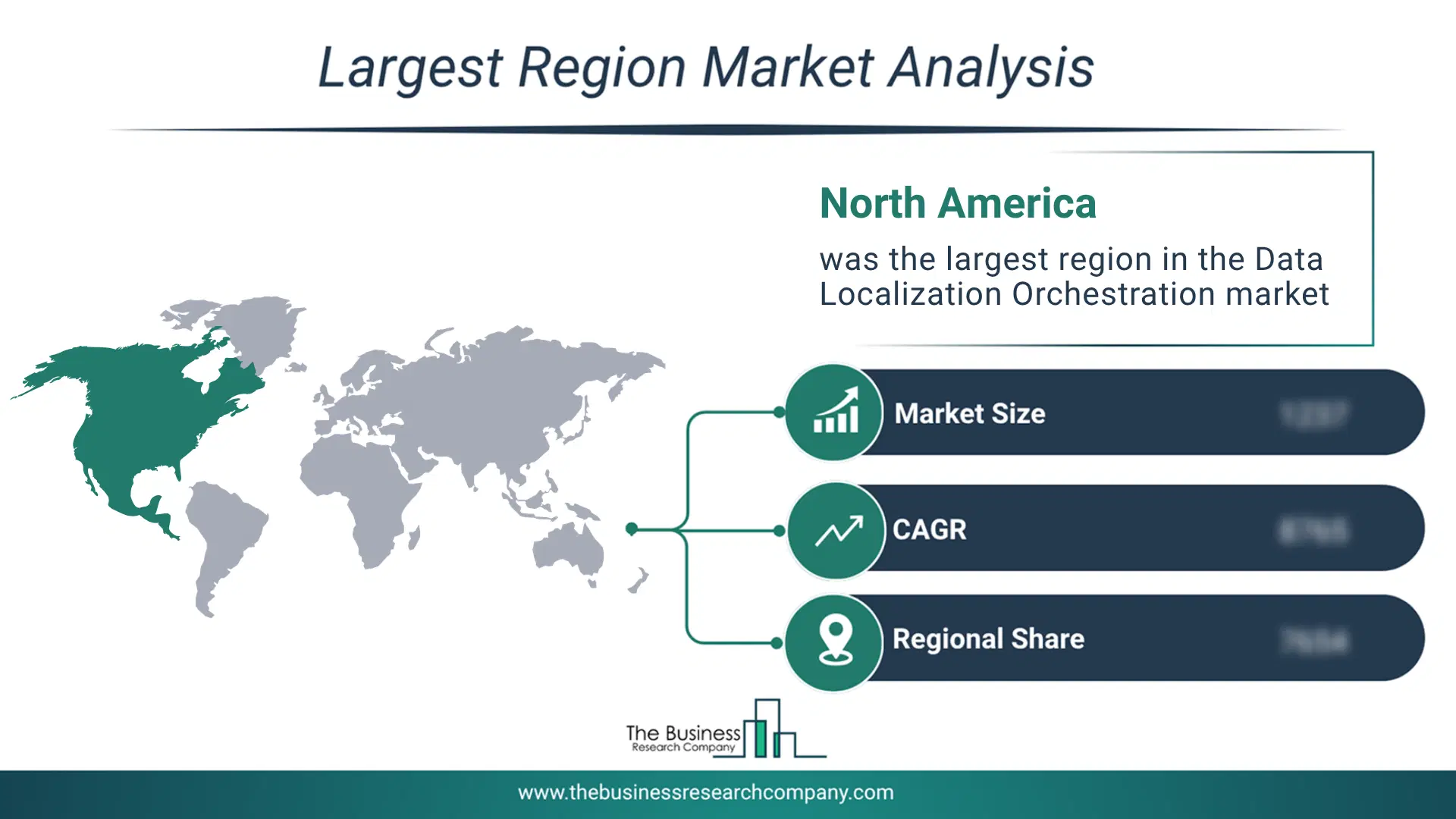
Regional Outlook
North America was the largest region in the data localization orchestration market in 2025. Asia-Pacific is expected to be the fastest-growing region in the forecast period. The regions covered in this market report are Asia-Pacific, South East Asia, Western Europe, Eastern Europe, North America, South America, Middle East, Africa. The countries covered in this market report are Australia, Brazil, China, France, Germany, India, Indonesia, Japan, Taiwan, Russia, South Korea, UK, USA, Canada, Italy, Spain.What Defines the Data Localization Orchestration Market?
The data localization orchestration market consists of revenues earned by entities by providing services such as data residency planning and advisory, compliance and regulatory consulting, cross-border data flow management, encryption and access control services, and data governance and policy enforcement. The market value includes the value of related goods sold by the service provider or included within the service offering. The data localization orchestration market also includes sales of data storage appliances, network security hardware, hardware encryption modules, and backup and recovery devices. Values in this market are ‘factory gate’ values, that is the value of goods sold by the manufacturers or creators of the goods, whether to other entities (including downstream manufacturers, wholesalers, distributors and retailers) or directly to end customers. The value of goods in this market includes related services sold by the creators of the goods.How is Market Value Defined and Measured?
The market value is defined as the revenues that enterprises gain from the sale of goods and/or services within the specified market and geography through sales, grants, or donations in terms of the currency (in USD unless otherwise specified). The revenues for a specified geography are consumption values that are revenues generated by organizations in the specified geography within the market, irrespective of where they are produced. It does not include revenues from resales along the supply chain, either further along the supply chain or as part of other products.
This chart presents market attractiveness based on a quantitative evaluation of growth, competition, strategic alignment, and risk, offering a clear view of opportunity areas for decision-making. This chart is for illustrative purposes; the full report contains the complete analysis.

This chart highlights the Total Addressable Market (TAM) by estimating the maximum revenue opportunity using an assumption-driven approach, supporting strategic planning and opportunity sizing across markets. The chart is illustrative; the full report provides a more comprehensive analysis.
What Key Data and Analysis Are Included in the Data Localization Orchestration Market Report 2026?
The data localization orchestration market research report is one of a series of new reports from The Business Research Company that provides market statistics, including industry global market size, regional shares, competitors with the market share, detailed market segments, market trends and opportunities, and any further data you may need to thrive in the data localization orchestration industry. The market research report delivers a complete perspective of everything you need, with an in-depth analysis of the current and future state of the industry.Data Localization Orchestration Market Report Forecast Analysis
| Report Attribute | Details |
|---|---|
| Market Size Value In 2026 | $4.77 billion |
| Revenue Forecast In 2030 | $9.58 billion |
| Growth Rate | CAGR of 19% from 2026 to 2030 |
| Base Year For Estimation | 2025 |
| Actual Estimates/Historical Data | 2020-2025 |
| Forecast Period | 2026 - 2030 |
| Market Representation | Revenue in USD Billion and CAGR from 2026 to 2030 |
| Segments Covered | Component, Deployment Mode, Organization Size, Application, End-User |
| Regional Scope | Asia-Pacific, Western Europe, Eastern Europe, North America, South America, Middle East, Africa |
| Country Scope | The Countries Covered In This Market Report Are Australia, Brazil, China, France, Germany, India, Indonesia, Japan, Taiwan, Russia, South Korea, Uk, Usa, Canada, Italy, Spain. |
| Key Companies Profiled | Amazon Web Services (AWS) Inc., Google LLC, Microsoft Corporation, Dell Technologies Inc., Tencent Holdings Ltd., Hitachi Vantara LLC, IBM Corporation, Cisco Systems Inc., Oracle Corporation, SAP SE, Salesforce Inc., Hewlett Packard Enterprise (HPE), Infosys Limited, Capgemini SE, VMware Inc., Equinix Inc., NetApp Inc., Rackspace Technology Ltd., Snowflake Inc., Cloudera Inc., Akana, Alibaba Cloud, Sovereign Systems Inc. |
| Customization Scope | Request for Customization |
| Pricing And Purchase Options | Explore Purchase Options |