

Data Visualization Tools Market Report 2026
Global Outlook – By Tool (Standalone, Integrated), By Business Function (Marketing And Sales, Human Resources, Operations, Finance), By Deployment Mode (On-Premises, Cloud), By Organization Size (Large Enterprises, Small And Medium-Sized Enterprises (SMEs)), By Vertical (Banking, Financial Services And Insurance (BFSI), Government, Healthcare And Life Sciences, Retail And E-Commerce, Manufacturing, Transportation And Logistics, Telecommunications And Information Technology (IT), Other Verticals) – Market Size, Trends, Strategies, and Forecast to 2030
Data Visualization Tools Market Overview
• Data Visualization Tools market size has reached to $9.46 billion in 2025 • Expected to grow to $17.33 billion in 2030 at a compound annual growth rate (CAGR) of 12.7% • Growth Driver: Navigating Insights With IOT Driving Data Visualization Tools Market Growth • Market Trend: Technological Advancements Reshaping The Data Visualization Tools Market • North America was the largest region in 2025 and Asia-Pacific is the fastest growing region.Market Gains By 2030 – Top Opportunities By Segment
Market Gain identifies the most promising market opportunities by highlighting the segments or products expected to generate the highest incremental revenue growth over the next five years.
What Is Covered Under Data Visualization Tools Market?
Data visualization tools refer to software programs that display information visually, such as in graphs, charts, or heat maps, for data analysis. These tools facilitate working with and understanding vast amounts of data. The data visualization tools are used for the transformation of unprocessed data into knowledge, and for data presentation, transparent reporting, scalability with data integration, and data visualization in an intelligent and unique approach. The main types of data visualization tools are standalone and integrated. Standalone data visualization tools are used by data scientists and analysts to create advanced visualizations and customized dynamic charts. Standalone data visualization tools refer to the tools that enable teams to combine data from many sources. It is often employed as a basic data tool. The data visualization tools are employed in large enterprises and small and medium-sized enterprises in the field of marketing and sales, human resources, operations, and finance. The data visualization tools are used in BFSI, government, healthcare and life sciences, retail and eCommerce, manufacturing, transportation and logistics, telecommunications and IT, and other verticals.
What Is The Data Visualization Tools Market Size and Share 2026?
The data visualization tools market size has grown rapidly in recent years. It will grow from $9.46 billion in 2025 to $10.73 billion in 2026 at a compound annual growth rate (CAGR) of 13.3%. The growth in the historic period can be attributed to increasing enterprise data generation volumes, adoption of business intelligence platforms, growth of data-driven decision-making, expansion of enterprise reporting needs, increasing use of dashboards across business functions.What Is The Data Visualization Tools Market Growth Forecast?
The data visualization tools market size is expected to see rapid growth in the next few years. It will grow to $17.33 billion in 2030 at a compound annual growth rate (CAGR) of 12.7%. The growth in the forecast period can be attributed to growing adoption of augmented analytics, rising demand for embedded analytics solutions, expansion of cloud-native data platforms, increasing use of visualization in AI-driven insights, growing focus on predictive and prescriptive analytics. Major trends in the forecast period include increasing adoption of self-service visualization tools, rising demand for real-time interactive dashboards, growing integration with advanced analytics platforms, expansion of cloud-based visualization solutions, enhanced focus on data storytelling capabilities.

Global Data Visualization Tools Market Segmentation
1) By Tool: Standalone, Integrated 2) By Business Function: Marketing And Sales, Human Resources, Operations, Finance 3) By Deployment Mode: On-Premises, Cloud 4) By Organization Size: Large Enterprises, Small And Medium-Sized Enterprises (SMEs) 5) By Vertical: Banking, Financial Services And Insurance (BFSI), Government, Healthcare And Life Sciences, Retail And E-Commerce, Manufacturing, Transportation And Logistics, Telecommunications And Information Technology (IT), Other Verticals Subsegments: 1) By Standalone: Desktop Applications, Web-Based Solutions 2) By Integrated: Business Intelligence (BI) Platforms, Data Analytics Software, Cloud-Based Integrated Tools The top segments in the data visualization tools market will be: • Standalone will reach $9 Billion by 2030. • Integrated will reach $8 Billion by 2030.What Is The Driver Of The Data Visualization Tools Market?
The increase in demand for IoT devices is expected to propel the growth of the data visualization tools market going forward. IoT devices, or Internet of Things devices, refer to physical objects or devices embedded with sensors, software, and connectivity features that enable them to collect, exchange, and transmit data over the internet. IoT devices contribute valuable data to Data Visualization Tools, enabling organizations to gain insights, make informed decisions, and optimize operations across various industries. The integration of IoT-generated data with visualization tools enhances the capability to understand complex systems and trends in real time. For instance, in October 2025, according to internet of things (IoT) Analytics, a Germany-based intelligence company, the connected internet of things (IoT) device base climbed to 18.5 billion in 2024, reflecting a robust 12% year-on-year increase versus 2023. Therefore, the increase in demand for IoT devices is driving the growth of the data visualization tools industry.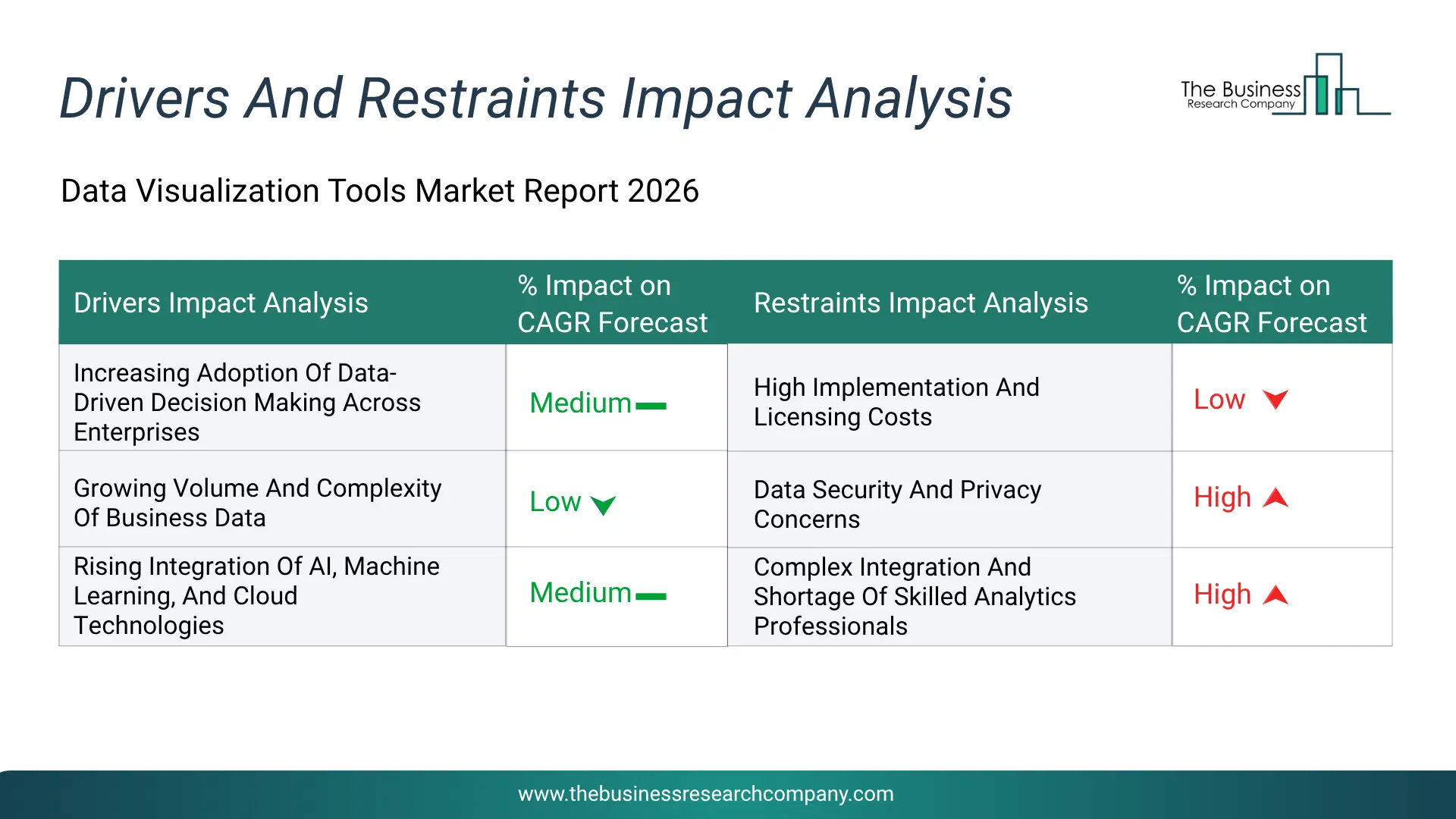
Infographic Chart Showing Key Market Drivers Analysis And Restraints For Data Visualization Tools Market
The chart presents an impact analysis of key drivers and restraints, quantifying their relative influence on the market's growth rate and helping assess the balance between growth enablers and limiting factors. This chart offers a high-level perspective; the full report contains more detailed insights.
How Will The Drivers Impact Growth In The Global Data Visualization Tools Market?
• Increasing Adoption Of Data-Driven Decision Making Across Enterprises (Medium) – During the forecast period, the increasing adoption of data-driven decision making across enterprises is expected to emerge as a major factor driving the expansion of the data visualization tools market by 2030. organizations are increasingly utilizing interactive dashboards, charts, and real-time reporting platforms to transform complex business data into actionable insights that support strategic planning and operational performance. these solutions enable decision-makers to monitor key performance indicators, identify emerging trends, and respond quickly to changing business conditions, strengthening enterprise-wide adoption of visual analytics. • Growing Volume And Complexity Of Business Data (Low) – During the forecast period, the growing volume and complexity of business data are expected to emerge as a major factor driving the expansion of the data visualization tools market by 2030. businesses are collecting massive datasets from cloud applications, IoT devices, enterprise systems, customer interactions, and digital platforms, creating the need for advanced visualization solutions capable of consolidating and presenting information in an easily understandable format. these tools improve analytical efficiency by helping organizations identify patterns, correlations, risks, and opportunities across multiple data sources. • Rising Integration Of AI, Machine Learning, And Cloud Technologies (Medium) – During the forecast period, the rising integration of AI, machine learning, and cloud technologies is expected to act as a key growth catalyst for the data visualization tools market by 2030. aI-powered visualization platforms automate data preparation, generate predictive insights, recommend optimal visual formats, and detect anomalies, while cloud deployment enables remote access, scalability, seamless collaboration, and simplified system integration. these technological advancements are enhancing analytics capabilities and making advanced visualization solutions more accessible across diverse industries.How Will The Restraints Impact Growth In The Global Data Visualization Tools Market?
• High Implementation And Licensing Costs (Medium) – During the forecast period, high Implementation And Licensing Costs remain one of the primary restraints limiting the widespread adoption of Data Visualization Tools, particularly among small and medium-sized enterprises (SMEs). Although modern visualization platforms provide advanced analytics, AI-enabled dashboards, predictive modeling, real-time reporting, and enterprise integration capabilities, deploying these solutions often requires substantial upfront investments. Organizations must bear expenses related to software licensing, cloud subscriptions, infrastructure upgrades, customization, system integration, employee training, technical consulting, maintenance, and ongoing support services. In addition, premium visualization platforms frequently charge recurring subscription fees based on users, storage capacity, or advanced analytical features, further increasing the total cost of ownership. For businesses operating under limited IT budgets, these high costs often outweigh the expected return on investment, causing delays in technology adoption or forcing organizations to rely on basic reporting tools instead of advanced visualization platforms. Consequently, cost-related challenges continue to restrict market penetration, especially in developing economies and among smaller enterprises. • Data Security And Privacy Concerns (Low) – During the forecast period, data Security And Privacy Concerns continue to act as a significant restraint for the Data Visualization Tools Market because these platforms often process highly confidential business information, including customer records, financial transactions, healthcare data, intellectual property, and operational metrics. As organizations increasingly migrate visualization workloads to cloud environments and integrate multiple enterprise systems, concerns regarding unauthorized access, cyberattacks, ransomware incidents, insider threats, and data breaches become more prominent. Businesses must also comply with stringent data protection regulations such as GDPR, CCPA, HIPAA, and various regional privacy laws, which require robust governance, encryption, access controls, and audit mechanisms. Failure to meet these compliance standards may result in severe financial penalties and reputational damage. Consequently, many organizations adopt cautious implementation strategies or delay cloud-based deployments until adequate security measures are established. These security and regulatory concerns slow technology adoption and continue to restrain the overall growth of the Data Visualization Tools Market. • Complex Integration And Shortage Of Skilled Analytics Professionals (Medium) – During the forecast period, complex Integration And Shortage Of Skilled Analytics Professionals is another important restraint affecting the growth of the Data Visualization Tools Market. Many organizations operate with multiple legacy databases, enterprise resource planning (ERP) systems, customer relationship management (CRM) platforms, cloud applications, and third-party software that store information in different formats. Successfully integrating these diverse data sources into a single visualization platform requires extensive data cleansing, transformation, governance, and interoperability, making implementation technically complex and time-consuming. Furthermore, organizations frequently face a shortage of professionals with expertise in data engineering, business intelligence, dashboard design, advanced analytics, and visualization best practices. Without skilled personnel, businesses often struggle to design meaningful dashboards, maintain data quality, interpret analytical results, and maximize the value of visualization platforms. These technical complexities increase implementation costs, prolong deployment timelines, and reduce user adoption, particularly among organizations with limited digital maturity, thereby restraining the overall expansion of the Data Visualization Tools Market.Key Players In The Global Data Visualization Tools Market
Major companies operating in the data visualization tools market are Tableau Software; SAP SE; The International Business Machines Corporation; Oracle Corporation; Microsoft Corporation; Alibaba Group Holding Limited; Alteryx Inc.; Amazon Web Services Inc.; Domo Inc.; Dundas Data Visualization Inc.; GoodData Corporation; Klipfolio Inc.; QlikTech International AB; Salesforce Inc.; SAS Institute Inc.; Sisense Inc.; TIBCO Software Inc.; Zegami Ltd.; Looker Data Sciences Inc.; Google Data Studio; SAP Lumira; MicroStrategy; Yellowfin Business Intelligence; Slemma; Zoho Corporation Pvt. Ltd.; Datawrapper Gmbh; ThoughtSpot Inc.; Periscope Data Inc.
This chart is for illustrative purposes; the full report includes a detailed competitor analysis and comprehensive overview of the top 10 companies in the market.

This chart maps companies by product innovation and brand strength, with bubble size indicating relative revenue, helping identify market leaders, challengers, and niche players. This is an illustrative chart; the full report provides a complete and accurate competitive analysis.
Global Data Visualization Tools Market Trends and Insights
Major comapnies opearting in the data visualization tools market are focusing on developing advanced software tools, such as AI-powered data visualization systems, to boost decision-making efficiency, enhance operational visibility, and reduce manual analysis. AI-powered data visualization tools refer to advanced software that automatically transforms complex supply chain data into intuitive charts and dashboards, making it easier to identify trends and insights. For instance, in September 2024, GrubMarket, a US-based food technology company, launched the GrubAssist Charts, an AI-powered data visualization tool. The GrubAssist Charts feature is a powerful tool within GrubMarket's enterprise AI assistant, GrubAssist, designed to help food supply chain businesses visualize complex data through dynamic, easy-to-understand charts and graphs. By using natural language commands, users can generate intuitive visual reports tailored to their needs, allowing them to track key performance indicators (KPIs), analyze sales trends, and monitor profitability across vendors and customers. This feature, available on both desktop and mobile, simplifies data interpretation for business leaders, analysts, and sales teams, enabling more informed decision-making at a glance.What Are Latest Mergers And Acquisitions In The Data Visualization Tools Market?
In June 2023, ThoughtSpot Inc., a US‑based provider of AI‑powered analytics and business intelligence platforms, acquired Mode Analytics Inc. for $200 million. With this acquisition, ThoughtSpot aimed to enhance its technological capability and market offering by combining Mode’s code‑first analytics and visualization tools with its AI‑driven search and self‑service analytics platform to broaden its appeal across both data teams and business users. Mode Analytics is a US‑based provider of a data visualization tools.
Regional Insights
North America was the largest region in the data visualization tools market in 2025. Asia-Pacific is expected to be the fastest-growing region in the forecast period. The regions covered in this market report are Asia-Pacific, South East Asia, Western Europe, Eastern Europe, North America, South America, Middle East, Africa. The countries covered in this market report are Australia, Brazil, China, France, Germany, India, Indonesia, Japan, Taiwan, Russia, South Korea, UK, USA, Canada, Italy, SpainWhat Defines the Data Visualization Tools Market?
The data visualization tools market consists of sales of scatter plots, bar charts, heat maps, line graphs, pie charts, area charts, choropleth maps and histograms. Values in this market are ‘factory gate’ values, that is the value of goods sold by the manufacturers or creators of the goods, whether to other entities (including downstream manufacturers, wholesalers, distributors and retailers) or directly to end customers. The value of goods in this market includes related services sold by the creators of the goods.How is Market Value Defined and Measured?
The market value is defined as the revenues that enterprises gain from the sale of goods and/or services within the specified market and geography through sales, grants, or donations in terms of the currency (in USD unless otherwise specified). The revenues for a specified geography are consumption values that are revenues generated by organizations in the specified geography within the market, irrespective of where they are produced. It does not include revenues from resales along the supply chain, either further along the supply chain or as part of other products.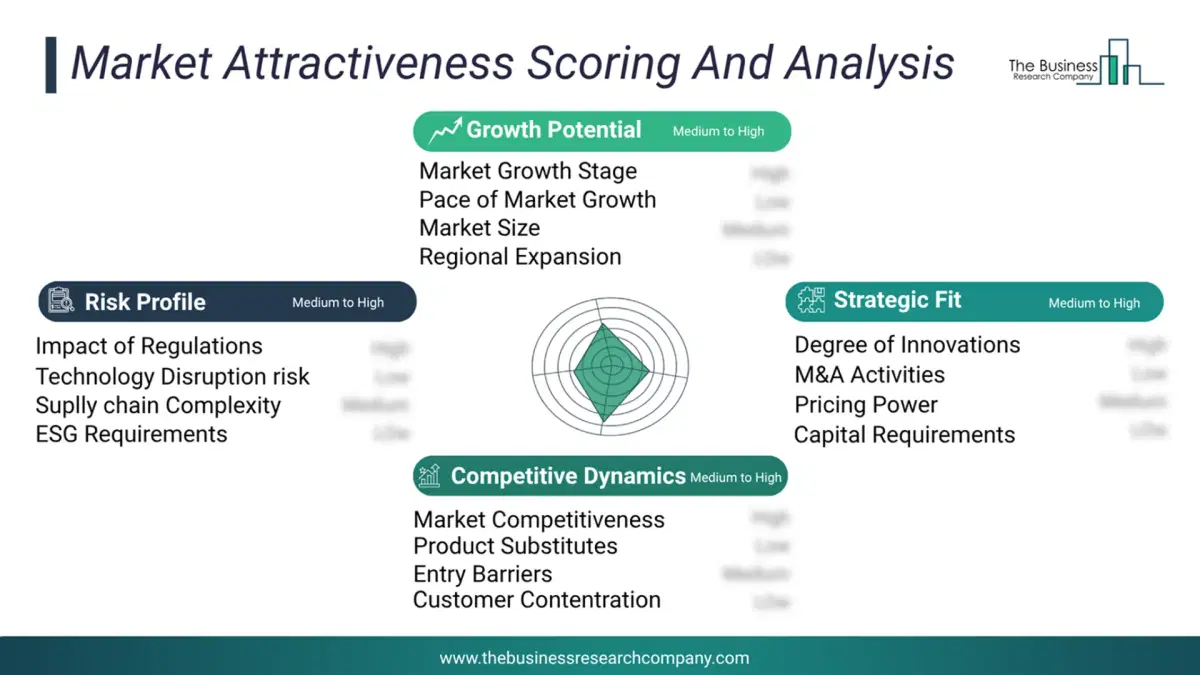
This chart presents market attractiveness based on a quantitative evaluation of growth, competition, strategic alignment, and risk, offering a clear view of opportunity areas for decision-making. This chart is for illustrative purposes; the full report contains the complete analysis.
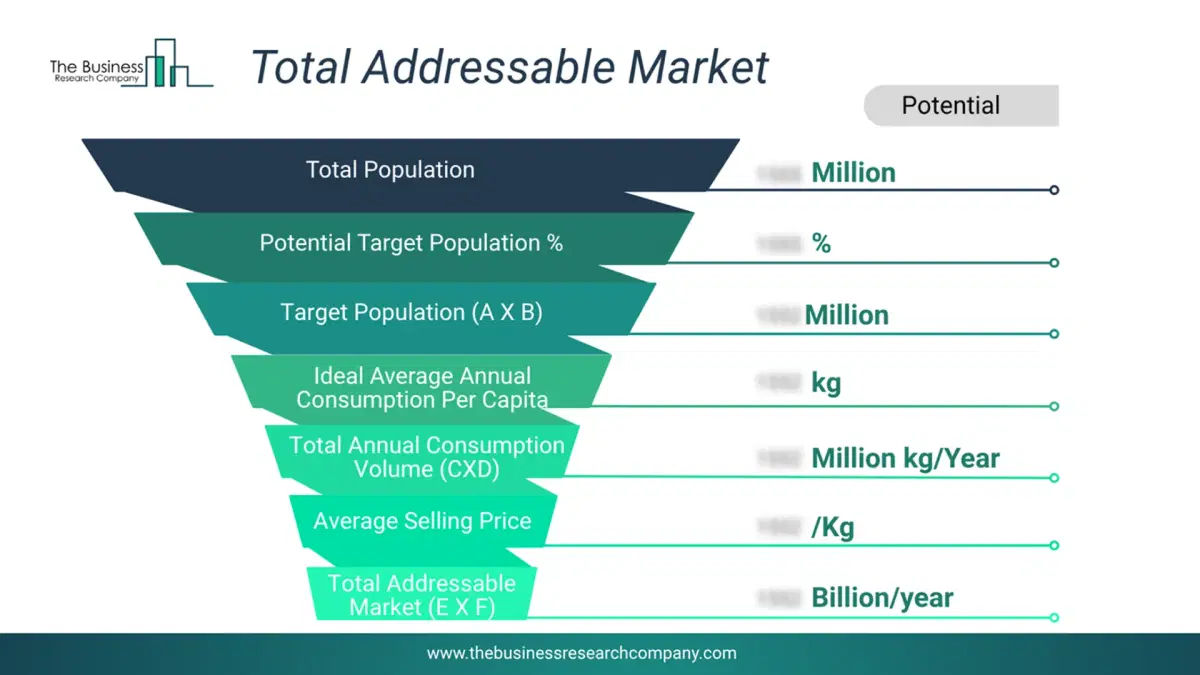
This chart highlights the Total Addressable Market (TAM) by estimating the maximum revenue opportunity using an assumption-driven approach, supporting strategic planning and opportunity sizing across markets. The chart is illustrative; the full report provides a more comprehensive analysis.
What Key Data and Analysis Are Included in the Data Visualization Tools Market Report 2026?
The data visualization tools market research report is one of a series of new reports from The Business Research Company that provides market statistics, including industry global market size, regional shares, competitors with the market share, detailed market segments, market trends and opportunities, and any further data you may need to thrive in the data visualization tools industry. The market research report delivers a complete perspective of everything you need, with an in-depth analysis of the current and future state of the industry.Data Visualization Tools Market Report Forecast Analysis
| Report Attribute | Details |
|---|---|
| Market Size Value In 2026 | $10.73 billion |
| Revenue Forecast In 2030 | $17.33 billion |
| Growth Rate | CAGR of 12.7% from 2026 to 2030 |
| Base Year For Estimation | 2025 |
| Actual Estimates/Historical Data | 2020-2025 |
| Forecast Period | 2026 - 2030 |
| Market Representation | Revenue in USD Billion and CAGR from 2026 to 2030 |
| Segments Covered | Tool, Business Function, Deployment Mode, Organization Size, Vertical |
| Regional Scope | Asia-Pacific, Western Europe, Eastern Europe, North America, South America, Middle East, Africa |
| Country Scope | The countries covered in the report are Australia, Brazil, China, France, Germany, India, Indonesia, Japan, Taiwan, Russia, South Korea, UK, USA, Canada, Italy, Spain. |
| Key Companies Profiled | Tableau Software; SAP SE; The International Business Machines Corporation; Oracle Corporation; Microsoft Corporation; Alibaba Group Holding Limited; Alteryx Inc.; Amazon Web Services Inc.; Domo Inc.; Dundas Data Visualization Inc.; GoodData Corporation; Klipfolio Inc.; QlikTech International AB; Salesforce Inc.; SAS Institute Inc.; Sisense Inc.; TIBCO Software Inc.; Zegami Ltd.; Looker Data Sciences Inc.; Google Data Studio; SAP Lumira; MicroStrategy; Yellowfin Business Intelligence; Slemma; Zoho Corporation Pvt. Ltd.; Datawrapper Gmbh; ThoughtSpot Inc.; Periscope Data Inc. |
| Customization Scope | Request for Customization |
| Pricing And Purchase Options | Explore Purchase Options |