
Database Acceleration Market Report 2026
Global Outlook – By Type (In-Memory Computing Solutions, Caching Solutions, Indexing Optimization Tools, Graphics Processing Unit (GPU)-Based Acceleration, Field-Programmable Gate Array (FPGA)-Based Acceleration, Parallel Query Execution Tools, Other Types), By Deployment (On-Premise, Cloud-Based, Hybrid), By Application (Real-Time Analytics And Reporting, Online Transaction Processing (OLTP) Acceleration, High-Volume Data Ingestion, Business Intelligence (BI) And Dashboards, Fraud Detection And Risk Analysis, IoT And Edge Data Processing, Other Applications), By End User (Banking, Financial Services, And Insurance (BFSI), Information Technology (IT) And Telecommunications) – Market Size, Trends, Strategies, and Forecast to 2030
Database Acceleration Market Overview
• Database Acceleration market size has reached to $12.17 billion in 2025 • Expected to grow to $13.12 billion in 2030 at a compound annual growth rate (CAGR) of 8.1% • Growth Driver: Surge In Data Processing And Storage Demand Fueling The Growth Of The Market Due To Rapid Expansion Of Cloud, IoT, And Digital Data Volumes • Market Trend: In-Memory Columnar Query Execution Enhances Real-Time Data Processing Efficiency • North America was the largest region in 2025 and Asia-Pacific is the fastest growing region.What Is Covered Under Database Acceleration Market?
Database acceleration refers to technologies, software, and hardware solutions designed to optimize the speed, efficiency, and performance of database operations by reducing query latency, improving transaction processing, and enabling faster data retrieval and analytics. It leverages techniques such as in-memory computing, caching, indexing optimization, GPU or FPGA-based processing, and parallel query execution to enhance database throughput, support high-volume workloads, and deliver real-time insights in complex enterprise and analytical environments. The main types of database acceleration include in-memory computing solutions, caching solutions, indexing optimization tools, graphics processing unit (GPU)-based acceleration, field-programmable gate array (FPGA)-based acceleration, parallel query execution tools, and others. In-memory computing solutions refer to technologies that store and process data directly in the system’s main memory (RAM) rather than on disk storage, enabling significantly faster data retrieval, real-time processing, and enhanced query performance for high-speed analytics and transaction workloads. The deployment categories as on-premise, cloud-based, and hybrid, and the applications such as real-time analytics and reporting, online transaction processing (OLTP) acceleration, high-volume data ingestion, business intelligence (BI) and dashboards, fraud detection and risk analysis, IoT and edge data processing, and others, and the key end users include banking, financial services, and insurance (BFSI), information technology (IT) and telecommunications, retail and e-commerce, healthcare and life sciences, and government and defence, and others.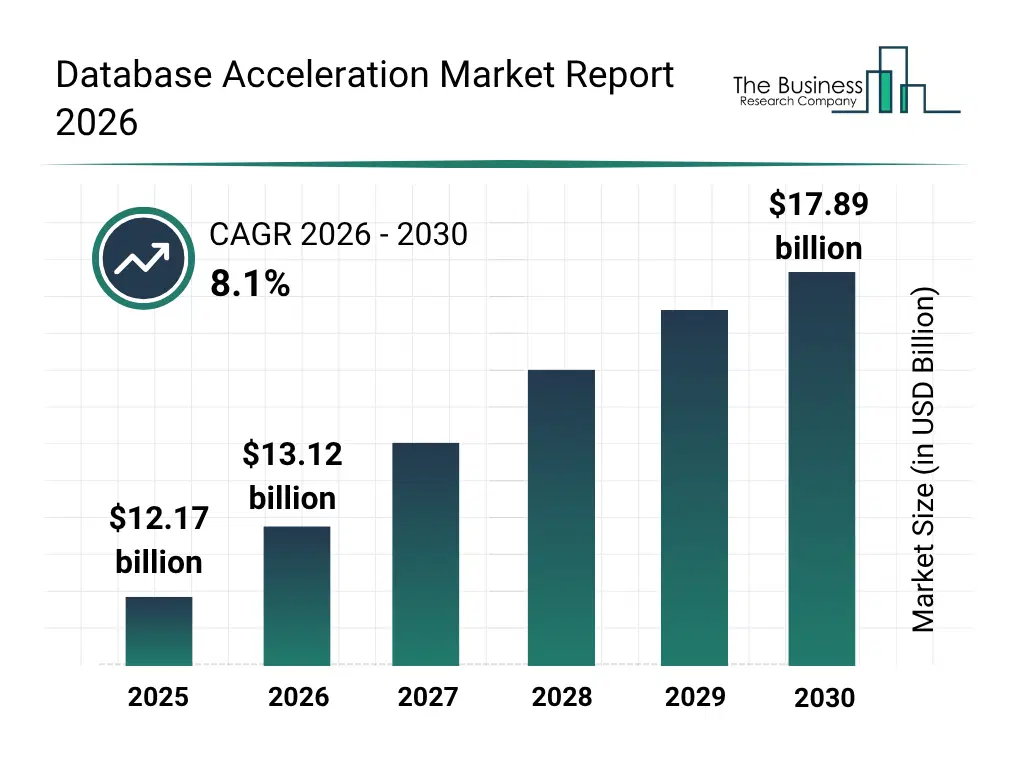
What Is The Database Acceleration Market Size and Share 2026?
The database acceleration market size has grown strongly in recent years. It will grow from $12.17 billion in 2025 to $13.12 billion in 2026 at a compound annual growth rate (CAGR) of 7.8%. The growth in the historic period can be attributed to rise of enterprise data warehousing needs, increasing adoption of relational databases, growth of online transaction processing systems, expansion of business intelligence tools, emergence of big data analytics platforms.What Is The Database Acceleration Market Growth Forecast?
The database acceleration market size is expected to see strong growth in the next few years. It will grow to $17.89 billion by 2030 at a compound annual growth rate (CAGR) of 8.1%. The growth in the forecast period can be attributed to surge in real-time analytics demand, increasing adoption of AI-powered data platforms, growth in cloud-native database deployments, rising need for low-latency transaction systems, expansion of edge and distributed data processing. Major trends in the forecast period include AI driven database query optimization, in-memory and real-time data processing acceleration, gpu and fpga based database computing adoption, cloud native distributed database acceleration, automated indexing and workload optimization systems.
Global Database Acceleration Market Segmentation
1) By Type: In-Memory Computing Solutions, Caching Solutions, Indexing Optimization Tools, Graphics Processing Unit (GPU)-Based Acceleration, Field-Programmable Gate Array (FPGA)-Based Acceleration, Parallel Query Execution Tools, Other Types 2) By Deployment: On-Premise, Cloud-Based, Hybrid 3) By Application: Real-Time Analytics And Reporting, Online Transaction Processing (OLTP) Acceleration, High-Volume Data Ingestion, Business Intelligence (BI) And Dashboards, Fraud Detection And Risk Analysis, IoT And Edge Data Processing, Other Applications 4) By End User: Banking, Financial Services, And Insurance (BFSI), Information Technology (IT) And Telecommunications, Retail And E-commerce, Healthcare And Life Sciences, Government And Defense, Other End Users Subsegments: 1) By In-Memory Computing Solutions: Distributed In-Memory Data Grids, In-Memory Analytics Engines, In-Memory OLTP Databases, Hybrid Transactional Analytical Processing Systems, Memory-Optimized Storage Engines 2) By Caching Solutions: Application-Level Caching, Database Query Caching, Distributed Caching Systems, Content Delivery Caching, Write-Through And Write-Behind Caching 3) By Indexing Optimization Tools: Columnar Indexing, Bitmap Indexing, Hash Indexing, Adaptive Indexing, Full-Text Indexing 4) By Graphics Processing Unit (GPU)-Based Acceleration: GPU-Accelerated Query Processing, GPU-Based Data Analytics, Deep Learning Database Acceleration, Parallel GPU Computing Frameworks, Real-Time GPU Data Processing 5) By Field-Programmable Gate Array (FPGA)-Based Acceleration: FPGA-Based Query Acceleration, Hardware-Accelerated Data Filtering, Custom FPGA Data Pipelines, Low-Latency Transaction Processing, Real-Time Analytics Acceleration 6) By Parallel Query Execution Tools: Massively Parallel Processing Systems, Distributed Query Engines, Parallel SQL Execution Frameworks, Multi-Threaded Query Processors, Cluster-Based Query Execution 7) By Other Types: Data Compression Acceleration Tools, Storage Optimization Solutions, Network Acceleration Tools, AI-Driven Query Optimization, Workload Management And Scheduling ToolsWhat Is The Driver Of The Database Acceleration Market?
The rising data processing and storage demand is expected to propel the growth of the database acceleration market going forward. Data processing and storage is the systematic collection, transformation, organization, and retention of data in a usable format so it can be efficiently accessed, analyzed, and retrieved when needed. Data processing and storage is rising primarily due to the exponential growth of digital data generated from cloud applications, IoT devices, and online services, which requires continuous computation, organization, and scalable storage infrastructure to manage efficiently. Higher data processing and storage enable database acceleration by supporting faster data indexing and caching, which improves query execution speed and reduces response time when handling large volumes of data. For instance, in November 2025, according to the House of Commons Library, a UK-based library and information resource of the lower house of the British Parliament, the UK’s data centre capacity was around 1.6 GW in 2024, and it is projected to increase significantly, reaching an estimated range of 3.3 GW to 6.3 GW by 2030. Therefore, the rising data processing and storage demand is driving the growth of the database acceleration industry.Key Players In The Global Database Acceleration Market
Major companies operating in the database acceleration market are Microsoft Corporation; Amazon Web Services Inc.; International Business Machines Corporation; Oracle Corporation; SAP SE; MongoDB Inc.; Teradata Corporation; Cloudera Inc.; Couchbase Inc.; Kx Systems Inc.; SingleStore Inc.; Aerospike Inc.; Exasol AG; Hazelcast Inc.; Altibase Corporation; GridGain Systems Inc.; MemVerge Inc.; VoltDB Inc.; Raima Inc.; McObject LLC.
This chart is for illustrative purposes; the full report includes a detailed competitor analysis and comprehensive overview of the top 10 companies in the market.
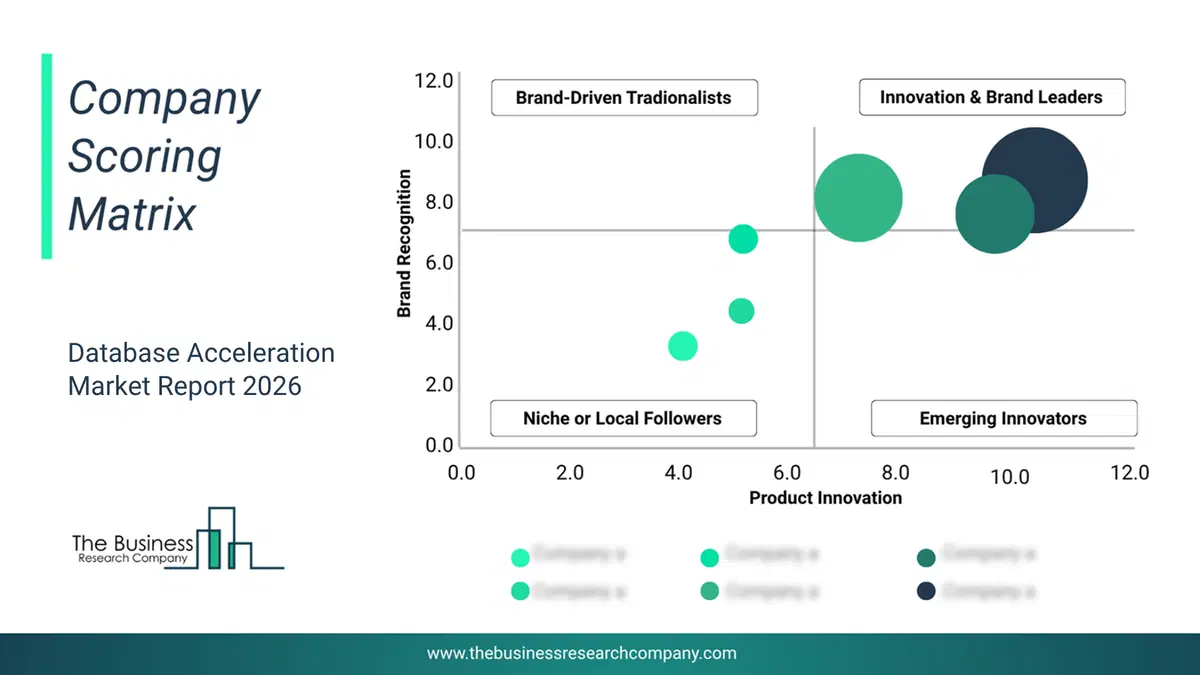
This chart maps companies by product innovation and brand strength, with bubble size indicating relative revenue, helping identify market leaders, challengers, and niche players. This is an illustrative chart; the full report provides a complete and accurate competitive analysis.
Global Database Acceleration Market Trends and Insights
Major companies operating in the database acceleration market are focusing on developing advanced solutions, such as in-memory columnar query execution systems to store and process active datasets directly in main memory instead of disk storage to reduce query latency. In-memory columnar query execution systems are database engines that store data in column-based format in main memory and process queries directly on that in-memory structure to enable faster analytical processing and reduced disk I/O. For instance, in July 2023, Oracle Corporation, a US-based software company, launched Oracle HeatWave Lakehouse as an extension of its cloud database platform. The solution integrates in-memory query acceleration across transactional and object storage data, enabling unified analytics without requiring separate extract, transform, and load pipelines. It also introduces automated data ingestion from cloud object stores into in-memory formats to reduce preparation time, built-in machine learning capabilities for in-database model training and inference, and native MySQL compatibility that allows enterprises to run operational and analytical workloads on a single system with reduced data movement overhead.What Are Latest Mergers And Acquisitions In The Database Acceleration Market?
In March 2025, International Business Machines Corporation, a US-based technology and consulting company, acquired Confluent Inc. for an undisclosed amount. Following the acquisition, IBM and Confluent together provide a unified smart data platform that delivers real-time, trusted data to AI models, agents, and automated workflows across hybrid and on-premises environments. This integration enables enterprises to operate with an AI-driven model where live data powers instant decision-making and scalable value creation. Confluent Inc. is a US-based company specializing in database acceleration.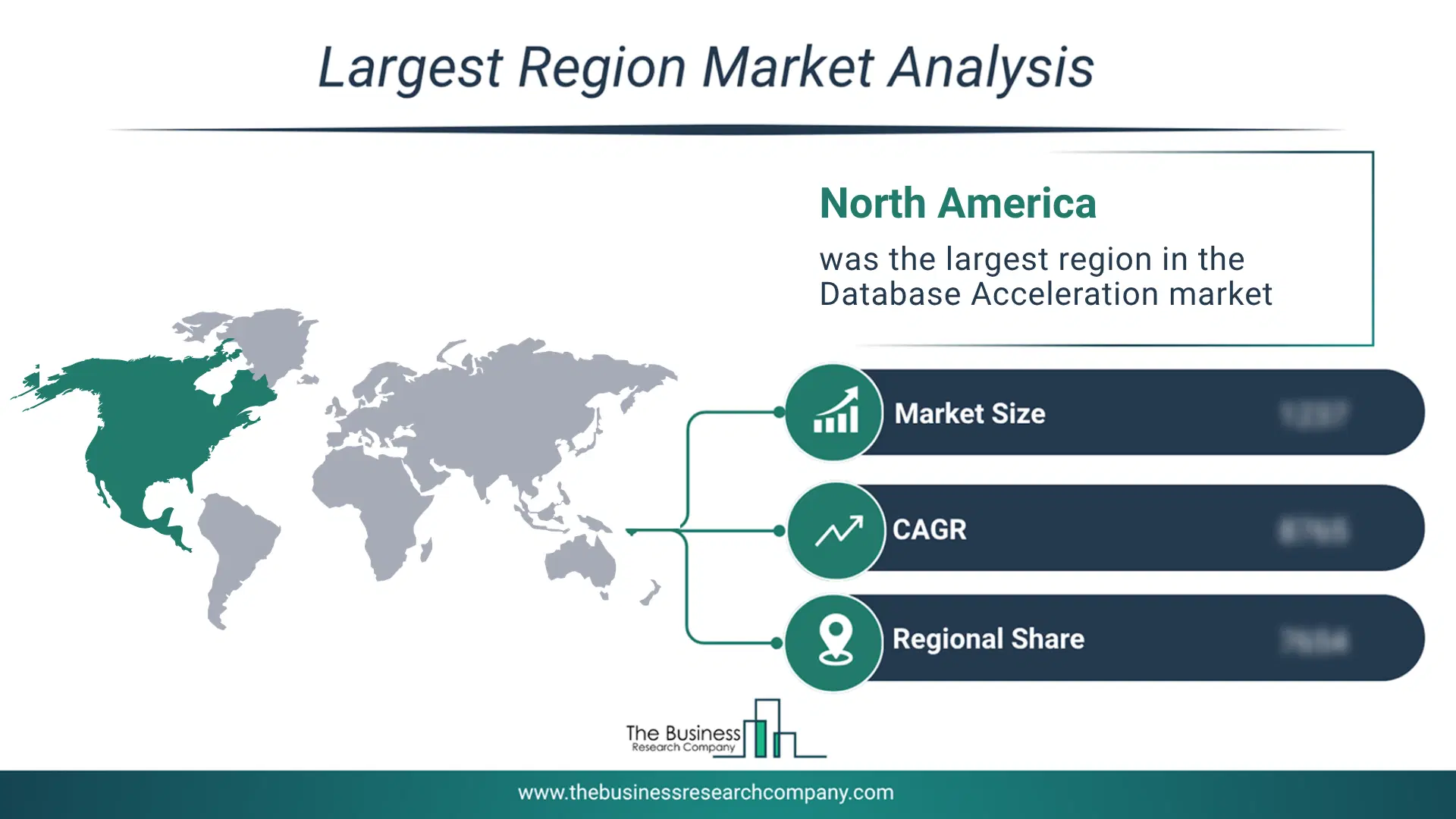
Regional Insights
North America was the largest region in the database acceleration market in 2025. Asia-Pacific is expected to be the fastest-growing region in the forecast period. The regions covered in this market report are Asia-Pacific, South East Asia, Western Europe, Eastern Europe, North America, South America, Middle East, Africa. The countries covered in this market report are Australia, Brazil, China, France, Germany, India, Indonesia, Japan, Taiwan, Russia, South Korea, UK, USA, Canada, Italy, Spain.What Defines the Database Acceleration Market?
The database acceleration market consists of revenues earned by entities by providing services such as database optimization, query acceleration, in-memory platform deployment, data caching, system integration, performance monitoring, and support services. The market value includes the value of related goods sold by the service provider or included within the service offering. The database acceleration market also includes sales of acceleration appliances, software platforms, hardware accelerators, and associated analytics tools. Values in this market are ‘factory gate’ values, that is the value of goods sold by the manufacturers or creators of the goods, whether to other entities (including downstream manufacturers, wholesalers, distributors and retailers) or directly to end customers. The value of goods in this market includes related services sold by the creators of the goods.How is Market Value Defined and Measured?
The market value is defined as the revenues that enterprises gain from the sale of goods and/or services within the specified market and geography through sales, grants, or donations in terms of the currency (in USD unless otherwise specified). The revenues for a specified geography are consumption values that are revenues generated by organizations in the specified geography within the market, irrespective of where they are produced. It does not include revenues from resales along the supply chain, either further along the supply chain or as part of other products.
This chart presents market attractiveness based on a quantitative evaluation of growth, competition, strategic alignment, and risk, offering a clear view of opportunity areas for decision-making. This chart is for illustrative purposes; the full report contains the complete analysis.

This chart highlights the Total Addressable Market (TAM) by estimating the maximum revenue opportunity using an assumption-driven approach, supporting strategic planning and opportunity sizing across markets. The chart is illustrative; the full report provides a more comprehensive analysis.
What Key Data and Analysis Are Included in the Database Acceleration Market Report 2026?
The database acceleration market research report is one of a series of new reports from The Business Research Company that provides market statistics, including industry global market size, regional shares, competitors with the market share, detailed market segments, market trends and opportunities, and any further data you may need to thrive in the database acceleration industry. The market research report delivers a complete perspective of everything you need, with an in-depth analysis of the current and future state of the industry.Database Acceleration Market Report Forecast Analysis
| Report Attribute | Details |
|---|---|
| Market Size Value In 2026 | $13.12 billion |
| Revenue Forecast In 2030 | $17.89 billion |
| Growth Rate | CAGR of 8.1% from 2026 to 2030 |
| Base Year For Estimation | 2025 |
| Actual Estimates/Historical Data | 2020-2025 |
| Forecast Period | 2026 - 2030 |
| Market Representation | Revenue in USD Billion and CAGR from 2026 to 2030 |
| Segments Covered | Type, Deployment, Application, End User |
| Regional Scope | Asia-Pacific, Western Europe, Eastern Europe, North America, South America, Middle East, Africa |
| Country Scope | The Countries Covered In This Market Report Are Australia, Brazil, China, France, Germany, India, Indonesia, Japan, Taiwan, Russia, South Korea, Uk, Usa, Canada, Italy, Spain. |
| Key Companies Profiled | Microsoft Corporation, Amazon Web Services Inc., International Business Machines Corporation, Oracle Corporation, SAP SE, MongoDB Inc., Teradata Corporation, Cloudera Inc., Couchbase Inc., Kx Systems Inc., SingleStore Inc., Aerospike Inc., Exasol AG, Hazelcast Inc., Altibase Corporation, GridGain Systems Inc., MemVerge Inc., VoltDB Inc., Raima Inc., McObject LLC. |
| Customization Scope | Request for Customization |
| Pricing And Purchase Options | Explore Purchase Options |