
Decaffeinated Roasted Coffee Market Report 2026
Global Outlook – By Form (Whole, Ground), By Distribution Channel (Supermarkets And Hypermarkets, Specialty Stores, Online Retail, Other Distribution Channels ), By End Use (Retail Or Household, Foodservice ) – Market Size, Trends, Strategies, and Forecast to 2030
Decaffeinated Roasted Coffee Market Overview
• Decaffeinated Roasted Coffee market size has reached to $2.85 billion in 2025 • Expected to grow to $3.88 billion in 2030 at a compound annual growth rate (CAGR) of 6.5% • Growth Driver: The Increasing Consumption of Coffee Fueling the Decaffeinated Roasted Coffee Market • Market Trend: Chemical-Free Decaffeination Capacity Expansion Supports Rising Demand for Premium Decaf Coffee • Europe was the largest region in 2025.What Is Covered Under Decaffeinated Roasted Coffee Market?
Decaffeinated roasted coffee refers to ordinary coffee that has most of its caffeine removed. This coffee is used by people who don’t want to consume caffeine but still want to drink coffee. The main forms of decaffeinated roasted coffee are whole, ground, and others. Ground coffee is roasted coffee beans that have been ground down to be brewed for coffee. The various distribution channels involved supermarkets and hypermarkets, specialty stores, online retail, and others, that are used by retail/household and food service.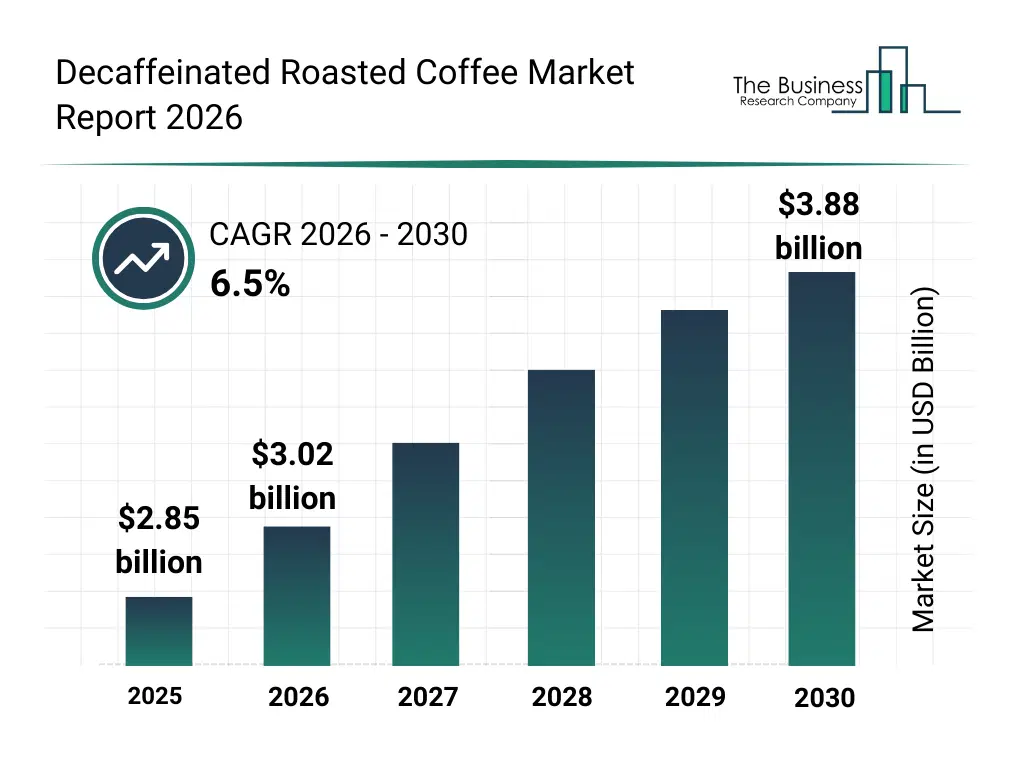
What Is The Decaffeinated Roasted Coffee Market Size and Share 2026?
The decaffeinated roasted coffee market size has grown strongly in recent years. It will grow from $2.85 billion in 2025 to $3.02 billion in 2026 at a compound annual growth rate (CAGR) of 5.8%. The growth in the historic period can be attributed to growing consumer preference for low-caffeine beverages, rising health awareness among coffee drinkers, expansion of retail coffee distribution networks, increasing availability of decaffeinated variants, steady demand from foodservice channels.What Is The Decaffeinated Roasted Coffee Market Growth Forecast?
The decaffeinated roasted coffee market size is expected to see strong growth in the next few years. It will grow to $3.88 billion in 2030 at a compound annual growth rate (CAGR) of 6.5%. The growth in the forecast period can be attributed to increasing demand for clean-label coffee products, rising consumption of specialty coffee, expansion of online coffee sales, growing preference for sustainable coffee sourcing, increasing innovation in decaffeination technologies. Major trends in the forecast period include increasing adoption of chemical-free decaffeination processes, rising demand for premium and specialty decaffeinated coffee, growing focus on flavor retention and aroma quality, expansion of single-serve decaffeinated formats, enhanced emphasis on sustainable coffee sourcing.
Global Decaffeinated Roasted Coffee Market Segmentation
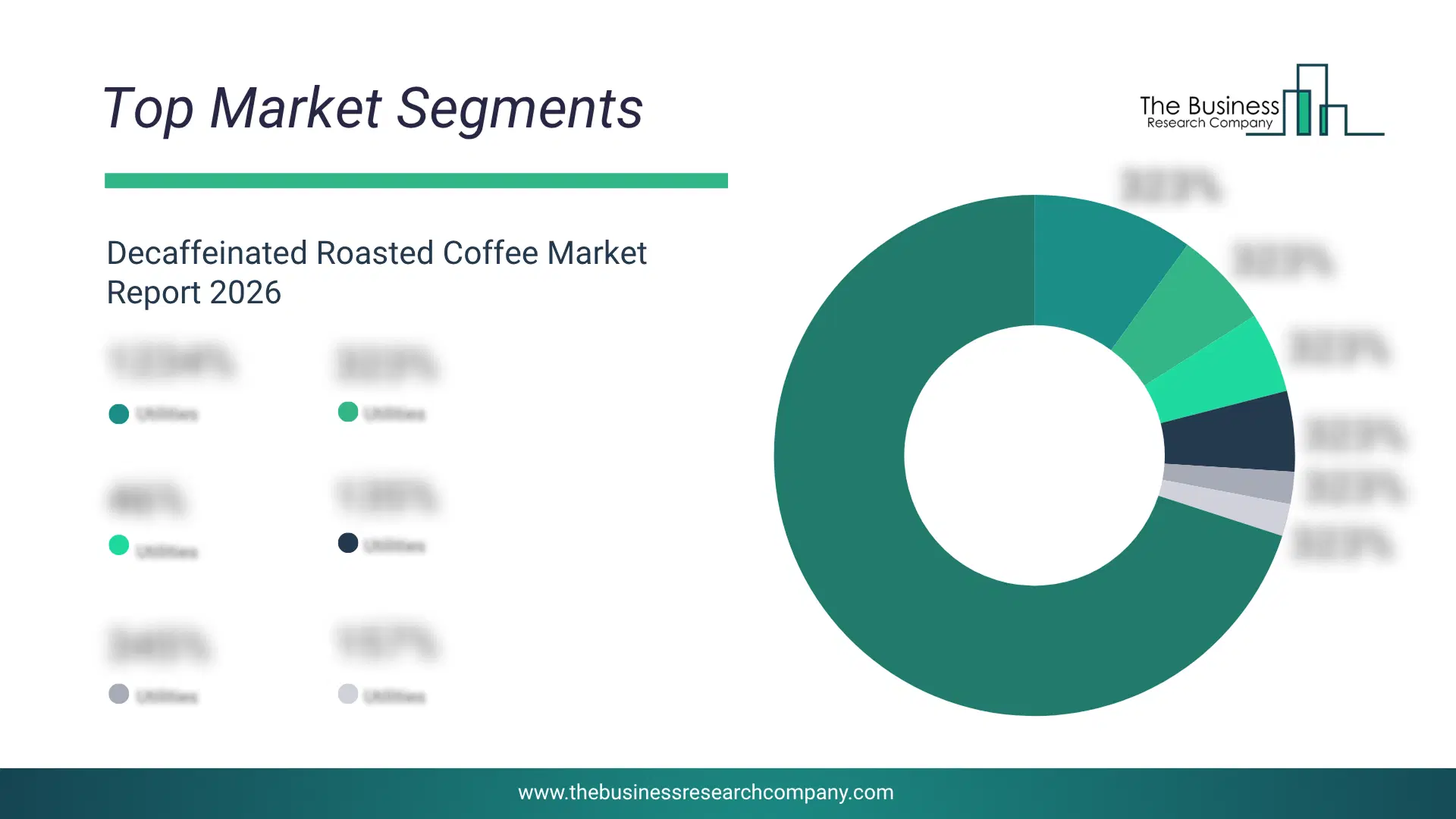
1) By Form: Whole, Ground 2) By Distribution Channel: Supermarkets And Hypermarkets, Specialty Stores, Online Retail, Other Distribution Channels 3) By End Use: Retail Or Household, Foodservice Subsegments: 1) By Whole: Whole Bean Decaffeinated Coffee 2) By Ground: Coarse Ground Decaffeinated Coffee, Medium Ground Decaffeinated Coffee, Fine Ground Decaffeinated CoffeeWhat Is The Driver Of The Decaffeinated Roasted Coffee Market?
The increasing consumption of coffee is expected to propel the growth of the decaffeinated roasted coffee market going forward. Coffee refers to the globally consumed beverage produced from roasted coffee beans, appreciated for its rich flavor and energizing properties due to natural caffeine content. Coffee consumption is rising as consumers adopt diverse coffee-drinking habits, experiment with specialty beverages, and increase at-home coffee preparation. Decaffeinated roasted coffee benefits from this trend by offering full coffee flavor with reduced caffeine, appealing to health-conscious consumers and those sensitive to caffeine. For instance, in March 2024, according to the International Coffee Organization, a UK-based intergovernmental body, world coffee consumption reached 0.1761 billion bags in 2022/23, demonstrating continued global growth in coffee demand. Therefore, the increasing consumption of coffee is driving the growth of the decaffeinated roasted coffee industry.Key Players In The Global Decaffeinated Roasted Coffee Market
Major companies operating in the decaffeinated roasted coffee market are Luigi Lavazza S.p.A, Nestlé S.A, Joe Coffee Company, Peet's Coffee & Tea Inc, Volcanica Coffee Company, Cafe Don Pablo, Tchibo Coffee International Limited, The J.M. Smucker Company, Lifeboost LLC, Kicking Horse Coffee Co Ltd, Koffee Kult Corp, Cafédirect PLC, Eight O'Clock Coffee Company, Fresh Roasted, Colombian Brew Ground Coffee, Caribou Coffee Operating Company Inc., Jacobs Douwe Egberts Pro, Massimo Zanetti Beverage Group, Illycaffè S.p.A, Bewley’s Tea & Coffee, Alois Dallmayr KG, Cameron’s Coffee, Puroast Coffee Company, Allegro Coffee Company, No Fun Jo Decaf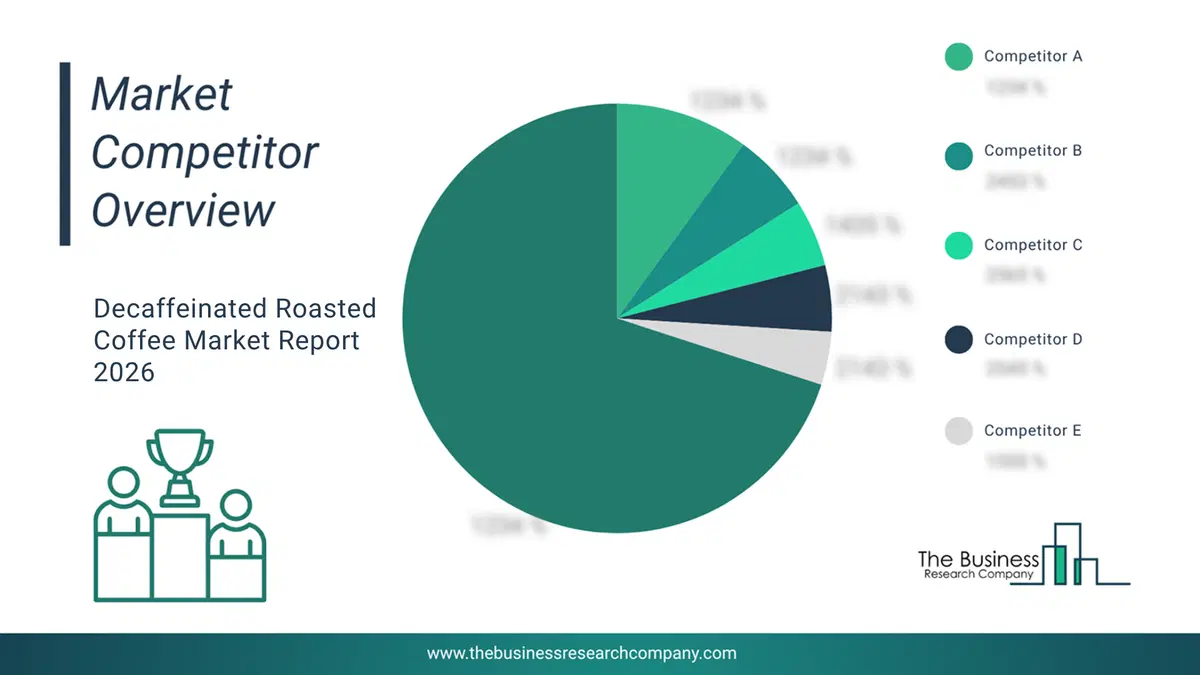
This chart is for illustrative purposes; the full report includes a detailed competitor analysis and comprehensive overview of the top 10 companies in the market.
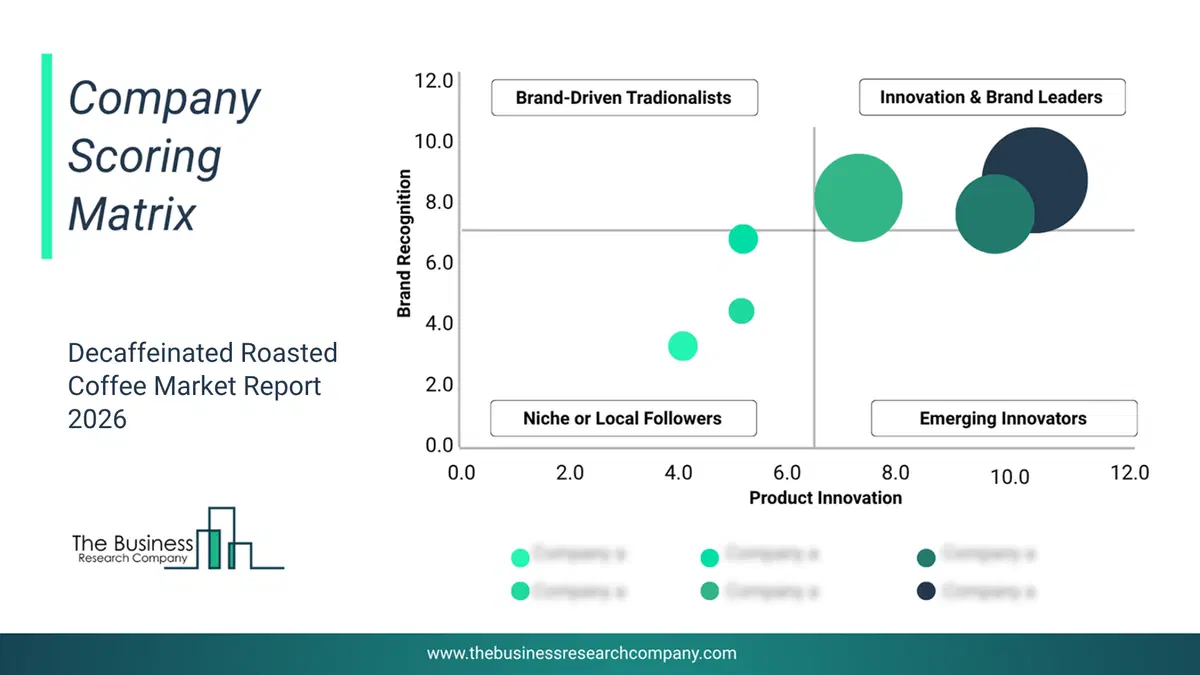
This chart maps companies by product innovation and brand strength, with bubble size indicating relative revenue, helping identify market leaders, challengers, and niche players. This is an illustrative chart; the full report provides a complete and accurate competitive analysis.
Global Decaffeinated Roasted Coffee Market Trends and Insights
Major companies operating in the decaffeinated roasted coffee market are focusing on expanding chemical-free water-based decaffeination capacity, such as new Swiss Water Process production lines, to meet rising demand for high-quality decaf and respond to growing consumer concern about solvent-based methods. Chemical-free water-based decaffeination uses only water, carbon filters, and carefully controlled extraction to remove caffeine from green coffee beans without methylene chloride or other chemical solvents, helping preserve origin flavor while offering a “clean label” decaf that aligns with wellness-focused and all-day coffee consumption trends. For instance, in September 2023, Swiss Water Decaffeinated Coffee Inc., a Canada-based specialty coffee company and premium green-coffee decaffeinator, launched its second decaffeination line at its Delta, British Columbia, facility, completing the consolidation of all production into a single site and significantly increasing unused capacity for its proprietary Swiss Water® Process; this new line enabled a strong recovery in production volumes in late 2023, improved scale efficiencies, and positioned the company to help more roasting customers transition to chemical-free decaffeinated coffee as demand for premium decaf continues to grow.What Are Latest Mergers And Acquisitions In The Decaffeinated Roasted Coffee Market?
In February 2023, Westrock Coffee Company, a US-based manufacturer of coffee, tea, and extracts, acquired Bixby Roasting Co. for an undisclosed amount. This acquisition would expand Westrock’s reach in newer geographies and help it adjust to changing consumer trends. Bixby Roasting Co. is a US-based roasted coffee manufacturer, including decaffeinated roasted coffee.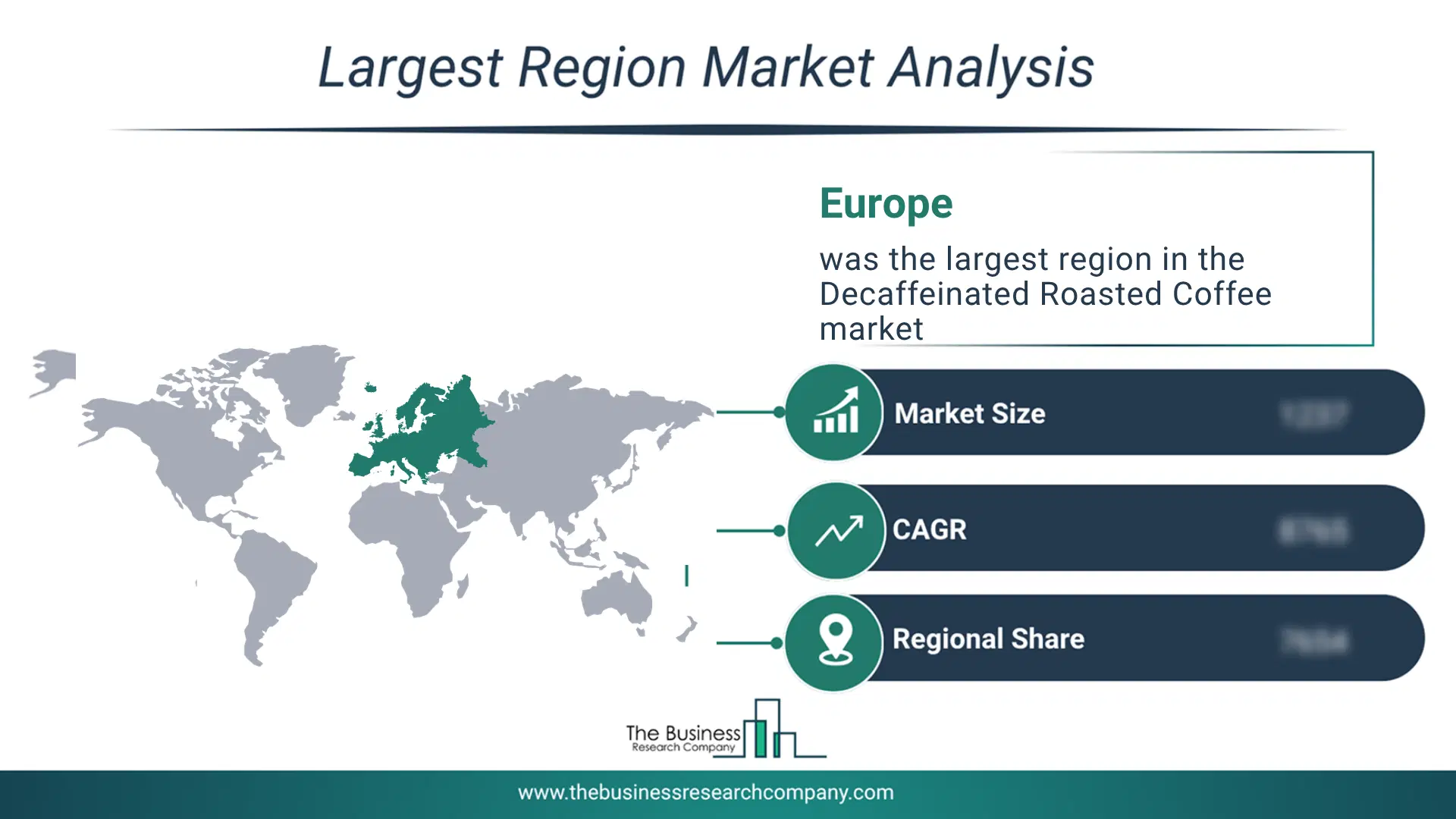
Regional Outlook
Europe was the largest region in the decaffeinated roasted coffee market in 2025. The regions covered in this market report are Asia-Pacific, South East Asia, Western Europe, Eastern Europe, North America, South America, Middle East and Africa. The countries covered in this market report are Australia, Brazil, China, France, Germany, India, Indonesia, Japan, Taiwan, Russia, South Korea, UK, USA, Italy, Spain, CanadaWhat Defines the Decaffeinated Roasted Coffee Market?
The decaffeinated roasted coffee market consists of sales of liberica and excelsa coffee bean species. Values in this market are ‘factory gate’ values, that is the value of goods sold by the manufacturers or creators of the goods, whether to other entities (including downstream manufacturers, wholesalers, distributors, and retailers) or directly to end customers. The value of goods in this market includes related services sold by the creators of the goods.How is Market Value Defined and Measured?
The market value is defined as the revenues that enterprises gain from the sale of goods and/or services within the specified market and geography through sales, grants, or donations in terms of the currency (in USD unless otherwise specified). The revenues for a specified geography are consumption values that are revenues generated by organizations in the specified geography within the market, irrespective of where they are produced. It does not include revenues from resales along the supply chain, either further along the supply chain or as part of other products.
This chart presents market attractiveness based on a quantitative evaluation of growth, competition, strategic alignment, and risk, offering a clear view of opportunity areas for decision-making. This chart is for illustrative purposes; the full report contains the complete analysis.

This chart highlights the Total Addressable Market (TAM) by estimating the maximum revenue opportunity using an assumption-driven approach, supporting strategic planning and opportunity sizing across markets. The chart is illustrative; the full report provides a more comprehensive analysis.
What Key Data and Analysis Are Included in the Decaffeinated Roasted Coffee Market Report 2026?
The decaffeinated roasted coffee market research report is one of a series of new reports from The Business Research Company that provides market statistics, including industry global market size, regional shares, competitors with the market share, detailed market segments, market trends and opportunities, and any further data you may need to thrive in the decaffeinated roasted coffee industry. The market research report delivers a complete perspective of everything you need, with an in-depth analysis of the current and future state of the industry.Decaffeinated Roasted Coffee Market Report Forecast Analysis
| Report Attribute | Details |
|---|---|
| Market Size Value In 2026 | $3.02 billion |
| Revenue Forecast In 2030 | $3.88 billion |
| Growth Rate | CAGR of 5.8% from 2026 to 2030 |
| Base Year For Estimation | 2025 |
| Actual Estimates/Historical Data | 2020-2025 |
| Forecast Period | 2026 - 2030 |
| Market Representation | Revenue in USD Billion and CAGR from 2026 to 2030 |
| Segments Covered | Form, Distribution Channel, End Use |
| Regional Scope | Asia-Pacific, Western Europe, Eastern Europe, North America, South America, Middle East, Africa |
| Country Scope | The countries covered in the report are Australia, Brazil, China, France, Germany, India, Indonesia, Japan, Taiwan, Russia, South Korea, UK, USA, Canada, Italy, Spain. |
| Key Companies Profiled | Luigi Lavazza S.p.A, Nestlé S.A, Joe Coffee Company, Peet's Coffee & Tea Inc, Volcanica Coffee Company, Cafe Don Pablo, Tchibo Coffee International Limited, The J.M. Smucker Company, Lifeboost LLC, Kicking Horse Coffee Co Ltd, Koffee Kult Corp, Cafédirect PLC, Eight O'Clock Coffee Company, Fresh Roasted, Colombian Brew Ground Coffee, Caribou Coffee Operating Company Inc., Jacobs Douwe Egberts Pro, Massimo Zanetti Beverage Group, Illycaffè S.p.A, Bewley’s Tea & Coffee, Alois Dallmayr KG, Cameron’s Coffee, Puroast Coffee Company, Allegro Coffee Company, No Fun Jo Decaf |
| Customization Scope | Request for Customization |
| Pricing And Purchase Options | Explore Purchase Options |