
Contact Us
  Search
The Business Research Company Logo
Decentralized Trial Wearable Global Market Opportunities And Strategies To 2035
Published :June 2026
Pages :408
Format :PDF
Delivery Time :2-3 Business Days
ⓘ
Why 2-3 days? We update the report with the latest data and news before delivery. Let us know if you need us to expedite.
Report Price :$4,490.00

Decentralized Trial Wearable Global Market Opportunities And Strategies To 2035

By Product Type (Smartwatches, Fitness Trackers, Biosensors, Smart Clothing, Other Product Types), By Distribution Channel (Online, Offline), By Application (Remote Patient Monitoring, Clinical Trials, Disease Management, Other Applications), By End-User (Pharmaceutical Companies, Contract Research Organizations, Healthcare Providers, Other End-Users), And By Region, Opportunities And Strategies – Global Forecast To 2035

Decentralized Trial Wearable Market Definition

Decentralized trial wearables refer to wearable devices, sensor-enabled technologies, software platforms, and supporting services used to collect, transmit, manage, and analyze health-related data from clinical trial participants in decentralized or hybrid clinical trials conducted outside traditional centralized research sites. These systems integrate hardware, software and services to enable continuous or periodic remote data capture without requiring frequent on-site visits. They are widely used by pharmaceutical companies, contract research organizations, healthcare providers, and research institutions to enhance patient recruitment, engagement, retention, and data accuracy. Patients and participants use these integrated solutions in real-world settings such as homes and community environments, enabling more naturalistic, longitudinal, and real-time health data collection for clinical research. The market covered in this report consists of revenues generated by entities (organizations, sole traders, and partnerships) by providing wearable devices and associated platforms that enable remote data collection and monitoring in decentralized clinical trials. These solutions support continuous tracking of patient health metrics, improving data accuracy and reducing the need for frequent site visits. They also enhance patient engagement and trial efficiency by enabling real-time data transmission, remote oversight, and seamless integration with digital health ecosystems.
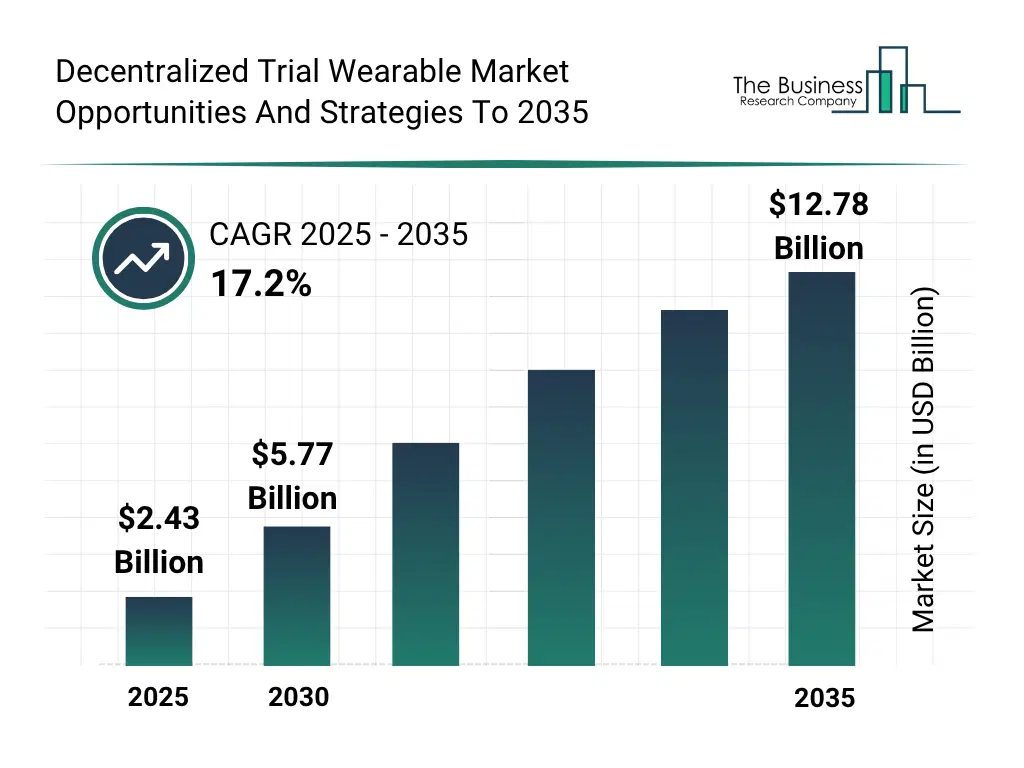
Decentralized Trial Wearable Global Market Opportunities And Strategies To 2035 Market Size and growth rate 2026 to 2030: Graph

Decentralized Trial Wearable Market Size

The global decentralized trial wearable market reached a value of nearly $2,428.6 million in 2025, having grown at a compound annual growth rate (CAGR) of 22.4% since 2020. The market is expected to grow from $2,428.6 million in 2025 to $5,769.8 million in 2030 at a rate of 18.9%. The market is then expected to grow at a CAGR of 17.2% from 2030 and reach $12,782.5 million in 2035. Growth in the historic period resulted from rising global clinical trial volume, demand for personalized and patient-centric healthcare models, growing reliance on remote patient monitoring (RPM) in clinical trials and increased number of decentralized clinical trials (DCTS). Factors that negatively affected growth in the historic period were data privacy and protection risks and high implementation cost. Going forward, growing need for real-world data (RWD) in clinical trials, growing efforts towards reducing clinical trial costs and timelines, growing investment in digital therapeutics and digital health tools and shift toward outcome-based and data-driven clinical trial designs will drive the growth. Factors that could hinder the growth of the decentralized trial wearable market in the future include lack of standardization in trial protocols, stringent data protection regulations and impact of trade wars and tariffs.
Research Expert

Book your 30 minutes free consultation with our research experts

Decentralized Trial Wearable Market Segmentation

The decentralized trial wearable market is segmented by product type, by distribution channel, by application, and by end-user.

By Product –
The decentralized trial wearable market is segmented by product type into:
    • a) Smartwatches
    • b) Fitness Trackers
    • c) Biosensors
    • d) Smart Clothing
    • e) Other Product Types
The smartwatches market was the largest segment of the decentralized trial wearable market segmented by product type, accounting for 38.0% or $922.9 million of the total in 2025. Going forward, the biosensors segment is expected to be the fastest-growing segment in the decentralized trial wearable market segmented by product type, at a CAGR of 21.4% during 2025-2030.

By Distribution Channel –
The decentralized trial wearable market is segmented by distribution channel into:
    • a) Online
    • b) Offline
The online market was the largest segment of the decentralized trial wearable market segmented by distribution channel, accounting for 64.5% or $1,565.7 million of the total in 2025. Going forward, the online segment is expected to be the fastest-growing segment in the decentralized trial wearable market segmented by distribution channel, at a CAGR of 21.0% during 2025-2030.

By Application –
The decentralized trial wearable market is segmented by application into:
    • a) Remote Patient Monitoring
    • b) Clinical Trials
    • c) Disease Management
    • d) Other Applications
The remote patient monitoring market was the largest segment of the decentralized trial wearable market segmented by application, accounting for 38.3% or $930.4 million of the total in 2025. Going forward, the remote patient monitoring segment is expected to be the fastest-growing segment in the decentralized trial wearable market segmented by application, at a CAGR of 21.7% during 2025-2030.

By End-User –
The decentralized trial wearable market is segmented by end-user into:
    • a) Pharmaceutical Companies
    • b) Contract Research Organizations
    • c) Healthcare Providers
    • d) Other End-Users
The pharmaceutical companies market was the largest segment of the decentralized trial wearable market segmented by end-user, accounting for 41.5% or $1,007.2 million of the total in 2025. Going forward, the contract research organizations segment is expected to be the fastest-growing segment in the decentralized trial wearable market segmented by end-user, at a CAGR of 21.6% during 2025-2030.

By Geography - The decentralized trial wearable market is segmented by geography into:
      o Asia Pacific
      • China
      • India
      • Japan
      • Australia
      • Indonesia
      • South Korea
      o North America
      • USA
      • Canada
      o South America
      • Brazil
      o Western Europe
      • France
      • Germany
      • UK
      • Italy
      • Spain
      o Eastern Europe
      • Russia
      o Middle East
      o Africa
North America was the largest region in the decentralized trial wearable market, accounting for 44.2% or $1,073.9 million of the total in 2025. It was followed by Asia Pacific, Western Europe and then the other regions. Going forward, the fastest-growing regions in the decentralized trial wearable market will be Asia Pacific and North America where growth will be at CAGRs of 21.7% and 19.1% respectively. These will be followed by Eastern Europe and Middle East where the markets are expected to grow at CAGRs of 17.4% and 17.3% respectively.

Decentralized Trial Wearable Market Drivers

The key drivers of the decentralized trial wearable market include: Growing Need For Real-World Data (RWD) In Clinical Trials During the forecast period, the growing need for real-world data (RWD) in clinical trials is expected propel growth in the decentralized trial wearable market. As regulatory bodies, including the U.S. Food and Drug Administration (FDA), increasingly emphasize the use of real-world evidence (RWE) to support regulatory decision-making and post-market surveillance, there is a rising demand for continuous, real-time patient data collection beyond traditional clinical settings. Real-world data, which includes information collected from electronic health records, claims databases, registries, and digital health technologies such as wearable devices, is expected to play a critical role in generating clinical evidence on the safety and effectiveness of medical products. The growing need for real-world data (RWD) in clinical trials growth contribution during the forecast period in 2026 is 2.0%.

Decentralized Trial Wearable Market Restraints

The key restraints on the decentralized trial wearable market include: Stringent Data Protection Regulations During the forecast period, stringent data protection regulations are expected to restrict the growth of the decentralized trial wearable market. Increasing regulatory requirements under frameworks such as the General Data Protection Regulation (GDPR) are creating significant compliance challenges for clinical trial sponsors, wearable device manufacturers, and digital health platform providers. The need to ensure strict adherence to data privacy principles, including consent management, data minimization, secure data storage, and cross-border data transfer restrictions, is expected to increase operational complexity and implementation costs. Additionally, the requirement to establish clear data governance structures, define controller–processor responsibilities, and maintain transparency in data usage is expected to delay trial initiation and complicate multi-country study execution. Growth affected by the stringent data protection regulations during the forecast period in 2026 is -2.3%.

Decentralized Trial Wearable Market Competitive Landscape

Major Competitors are:

  • IQVIA Holdings Inc.
  • ICON Public Limited Company
  • LabCorp Drug Development Inc.
  • Signant Health Holding Corp
  • Clario Inc.
  • Other Competitors Include:

  • Medidata Solutions Inc.
  • Syneos Health
  • Empatica S.r.l.
  • Dexcom, Inc.
  • Clinical Ink Inc.
  • Science 37
  • Datacubed Health
  • CardieX
  • AliveCor
  • Koninklijke Philips N.V.
  • Seers Technology
  • Sky Labs Inc.
  • Mibro
  • Ametris (formerly ActiGraph)
  • Medable Inc.
  • Masimo Corporation
  • Garmin Ltd.
  • NeuroSky Taiwan Company Limited
  • Singular Wings Medical Co., Ltd.
  • Medrio
  • ObvioHealth
  • Huma Therapeutics Ltd.
  • Withings France SA
  • Activinsights Ltd
  • BioIntelliSense
  • Zephyr Technology Corporation
  • VivaLNK
  • Xealth
  • THREAD Research Inc
  • Mahalo Health
  • Hexoskin
  • Need data on a specific region in this market?

    Opportunities And Recommendations In The Decentralized Trial Wearable Market

    Opportunities – The top opportunities in the decentralized trial wearable market segmented by product type will arise in the smartwatches segment, which will gain $1,310.2 million of global annual sales by 2030. The top opportunities in the decentralized trial wearable market segmented by distribution channel will arise in the online segment, which will gain $2,498.5 million of global annual sales by 2030. The top opportunities in the decentralized trial wearable market segmented by application will arise in the remote patient monitoring segment, which will gain $1,550.2 million of global annual sales by 2030. The top opportunities in the decentralized trial wearable market segmented by end-user will arise in the pharmaceutical companies segment, which will gain $1,428.6 million of global annual sales by 2030. The decentralized trial wearable market size will gain the most in the USA at $1,350.7 million. Recommendations- To take advantage of the opportunities, The Business Research Company recommends the decentralized trial wearable companies to focus on regulatory-approved digital biomarker platforms and integrated remote monitoring solutions, focus on multi-sensor monitoring platforms and digital endpoint capabilities, focus on biosensors for clinical-grade decentralized trials, expand in emerging markets, continue to focus on developed markets, focus on expanding distribution through healthcare and digital partnerships, focus on integrated wearable ecosystems and strategic technology partnerships, focus on value-based tiered pricing models, focus on clinical trust and participant engagement, focus on targeted digital promotion and industry partnerships, focus on contract research organizations to accelerate market expansion, focus on remote patient monitoring to strengthen long-term growth, focus on online distribution channels to expand patient reach.
    Chat with us