
Deep Space Optical Communication Market Report 2026
Global Outlook – By Component (Transceivers, Modulators, Detectors, Amplifiers, Other Components ), By Communication Range (Near Deep Space, Mid Deep Space, Far Deep Space, Interplanetary Communication ), By Platform (Spacecraft, Satellites, Space Probes, Rovers, Orbiters, Landers ), By Deployment (Space-Based Systems, Ground-Based Systems, Hybrid Systems ), By End User (Government Space Agencies, Commercial Space Companies, Defense Organizations, Research Institutions, Academic Organizations ) – Market Size, Trends, Strategies, and Forecast to 2030
Deep Space Optical Communication Market Overview
• Deep Space Optical Communication market size has reached to $1.16 billion in 2025 • Expected to grow to $3.09 billion in 2030 at a compound annual growth rate (CAGR) of 21.6% • Growth Driver: The Government Investments In Space Programs Driving The Growth Of The Market Due To The Need To Advance National Security And Defense Capabilities • Market Trend: Advancements In Deep Space Optical Communication Strengthen High-Speed Interplanetary Data Transmission • North America was the largest region in 2025 and Asia-Pacific is the fastest growing region.What Is Covered Under Deep Space Optical Communication Market?
Deep space optical communication refers to a communication technology that uses laser-based optical signals to transmit data between spacecraft and Earth over extremely long distances in deep space. It enables significantly higher data rates, improved bandwidth efficiency, and faster transmission of scientific data compared with traditional radio frequency communication systems. The technology relies on advanced optical terminals, precision pointing systems, and ground-based laser receivers to support future lunar, planetary, and interplanetary missions. The main components of deep space optical communication include transceivers, modulators, detectors, amplifiers, and other components. Transceivers refer to optical communication devices that transmit and receive laser-based signals to enable high-speed data exchange between deep-space spacecraft and ground stations. These systems support near deep space, mid deep space, far deep space, and interplanetary communication and are deployed across spacecraft, satellites, space probes, rovers, orbiters, and landers. They are implemented through space-based systems, ground-based systems, and hybrid systems, serving end users including government space agencies, commercial space companies, defense organizations, research institutions, and academic organizations.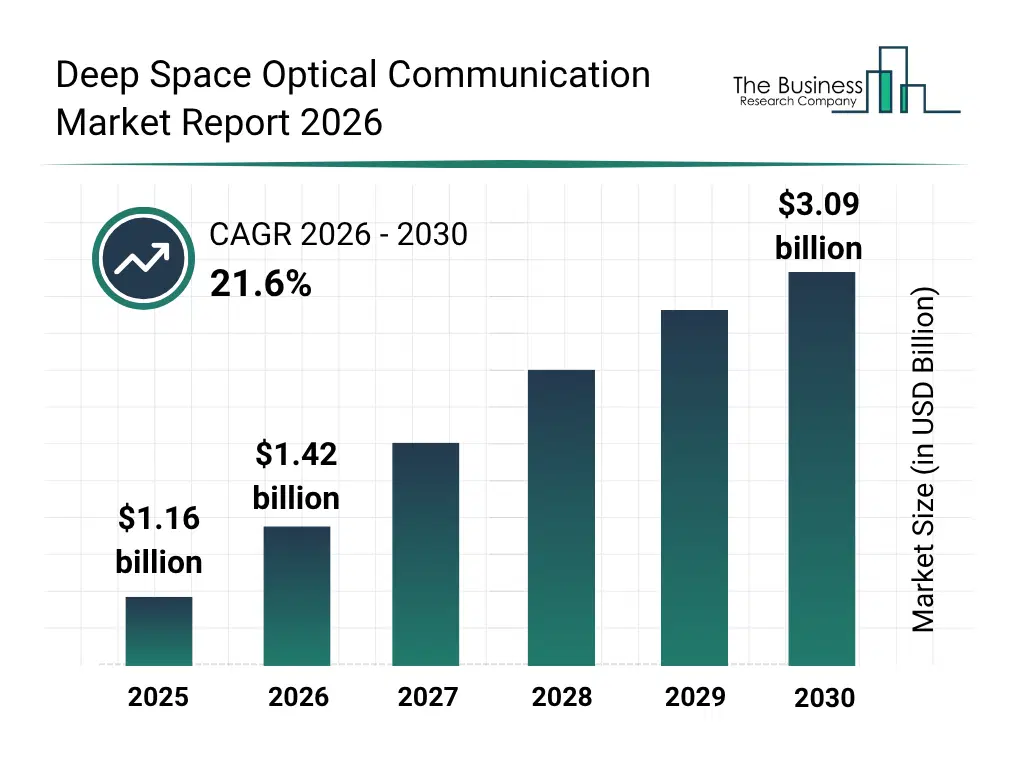
What Is The Deep Space Optical Communication Market Size and Share 2026?
The deep space optical communication market size has grown exponentially in recent years. It will grow from $1.16 billion in 2025 to $1.42 billion in 2026 at a compound annual growth rate (CAGR) of 22.0%. The growth in the historic period can be attributed to increasing deep space exploration activities, rising demand for higher spacecraft data transmission capacity, growing volume of scientific data from space missions, increasing limitations of traditional RF communication, rising need for efficient deep space bandwidth utilization.What Is The Deep Space Optical Communication Market Growth Forecast?
The deep space optical communication market size is expected to see exponential growth in the next few years. It will grow to $3.09 billion in 2030 at a compound annual growth rate (CAGR) of 21.6%. The growth in the forecast period can be attributed to increasing demand for ultra-high-speed space communications, rising deployment of lunar and planetary missions, growing need for high-resolution scientific data transmission, increasing adoption of optical communication terminals, expanding requirements for interplanetary data connectivity. Major trends in the forecast period include increasing demand for high-bandwidth deep space communication, rising adoption of laser-based spacecraft communication, growing need for faster scientific data transmission, increasing demand for precision optical pointing systems, expanding deployment of high-speed optical ground stations.
Global Deep Space Optical Communication Market Segmentation
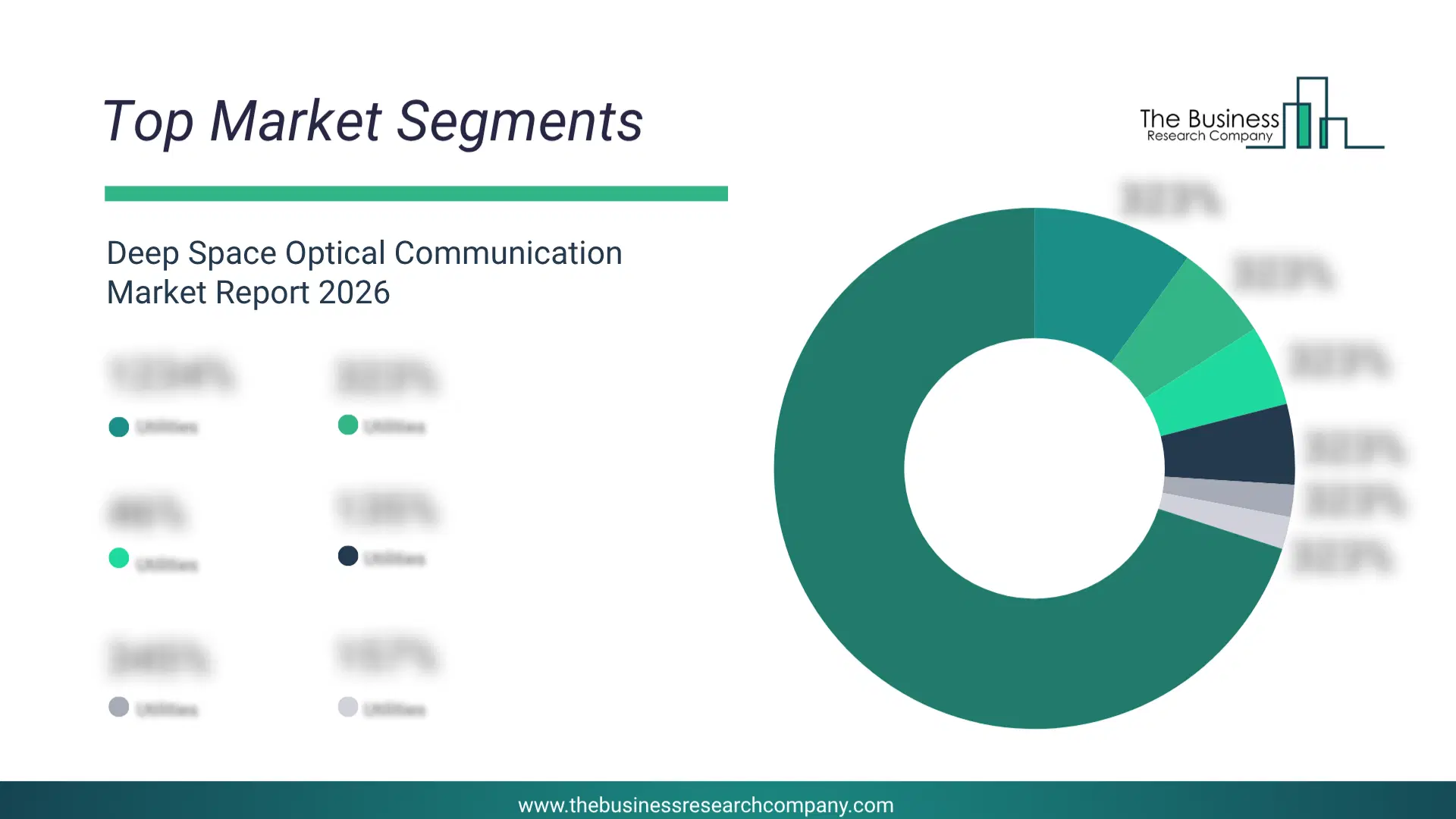
1) By Component: Transceivers, Modulators, Detectors, Amplifiers, Other Components 2) By Communication Range: Near Deep Space, Mid Deep Space, Far Deep Space, Interplanetary Communication 3) By Platform: Spacecraft, Satellites, Space Probes, Rovers, Orbiters, Landers 4) By Deployment: Space-Based Systems, Ground-Based Systems, Hybrid Systems 5) By End User: Government Space Agencies, Commercial Space Companies, Defense Organizations, Research Institutions, Academic Organizations Subsegments: 1) By Transceivers: Laser Communication Transceivers, Integrated Optical Transceivers, Spaceborne Optical Transceivers, Ground Station Optical Transceivers 2) By Modulators: Electro Optical Modulators, Acousto Optical Modulators, Phase Modulators, Intensity Modulators 3) By Detectors: Avalanche Photodiode Detectors, Single Photon Detectors, Charge Coupled Device Detectors, Complementary Metal Oxide Semiconductor Detectors 4) By Amplifiers: Fiber Optical Amplifiers, Semiconductor Optical Amplifiers, Raman Optical Amplifiers, Solid State Optical Amplifiers 5) By Other Components: Optical Antennas, Beam Steering Assemblies, Optical Filters, Wavelength MultiplexersWhat Is The Driver Of The Deep Space Optical Communication Market?
The government investments in space programs are expected to propel the growth of the deep space optical communication market going forward. Investments in space programs refer to the allocation of financial resources by governments, private companies, or international organizations to support the research, development, launch, operation, and advancement of space exploration, satellite systems, space infrastructure, and related technologies. Government investments in space programs are due to the need to advance national security and defense capabilities by strengthening satellite communications, intelligence gathering, missile warning, surveillance, navigation, and secure military operations in space. Investments in space programs accelerate the development and deployment of deep space missions, advanced satellites, and supporting ground infrastructure, driving the demand for high-speed, reliable deep space optical communication systems. For instance, in July 2024, according to The Space Foundation, a US-based nonprofit group, international government spending on space programs increased by 11% year-over-year, reaching $125 billion in 2024. Therefore, government investments in space programs are driving the growth of the deep space optical communication industry.Key Players In The Global Deep Space Optical Communication Market
Major companies operating in the deep space optical communication market are NASA Jet Propulsion Laboratory, Airbus Defence and Space SAS, Lockheed Martin Corporation, Northrop Grumman Corporation, Thales Alenia Space SAS, Space Exploration Technologies Corp., Tesat-Spacecom GmbH & Co. KG, L3Harris Technologies Inc., Honeywell International Inc., CACI International Inc., BAE Systems plc, BridgeComm Inc., Blue Origin LLC, General Atomics Electromagnetic Systems Inc., Rocket Lab Corporation, Sierra Space Corporation, Cailabs SAS, Gooch & Housego PLC, GomSpace Group AB, Astro Digital Inc., Xenesis Inc., Voyager Technologies Inc., Astrolight UAB, Transcelestial Technologies Pte. Ltd.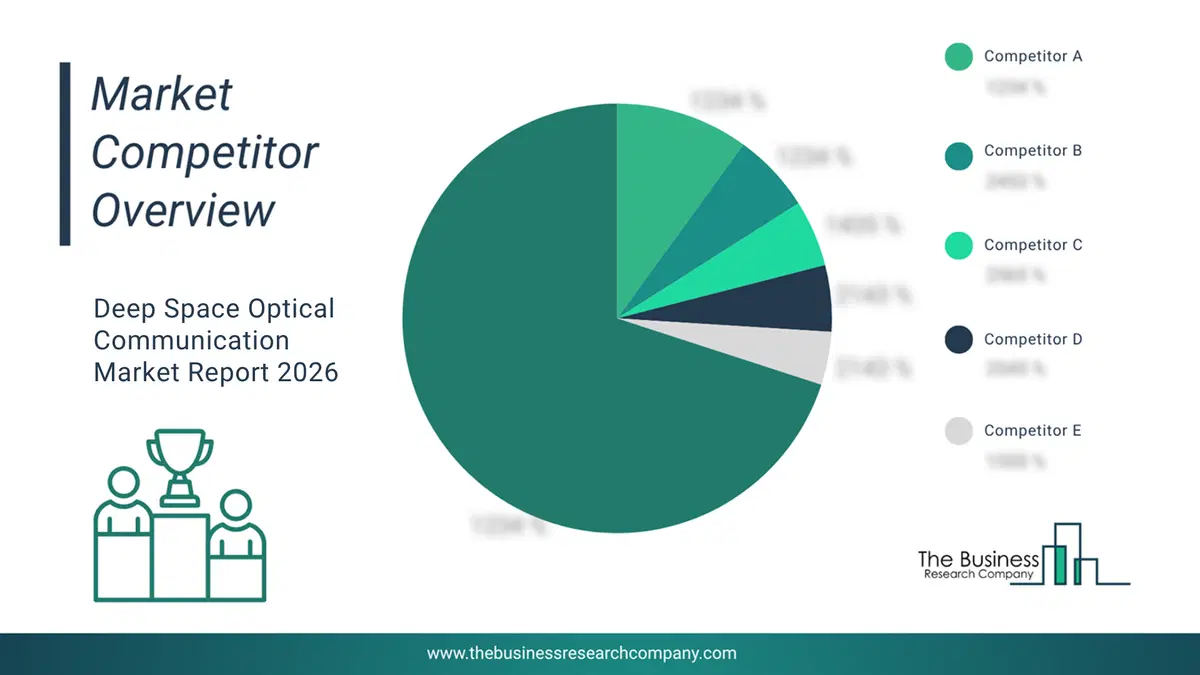
This chart is for illustrative purposes; the full report includes a detailed competitor analysis and comprehensive overview of the top 10 companies in the market.
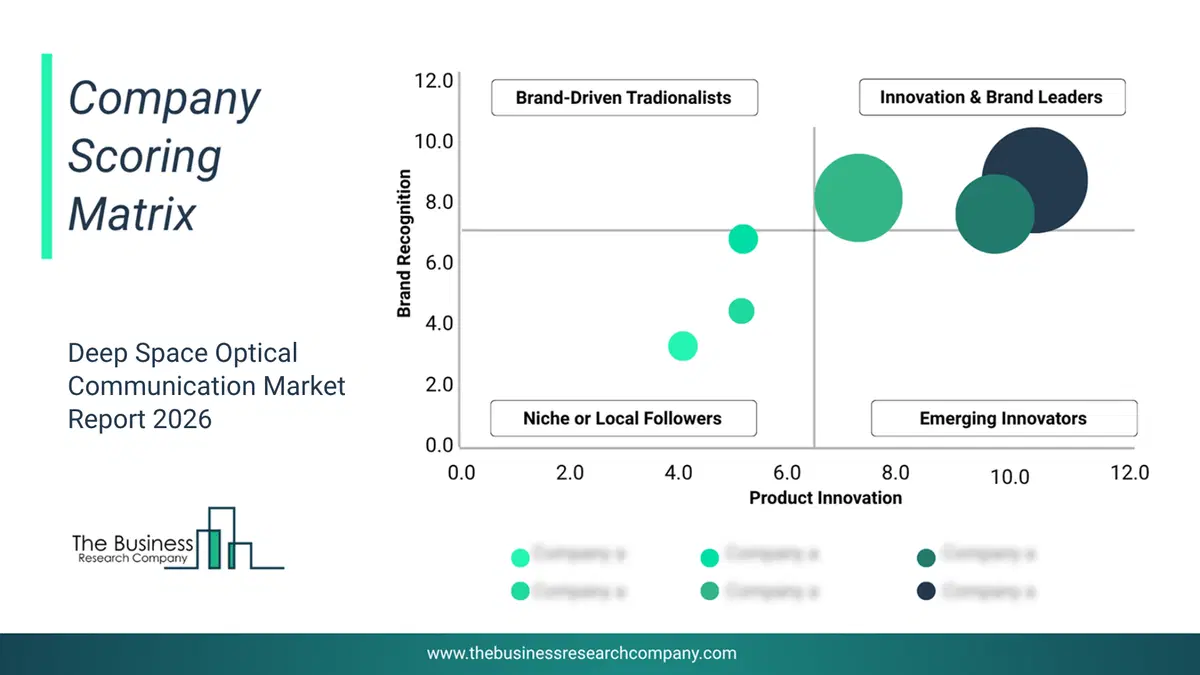
This chart maps companies by product innovation and brand strength, with bubble size indicating relative revenue, helping identify market leaders, challengers, and niche players. This is an illustrative chart; the full report provides a complete and accurate competitive analysis.
Global Deep Space Optical Communication Market Trends and Insights
Major companies operating in the deep space optical communication market are focusing on advancing laser-based communication technologies to enable higher data transmission rates, improve interoperability between international space networks, and support future deep-space exploration missions. Laser-based communication technologies refer to communication systems that use highly focused laser beams to transmit data over long distances, enabling higher bandwidth, faster data transfer, and more secure communications than radio frequency systems. For instance, in July 2025, the European Space Agency (ESA), a France-based intergovernmental organization, successfully established Europe's first deep-space optical communication link with NASA's Deep Space Optical Communications (DSOC) experiment aboard the Psyche mission located approximately 265 million kilometers from Earth. The milestone demonstrated a two-way laser communication link using dedicated optical ground stations in Greece, validating high-speed, long-distance optical communications and laying the foundation for future solar system Internet infrastructure and next-generation deep-space missions.What Are Latest Mergers And Acquisitions In The Deep Space Optical Communication Market?
In January 2026, IonQ Inc., a US-based quantum computing and networking company, completed the acquisition of Skyloom Global Corp. for an undisclosed amount. Through this acquisition, IonQ aims to strengthen its free-space optical communication and quantum networking capabilities by integrating Skyloom’s expertise in optical communication terminals, photonic systems engineering, and secure high-speed space communications. Skyloom Global Corp. is a US-based company that develops free-space optical communication technologies and optical communication terminals for satellite-to-satellite and satellite-to-ground communications.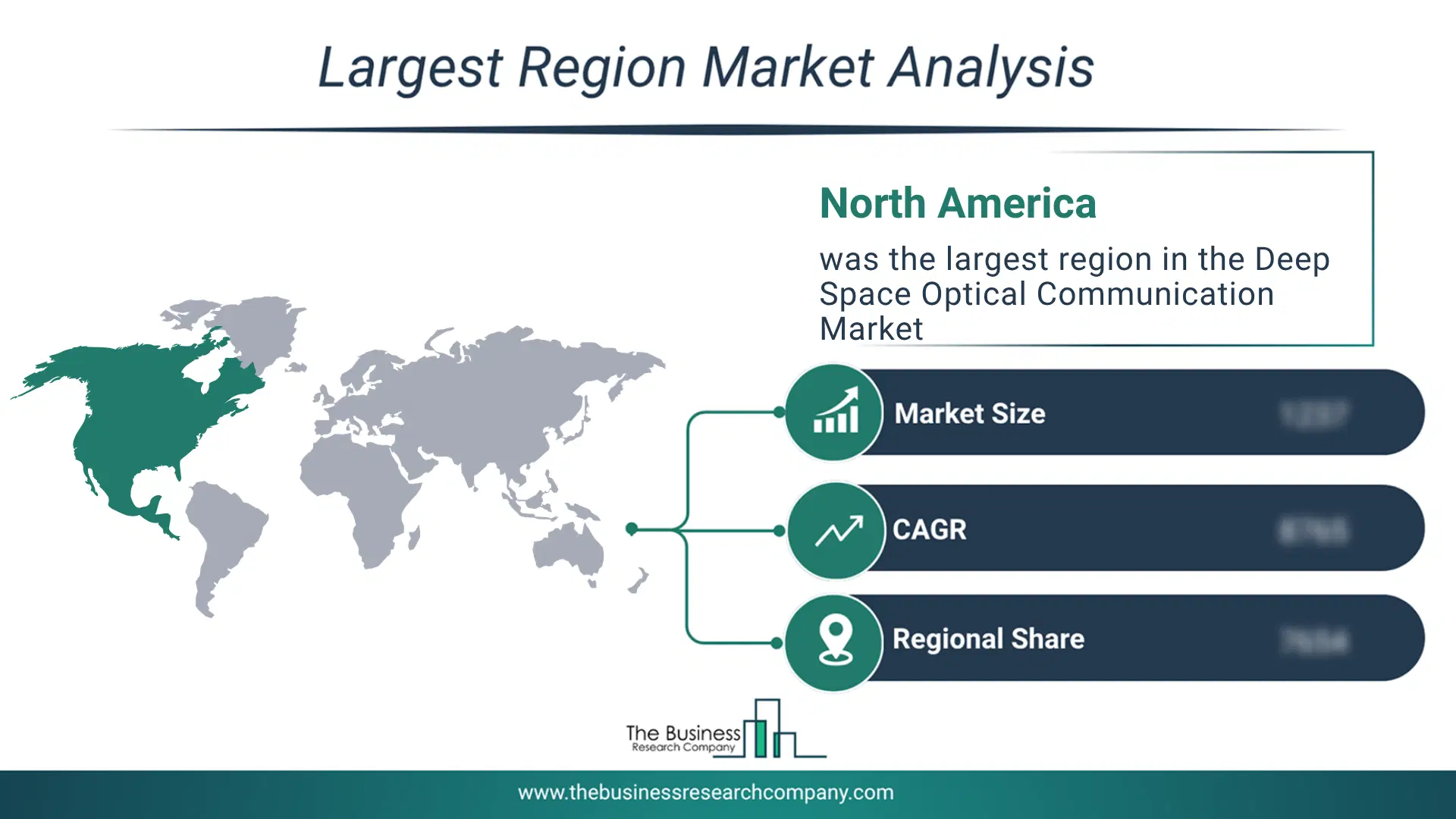
Regional Insights
North America was the largest region in the deep space optical communication market in 2025. Asia-Pacific is expected to be the fastest-growing region in the forecast period. The regions covered in this market report are Asia-Pacific, South East Asia, Western Europe, Eastern Europe, North America, South America, Middle East, Africa. The countries covered in this market report are Australia, Brazil, China, France, Germany, India, Indonesia, Japan, Taiwan, Russia, South Korea, UK, USA, Canada, Italy, Spain.What Defines the Deep Space Optical Communication Market?
The deep space optical communication market consists of revenues earned by entities by providing services such as deep space optical data transmission, optical ground station support, spacecraft optical communication terminal, and laser communication system development and integration. The market value includes the value of related goods sold by the service provider or included within the service offering. The deep space optical communication market also includes sales of laser communication terminals, optical ground station equipment, and precision pointing and tracking systems. Values in this market are ‘factory gate’ values, that is the value of goods sold by the manufacturers or creators of the goods, whether to other entities (including downstream manufacturers, wholesalers, distributors and retailers) or directly to end customers. The value of goods in this market includes related services sold by the creators of the goods.How is Market Value Defined and Measured?
The market value is defined as the revenues that enterprises gain from the sale of goods and/or services within the specified market and geography through sales, grants, or donations in terms of the currency (in USD unless otherwise specified). The revenues for a specified geography are consumption values that are revenues generated by organizations in the specified geography within the market, irrespective of where they are produced. It does not include revenues from resales along the supply chain, either further along the supply chain or as part of other products.
This chart presents market attractiveness based on a quantitative evaluation of growth, competition, strategic alignment, and risk, offering a clear view of opportunity areas for decision-making. This chart is for illustrative purposes; the full report contains the complete analysis.

This chart highlights the Total Addressable Market (TAM) by estimating the maximum revenue opportunity using an assumption-driven approach, supporting strategic planning and opportunity sizing across markets. The chart is illustrative; the full report provides a more comprehensive analysis.
What Key Data and Analysis Are Included in the Deep Space Optical Communication Market Report 2026?
The deep space optical communication market research report is one of a series of new reports from The Business Research Company that provides market statistics, including industry global market size, regional shares, competitors with the market share, detailed market segments, market trends and opportunities, and any further data you may need to thrive in the deep space optical communication industry. The market research report delivers a complete perspective of everything you need, with an in-depth analysis of the current and future state of the industry.Deep Space Optical Communication Market Report Forecast Analysis
| Report Attribute | Details |
|---|---|
| Market Size Value In 2026 | $1.42 billion |
| Revenue Forecast In 2030 | $3.09 billion |
| Growth Rate | CAGR of 21.6% from 2026 to 2030 |
| Base Year For Estimation | 2025 |
| Actual Estimates/Historical Data | 2020-2025 |
| Forecast Period | 2026 - 2030 |
| Market Representation | Revenue in USD Billion and CAGR from 2026 to 2030 |
| Segments Covered | Component, Communication Range, Platform, Deployment, End User |
| Regional Scope | Asia-Pacific, Western Europe, Eastern Europe, North America, South America, Middle East, Africa |
| Country Scope | The countries covered in the report are Australia, Brazil, China, France, Germany, India, Indonesia, Japan, Taiwan, Russia, South Korea, UK, USA, Canada, Italy, Spain. |
| Key Companies Profiled | NASA Jet Propulsion Laboratory, Airbus Defence and Space SAS, Lockheed Martin Corporation, Northrop Grumman Corporation, Thales Alenia Space SAS, Space Exploration Technologies Corp., Tesat-Spacecom GmbH & Co. KG, L3Harris Technologies Inc., Honeywell International Inc., CACI International Inc., BAE Systems plc, BridgeComm Inc., Blue Origin LLC, General Atomics Electromagnetic Systems Inc., Rocket Lab Corporation, Sierra Space Corporation, Cailabs SAS, Gooch & Housego PLC, GomSpace Group AB, Astro Digital Inc., Xenesis Inc., Voyager Technologies Inc., Astrolight UAB, Transcelestial Technologies Pte. Ltd. |
| Customization Scope | Request for Customization |
| Pricing And Purchase Options | Explore Purchase Options |