
Deep Space Optical Data Terminal Market Report 2026
Global Outlook – By Component (Transmitter, Receiver, Modulator, Demodulator, Other Components), By Platform (Spacecraft, Ground Stations, Satellites, Probes, Other Platforms), By Application (Satellite Communication, Deep Space Exploration, Interplanetary Missions, Scientific Research, Military And Defense, Other Applications), By End-User (Government Agencies, Space Agencies, Commercial Space Companies, Research Institutes, Other End-Users) – Market Size, Trends, Strategies, and Forecast to 2030
Deep Space Optical Data Terminal Market Overview
• Deep Space Optical Data Terminal market size has reached to $0.55 billion in 2025 • Expected to grow to $1.02 billion in 2030 at a compound annual growth rate (CAGR) of 13.1% • Growth Driver: The Increase In The Number Of Satellite Launches Is Fueling The Growth Of The Market Due To The Rising Demand For Advanced Communication Systems • Market Trend: Advancing High-Speed Optical Communication For Deep-Space Missions • North America was the largest region in 2025 and Asia-Pacific is the fastest growing region.What Is Covered Under Deep Space Optical Data Terminal Market?
A deep space optical data terminal is a communication system that transmits and receives data using laser-based optical signals across vast distances in space. It enables high-speed, high-capacity data transfer with minimal signal loss. The terminal improves communication efficiency and reliability for long-range space missions. Its core advantage lies in delivering faster and more secure data transmission compared to traditional radio frequency systems. The main components of a deep space optical data terminal are transmitter, receiver, modulator, demodulator, and others. A transmitter is a device that converts data into optical signals for long-distance space communication. The platforms include spacecraft, ground stations, satellites, probes, and others for various applications, including satellite communication, deep space exploration, interplanetary missions, scientific research, military and defense, and others, and are used by several end-users, such as government agencies, space agencies, commercial space companies, research institutes, and others.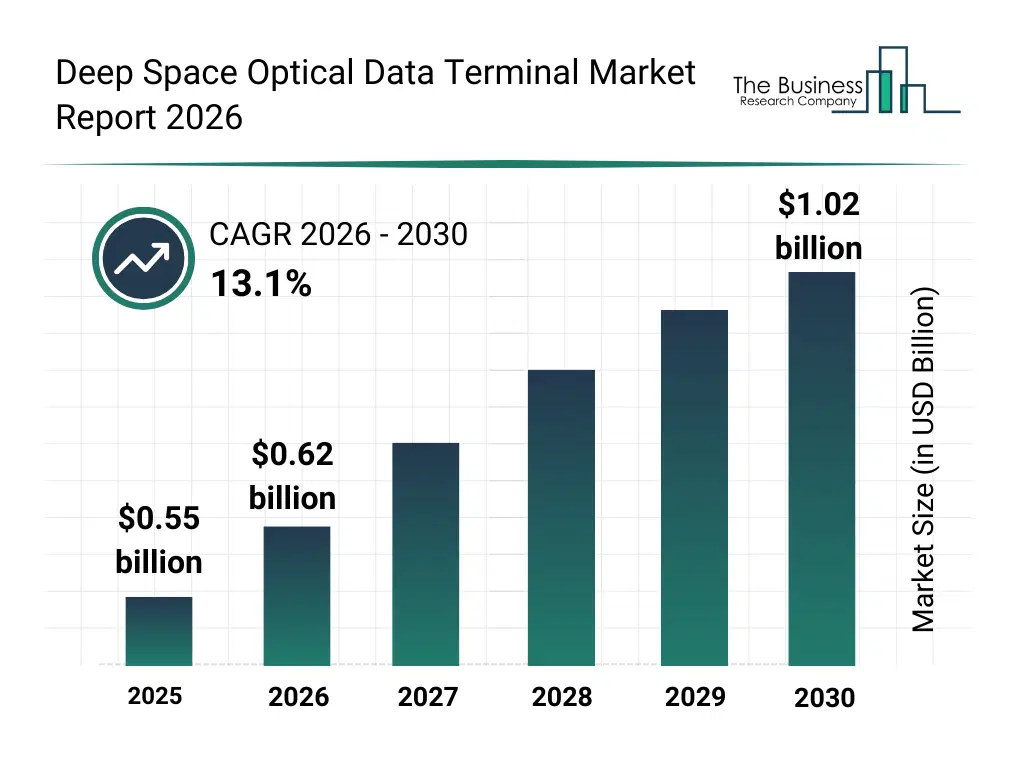
What Is The Deep Space Optical Data Terminal Market Size and Share 2026?
The deep space optical data terminal market size has grown rapidly in recent years. It will grow from $0.55 billion in 2025 to $0.62 billion in 2026 at a compound annual growth rate (CAGR) of 13.4%. The growth in the historic period can be attributed to development of laser-based space communication, adoption in interplanetary missions, advancements in optical detectors, growth in satellite communication infrastructure, early integration with ground station terminals.What Is The Deep Space Optical Data Terminal Market Growth Forecast?
The deep space optical data terminal market size is expected to see rapid growth in the next few years. It will grow to $1.02 billion in 2030 at a compound annual growth rate (CAGR) of 13.1%. The growth in the forecast period can be attributed to expansion in high-capacity space missions, development of adaptive optics for deep space, integration with ai-based signal optimization, growth in space exploration initiatives, commercialization of optical communication networks. Major trends in the forecast period include increasing adoption of optical communication over rf systems for deep space missions, advancements in adaptive optics for atmospheric distortion mitigation, growth in high-power laser transmitters for long-distance data transmission, development of compact optical terminals for small spacecraft and probes, rising need for secure, high-throughput data links for scientific and interplanetary missions.
Global Deep Space Optical Data Terminal Market Segmentation
1) By Component: Transmitter, Receiver, Modulator, Demodulator, Other Components 2) By Platform: Spacecraft, Ground Stations, Satellites, Probes, Other Platforms 3) By Application: Satellite Communication, Deep Space Exploration, Interplanetary Missions, Scientific Research, Military And Defense, Other Applications 4) By End-User: Government Agencies, Space Agencies, Commercial Space Companies, Research Institutes, Other End-Users Subsegments: 1) By Transmitter: Laser Diode, Fiber Lasers, Solid-State Lasers 2) By Receiver: Photodetectors, Avalanche Photodiodes (APDs), Single-Photon Detectors 3) By Modulator: Electro-Optic Modulators, Acousto-Optic Modulators, Lithium Niobate Modulators 4) By Demodulator: Coherent Demodulators, Direct Detection Demodulators 5) By Other Components: Optical Amplifiers, Beam Steering Units, Control Electronics, Cooling SystemsWhat Is Driver Of The Deep Space Optical Data Terminal Market?
The increasing need for high-speed data transmission is expected to propel the growth of the deep space optical data terminal market going forward. High-speed data transmission refers to the rapid transfer of large volumes of digital information through advanced communication systems that can process and deliver data at unprecedented rates. The growing demand for high-speed data transmission is primarily driven by the exponential increase in space-based missions and scientific instruments that generate massive amounts of data requiring efficient transmission back to Earth. The rising need for high-speed data transmission drives the adoption of advanced optical communication terminals that enable spacecraft to transmit scientific data and high-definition imagery at much faster rates than traditional radio frequency systems. For instance, in May 2023, according to the National Aeronautics and Space Administration, a US-based government space agency, NASA's Terabyte Infrared Delivery (TBIRD) system achieved 200 gigabits per second data transmission from space to ground, doubling its previous record of 100 gigabits per second from June 2022. Therefore, the increasing need for high-speed data transmission is driving the growth of the deep space optical data terminal industry.Key Players In The Global Deep Space Optical Data Terminal Market
Major companies operating in the deep space optical data terminal market are Safran S.A., Thales Group, CACI International Inc., Mynaric AG, Viasat Inc., General Atomics Technologies Corporation, Hensoldt AG, Eutelsat Communications S.A., Hughes Network Systems LLC, TNO, NKT Photonics A/S, Honeywell Aerospace, TrellisWare Technologies Inc., Cailabs SAS, Transcelestial Technologies Pte Ltd, Bridgecomm Inc., Antrix Corporation Limited, MBryonics Inc., Odysseus Space Inc., Avantier Inc., FSO Instruments Inc.
This chart is for illustrative purposes; the full report includes a detailed competitor analysis and comprehensive overview of the top 10 companies in the market.
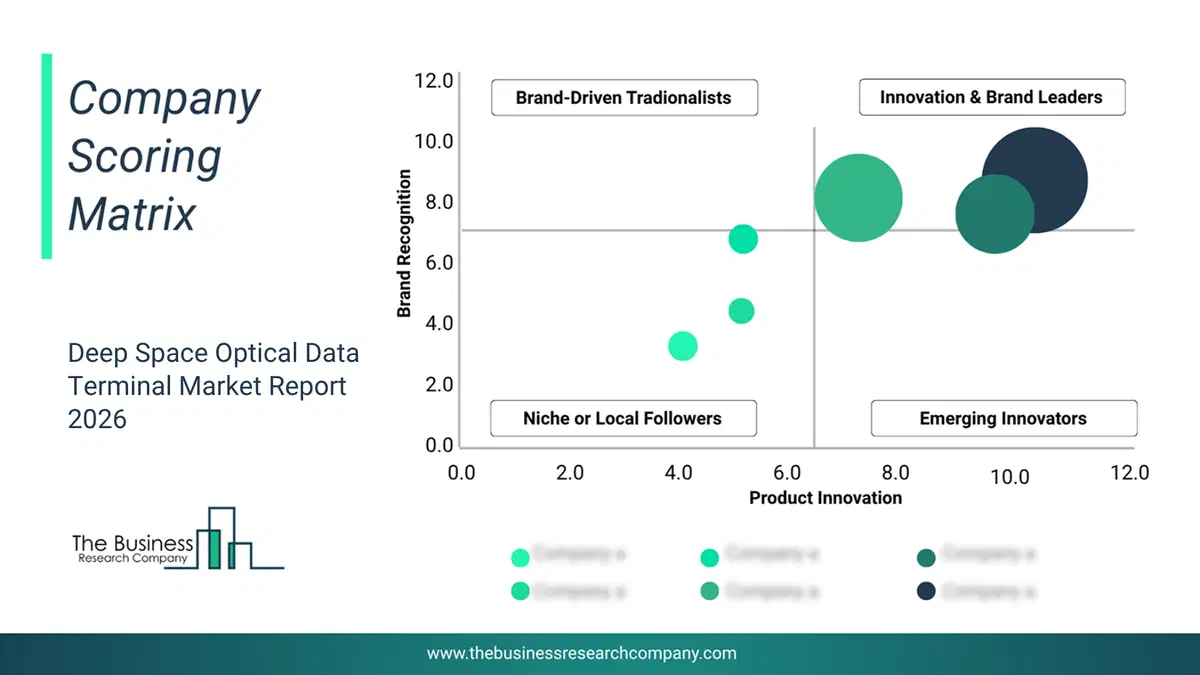
This chart maps companies by product innovation and brand strength, with bubble size indicating relative revenue, helping identify market leaders, challengers, and niche players. This is an illustrative chart; the full report provides a complete and accurate competitive analysis.
Global Deep Space Optical Data Terminal Market Trends and Insights
Major companies operating in the deep space optical data terminal market are focusing on developing advanced products, such as high-power fiber laser systems, to enable secure, high-speed communication across deep-space distances. A high-power fiber laser system generates a narrow-linewidth, multi-kilowatt beam that allows distant spacecraft to locate and lock onto a ground station, establishing an optical link for data downlink and uplink. For instance, in July 2025, the European Space Agency (ESA), a France-based space exploration organization, established Europe’s first deep-space optical communication link with NASA’s Psyche mission using a fiber laser system from NKT Photonics. The transmitter, located at the Kryoneri Observatory in Greece, successfully communicated with the Psyche spacecraft, 265 million kilometers away, demonstrating the system’s precision, power, and sensitivity. This milestone highlights the role of fiber laser–based optical terminals in advancing future interplanetary missions and setting a new standard for deep-space communication.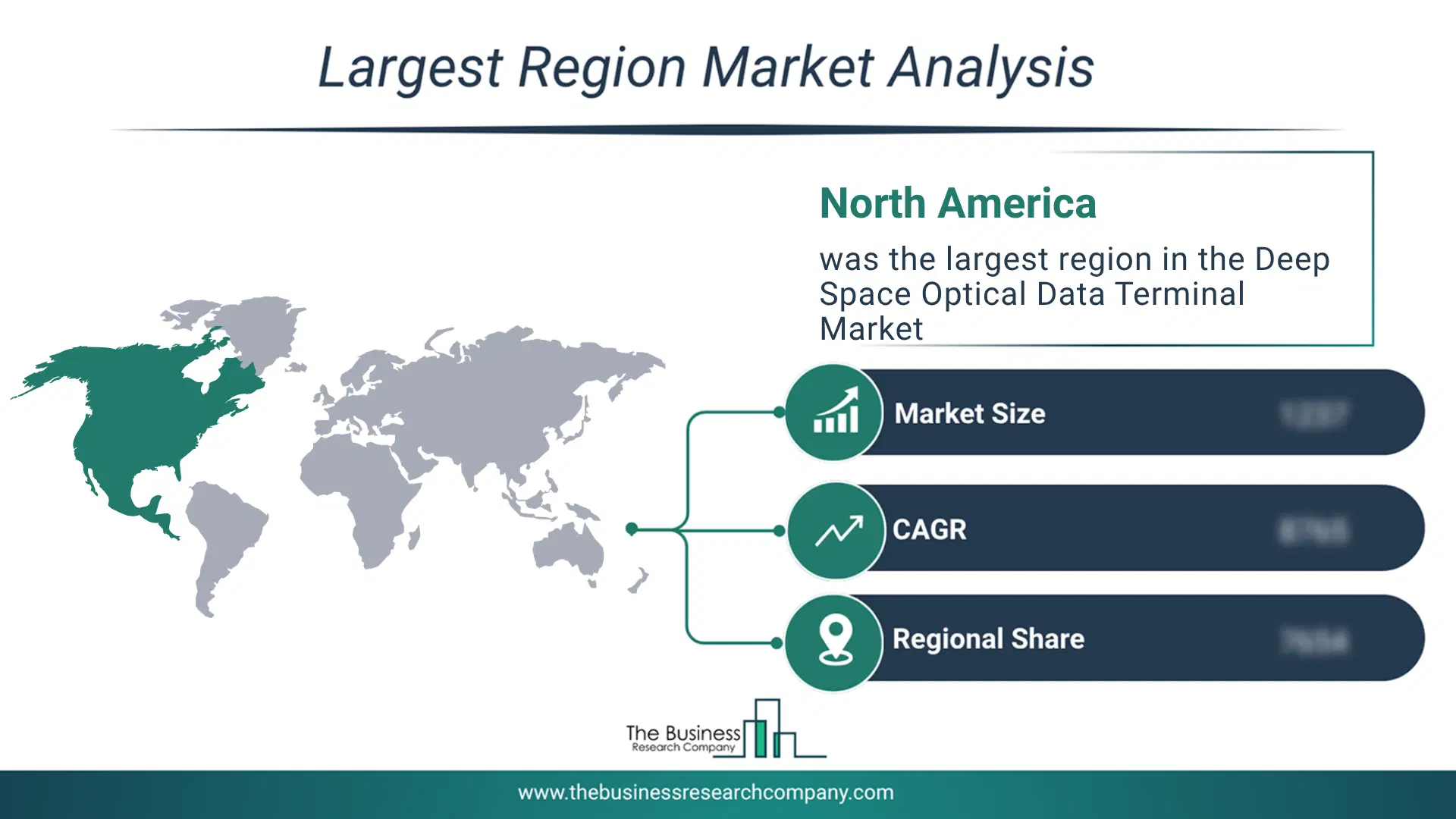
Regional Insights
North America was the largest region in the deep space optical data terminal market in 2025. Asia-Pacific is expected to be the fastest-growing region in the forecast period. The regions covered in this market report are Asia-Pacific, South East Asia, Western Europe, Eastern Europe, North America, South America, Middle East, Africa. The countries covered in this market report are Australia, Brazil, China, France, Germany, India, Indonesia, Japan, Taiwan, Russia, South Korea, UK, USA, Canada, Italy, SpainWhat Defines the Deep Space Optical Data Terminal Market?
The deep space optical data terminal market consists of sales of onboard space terminals, ground station terminals, adaptive optics systems, detectors, and optical receivers. Values in this market are ‘factory gate’ values, that is, the value of goods sold by the manufacturers or creators of the goods, whether to other entities (including downstream manufacturers, wholesalers, distributors, and retailers) or directly to end customers. The value of goods in this market includes related services sold by the creators of the goods.How is Market Value Defined and Measured?
The market value is defined as the revenues that enterprises gain from the sale of goods and/or services within the specified market and geography through sales, grants, or donations in terms of the currency (in USD unless otherwise specified). The revenues for a specified geography are consumption values that are revenues generated by organizations in the specified geography within the market, irrespective of where they are produced. It does not include revenues from resales along the supply chain, either further along the supply chain or as part of other products.
This chart presents market attractiveness based on a quantitative evaluation of growth, competition, strategic alignment, and risk, offering a clear view of opportunity areas for decision-making. This chart is for illustrative purposes; the full report contains the complete analysis.

This chart highlights the Total Addressable Market (TAM) by estimating the maximum revenue opportunity using an assumption-driven approach, supporting strategic planning and opportunity sizing across markets. The chart is illustrative; the full report provides a more comprehensive analysis.
What Key Data and Analysis Are Included in the Deep Space Optical Data Terminal Market Report 2026?
The deep space optical data terminal market research report is one of a series of new reports from The Business Research Company that provides market statistics, including industry global market size, regional shares, competitors with the market share, detailed market segments, market trends and opportunities, and any further data you may need to thrive in the deep space optical data terminal industry. The market research report delivers a complete perspective of everything you need, with an in-depth analysis of the current and future state of the industry.Deep Space Optical Data Terminal Market Report Forecast Analysis
| Report Attribute | Details |
|---|---|
| Market Size Value In 2026 | $0.62 billion |
| Revenue Forecast In 2030 | $1.02 billion |
| Growth Rate | CAGR of 13.1% from 2026 to 2030 |
| Base Year For Estimation | 2025 |
| Actual Estimates/Historical Data | 2020-2025 |
| Forecast Period | 2026 - 2030 |
| Market Representation | Revenue in USD Billion and CAGR from 2026 to 2030 |
| Segments Covered | Component, Platform, Application, End-User |
| Regional Scope | Asia-Pacific, Western Europe, Eastern Europe, North America, South America, Middle East, Africa |
| Country Scope | The countries covered in the deep space optical data terminal market report are Australia, Brazil, China, France, Germany, India, Indonesia, Japan, Taiwan, Russia, South Korea, UK, USA, Canada, Italy, Spain |
| Key Companies Profiled | Safran S.A., Thales Group, CACI International Inc., Mynaric AG, Viasat Inc., General Atomics Technologies Corporation, Hensoldt AG, Eutelsat Communications S.A., Hughes Network Systems LLC, TNO, NKT Photonics A/S, Honeywell Aerospace, TrellisWare Technologies Inc., Cailabs SAS, Transcelestial Technologies Pte Ltd, Bridgecomm Inc., Antrix Corporation Limited, MBryonics Inc., Odysseus Space Inc., Avantier Inc., FSO Instruments Inc. |
| Customization Scope | Request for Customization |
| Pricing And Purchase Options | Explore Purchase Options |