
Deep Space Radiation Monitoring Market Report 2026
Global Outlook – By Component (Detectors, Sensors, Software, Services), By Radiation Type (Galactic Cosmic Rays, Solar Particle Events, Trapped Radiation Belts, Other Radiation Type), By Platform (Satellites, Spacecraft, Space Stations, Deep Space Probes, Other Platforms), By Application (Space Missions, Astronaut Safety, Scientific Research, Satellite Operations, Other Applications), By End-User (Space Agencies, Commercial Space Companies, Research Institutes, Defense, Other End Users) – Market Size, Trends, Strategies, and Forecast to 2030
Deep Space Radiation Monitoring Market Overview
• Deep Space Radiation Monitoring market size has reached to $1.39 billion in 2025 • Expected to grow to $2.15 billion in 2030 at a compound annual growth rate (CAGR) of 9.1% • Growth Driver: Growing Commercial Space Activities Fueling The Growth Of The Market Due To Rising Private Sector Investments And Lower Launch Costs • Market Trend: Joint Research in Space Radiation: Safeguarding Astronauts on Deep Space Missions • North America was the largest region in 2025 and Asia-Pacific is the fastest growing region.What Is Covered Under Deep Space Radiation Monitoring Market?
Deep space radiation monitoring is the process of detecting and measuring cosmic rays, solar particles, and other forms of radiation in outer space. It uses specialized sensors and instruments aboard spacecraft or satellites to ensure accurate data collection. This monitoring is critical for protecting astronauts, spacecraft electronics, and mission integrity from harmful radiation exposure. The main components of deep space radiation monitoring include detectors, sensors, software, and services. Detectors are critical devices designed to measure and analyze radiation levels in deep space, capturing high-energy particles from sources such as galactic cosmic rays, solar particle events, and trapped radiation belts. These systems are deployed across platforms including satellites, spacecraft, space stations, and deep space probes, with applications in space missions, astronaut safety, scientific research, and satellite operations. The key end-users are space agencies, commercial space companies, research institutes, and defense organizations.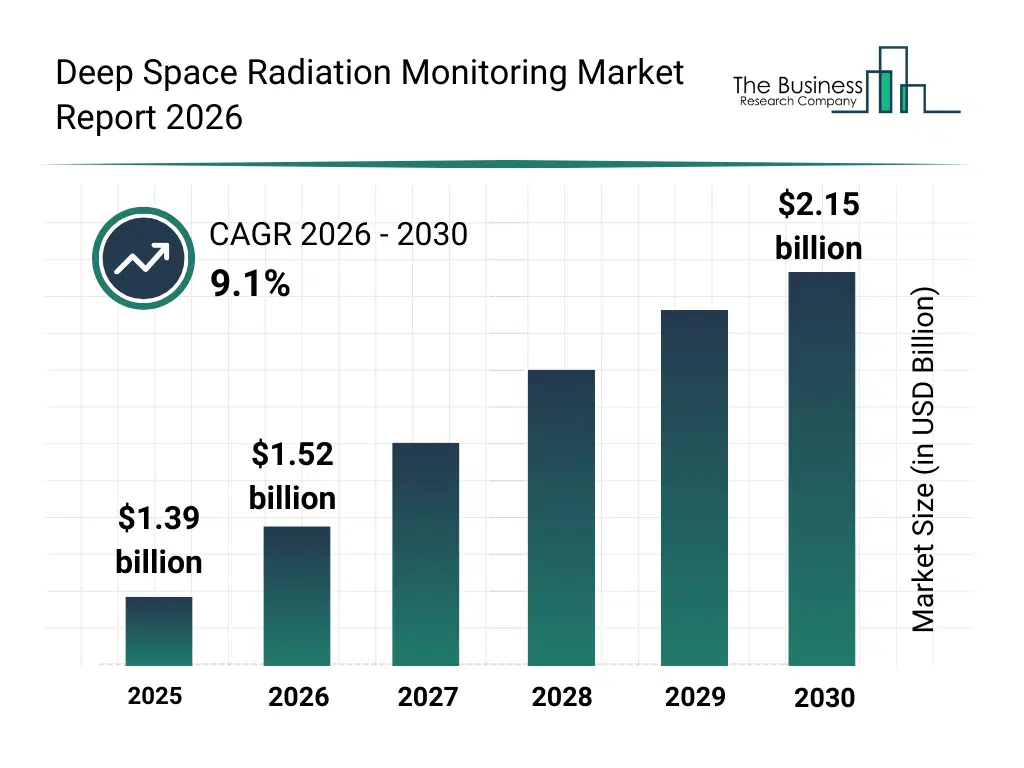
What Is The Deep Space Radiation Monitoring Market Size and Share 2026?
The deep space radiation monitoring market size has grown strongly in recent years. It will grow from $1.39 billion in 2025 to $1.52 billion in 2026 at a compound annual growth rate (CAGR) of 9.4%. The growth in the historic period can be attributed to increasing number of deep space missions, development of advanced radiation sensors, growing investment in astronaut safety programs, early adoption of satellite-based monitoring instruments, rising awareness of cosmic radiation hazards.What Is The Deep Space Radiation Monitoring Market Growth Forecast?
The deep space radiation monitoring market size is expected to see strong growth in the next few years. It will grow to $2.15 billion in 2030 at a compound annual growth rate (CAGR) of 9.1%. The growth in the forecast period can be attributed to expansion of crewed deep space exploration, integration of AI-based radiation analysis, miniaturization of radiation monitoring instruments, increased deployment of dedicated radiation monitoring satellites, growing demand for real-time space environment data. Major trends in the forecast period include advancements in high-sensitivity spaceborne radiation detection instruments, increasing incorporation of radiation-hardened electronics for deep space missions, growing deployment of long-duration radiation monitoring satellites and probes, development of compact, lightweight dosimeters for astronaut and spacecraft protection, rising need for continuous radiation environment assessment for interplanetary missions.
Global Deep Space Radiation Monitoring Market Segmentation
1) By Component: Detectors, Sensors, Software, Services 2) By Radiation Type: Galactic Cosmic Rays, Solar Particle Events, Trapped Radiation Belts, Other Radiation Type 3) By Platform: Satellites, Spacecraft, Space Stations, Deep Space Probes, Other Platforms 4) By Application: Space Missions, Astronaut Safety, Scientific Research, Satellite Operations, Other Applications 5) By End-User: Space Agencies, Commercial Space Companies, Research Institutes, Defense, Other End Users Subsegments: 1) By Detectors: Semiconductor Detectors, Scintillation Detectors, Solid-State Detectors, Gas-Filled Detectors 2) By Sensors: Particle Sensors, Neutron Sensors, Gamma-Ray Sensors, Dosimetry Sensors 3) By Software: Data Acquisition Software, Radiation Modeling And Simulation Software, Monitoring And Control Software, Data Analytics And Visualization Tools 4) By Services: Calibration Services, Radiation Testing Services, Data Analysis And Reporting Services, Maintenance And Support ServicesWhat Is Driver Of The Deep Space Radiation Monitoring Market?
The growing commercial space activities are expected to propel the growth of deep space radiation monitoring going forward. Commercial space activities refer to space-related operations and services conducted by private companies for profit, including satellite launches, space tourism, resource exploration, and related technologies. Commercial space activities are rising due to increasing private sector investment driven by lower launch costs and advancements in space technologies. Deep space radiation monitoring supports this need by providing real-time detection and dosimetry solutions that protect astronauts, spacecraft electronics, and payloads against harmful cosmic radiation and solar particle events. For instance, in January 2024, according to The Space Foundation, a US-based nonprofit organization that promotes space innovation, education, and collaboration, global launch activity continued its upward trajectory for the third consecutive year, recording 223 attempts with 212 successful missions, while commercial launches surged by 50% compared to 2022. Therefore, the growing commercial space activities are driving the growth of deep space radiation monitoring.Key Players In The Global Deep Space Radiation Monitoring Market
Major companies operating in the deep space radiation monitoring market are Airbus Defence and Space GmbH, Lockheed Martin Corporation, Northrop Grumman Corporation, Honeywell International Inc., National Aeronautics and Space Administration (NASA), Renesas Electronics Corporation, Teledyne e2v Limited, Thales Alenia Space S.A.S., HORIBA Ltd., Mirion Technologies Inc., Exail Holding SAS, Deutsches Zentrum für Luft- und Raumfahrt e.V. (German Aerospace Center), Rocket Lab USA Inc., 3D PLUS SAS, Argotec S.r.l., Hubert Curien Laboratory (Laboratoire Hubert Curien – Université Jean Monnet / CNRS), ADVACAM s.r.o., ispace inc., StemRad Ltd., European Space Agency (ESA)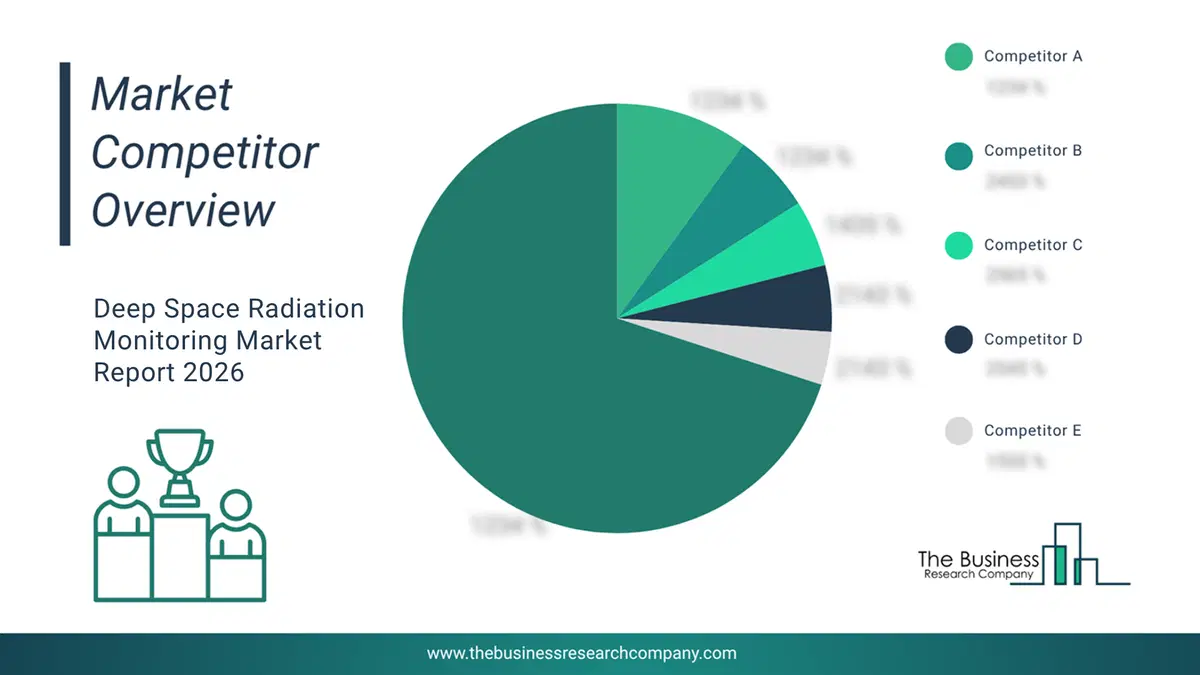
This chart is for illustrative purposes; the full report includes a detailed competitor analysis and comprehensive overview of the top 10 companies in the market.
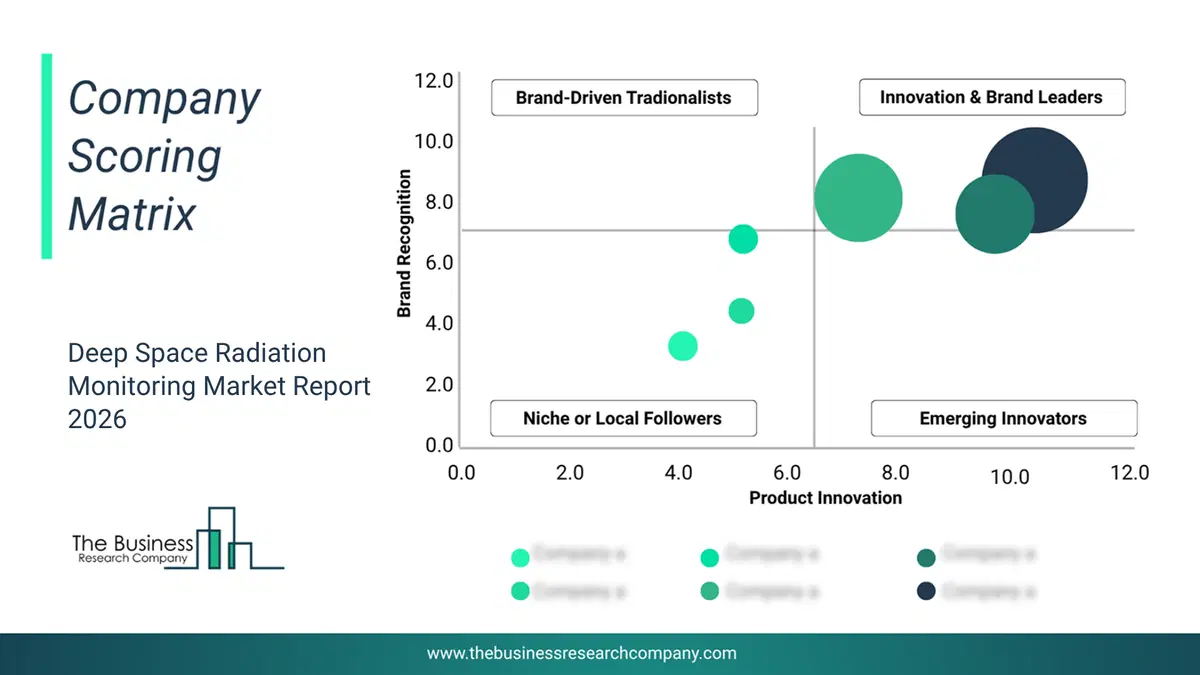
This chart maps companies by product innovation and brand strength, with bubble size indicating relative revenue, helping identify market leaders, challengers, and niche players. This is an illustrative chart; the full report provides a complete and accurate competitive analysis.
Global Deep Space Radiation Monitoring Market Trends and Insights
Major companies operating in the deep space radiation monitoring market are focusing on joint research into space radiation aiming astronaut safety in deep space missions. Joint research into space radiation is a collaborative effort between organizations or nations to study cosmic rays, solar particles, and their effects on spacecraft, technology, and human health in space environments. For instance, in June 2025, The German Aerospace Center (DLR), a Germany-based national research center for aeronautics, space, energy, and transportation, and The National Aeronautics and Space Administration (NASA), a US-based government agency responsible for civilian space exploration and research, signed a renewed agreement during the Paris Air Show to continue joint research into space radiation, focusing on astronaut safety in deep space missions through the integration of DLR's advanced M-42 EXT radiation detectors on NASA's Artemis II mission. This aims to address the significant health risks posed by space radiation by deploying upgraded measurement instruments with improved energy resolution, building on the valuable dataset gathered from Artemis I and enabling the development of more effective protective measures for future lunar and exploratory missions.What Are Latest Mergers And Acquisitions In The Deep Space Radiation Monitoring Market? JAXA Partners With Varadis For DESTINY+ Radiation Monitoring
In December 2023, the Japan Aerospace Exploration Agency (JAXA), a Japan-based national space agency, partnered with Varadis to equip the DESTINY+ mission with advanced radiation detection sensors. With this partnership, JAXA and Varadis aim to leverage advanced radiation detection technology to accurately monitor deep space radiation and gather critical scientific data on cosmic dust from the Phaethon asteroid, enhancing our understanding of the origins of organic matter on Earth. Varadis is an Ireland-based technology company specializing in space radiation sensors and monitoring solutions.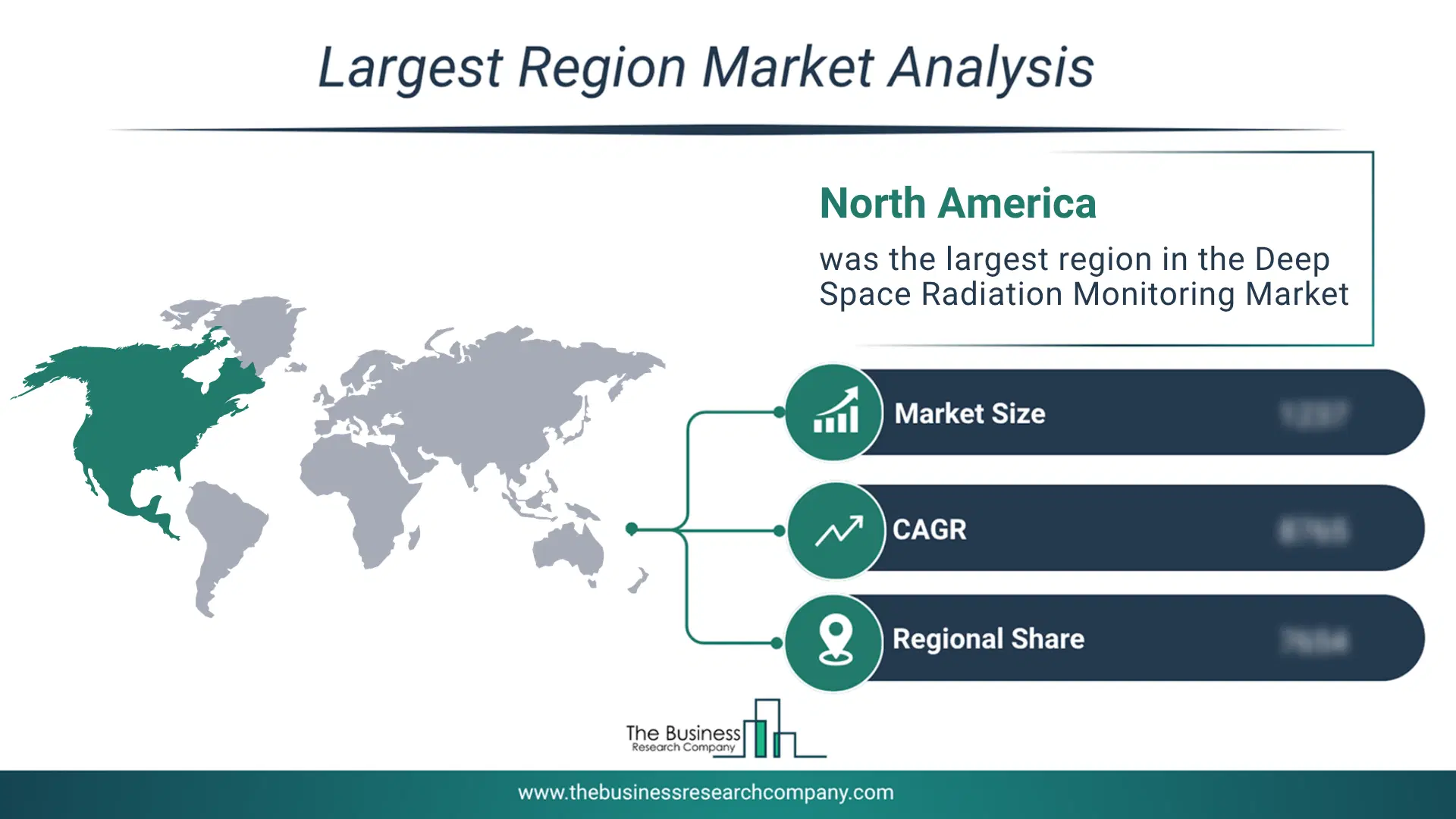
Regional Insights
North America was the largest region in the deep space radiation monitoring market in 2025. Asia-Pacific is expected to be the fastest-growing region in the forecast period. The regions covered in this market report are Asia-Pacific, South East Asia, Western Europe, Eastern Europe, North America, South America, Middle East, Africa. The countries covered in this market report are Australia, Brazil, China, France, Germany, India, Indonesia, Japan, Taiwan, Russia, South Korea, UK, USA, Canada, Italy, SpainWhat Defines the Deep Space Radiation Monitoring Market?
The deep space radiation monitoring market consists of revenues earned by entities by providing services such as radiation detection, data analysis, space environment assessment, and mission monitoring. The market value includes the value of related goods sold by the service provider or included within the service offering. The deep space radiation monitoring market also includes sales of spaceborne radiation sensors, dosimeters, monitoring satellites, and associated instrumentation. Values in this market are ‘factory gate’ values, that is, the value of goods sold by the manufacturers or creators of the goods, whether to other entities (including downstream manufacturers, wholesalers, distributors, and retailers) or directly to end customers. The value of goods in this market includes related services sold by the creators of the goods.How is Market Value Defined and Measured?
The market value is defined as the revenues that enterprises gain from the sale of goods and/or services within the specified market and geography through sales, grants, or donations in terms of the currency (in USD unless otherwise specified). The revenues for a specified geography are consumption values that are revenues generated by organizations in the specified geography within the market, irrespective of where they are produced. It does not include revenues from resales along the supply chain, either further along the supply chain or as part of other products.
This chart presents market attractiveness based on a quantitative evaluation of growth, competition, strategic alignment, and risk, offering a clear view of opportunity areas for decision-making. This chart is for illustrative purposes; the full report contains the complete analysis.

This chart highlights the Total Addressable Market (TAM) by estimating the maximum revenue opportunity using an assumption-driven approach, supporting strategic planning and opportunity sizing across markets. The chart is illustrative; the full report provides a more comprehensive analysis.
What Key Data and Analysis Are Included in the Deep Space Radiation Monitoring Market Report 2026?
The deep space radiation monitoring market research report is one of a series of new reports from The Business Research Company that provides market statistics, including industry global market size, regional shares, competitors with the market share, detailed market segments, market trends and opportunities, and any further data you may need to thrive in the deep space radiation monitoring industry. The market research report delivers a complete perspective of everything you need, with an in-depth analysis of the current and future state of the industry.Deep Space Radiation Monitoring Market Report Forecast Analysis
| Report Attribute | Details |
|---|---|
| Market Size Value In 2026 | $1.52 billion |
| Revenue Forecast In 2030 | $2.15 billion |
| Growth Rate | CAGR of 9.1% from 2026 to 2030 |
| Base Year For Estimation | 2025 |
| Actual Estimates/Historical Data | 2020-2025 |
| Forecast Period | 2026 - 2030 |
| Market Representation | Revenue in USD Billion and CAGR from 2026 to 2030 |
| Segments Covered | Component, Radiation Type, Platform, Application, End-User |
| Regional Scope | Asia-Pacific, Western Europe, Eastern Europe, North America, South America, Middle East, Africa |
| Country Scope | The countries covered in the deep space radiation monitoring market report are Australia, Brazil, China, France, Germany, India, Indonesia, Japan, Taiwan, Russia, South Korea, UK, USA, Canada, Italy, Spain |
| Key Companies Profiled | Airbus Defence and Space GmbH, Lockheed Martin Corporation, Northrop Grumman Corporation, Honeywell International Inc., National Aeronautics and Space Administration (NASA), Renesas Electronics Corporation, Teledyne e2v Limited, Thales Alenia Space S.A.S., HORIBA Ltd., Mirion Technologies Inc., Exail Holding SAS, Deutsches Zentrum für Luft- und Raumfahrt e.V. (German Aerospace Center), Rocket Lab USA Inc., 3D PLUS SAS, Argotec S.r.l., Hubert Curien Laboratory (Laboratoire Hubert Curien – Université Jean Monnet / CNRS), ADVACAM s.r.o., ispace inc., StemRad Ltd., European Space Agency (ESA) |
| Customization Scope | Request for Customization |
| Pricing And Purchase Options | Explore Purchase Options |