
Defense Cyber Warfare Market Report 2026
Global Outlook – By Service Type (Data Hosting, Data Processing, Data Integration, Data Analytics), By Solution (Defense Solutions, Threat Assessment, Network Fortification, Training Services), By Deployment Type (On-Premises, Cloud), By Application (Network Security, Data Loss Prevention, Endpoint Security, Identity And Access Management, Risk And Compliance Management, Supervisory Control And Data Acquisition Or Industrial Control Systems Security, Threat Intelligence And Response, Security Monitoring And Analytics), By End User (Government) – Market Size, Trends, Strategies, and Forecast to 2030
Defense Cyber Warfare Market Overview
• Defense Cyber Warfare market size has reached to $163.24 billion in 2025 • Expected to grow to $253.48 billion in 2030 at a compound annual growth rate (CAGR) of 9.1% • Growth Driver: Growing Cybersecurity Concerns Fueling The Growth Of The Market Due To Rising Sophistication Of Cyberattacks • Market Trend: Advancements In Cybersecurity Ontology Enhancing Real-Time Threat Detection And Decision-Making • North America was the largest region in 2025.What Is Covered Under Defense Cyber Warfare Market?
Defense cyber warfare refers to the use of cyber capabilities by military and defense organizations to protect national security infrastructure, systems, and networks against cyber threats and attacks. It involves detecting, preventing, and responding to cyber intrusions from hostile entities such as nation-states, terrorist groups, or cybercriminals targeting military operations or critical defense systems. The main service types of the defense cyber warfare include data hosting, data processing, data integration, and data analytics services. Data hosting refers to services that provide secure storage and management of sensitive defense-related data on physical or virtual servers, ensuring accessibility, redundancy, and protection against unauthorized access or cyber threats. The different solutions include defense solutions, threat assessment, network fortification, and training services. The multiple deployment types include on-premises and cloud. Multiple applications are network security, data loss prevention, endpoint security, identity and access management, risk and compliance management, supervisory control and data acquisition or industrial control systems security, threat intelligence and response, security monitoring and analytics, and they are used by several end-users such as government.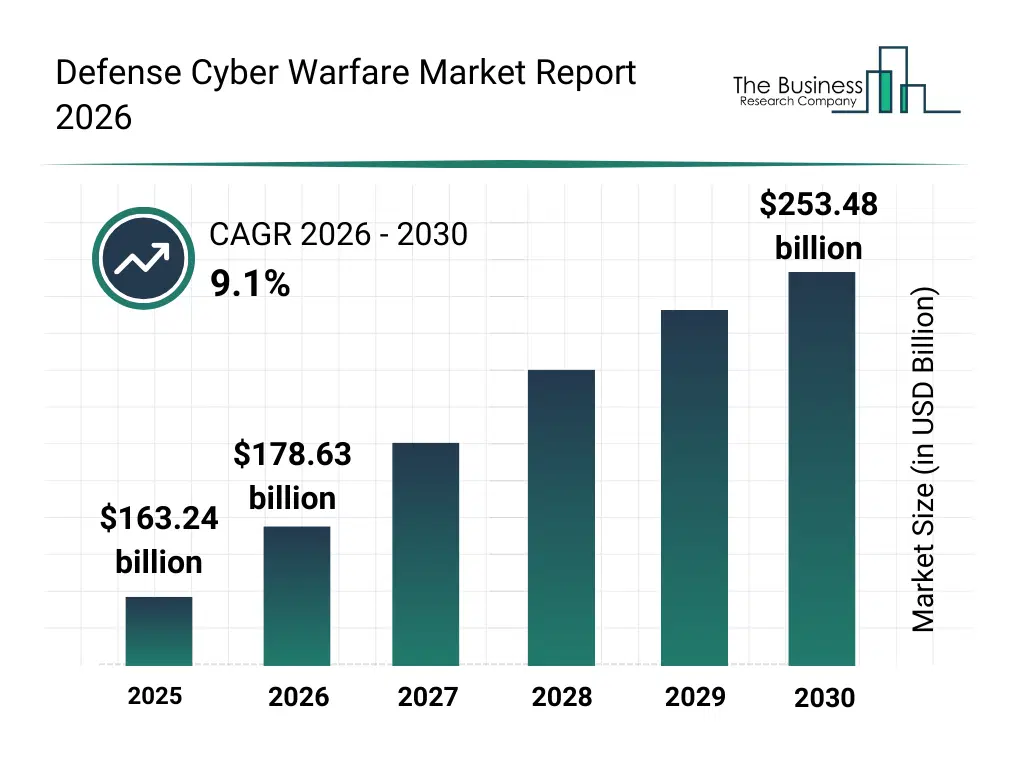
What Is The Defense Cyber Warfare Market Size and Share 2026?
The defense cyber warfare market size has grown strongly in recent years. It will grow from $163.24 billion in 2025 to $178.63 billion in 2026 at a compound annual growth rate (CAGR) of 9.4%. The growth in the historic period can be attributed to increasing frequency and sophistication of cyberattacks on defense networks, rising defense budgets allocated to cybersecurity, adoption of advanced threat detection and intrusion prevention technologies, growing reliance on digital and networked military systems, strategic collaborations and partnerships among defense cybersecurity providers.What Is The Defense Cyber Warfare Market Growth Forecast?
The defense cyber warfare market size is expected to see strong growth in the next few years. It will grow to $253.48 billion in 2030 at a compound annual growth rate (CAGR) of 9.1%. The growth in the forecast period can be attributed to integration of ai and machine learning for proactive cyber defense, expansion of secure communication and encryption solutions, rising demand for real-time threat intelligence and monitoring services, emphasis on protecting critical national defense infrastructure, development of automated incident response and vulnerability management tools. Major trends in the forecast period include increasing sophistication of cyber threats targeting defense systems, growth in real-time threat intelligence and automated incident response, expansion of secure military cloud and data hosting services, integration of behavioral analytics and ai-driven threat detection, rising demand for compliance and risk management in defense cybersecurity.
Global Defense Cyber Warfare Market Segmentation
1) By Service Type: Data Hosting, Data Processing, Data Integration, Data Analytics 2) By Solution: Defense Solutions, Threat Assessment, Network Fortification, Training Services 3) By Deployment Type: On-Premises, Cloud 4) By Application: Network Security, Data Loss Prevention, Endpoint Security, Identity And Access Management, Risk And Compliance Management, Supervisory Control And Data Acquisition Or Industrial Control Systems Security, Threat Intelligence And Response, Security Monitoring And Analytics 5) By End User: Government Subsegments: 1) By Data Hosting: Cloud-Based Hosting, On-Premises Hosting, Dedicated Server Hosting, Virtual Private Servers, Secure Military Data Centers 2) By Data Processing: Real-Time Data Processing, Batch Data Processing, Stream Data Processing, Edge Processing, Parallel And Distributed Processing 3) By Data Integration: Application Programming Interface Integration, Extract, Transform, Load Tools, Middleware Integration, Legacy System Integration, Sensor And Internet of Things Data Fusion 4) By Data Analytics: Descriptive Analytics, Predictive Analytics, Prescriptive Analytics, Behavioral Analytics, Geospatial And Temporal Analysis, Artificial Intelligence And Machine Learning Based Threat AnalyticsWhat Is Driver Of The Defense Cyber Warfare Market?
The growing cybersecurity concerns are expected to propel the growth in the defense cyber warfare market going forward. Cybersecurity concerns refer to the potential risks, vulnerabilities, and threats that can compromise the confidentiality, integrity, and availability of digital systems, networks, and data. The rise in cybersecurity concerns is due to the increasing sophistication of cyberattacks, enabling threat actors to exploit complex vulnerabilities, evade detection systems, and cause greater disruption to critical infrastructure and sensitive data. Defense cyber warfare strengthens cybersecurity by proactively identifying, countering, and preventing digital threats to critical systems. For instance, in November 2024, according to the Australian Cyber Security Centre, an Australia-based government agency, reported that in the financial year 2023–24, the Australian Cybersecurity Hotline operated by ASD received more than 36,700 calls, marking a 12% rise compared to the previous year, and ASD handled over 1,100 cybersecurity incidents during the same period. Therefore, the growing cybersecurity concerns are driving the growth of the defense cyber warfare industry.Key Players In The Global Defense Cyber Warfare Market
Major companies operating in the defense cyber warfare market are Raytheon Technologies Corporation, Lockheed Martin Corporation, Airbus SE, General Dynamics Corporation, Northrop Grumman Corporation, BAE Systems plc, Thales Group, L3Harris Technologies Inc., Leonardo S.p.A., Leidos Holdings Inc., DXC Technology Company, Huntington Ingalls Industries Inc., Booz Allen Hamilton Holding Corporation, Science Applications International Corporation, Rheinmetall AG, KBR Inc., CACI International Inc, Elbit Systems Ltd., Israel Aerospace Industries Ltd., Parsons Corporation, QinetiQ Group plc, Palantir Technologies Inc., Ultra Electronics Holdings Limited, Kratos Defense & Security Solutions Inc., Darktrace Holdings Limited
This chart is for illustrative purposes; the full report includes a detailed competitor analysis and comprehensive overview of the top 10 companies in the market.
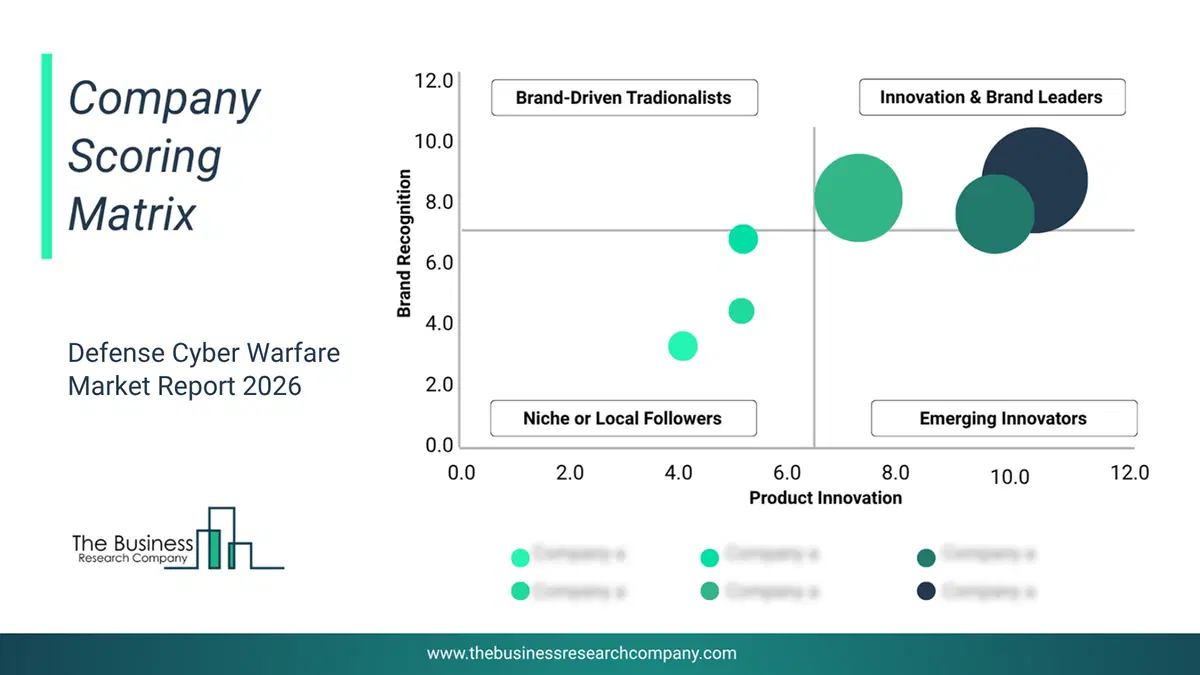
This chart maps companies by product innovation and brand strength, with bubble size indicating relative revenue, helping identify market leaders, challengers, and niche players. This is an illustrative chart; the full report provides a complete and accurate competitive analysis.
Global Defense Cyber Warfare Market Trends and Insights
Major companies operating in the defense cyber warfare market are focusing on technological advancements such as cybersecurity ontology to enhance threat detection, streamline data integration, and improve decision-making in real-time cyber operations. Cybersecurity ontology enables a structured representation of knowledge, allowing systems to understand, analyze, and respond to complex cyber threats more effectively. For instance, in January 2025, MITRE, an American not-for-profit organization, launched D3FEND 1.0, a cybersecurity ontology designed to standardize vocabulary and conceptual frameworks for defensive techniques targeting malicious cyber threats. The primary goal is to provide a stable, extensible, and integration-friendly structure that enables cybersecurity operations, strategic decision-making, and collaboration across the industry and government sectors. It includes features such as the cyber-attack-defense Tool (CAD), enabling users to map defensive actions, share knowledge, and tailor strategies for specific scenarios. It also offers a robust framework for integrating defensive measures into cybersecurity operations and decision-making processes across diverse environments.What Are Latest Mergers And Acquisitions In The Defense Cyber Warfare Market? Airbus Defense and Space Acquires Infodas To Enhance Cybersecurity Capabilities
In September 2024, Airbus Defense and Space, a division of Airbus SE, a Germany-based aeronautics company, acquired Infodas for an undisclosed amount. This acquisition strengthens its cybersecurity portfolio and enhances the protection of its digital infrastructure amid rising cyber threats, especially in defense and critical infrastructure sectors. Infodas is a German cybersecurity and IT solutions provider, including the defense sector.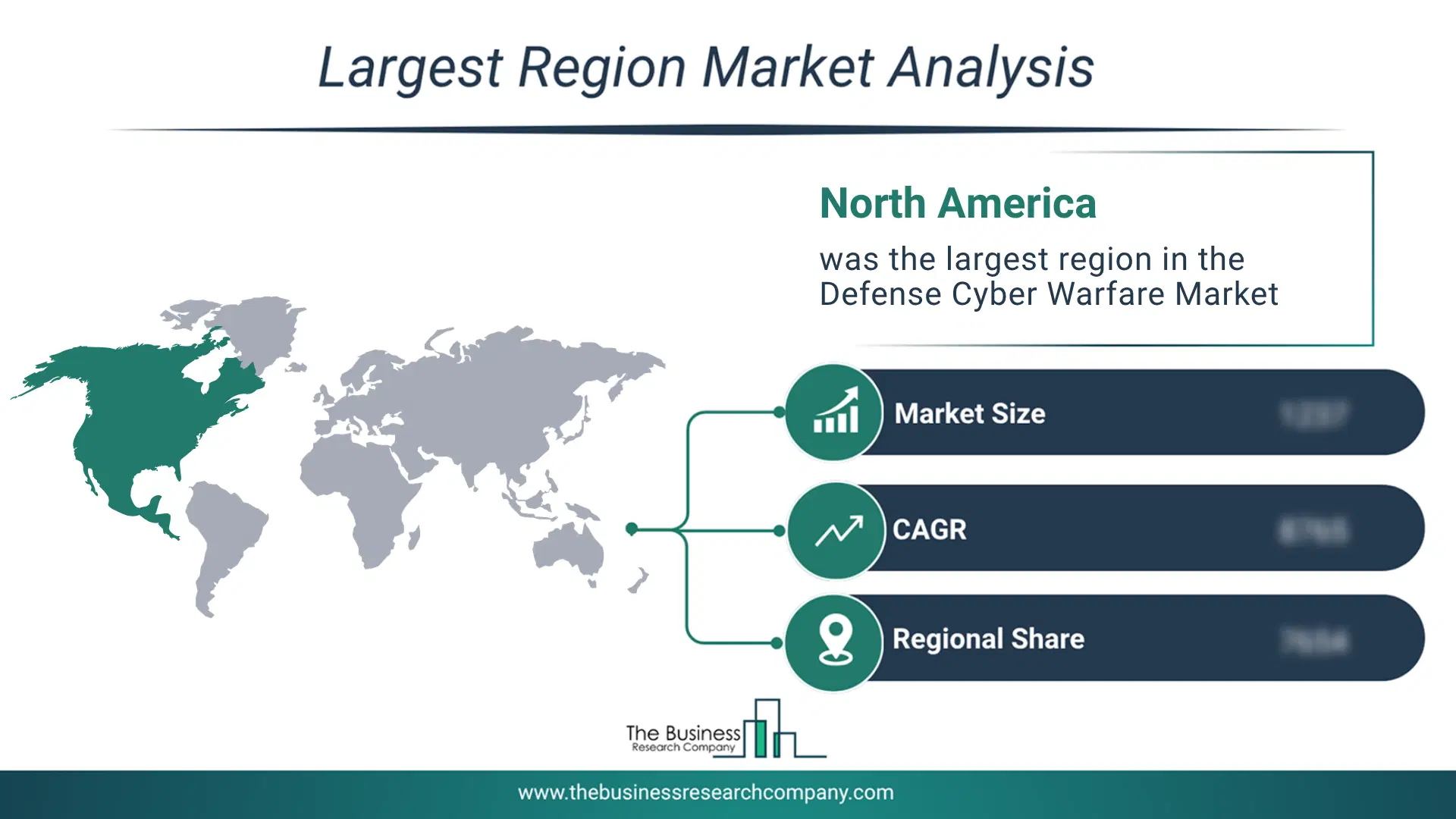
Regional Insights
North America was the largest region in the defense cyber warfare market in 2025. The regions covered in this market report are Asia-Pacific, South East Asia, Western Europe, Eastern Europe, North America, South America, Middle East, Africa. The countries covered in this market report are Australia, Brazil, China, France, Germany, India, Indonesia, Japan, Taiwan, Russia, South Korea, UK, USA, Canada, Italy, SpainWhat Defines the Defense Cyber Warfare Market?
The defense cyber warfare market consists of revenues earned by entities by providing services such as cyber threat intelligence, network defense, incident response, secure data hosting, vulnerability assessments, and real-time monitoring to protect military systems and national defense infrastructure from cyberattacks. The market value includes the value of related goods sold by the service provider or included within the service offering. The defense cyber warfare market includes sales of products such as advanced firewalls, intrusion detection systems, secure communication tools, cyber defense software, encryption devices, and threat analysis platforms designed to safeguard military networks and critical defense infrastructure. Values in this market are ‘factory gate’ values, that is, the value of goods sold by the manufacturers or creators of the goods, whether to other entities (including downstream manufacturers, wholesalers, distributors, and retailers) or directly to end customers. The value of goods in this market includes related services sold by the creators of the goods.How is Market Value Defined and Measured?
The market value is defined as the revenues that enterprises gain from the sale of goods and/or services within the specified market and geography through sales, grants, or donations in terms of the currency (in USD unless otherwise specified). The revenues for a specified geography are consumption values that are revenues generated by organizations in the specified geography within the market, irrespective of where they are produced. It does not include revenues from resales along the supply chain, either further along the supply chain or as part of other products.
This chart presents market attractiveness based on a quantitative evaluation of growth, competition, strategic alignment, and risk, offering a clear view of opportunity areas for decision-making. This chart is for illustrative purposes; the full report contains the complete analysis.

This chart highlights the Total Addressable Market (TAM) by estimating the maximum revenue opportunity using an assumption-driven approach, supporting strategic planning and opportunity sizing across markets. The chart is illustrative; the full report provides a more comprehensive analysis.
What Key Data and Analysis Are Included in the Defense Cyber Warfare Market Report 2026?
The defense cyber warfare market research report is one of a series of new reports from The Business Research Company that provides market statistics, including industry global market size, regional shares, competitors with the market share, detailed market segments, market trends and opportunities, and any further data you may need to thrive in the defense cyber warfare industry. The market research report delivers a complete perspective of everything you need, with an in-depth analysis of the current and future state of the industry.Defense Cyber Warfare Market Report Forecast Analysis
| Report Attribute | Details |
|---|---|
| Market Size Value In 2026 | $178.63 billion |
| Revenue Forecast In 2030 | $253.48 billion |
| Growth Rate | CAGR of 9.1% from 2026 to 2030 |
| Base Year For Estimation | 2025 |
| Actual Estimates/Historical Data | 2020-2025 |
| Forecast Period | 2026 - 2030 |
| Market Representation | Revenue in USD Billion and CAGR from 2026 to 2030 |
| Segments Covered | Service Type, Solution, Deployment Type, Application, End User |
| Regional Scope | Asia-Pacific, Western Europe, Eastern Europe, North America, South America, Middle East, Africa |
| Country Scope | The countries covered in the defense cyber warfare market report are Australia, Brazil, China, France, Germany, India, Indonesia, Japan, Taiwan, Russia, South Korea, UK, USA, Canada, Italy, Spain |
| Key Companies Profiled | Raytheon Technologies Corporation, Lockheed Martin Corporation, Airbus SE, General Dynamics Corporation, Northrop Grumman Corporation, BAE Systems plc, Thales Group, L3Harris Technologies Inc., Leonardo S.p.A., Leidos Holdings Inc., DXC Technology Company, Huntington Ingalls Industries Inc., Booz Allen Hamilton Holding Corporation, Science Applications International Corporation, Rheinmetall AG, KBR Inc., CACI International Inc, Elbit Systems Ltd., Israel Aerospace Industries Ltd., Parsons Corporation, QinetiQ Group plc, Palantir Technologies Inc., Ultra Electronics Holdings Limited, Kratos Defense & Security Solutions Inc., Darktrace Holdings Limited |
| Customization Scope | Request for Customization |
| Pricing And Purchase Options | Explore Purchase Options |