

Defense Cybersecurity Market Report 2026
Global Outlook – By Component (Solutions, Services), By Technology (Artificial Intelligence And Machine Learning, Blockchain, Zero Trust Architecture, Next Generation Firewalls, Threat Intelligence Platforms, Security Orchestration Automation And Response, Post Quantum Cryptography), By Deployment Mode (On-Premises, Cloud-Based), By Application (Threat Intelligence, Identity And Access Management, Data Loss Prevention, Security Information And Event Management, Other Applications), By End User (Military And Defense Agencies, Homeland Security, Intelligence Agencies) – Market Size, Trends, Strategies, and Forecast to 2030
Defense Cybersecurity Market Overview
• Defense Cybersecurity market size has reached to $35.58 billion in 2025 • Expected to grow to $62.3 billion in 2030 at a compound annual growth rate (CAGR) of 11.9% • Growth Driver: Increasing Sophistication Of Cyber Threats Fueling The Growth Of The Market Due To Increasing Digital Vulnerabilities And Rising Security Risks • Market Trend: Innovations In Artificial Intelligence-Driven Cybersecurity Models Strengthen Defense Against Advanced Cyber Threats • North America was the largest region in 2025 and Asia-Pacific is the fastest growing region.What Is Covered Under Defense Cybersecurity Market?
Defense cybersecurity refers to the protection of military, defense, and national security systems, networks, and data from cyber threats, attacks, and unauthorized access. It involves technologies, strategies, and operations designed to secure defense infrastructure, communication systems, weapons platforms, and intelligence networks against cyber espionage, malware, ransomware, and cyber warfare activities. The main components of defense cybersecurity include solutions and services. Solutions refer to cybersecurity platforms and technologies designed to protect defense networks, systems, and critical information assets from cyber threats and attacks. These solutions leverage technologies such as artificial intelligence and machine learning, blockchain, zero trust architecture, next generation firewalls, threat intelligence platforms, security orchestration automation and response, and post quantum cryptography and are deployed through On-Premises and Cloud-Based models. The various applications involved are threat intelligence, identity and access management, data loss prevention, security information and event management, and others, and they are used by several end users such as military and defense agencies, homeland security, and intelligence agencies.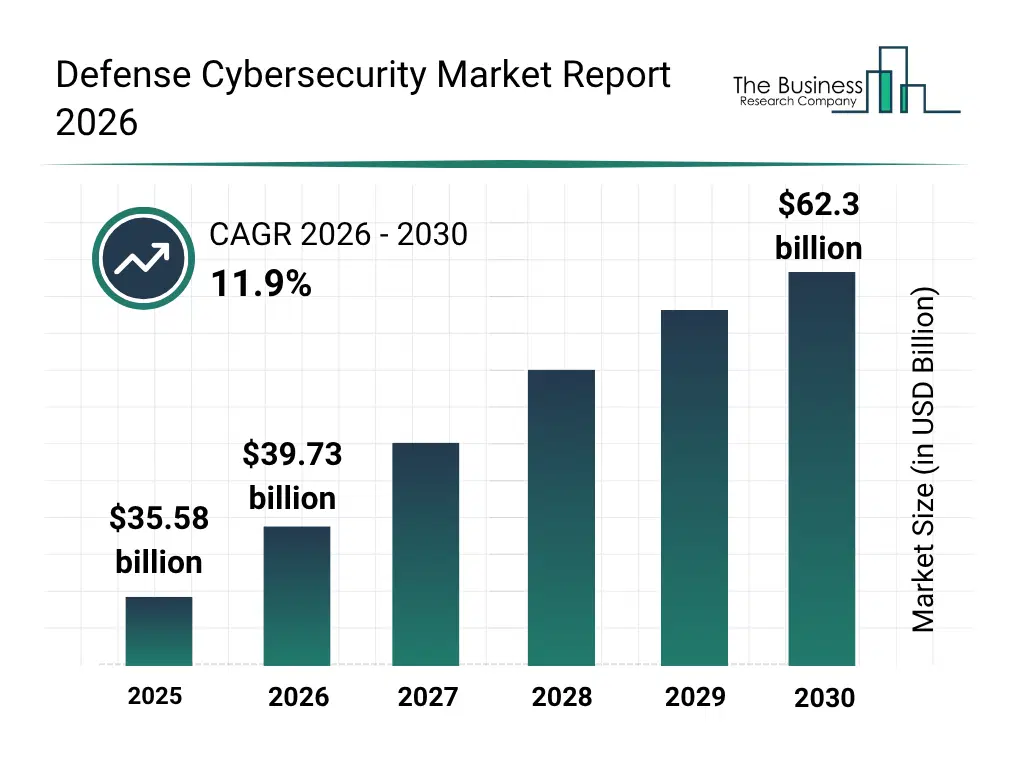
What Is The Defense Cybersecurity Market Size and Share 2026?
The defense cybersecurity market size has grown rapidly in recent years. It will grow from $35.58 billion in 2025 to $39.73 billion in 2026 at a compound annual growth rate (CAGR) of 11.7%. The growth in the historic period can be attributed to rising frequency of cyber warfare incidents, increasing defense digitalization initiatives, growing investment in military network protection, expansion of critical infrastructure security programs, increasing sophistication of cyber threats.What Is The Defense Cybersecurity Market Growth Forecast?
The defense cybersecurity market size is expected to see rapid growth in the next few years. It will grow to $62.3 billion in 2030 at a compound annual growth rate (CAGR) of 11.9%. The growth in the forecast period can be attributed to growing adoption of AI driven cyber defense systems, increasing deployment of cloud based defense security platforms, rising investments in quantum resistant encryption technologies, expansion of autonomous military systems security requirements, increasing government funding for national cyber resilience programs. Major trends in the forecast period include adoption of zero trust security frameworks across defense networks, increasing deployment of post quantum cryptography solutions, growing integration of security orchestration automation and response platforms, expansion of multi domain cyber defense capabilities, rising demand for advanced threat intelligence and cyber resilience programs.
Global Defense Cybersecurity Market Segmentation
1) By Component: Solutions; Services 2) By Technology: Artificial Intelligence And Machine Learning; Blockchain; Zero Trust Architecture; Next Generation Firewalls; Threat Intelligence Platforms; Security Orchestration Automation And Response; Post Quantum Cryptography 3) By Deployment Mode: On-Premises; Cloud-Based 4) By Application: Threat Intelligence; Identity And Access Management; Data Loss Prevention; Security Information And Event Management; Other Applications 5) By End User: Military And Defense Agencies; Homeland Security; Intelligence Agencies Subsegments: 1) By Solutions: Network Security; Endpoint Security; Cloud Security; Application Security; Data Protection And Encryption; Intrusion Detection And Prevention Systems 2) By Services: Managed Security Services; Professional Services; Consulting Services; Integration And Deployment Services; Support And Maintenance Services; Incident Response Services; Risk And Compliance Management Services; Training And Education ServicesWhat Is The Driver Of The Defense Cybersecurity Market?
The increasing sophistication of cyber threats is expected to propel the growth of defense cybersecurity going forward. Cyber threats refer to malicious activities or attacks that target computer systems, networks, or digital data to steal information, disrupt operations, damage infrastructure, or gain unauthorized access. The cyber threats are mainly driven by rapid digitalization and increased connectivity of critical systems, which expand attack surfaces and create more opportunities for cybercriminals and hostile actors to exploit security vulnerabilities. Defense cybersecurity helps combat cyber threats by detecting vulnerabilities, preventing unauthorized access, strengthening network security, and enabling rapid responses to cyberattacks before they cause significant damage. For instance, in October 2025, according to the National Cyber Security Centre, a UK-based government agency, a record 204 nationally significant cyberattacks were reported in the year ending September, reflecting a substantial increase compared to 89 incidents recorded during the previous 12-month period. Therefore, the increasing sophistication of cyber threats is driving the growth of the defense cybersecurity industry.Key Players In The Global Defense Cybersecurity Market
Major companies operating in the defense cybersecurity market are Airbus Defence and Space; RTX Corporation; Lockheed Martin Corporation; International Business Machines Corporation; Cisco Systems Inc.; General Dynamics Corporation; Northrop Grumman Corporation; BAE Systems plc; Thales S.A.; L3Harris Technologies Inc.; Leonardo S.p.A.; Leidos Holdings Inc.; Booz Allen Hamilton Holding Corporation; Science Applications International Corporation; CACI International Inc; KBR Inc.; Elbit Systems Ltd.; Israel Aerospace Industries Ltd.; Saab AB; Palantir Technologies Inc.; QinetiQ Group plc; Palo Alto Networks Inc.; CrowdStrike Holdings Inc.; Fortinet Inc.; Trellix; Check Point Software Technologies Ltd.; Microsoft CorporationGlobal Defense Cybersecurity Market Trends and Insights
Major companies operating in the defense cybersecurity market are focusing on developing advanced artificial intelligence-driven cybersecurity models to enhance threat detection, strengthen critical infrastructure protection, improve vulnerability analysis, and enable faster incident response against increasingly sophisticated cyber threats. Artificial intelligence-driven cybersecurity models use AI and machine learning to detect, analyze, and respond to cyber threats in real time, improving threat detection accuracy and enabling faster, automated cyber defense operations. For instance, in May 2026, OpenAI, a US-based artificial intelligence company, launched GPT-5.5-Cyber, a cybersecurity-focused AI model designed exclusively for critical cyber defenders to strengthen national cyber defense capabilities against advanced threats. The model offers features such as advanced threat detection, vulnerability analysis, incident response support, and trusted government access for securing critical infrastructure. This launch highlights the growing adoption of AI-driven cybersecurity solutions to combat increasingly complex cyber warfare attacks.What Are Latest Mergers And Acquisitions In The Defense Cybersecurity Market?
In April 2026, ServiceNow Inc., a US-based software company, acquired Armis Inc. for $7.75 billion in cash. With this acquisition, ServiceNow aims to strengthen its AI-driven cybersecurity capabilities by integrating Armis’ real-time cyber asset discovery platform to enhance asset visibility, improve cyber risk management, automate remediation workflows, and protect critical infrastructure across IT, OT, IoT, cloud, and connected devices. Armis Inc. is a US-based company specializing in cyber exposure management, asset visibility, and critical infrastructure security solutions that support defense cybersecurity.Regional Outlook
North America was the largest region in the defense cybersecurity market in 2025. Asia-Pacific is expected to be the fastest-growing region in the forecast period. The regions covered in this market report are Asia-Pacific, South East Asia, Western Europe, Eastern Europe, North America, South America, Middle East, Africa. The countries covered in this market report are Australia, Brazil, China, France, Germany, India, Indonesia, Japan, Taiwan, Russia, South Korea, UK, USA, Canada, Italy, Spain.What Defines the Defense Cybersecurity Market?
The defense cybersecurity market consists of revenues earned by entities by providing services such as threat detection and monitoring, network security management, endpoint protection, vulnerability assessment, and incident response. The market value includes the value of related goods sold by the service provider or included within the service offering. Only goods and services traded between entities or sold to end consumers are included.How is Market Value Defined and Measured?
The market value is defined as the revenues that enterprises gain from the sale of goods and/or services within the specified market and geography through sales, grants, or donations in terms of the currency (in USD unless otherwise specified). The revenues for a specified geography are consumption values that are revenues generated by organizations in the specified geography within the market, irrespective of where they are produced. It does not include revenues from resales along the supply chain, either further along the supply chain or as part of other products.What Key Data and Analysis Are Included in the Defense Cybersecurity Market Report 2026?
The defense cybersecurity market research report is one of a series of new reports from The Business Research Company that provides market statistics, including industry global market size, regional shares, competitors with the market share, detailed market segments, market trends and opportunities, and any further data you may need to thrive in the defense cybersecurity industry. The market research report delivers a complete perspective of everything you need, with an in-depth analysis of the current and future state of the industry.Defense Cybersecurity Market Report Forecast Analysis
| Report Attribute | Details |
|---|---|
| Market Size Value In 2026 | $39.73 billion |
| Revenue Forecast In 2030 | $62.3 billion |
| Growth Rate | CAGR of 11.9% from 2026 to 2030 |
| Base Year For Estimation | 2025 |
| Actual Estimates/Historical Data | 2020-2025 |
| Forecast Period | 2026 - 2030 |
| Market Representation | Revenue in USD Billion and CAGR from 2026 to 2030 |
| Segments Covered | Component, Technology, Deployment Mode, Application, End User |
| Regional Scope | Asia-Pacific, Western Europe, Eastern Europe, North America, South America, Middle East, Africa |
| Country Scope | The countries covered in the report are Australia, Brazil, China, France, Germany, India, ... |
| Key Companies Profiled | Airbus Defence and Space; RTX Corporation; Lockheed Martin Corporation; International Business Machines Corporation; Cisco Systems Inc.; General Dynamics Corporation; Northrop Grumman Corporation; BAE Systems plc; Thales S.A.; L3Harris Technologies Inc.; Leonardo S.p.A.; Leidos Holdings Inc.; Booz Allen Hamilton Holding Corporation; Science Applications International Corporation; CACI International Inc; KBR Inc.; Elbit Systems Ltd.; Israel Aerospace Industries Ltd.; Saab AB; Palantir Technologies Inc.; QinetiQ Group plc; Palo Alto Networks Inc.; CrowdStrike Holdings Inc.; Fortinet Inc.; Trellix; Check Point Software Technologies Ltd.; Microsoft Corporation |
| Customization Scope | Request for Customization |
| Pricing And Purchase Options | Explore Purchase Options |