
Defense Support and Auxiliary Equipment Market Report 2026
Global Outlook – By Type (Military Radars, Military Satellites, Other Defense Support And Auxiliary Equipment), By Payload Type (Communication Payload, Navigation Payload, Imaging Payload, Others ), By Application (Intelligence, Surveillance, And Reconnaissance (Isr), Communication, Navigation) – Market Size, Trends, Strategies, and Forecast to 2030
Defense Support and Auxiliary Equipment Market Overview
• Defense Support and Auxiliary Equipment market size has reached to $158.79 billion in 2025 • Expected to grow to $227.7 billion in 2030 at a compound annual growth rate (CAGR) of 7.7% • Growth Driver: Rising Defense Spending Fuels Growth Of Defense Support And Auxiliary Equipment Market • Market Trend: Major Defense Firms Prioritize Domestically Built Submarines For Competitive Edge • North America was the largest region in 2025 and Asia-Pacific is the fastest growing region.What Is Covered Under Defense Support and Auxiliary Equipment Market?
The defense support and auxiliary equipment refer to support and auxiliary equipment used for defense operations, including equipment such as sonars. The defense support and auxiliary equipment include all mobile and fixed systems required to support the operation of the primary defense systems. The main types of defense support and auxiliary equipment are military radars, military satellites, and other defense support, and auxiliary equipment. Military satellites are man-made satellites that are used for military purposes. Navigation, intelligence gathering, and military communications are the most prevalent missions. The different types of payloads include communication payloads, navigation payloads, imaging payloads, and others and are used in several applications such as intelligence, surveillance, and reconnaissance (ISR), communication, and navigation.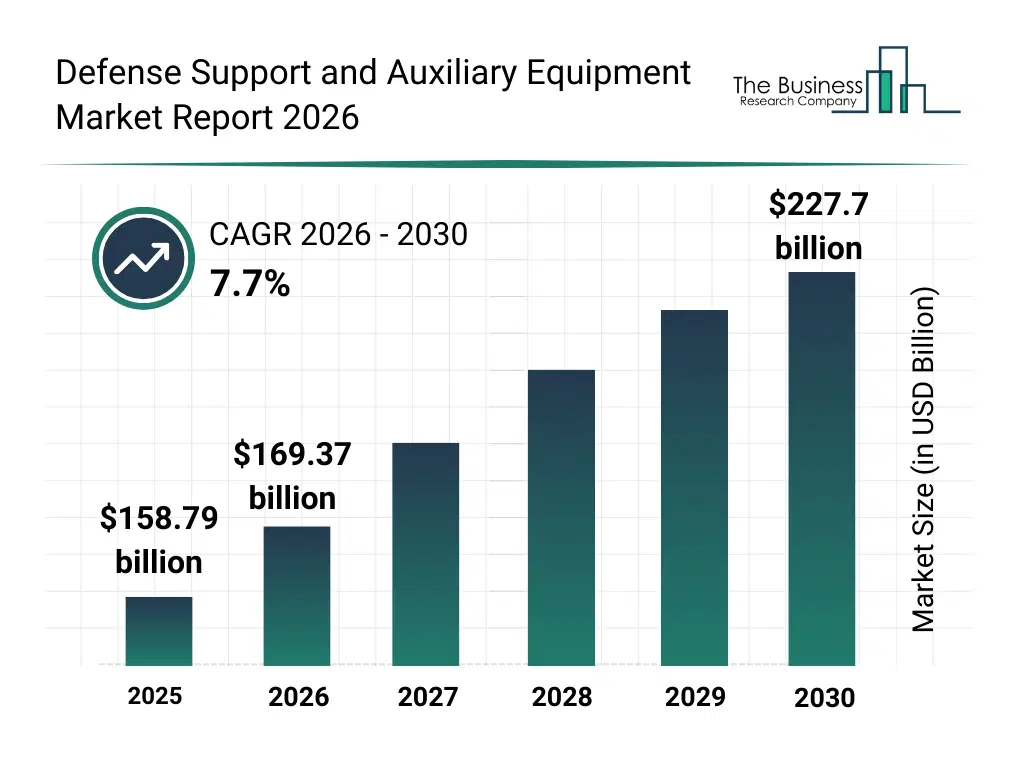
What Is The Defense Support and Auxiliary Equipment Market Size and Share 2026?
The defense support and auxiliary equipment market size has grown strongly in recent years. It will grow from $158.79 billion in 2025 to $169.37 billion in 2026 at a compound annual growth rate (CAGR) of 6.7%. The growth in the historic period can be attributed to expansion of global defense infrastructure and military bases, technological advancements in radar and sonar systems, growth in satellite-based defense communication systems, increased procurement of mobile and fixed defense support equipment, government defense contracts driving production and innovation.What Is The Defense Support and Auxiliary Equipment Market Growth Forecast?
The defense support and auxiliary equipment market size is expected to see strong growth in the next few years. It will grow to $227.7 billion in 2030 at a compound annual growth rate (CAGR) of 7.7%. The growth in the forecast period can be attributed to rising adoption of next-generation radar, sonar, and satellite systems, growth in defense modernization programs globally, integration of ai and autonomous systems in defense support equipment, increasing investment in mobile and deployable defense solutions, expansion of maintenance and support services for defense auxiliary systems. Major trends in the forecast period include increasing adoption of isr systems in defense operations, rising demand for military communication and navigation equipment, expansion of satellite-based defense support systems, growing investment in naval and airborne defense auxiliary equipment, enhanced logistics and transport solutions for military deployments.
Global Defense Support and Auxiliary Equipment Market Segmentation
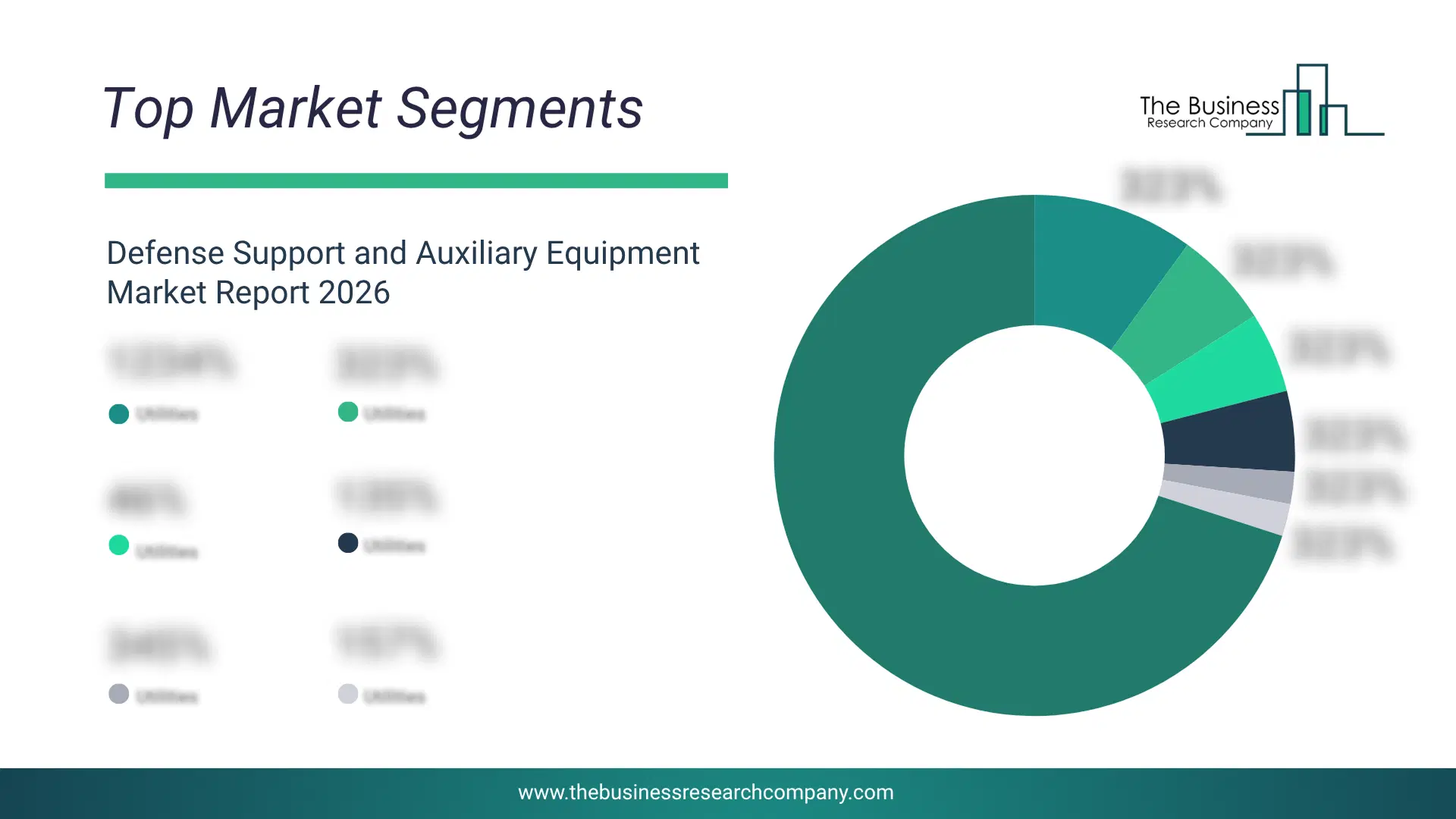
1) By Type: Military Radars, Military Satellites, Other Defense Support And Auxiliary Equipment 2) By Payload Type: Communication Payload, Navigation Payload, Imaging Payload, Others 3) By Application: Intelligence, Surveillance, And Reconnaissance (Isr), Communication, Navigation Subsegments: 1) By Military Radars: Airborne Radars, Ground-Based Radars, Naval Radars, Space-Based Radars, Other Military Radars 2) By Military Satellites: Communication Satellites, Reconnaissance Satellites, Navigation Satellites, Earth Observation Satellites, Other Military Satellites 3) By Other Defense Support And Auxiliary Equipment: Military Communication Equipment, Military Sensors And Detectors, Defense Logistics Equipment, Military Transport Vehicles, Other Defense Support EquipmentWhat Is Driver Of The Defense Support and Auxiliary Equipment Market?
Rapid advances in wireless technology and miniaturization (which refers to designing smaller components for equipment) are expected to drive innovation in the defense market, thus driving the market during the forecast period. Furthermore, technologies such as 3D printing, artificial intelligence, and big data analytics are being used during the manufacturing process, resulting in higher productivity, lower operating costs, and higher margins. Lower operating costs lead to higher margins. This allows companies to expand production and increase product portfolios, thus driving the growth of the defense support and auxiliary equipment industry.Key Players In The Global Defense Support and Auxiliary Equipment Market
Major companies operating in the defense support and auxiliary equipment market are Raytheon Technologies Corporation, Thales Group, The Boeing Company, Leidos, Leonardo SpA, ManTech International Corp., L3 Technologies Inc., Rostec State Corporation, Bae Systems plc, RTX Corp, Lockheed Martin Corporation, General Dynamics Corporation, British Aerospace Engines Systems Plc, Northrop Grumman Corporation, Safran S.A, Honeywell International Inc., United Technologies Corporation, Elbit Systems Ltd., Rheinmetall AG, Harris Corporation, Cobham Ltd., Moog Inc., Meggitt Plc, Curtiss-Wright Corporation., Teledyne FLIR LLC, Ultra Electronics Holdings Plc, Esterline Technologies Corporation, Kongsberg Gruppen ASA, British Foreign & Colonial Automatic Light Controlling Company Ltd., QinetiQ Group Plc, Kratos Defense & Security Solutions Inc., AVAV - AeroVironment Inc., Textron Inc., Cubic Corp, Science Applications International Corporation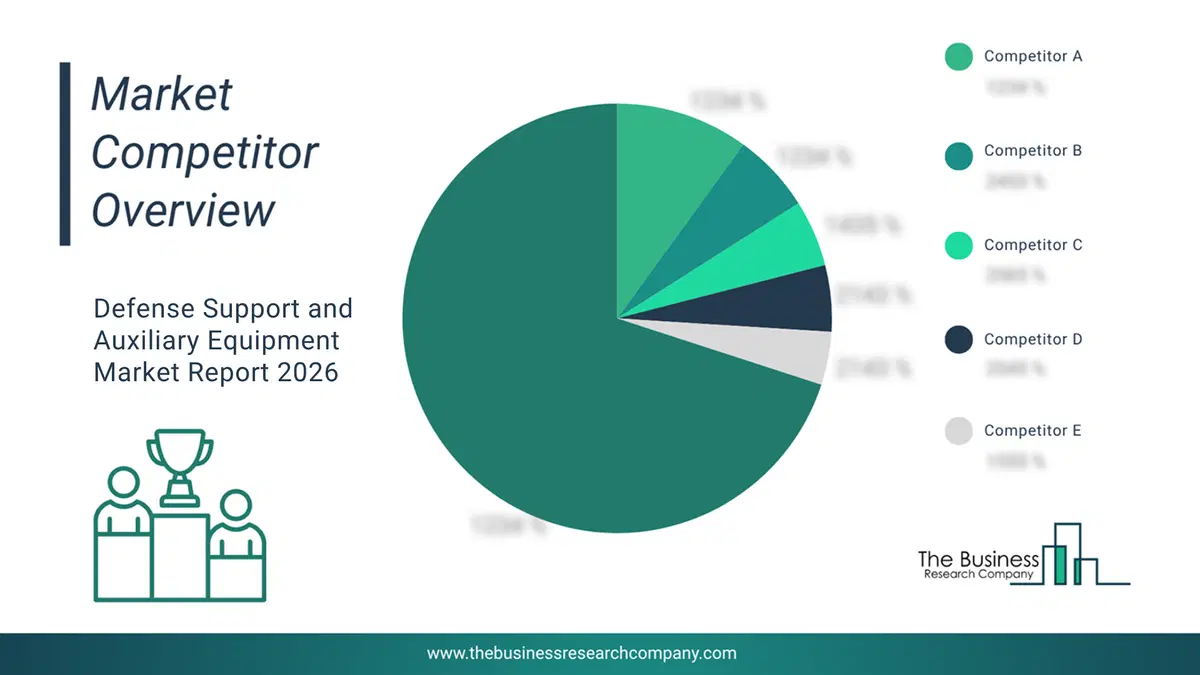
This chart is for illustrative purposes; the full report includes a detailed competitor analysis and comprehensive overview of the top 10 companies in the market.
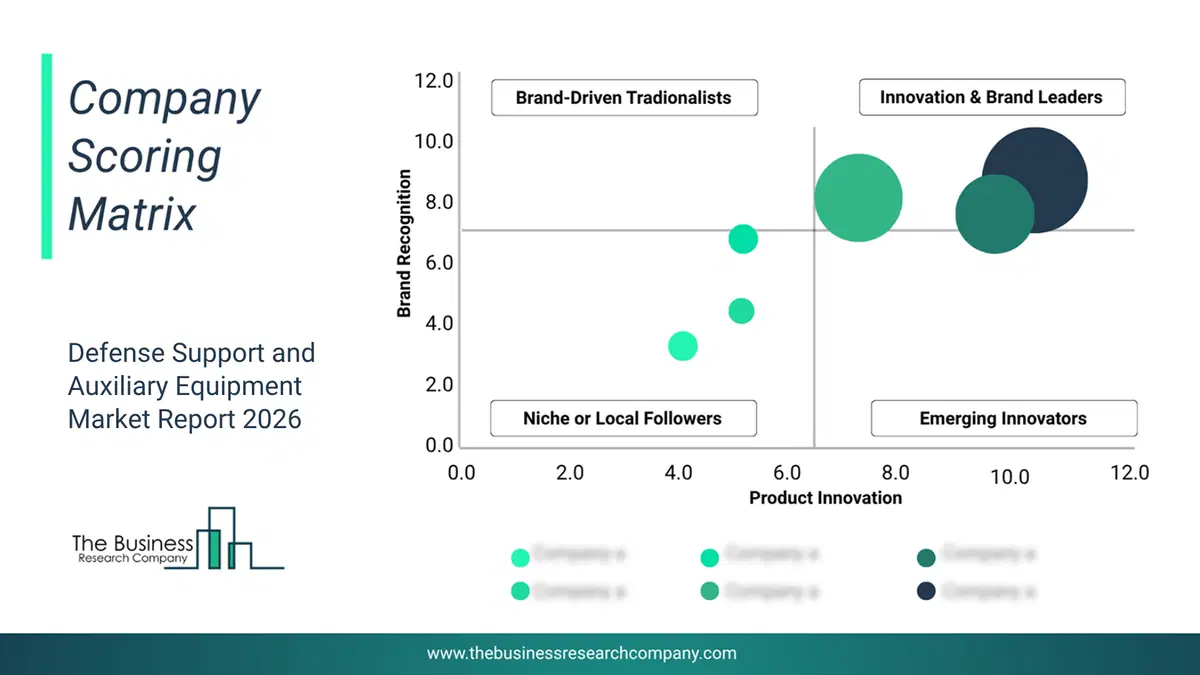
This chart maps companies by product innovation and brand strength, with bubble size indicating relative revenue, helping identify market leaders, challengers, and niche players. This is an illustrative chart; the full report provides a complete and accurate competitive analysis.
Global Defense Support and Auxiliary Equipment Market Trends and Insights
Major companies operating in the defense support and auxiliary equipment market are focused on introducing domestically built submarines to gain a competitive edge in the market. A domestically built submarine is a submarine that is designed, developed, and constructed within the country's borders without relying on foreign technology or expertise. The submarine is a critical component of defense auxiliary equipment, and it is used to protect naval vessels and other assets from hostile attacks in the maritime domain. In September 2023, Taiwan, a country in East Asia, launched its first domestically built submarine, representing an important achievement in the replacement of an outdated naval capacity. The diesel-electric attack submarine, named Hai Kun after a legendary fish in Chinese folklore, was launched in the southern city of Kaohsiung at the CSBC (China Shipbuilding Corporation) Shipyard. The submarine is equipped with digital sonar systems, integrated combat systems, and auxiliary equipment systems, including periscopes.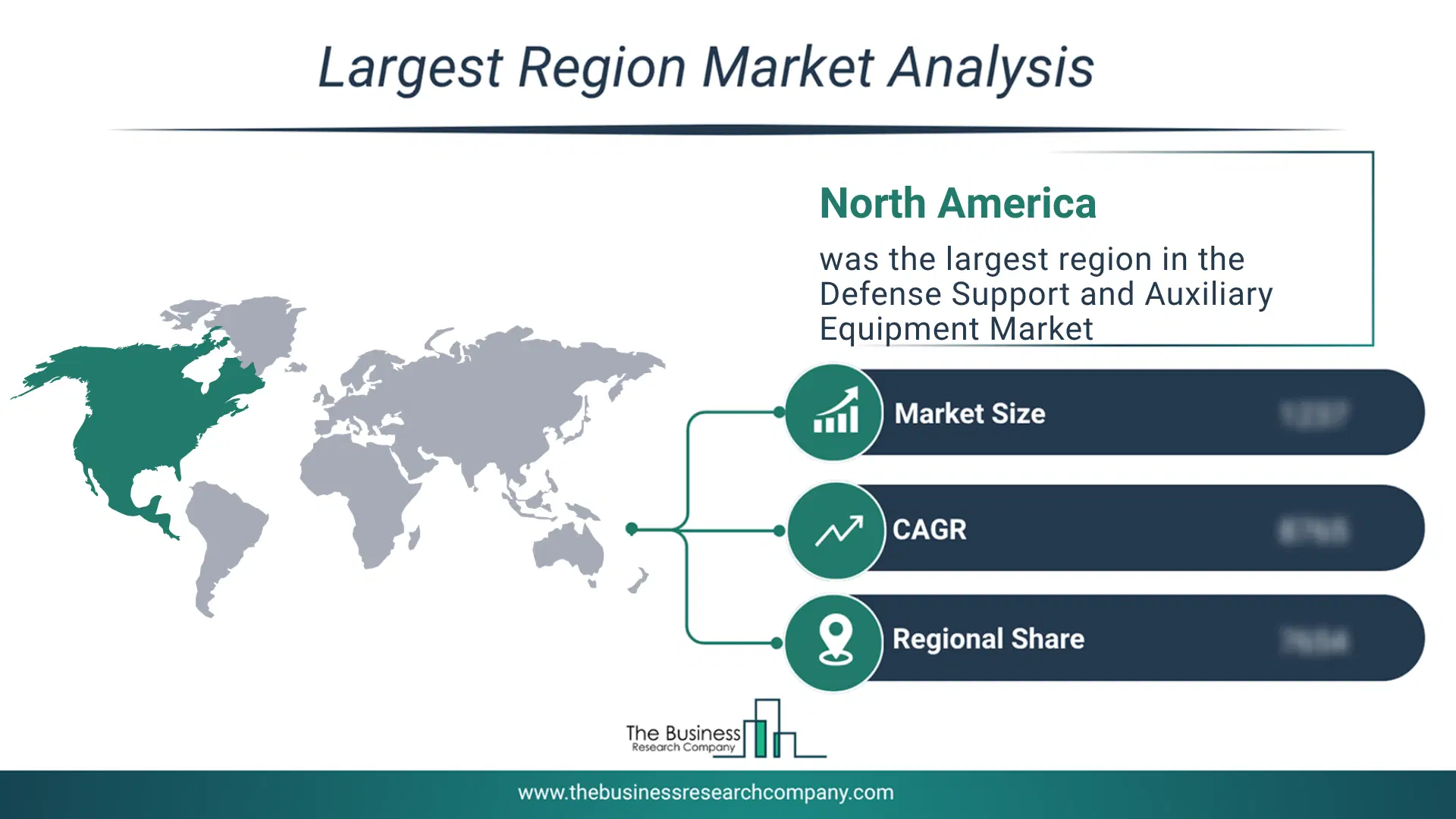
Regional Insights
North America was the largest region in defense support and auxiliary equipment market in 2025. Asia-Pacific is expected to be the fastest growing region in the forecast period. The regions covered in this market report are Asia-Pacific, South East Asia, Western Europe, Eastern Europe, North America, South America, Middle East, Africa. The countries covered in this market report are China, India, Japan, Australia, Indonesia, South Korea, Bangladesh, Thailand, Vietnam, Malaysia, Singapore, Philippines, Hong Kong, Taiwan, New Zealand, UK, Germany, France, Italy, Spain, Austria, Belgium, Denmark, Finland, Ireland, Netherlands, Norway, Portugal, Sweden, Switzerland, Russia, Czech Republic, Poland, Romania, Ukraine, USA, Canada, Mexico, Brazil, Chile, Argentina, Colombia, Peru, Saudi Arabia, Israel, Iran, Turkey, UAE, Egypt, Nigeria, South Africa.What Defines the Defense Support and Auxiliary Equipment Market?
The defense support and auxiliary equipment market consists of sales of defense support and auxiliary equipment such as radars, and satellites. Values in this market are ‘factory gate’ values, that is the value of goods sold by the manufacturers or creators of the goods, whether to other entities (including downstream manufacturers, wholesalers, distributors, and retailers) or directly to end customers. The value of goods in this market includes related services sold by the creators of the goods.How is Market Value Defined and Measured?
The market value is defined as the revenues that enterprises gain from the sale of goods and/or services within the specified market and geography through sales, grants, or donations in terms of the currency (in USD unless otherwise specified). The revenues for a specified geography are consumption values that are revenues generated by organizations in the specified geography within the market, irrespective of where they are produced. It does not include revenues from resales along the supply chain, either further along the supply chain or as part of other products.
This chart presents market attractiveness based on a quantitative evaluation of growth, competition, strategic alignment, and risk, offering a clear view of opportunity areas for decision-making. This chart is for illustrative purposes; the full report contains the complete analysis.

This chart highlights the Total Addressable Market (TAM) by estimating the maximum revenue opportunity using an assumption-driven approach, supporting strategic planning and opportunity sizing across markets. The chart is illustrative; the full report provides a more comprehensive analysis.
What Key Data and Analysis Are Included in the Defense Support and Auxiliary Equipment Market Report 2026?
The defense support and auxiliary equipment market research report is one of a series of new reports from The Business Research Company that provides market statistics, including industry global market size, regional shares, competitors with the market share, detailed market segments, market trends and opportunities, and any further data you may need to thrive in the defense support and auxiliary equipment industry. The market research report delivers a complete perspective of everything you need, with an in-depth analysis of the current and future state of the industry.Defense Support and Auxiliary Equipment Market Report Forecast Analysis
| Report Attribute | Details |
|---|---|
| Market Size Value In 2026 | $169.37 billion |
| Revenue Forecast In 2030 | $227.7 billion |
| Growth Rate | CAGR of 7.7% from 2026 to 2030 |
| Base Year For Estimation | 2025 |
| Actual Estimates/Historical Data | 2020-2025 |
| Forecast Period | 2026 - 2030 |
| Market Representation | Revenue in USD Billion and CAGR from 2026 to 2030 |
| Segments Covered | Type, Payload Type, Application |
| Regional Scope | Asia-Pacific, Western Europe, Eastern Europe, North America, South America, Middle East, Africa |
| Country Scope | The countries covered in the defense support and auxiliary equipment market report are China, India, Japan, Australia, Indonesia, South Korea, Bangladesh, Thailand, Vietnam, Malaysia, Singapore, Philippines, Hong Kong, Taiwan, New Zealand, UK, Germany, France, Italy, Spain, Austria, Belgium, Denmark, Finland, Ireland, Netherlands, Norway, Portugal, Sweden, Switzerland, Russia, Czech Republic, Poland, Romania, Ukraine, USA, Canada, Mexico, Brazil, Chile, Argentina, Colombia, Peru, Saudi Arabia, Israel, Iran, Turkey, UAE, Egypt, Nigeria, South Africa. |
| Key Companies Profiled | Raytheon Technologies Corporation, Thales Group, The Boeing Company, Leidos, Leonardo SpA, ManTech International Corp., L3 Technologies Inc., Rostec State Corporation, Bae Systems plc, RTX Corp, Lockheed Martin Corporation, General Dynamics Corporation, British Aerospace Engines Systems Plc, Northrop Grumman Corporation, Safran S.A, Honeywell International Inc., United Technologies Corporation, Elbit Systems Ltd., Rheinmetall AG, Harris Corporation, Cobham Ltd., Moog Inc., Meggitt Plc, Curtiss-Wright Corporation., Teledyne FLIR LLC, Ultra Electronics Holdings Plc, Esterline Technologies Corporation, Kongsberg Gruppen ASA, British Foreign & Colonial Automatic Light Controlling Company Ltd., QinetiQ Group Plc, Kratos Defense & Security Solutions Inc., AVAV - AeroVironment Inc., Textron Inc., Cubic Corp, Science Applications International Corporation |
| Customization Scope | Request for Customization |
| Pricing And Purchase Options | Explore Purchase Options |