
Delivery Robots Market Report 2026
Global Outlook – By Component (Hardware, Software), By Number Of Wheels (2-Wheel Robots, 3-Wheel Robots, 4-Wheel Robots, 6-Wheel Robots), By Speed Limit (Upto 3 Kph, High Than 3 Kph Upto 6 Kph, Higher Than 6 Kph), By Load Carrying Capacity (Upto 10 Kg, More Than 10 Kg Upto 50 Kg, More Than 50 Kg), By End-Use (Food And Beverage, Retail, Healthcare, Postal Service, Other End-Uses) – Market Size, Trends, Strategies, and Forecast to 2030
Delivery Robots Market Overview
• Delivery Robots market size has reached to $0.39 billion in 2025 • Expected to grow to $0.88 billion in 2030 at a compound annual growth rate (CAGR) of 17.6% • Growth Driver: The Influence Of Rising E-Commerce And Online Food Industries • Market Trend: Transforming Food Service With AI-Driven Delivery Robots • North America was the largest region in 2025 and Asia-Pacific is the fastest growing region.What Is Covered Under Delivery Robots Market?
Delivery robots, also known as autonomous delivery robots or delivery drones, are unmanned vehicles designed to transport goods, parcels, or food items from one location to another autonomously, without direct human intervention. These robots utilize a combination of sensors, cameras, GPS navigation, and artificial intelligence algorithms to navigate their surroundings, avoid obstacles, and reach their destinations safely. The main types of components in delivery robots are hardware and software. Hardware refers to the physical components of the delivery robot, including the chassis, motors, sensors, and any other mechanical parts that contribute to their physical capabilities such as durability and maneuverability. They are categorized by number of wheels, including 2-wheel robots, 3-wheel robots, 4-wheel robots, and 6-wheel robots, with speed limits ranging from up to 3 kph, high enough to go up to 6 kph, and higher than 6 kph. Robots with different load-carrying capacities such as up to 10 kg, more than 10 kg, up to 50 kg, and more than 50 kg, are used by end-users in industries such as food and beverage, retail, healthcare, postal service, and others.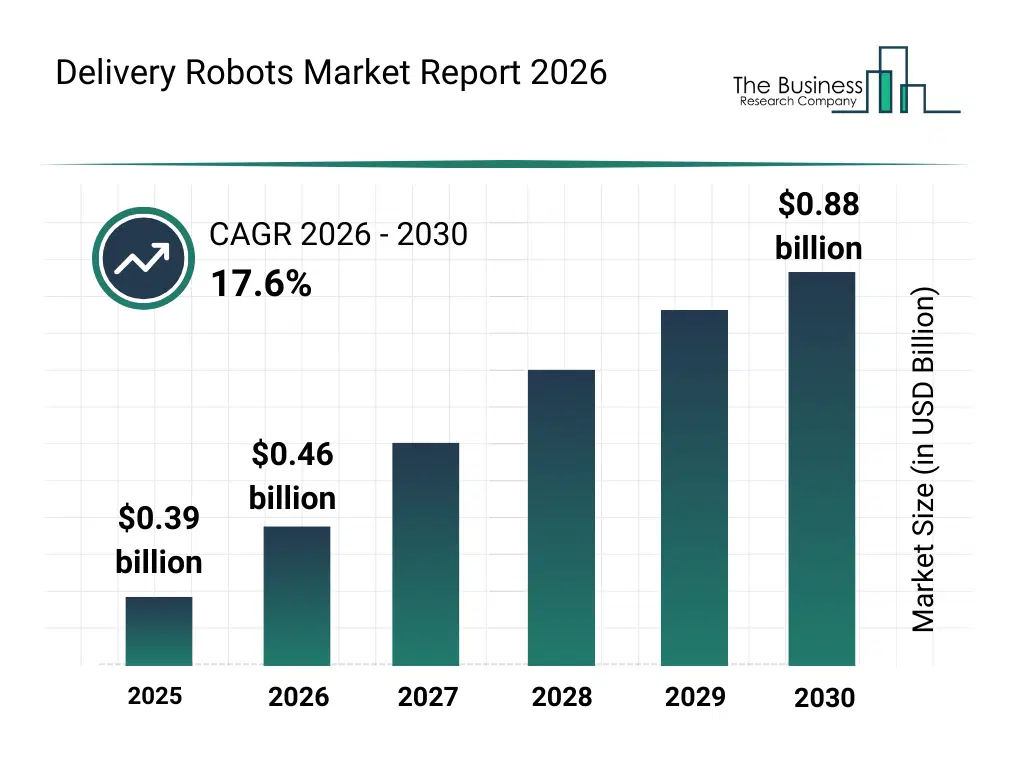
What Is The Delivery Robots Market Size and Share 2026?
The delivery robots market size has grown rapidly in recent years. It will grow from $0.39 billion in 2025 to $0.46 billion in 2026 at a compound annual growth rate (CAGR) of 17.4%. The growth in the historic period can be attributed to expansion of e-commerce and on-demand delivery services, advancements in autonomous navigation technologies, increasing labor shortages in logistics, pilot deployments in smart cities, supportive regulatory sandboxes.What Is The Delivery Robots Market Growth Forecast?
The delivery robots market size is expected to see rapid growth in the next few years. It will grow to $0.88 billion in 2030 at a compound annual growth rate (CAGR) of 17.6%. The growth in the forecast period can be attributed to increasing commercialization of autonomous delivery fleets, expansion into healthcare and postal services, rising investments in smart city infrastructure, growing focus on zero-emission delivery solutions, advances in robotics and AI algorithms. Major trends in the forecast period include expansion of last-mile autonomous delivery solutions, integration of ai-based navigation and obstacle avoidance, growth of fleet management platforms, rising adoption in urban logistics, focus on energy-efficient robotic designs.Tariff Impact On Delivery Robots Market
Tariffs are impacting the delivery robots market by increasing the cost of imported sensors, cameras, lithium-ion batteries, motors, and embedded control systems essential for autonomous operation. Urban delivery deployments in North America and Europe are most affected due to reliance on globally sourced robotic components, while Asia-Pacific manufacturers face export pricing pressures. These tariffs are raising production costs and slowing large-scale rollouts. At the same time, they are accelerating domestic component manufacturing, regional supply chain development, and innovation in cost-efficient autonomous delivery platforms.
Global Delivery Robots Market Segmentation
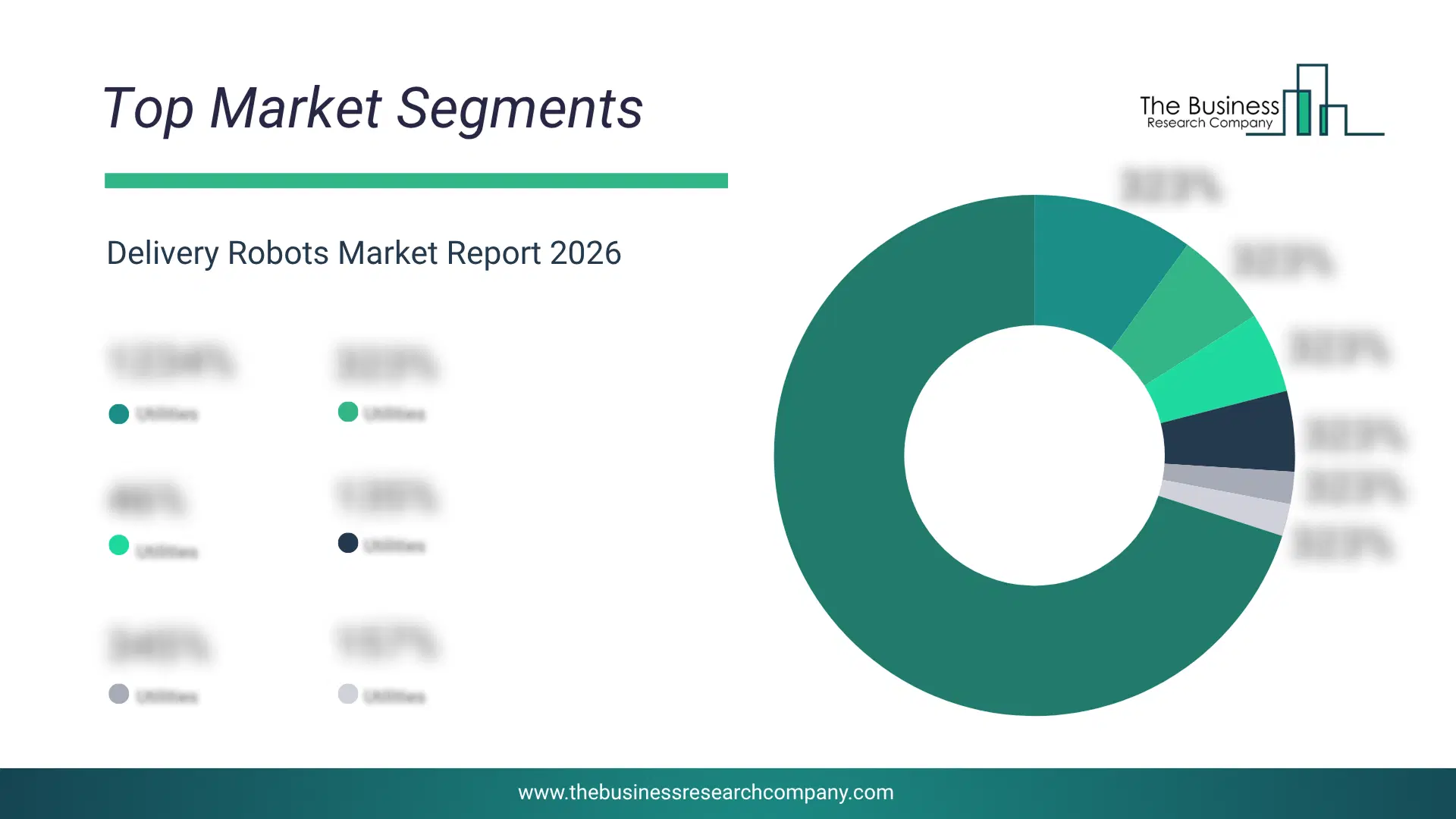
1) By Component: Hardware, Software 2) By Number Of Wheels: 2-Wheel Robots, 3-Wheel Robots, 4-Wheel Robots, 6-Wheel Robots 3) By Speed Limit: Upto 3 Kph, High Than 3 Kph Upto 6 Kph, Higher Than 6 Kph 4) By Load Carrying Capacity: Upto 10 Kg, More Than 10 Kg Upto 50 Kg, More Than 50 Kg 5) By End-Use: Food And Beverage, Retail, Healthcare, Postal Service, Other End-Uses Subsegments: 1) By Hardware: Motors, Sensors, Actuators, Power Supply, Control Systems, Chassis 2) By Software: Navigation Software, Control Software, Artificial Intelligence (AI) Software, Fleet Management Software, User Interface SoftwareWhat Is The Driver Of The Delivery Robots Market?
The rising e-commerce and online food industries are expected to propel the growth of the delivery robot market going forward. The e-commerce industry involves buying and selling goods and services online. In contrast, the online food industry specifically focuses on the digital ordering and delivery of food products and services. The rise of the e-commerce and online food industries can be attributed to the increasing digitalization of society, technological advancements, changing consumer preferences towards convenience, and the expansion of internet access. The e-commerce and online food industries use delivery robots to streamline last-mile delivery processes, reduce operational costs, enhance efficiency, and meet increasing consumer demand for fast and convenient delivery options, leveraging autonomous technology to navigate urban environments and deliver goods directly to customers' doorsteps. For instance, in February 2024, according to the data released by the United States Census Bureau, a US-based government agency, e-commerce sales in the USA were $1,118.7 billion in 2023, an increase of 7.6% from 2022. Therefore, the rising e-commerce and online food industries are driving the growth of the delivery robot industry.Key Players In The Global Delivery Robots Market
Major companies operating in the delivery robots market are LG Electronics Inc., Panasonic Corporation, Softbank Robotics Group Corp., ABB Ltd., Omron Corporation, Fanuc Corporation, Kuka AG, Amazon Robotics, Nuro Inc., Boston Dynamics Inc., Kiwibot, Aethon Inc., Savioke Inc., Bear Robotics Inc., Starship Technologies Inc., Connected Robotics Inc., PAL Robotics SL, Hyundai Robotics Co. Ltd., RobotLAB Inc., Refraction AI, Relay Robotics Inc., Robby Technologies Inc.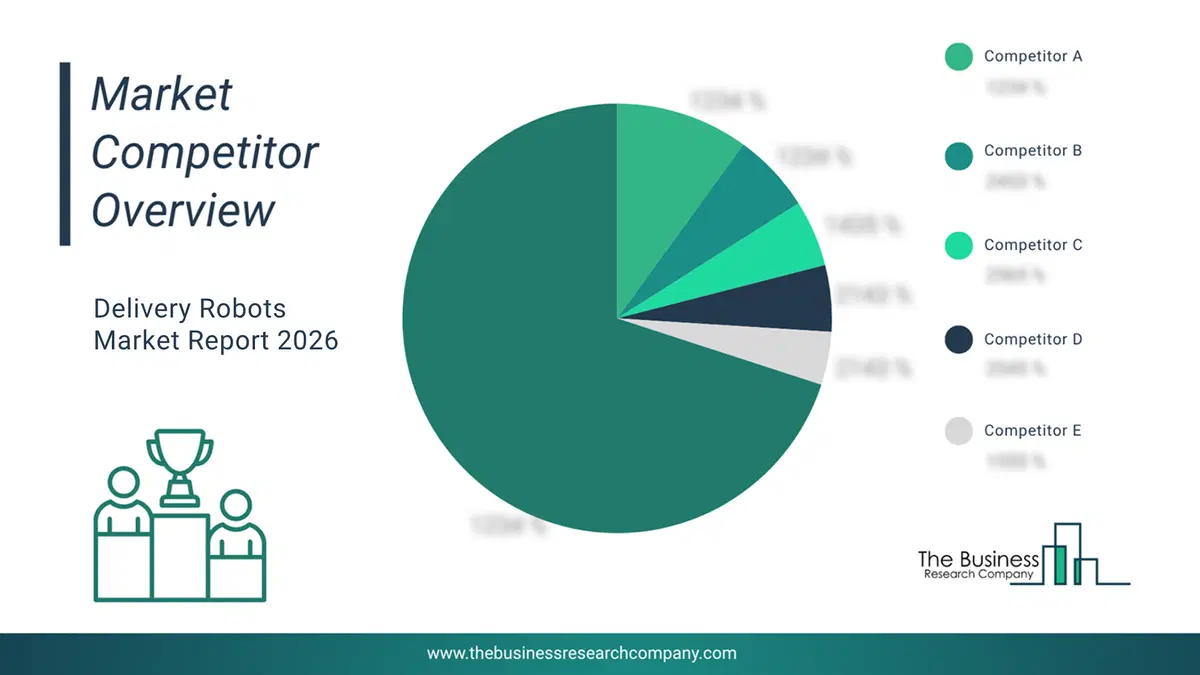
This chart is for illustrative purposes; the full report includes a detailed competitor analysis and comprehensive overview of the top 10 companies in the market.
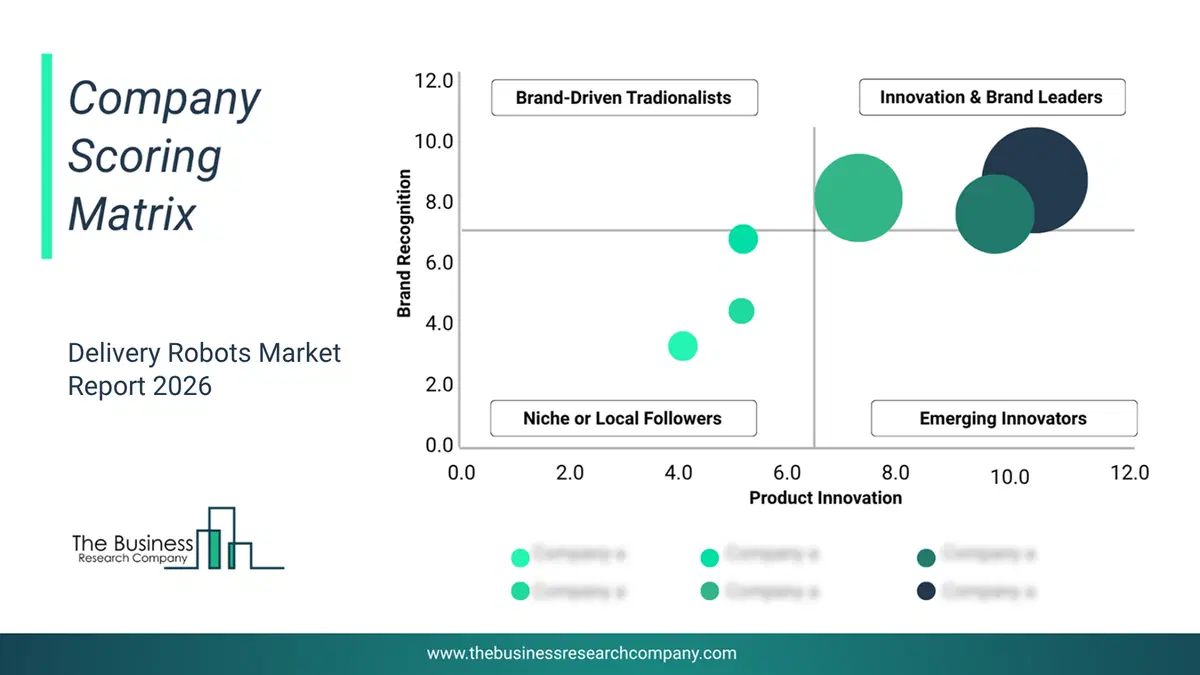
This chart maps companies by product innovation and brand strength, with bubble size indicating relative revenue, helping identify market leaders, challengers, and niche players. This is an illustrative chart; the full report provides a complete and accurate competitive analysis.
Global Delivery Robots Market Trends and Insights
Major companies operating in the delivery robot market are focusing on developing autonomous delivery robots such as Servi, to optimize route planning, adapt to dynamic environments, and enhance efficiency through AI-driven decision-making processes. Servi is an autonomous delivery robot designed to transport goods from one location to another without human intervention, navigating sidewalks, streets, or designated routes to complete last-mile deliveries. For instance, in February 2023, Bear Robotics Inc., a US-based engineering and robotics design company, launched Servi, a new service robot designed to revolutionize the food service industry by assisting staff in serving drinks and food, clearing tables, and allowing employees to focus on delivering outstanding service to customers and patients. Servi is equipped with AI and autonomous robot technology, 100% self-driving capabilities, light detection and ranging (lidar) sensors, and multiple cameras for intelligent navigation. It can learn different table locations and return to its post after deliveries.What Are Latest Mergers And Acquisitions In The Delivery Robots Market?
In April 2024, Kiwibot, a US-based robotics company, acquired AUTO Mobility Solutions for an undisclosed amount. The acquisition aims to enhance the security and technological capabilities of Kiwibot’s delivery robots. This strategic move addresses growing privacy concerns in the robotics industry, particularly regarding intelligent robots sourced from China and deployed in Western markets. AUTO Mobility Solutions, a China-based research and development company, specializes in mobile AI and self-driving technologies for indoor use.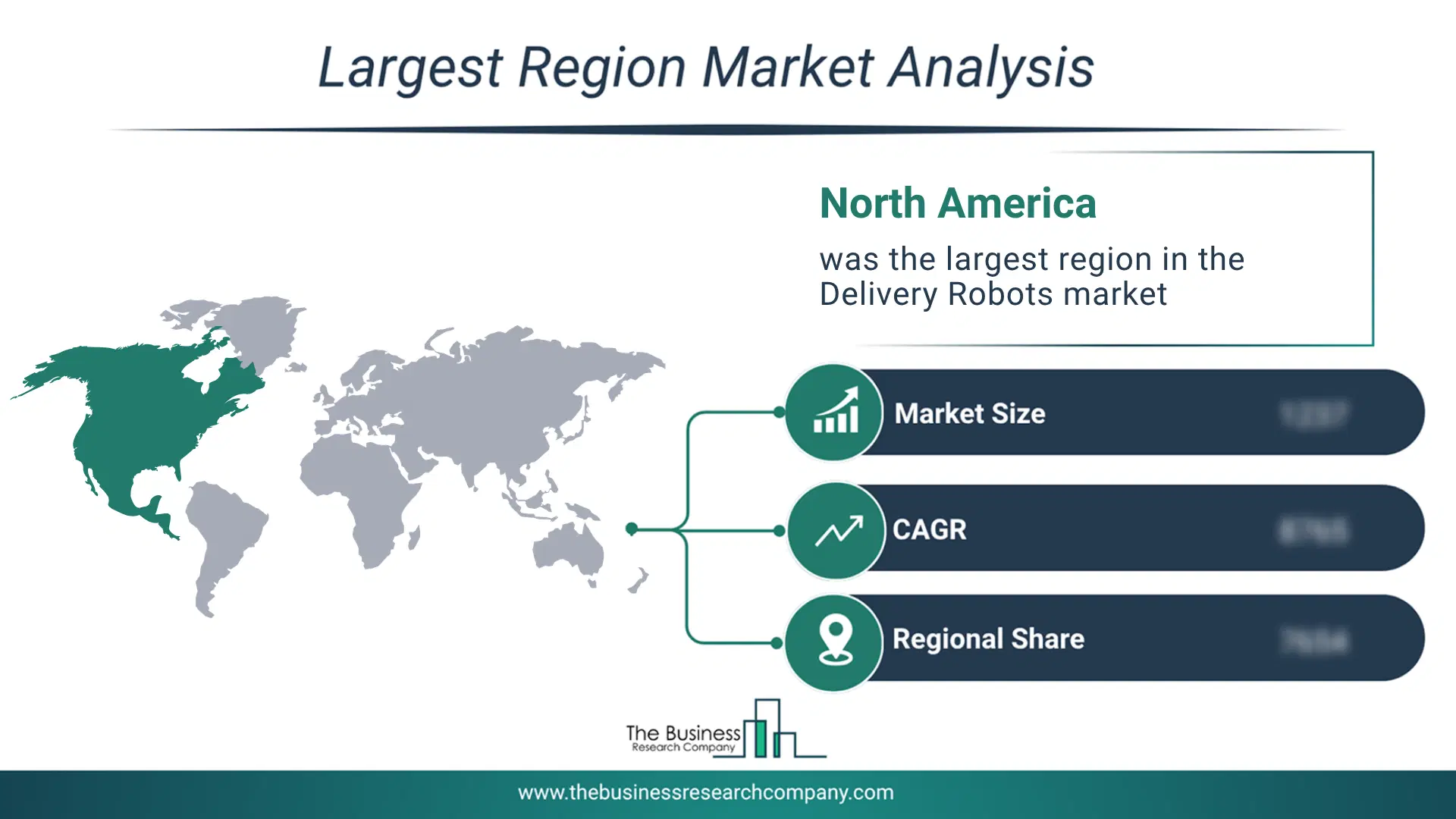
Regional Outlook
North America was the largest region in the delivery robots market in 2025. Asia-Pacific is expected to be the fastest growing region in the market. The regions covered in this market report are Asia-Pacific, South East Asia, Western Europe, Eastern Europe, North America, South America, Middle East, Africa The countries covered in this market report are Australia, Brazil, China, France, Germany, India, Indonesia, Japan, Taiwan, Russia, South Korea, UK, USA, Canada, Italy, Spain.What Defines the Delivery Robots Market?
The delivery robots market consists of sales of ground-based wheeled robots, ground-based autonomous vehicles, aerial drones, robotic couriers, and maritime or underwater robots. Values in this market are ‘factory gate’ values, that is the value of goods sold by the manufacturers or creators of the goods, whether to other entities (including downstream manufacturers, wholesalers, distributors and retailers) or directly to end customers. The value of goods in this market includes related services sold by the creators of the goods.How is Market Value Defined and Measured?
The market value is defined as the revenues that enterprises gain from the sale of goods and/or services within the specified market and geography through sales, grants, or donations in terms of the currency (in USD unless otherwise specified). The revenues for a specified geography are consumption values that are revenues generated by organizations in the specified geography within the market, irrespective of where they are produced. It does not include revenues from resales along the supply chain, either further along the supply chain or as part of other products.
This chart presents market attractiveness based on a quantitative evaluation of growth, competition, strategic alignment, and risk, offering a clear view of opportunity areas for decision-making. This chart is for illustrative purposes; the full report contains the complete analysis.

This chart highlights the Total Addressable Market (TAM) by estimating the maximum revenue opportunity using an assumption-driven approach, supporting strategic planning and opportunity sizing across markets. The chart is illustrative; the full report provides a more comprehensive analysis.
What Key Data and Analysis Are Included in the Delivery Robots Market Report 2026?
The delivery robots market research report is one of a series of new reports from The Business Research Company that provides market statistics, including industry global market size, regional shares, competitors with the market share, detailed market segments, market trends and opportunities, and any further data you may need to thrive in the delivery robots industry. The market research report delivers a complete perspective of everything you need, with an in-depth analysis of the current and future state of the industry.Delivery Robots Market Report Forecast Analysis
| Report Attribute | Details |
|---|---|
| Market Size Value In 2026 | $0.46 billion |
| Revenue Forecast In 2030 | $0.88 billion |
| Growth Rate | CAGR of 17.6% from 2026 to 2030 |
| Base Year For Estimation | 2025 |
| Actual Estimates/Historical Data | 2020-2025 |
| Forecast Period | 2026 - 2030 |
| Market Representation | Revenue in USD Billion and CAGR from 2026 to 2030 |
| Segments Covered | Component, Number Of Wheels, Speed Limit, Load Carrying Capacity, End-Use |
| Regional Scope | Asia-Pacific, Western Europe, Eastern Europe, North America, South America, Middle East, Africa |
| Key Companies Profiled | LG Electronics Inc., Panasonic Corporation, Softbank Robotics Group Corp., ABB Ltd., Omron Corporation, Fanuc Corporation, Kuka AG, Amazon Robotics, Nuro Inc., Boston Dynamics Inc., Kiwibot, Aethon Inc., Savioke Inc., Bear Robotics Inc., Starship Technologies Inc., Connected Robotics Inc., PAL Robotics SL, Hyundai Robotics Co. Ltd., RobotLAB Inc., Refraction AI, Relay Robotics Inc., Robby Technologies Inc. |
| Customization Scope | Request for Customization |
| Pricing And Purchase Options | Explore Purchase Options |