

Delta Robots Market Report 2026
Global Outlook – By Axis Type (Double Axis, Three Axis, Four Axis, Five Axis), By Application (Assembly, Pick And Place, Material Handling, Packaging), By End-User (Food And Beverages, Electrical And Electronics, Pharmaceuticals) – Market Size, Trends, Strategies, and Forecast to 2030
Delta Robots Market Overview
• Delta Robots market size has reached to $5.87 billion in 2025 • Expected to grow to $10.37 billion in 2030 at a compound annual growth rate (CAGR) of 12.3% • Growth Driver: Manufacturing Industry Surge Fuels Delta Robots Market Growth • Market Trend: Emergence Of Five-Axis Delta Robots In The Market Leaders' Product Portfolios • Asia-Pacific was the largest region and fastest growing region.What Is Covered Under Delta Robots Market?
Delta Robots are types of parallel robots that have arms that are manipulated either linearly or rotary and are coupled to a universal joint at the end effector. These robots are used in applications that require fast and precise movements, such as pick-and-place operations in manufacturing or assembly lines. The main axis types of delta robots are double-axis, three-axis, four-axis, and five-axis. A double axis, also known as a dual axis, is a type of chart that combines two different types of charts in a single graph. Delta robots play a significant role in double-axis systems, particularly in fast pick-and-place tasks, conveyor belt picking, sorting, and stacking, it has various applications such as assembly, pick and place, material handling, and packaging, and they can be used in different industries such as food and beverages, electrical and electronics, pharmaceuticals.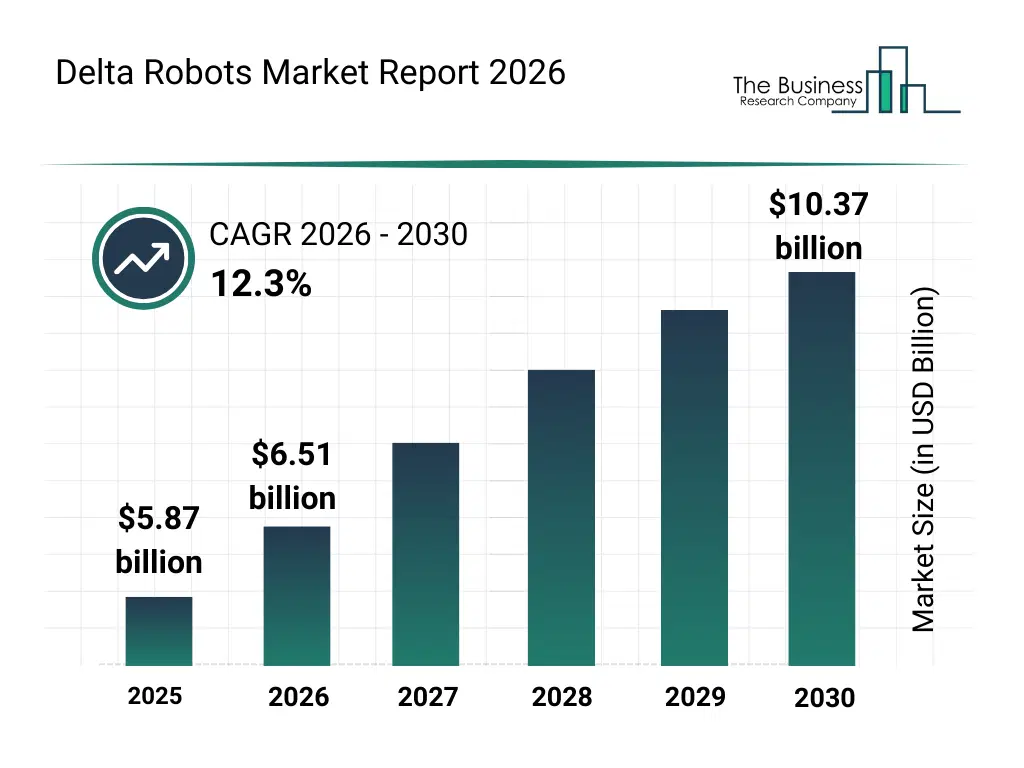
What Is The Delta Robots Market Size and Share 2026?
The delta robots market size has grown rapidly in recent years. It will grow from $5.87 billion in 2025 to $6.51 billion in 2026 at a compound annual growth rate (CAGR) of 11.0%. The growth in the historic period can be attributed to expansion of automated packaging lines, increasing demand for high-speed assembly solutions, rising labor cost pressures, growing use of robotics in electronics manufacturing, improved availability of precision actuators.What Is The Delta Robots Market Growth Forecast?
The delta robots market size is expected to see rapid growth in the next few years. It will grow to $10.37 billion in 2030 at a compound annual growth rate (CAGR) of 12.3%. The growth in the forecast period can be attributed to increasing adoption of smart factories, rising demand for flexible robotic automation, expansion of pharmaceutical packaging automation, growing integration of AI-based motion control, increasing investments in robotics R&D. Major trends in the forecast period include increasing deployment of high-speed pick-and-place systems, rising adoption in food and beverage automation, growing integration of vision-guided delta robots, expansion of compact robotic cells, enhanced focus on precision and throughput.Tariff Impact On Delta Robots Market
Tariffs are significantly impacting the delta robots market by increasing the cost of imported servo motors, precision actuators, controllers, sensors, and high-grade structural materials used in robot manufacturing. These impacts are most pronounced in Asia-Pacific and Europe, where a large share of delta robot production and component sourcing is export-oriented and dependent on cross-border supply chains. Higher tariffs are raising system integration costs for food processing, electronics, and pharmaceutical manufacturers, slowing deployment timelines for automation projects. At the same time, tariffs are encouraging local assembly, regional sourcing of components, and long-term investments in domestic robotics manufacturing ecosystems.
Global Delta Robots Market Segmentation
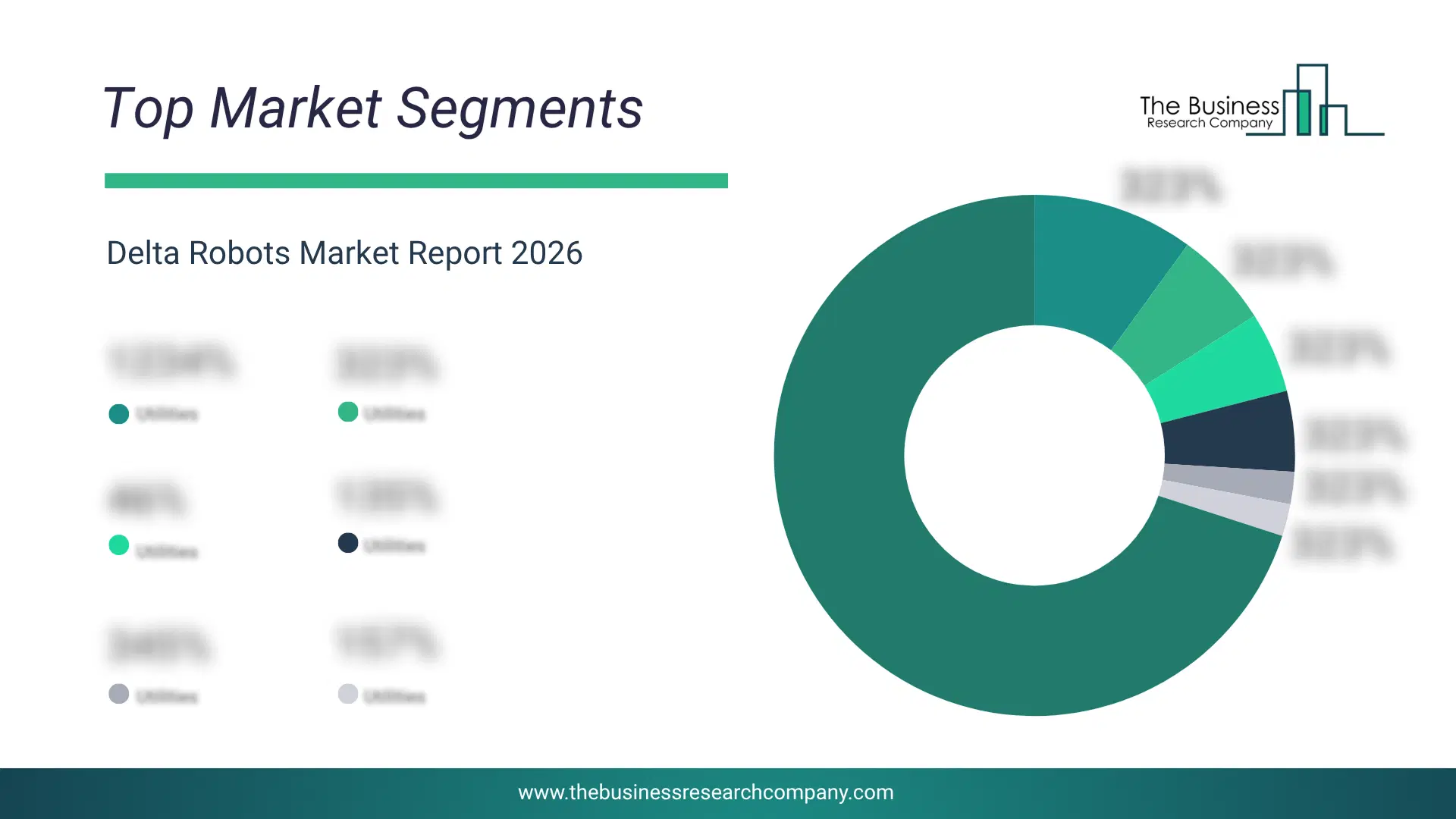
1) By Axis Type: Double Axis, Three Axis, Four Axis, Five Axis 2) By Application: Assembly, Pick And Place, Material Handling, Packaging 3) By End-User: Food And Beverages, Electrical And Electronics, Pharmaceuticals Subsegments: 1) By Double Axis: Two Degrees Of Freedom (2-DOF) Delta Robots 2) By Three Axis: Standard Three-Axis Delta Robots, High-Speed Three-Axis Delta Robots 3) By Four Axis: Extended Four-Axis Delta Robots 4) By Five Axis: Advanced Five-Axis Delta RobotsWhat Is The Driver Of The Delta Robots Market?
The rapid growth of the manufacturing industry is expected to propel the delta robots market forward. The manufacturing industry refers to the processes and businesses involved in transforming raw materials or components into finished goods. The manufacturing industry uses delta robots for high-speed and precision tasks, such as pick-and-place operations, due to their parallel structure, which enables rapid and accurate movements, enhancing overall efficiency in production lines. For instance, in September 2024, according to the Office for National Statistics, a UK-based government department, UK manufacturers' product sales reached $603.53 billion (£456.1 billion) in 2023, rising by $22.76 billion (£17.2 billion) (3.9%) from the $580.79 billion (£438.9 billion) recorded in 2022. Therefore, the rapid expansion of the manufacturing industry is driving the growth of the delta robot’s market.Key Players In The Global Delta Robots Market
Major companies operating in the delta robots market are Robert Bosch GmbH, Panasonic Holdings Corp., DENSO Corp., MIDEA Group Co. Ltd., Mitsubishi Electric Corporation (Mitsubishi Robotics), ABB Ltd., Hiwin Technologies Corp., Delta Electronics Inc., Kawasaki Heavy Industries Ltd., Seiko Epson Corp., OMRON Corporation, FANUC Corporation, Kuka AG, Yaskawa Electric Corporation, NACHI FUJIKOSHI Corporation, Staubli International AG, igus GmbH, Wittmann Battenfeld Group, Siesun Robot and Automation Co. Ltd., Universal Robots A/S, Omron Adept Technologies Inc., SAS iXAPACK GLOBAL, GSK CNC Equipment Co. Ltd., Cama 1 S.p.A, ERND Automation & Engineering GmbH, B-KM Surface Systems GmbH, ONExia Inc., Rethink Robotics, Codian Robotics BV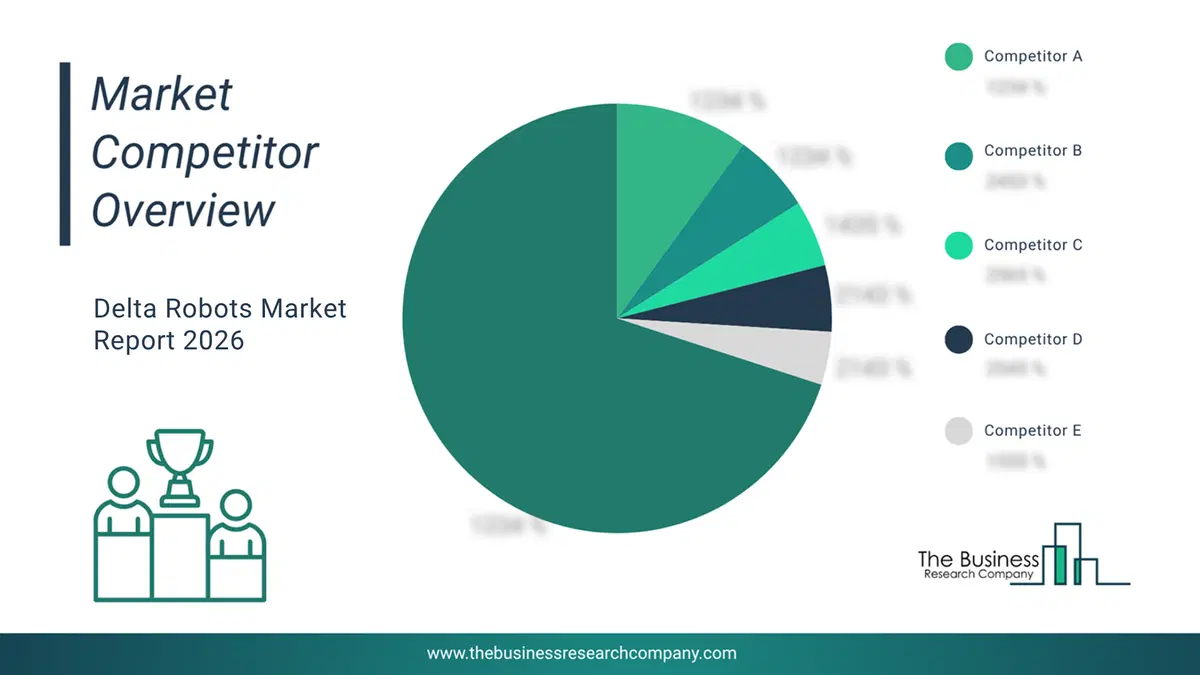
This chart is for illustrative purposes; the full report includes a detailed competitor analysis and comprehensive overview of the top 10 companies in the market.
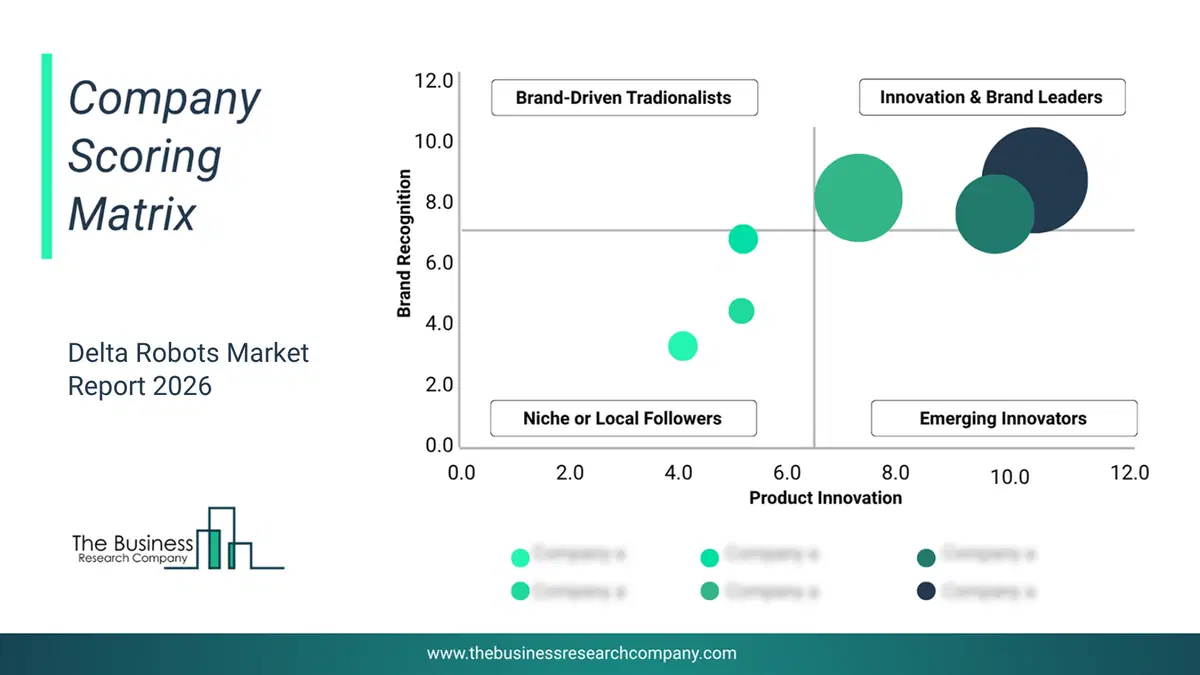
This chart maps companies by product innovation and brand strength, with bubble size indicating relative revenue, helping identify market leaders, challengers, and niche players. This is an illustrative chart; the full report provides a complete and accurate competitive analysis.
Global Delta Robots Market Trends and Insights
Major companies operating in the delta robot market are focusing on advanced solutions, such as the five-axis delta robot. A five-axis delta robot is a type of parallel robot that consists of three arms connected to universal joints at the base. For instance, in July 2023, ABB Ltd., a Switzerland-based automation company, launched the FlexPicker IRB 365, a five-axis delta robot that is the fastest in its class for lightweight product picking, packing, and re-orientation. The robot is powered by the OmniCoreTM C30 controller, which is the smallest Delta robot controller. The robot features a fifth axis of motion, which enables it to change the orientation of the picked item, making it suitable for applications such as packaging, parcel handling, and bottle handling.What Are Latest Mergers And Acquisitions In The Delta Robots Market?
In May 2023, Rockwell Automation, a US-based automation company, partnered with Autonox Robotics to enhance manufacturing capabilities. This partnership aimed at enhancing manufacturing capabilities through unified robot control solutions. This integration is expected to improve efficiency in the deployment and operation of robotic systems. Autonox Robotics is a Germany-based provider of delta robots.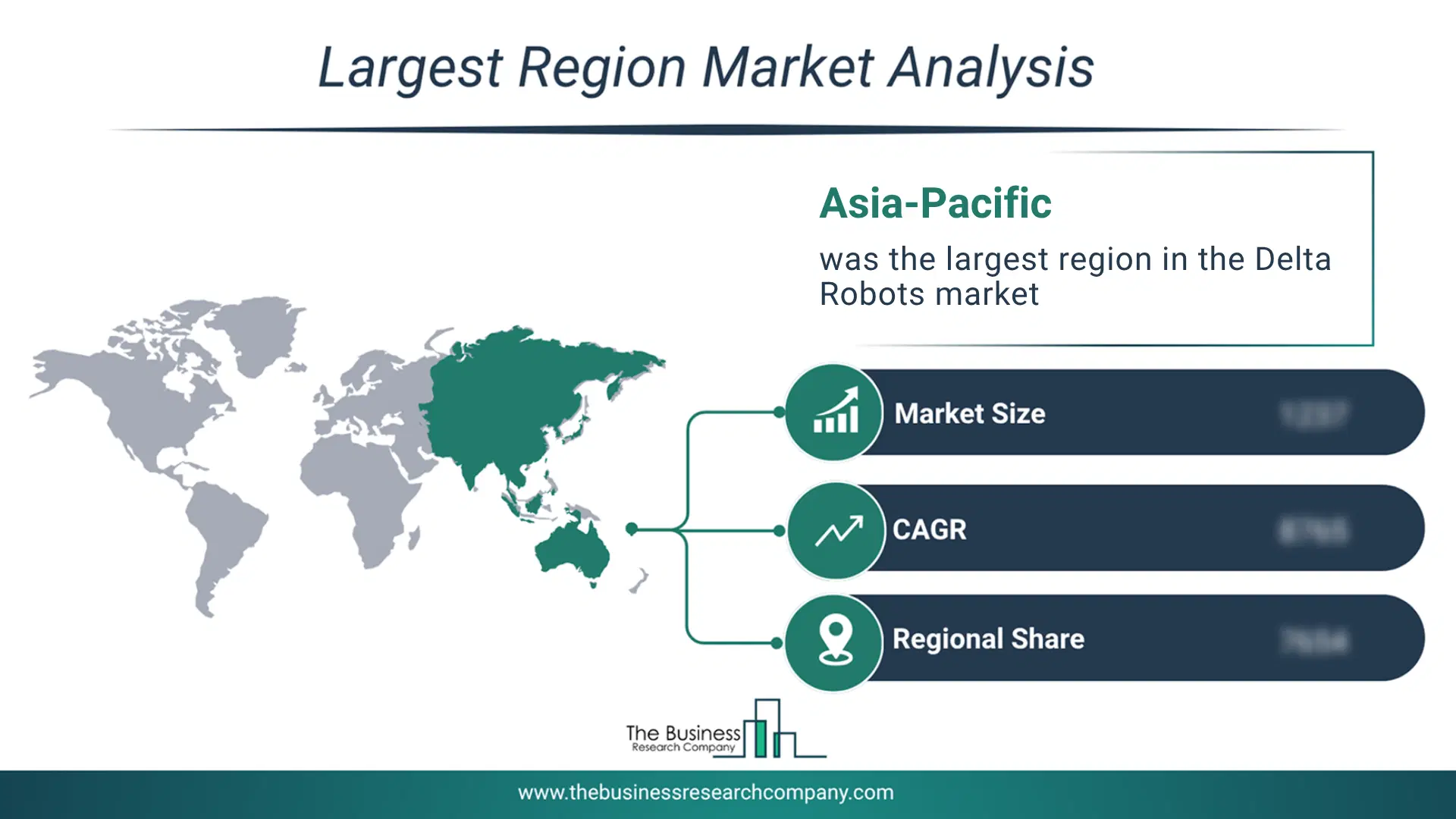
Regional Outlook
Asia-Pacific was the largest region in the delta robots market in 2025. Asia-Pacific is expected to be the fastest-growing region in the forecast period. The regions covered in this market report are Asia-Pacific, South East Asia, Western Europe, Eastern Europe, North America, South America, Middle East, Africa The countries covered in this market report are Australia, Brazil, China, France, Germany, India, Indonesia, Japan, Taiwan, Russia, South Korea, UK, USA, Canada, Italy, Spain.What Defines the Delta Robots Market?
The delta robots market consists of revenues earned by entities by providing services such as sorting, palletizing, machine loading/unloading, food processing, testing and inspection, and micro assembly. The market value includes the value of related goods sold by the service provider or included within the service offering. The delta robots market also includes sales of high-speed pick-and-place operations, controller systems, vision systems, conveyor systems, software, and programming tools. Values in this market are ‘factory gate’ values, that is the value of goods sold by the manufacturers or creators of the goods, whether to other entities (including downstream manufacturers, wholesalers, distributors, and retailers) or directly to end customers. The value of goods in this market includes related services sold by the creators of the goods.How is Market Value Defined and Measured?
The market value is defined as the revenues that enterprises gain from the sale of goods and/or services within the specified market and geography through sales, grants, or donations in terms of the currency (in USD unless otherwise specified). The revenues for a specified geography are consumption values that are revenues generated by organizations in the specified geography within the market, irrespective of where they are produced. It does not include revenues from resales along the supply chain, either further along the supply chain or as part of other products.
This chart presents market attractiveness based on a quantitative evaluation of growth, competition, strategic alignment, and risk, offering a clear view of opportunity areas for decision-making. This chart is for illustrative purposes; the full report contains the complete analysis.

This chart highlights the Total Addressable Market (TAM) by estimating the maximum revenue opportunity using an assumption-driven approach, supporting strategic planning and opportunity sizing across markets. The chart is illustrative; the full report provides a more comprehensive analysis.
What Key Data and Analysis Are Included in the Delta Robots Market Report 2026?
The delta robots market research report is one of a series of new reports from The Business Research Company that provides market statistics, including industry global market size, regional shares, competitors with the market share, detailed market segments, market trends and opportunities, and any further data you may need to thrive in the delta robots industry. The market research report delivers a complete perspective of everything you need, with an in-depth analysis of the current and future state of the industry.Delta Robots Market Report Forecast Analysis
| Report Attribute | Details |
|---|---|
| Market Size Value In 2026 | $6.51 billion |
| Revenue Forecast In 2030 | $10.37 billion |
| Growth Rate | CAGR of 12.3% from 2026 to 2030 |
| Base Year For Estimation | 2025 |
| Actual Estimates/Historical Data | 2020-2025 |
| Forecast Period | 2026 - 2030 |
| Market Representation | Revenue in USD Billion and CAGR from 2026 to 2030 |
| Segments Covered | Axis Type, Application, End-User |
| Regional Scope | Asia-Pacific, Western Europe, Eastern Europe, North America, South America, Middle East, Africa |
| Key Companies Profiled | Robert Bosch GmbH, Panasonic Holdings Corp., DENSO Corp., MIDEA Group Co. Ltd., Mitsubishi Electric Corporation (Mitsubishi Robotics), ABB Ltd., Hiwin Technologies Corp., Delta Electronics Inc., Kawasaki Heavy Industries Ltd., Seiko Epson Corp., OMRON Corporation, FANUC Corporation, Kuka AG, Yaskawa Electric Corporation, NACHI FUJIKOSHI Corporation, Staubli International AG, igus GmbH, Wittmann Battenfeld Group, Siesun Robot and Automation Co. Ltd., Universal Robots A/S, Omron Adept Technologies Inc., SAS iXAPACK GLOBAL, GSK CNC Equipment Co. Ltd., Cama 1 S.p.A, ERND Automation & Engineering GmbH, B-KM Surface Systems GmbH, ONExia Inc., Rethink Robotics, Codian Robotics BV |
| Customization Scope | Request for Customization |
| Pricing And Purchase Options | Explore Purchase Options |