
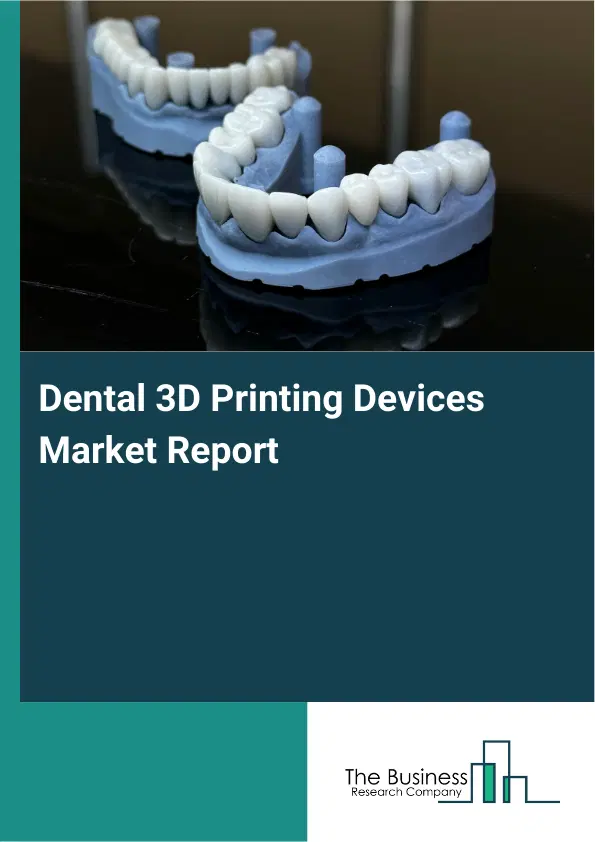
Dental 3D Printing Devices Market Report 2026
Global Outlook – By Device Type (Desktop 3D Printers, Industrial 3D Printers, Dental Specific 3D Printers), By Technology Type (Stereolithography (SLA), Digital Light Processing (DLP), Selective Laser Sintering (SLS), Material Jetting), By Material Type (Resins, Biocompatible Materials, Thermoplastics, Wax), By Application Area (Orthodontics, Prosthodontics, Implantology, Maxillofacial Surgery, Custom Dental Devices), By End-User (Dental Laboratories, Dental Clinics, Educational Institutions, Research Organizations) – Market Size, Trends, Strategies, and Forecast to 2030
Dental 3D Printing Devices Market Overview
• Dental 3D Printing Devices market size has reached to $6.33 billion in 2025 • Expected to grow to $13.42 billion in 2030 at a compound annual growth rate (CAGR) of 16.2% • Growth Driver: Rising Dental Disorder Prevalence Drives Market Growth Due To Increasing Incidence Of Tooth Decay And Gum Disease • Market Trend: Advancements In 3D-Printed Dentures Driving Precision, Efficiency, And Patient-Centered Care • North America was the largest region in 2025 and Asia-Pacific is the fastest growing region.What Is Covered Under Dental 3D Printing Devices Market?
Dental 3D printing devices are advanced tools used to fabricate customized dental products such as crowns, bridges, dentures, aligners, and surgical guides by layering biocompatible materials based on digital scans. These devices offer high precision, faster turnaround times, and reduced material waste, and they commonly use technologies such as stereolithography (SLA), digital light processing (DLP), or selective laser sintering (SLS). The main device types of dental 3D printing devices are desktop 3D printers, industrial 3D printers, and dental-specific 3D printers. Desktop 3D printers are designed to be compact and affordable, making them ideal for small dental clinics and laboratories. These devices operate using various technologies such as stereolithography (SLA), digital light processing (DLP), selective laser sintering (SLS), and material jetting. These devices utilize various materials such as resins, biocompatible materials, thermoplastics, and wax. They are widely applied in orthodontics, prosthodontics, implantology, maxillofacial surgery, and the production of custom dental devices and are extensively used by end users, including dental laboratories, clinics, educational institutions, and research organizations.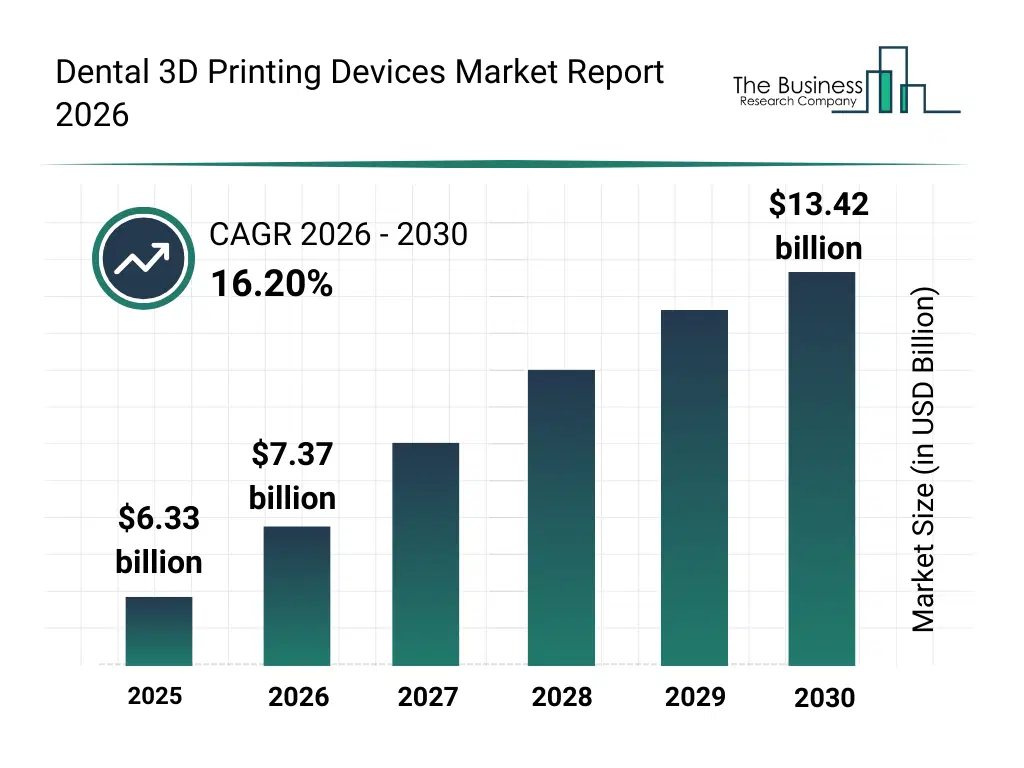
What Is The Dental 3D Printing Devices Market Size and Share 2026?
The dental 3D printing devices market size has grown rapidly in recent years. It will grow from $6.33 billion in 2025 to $7.37 billion in 2026 at a compound annual growth rate (CAGR) of 16.4%. The growth in the historic period can be attributed to high cost of traditional dental manufacturing, limited access to advanced 3D printing technologies, reliance on manual dental prosthetics fabrication, growing dental clinics and laboratories, early adoption of stereolithography and dlp technologies.What Is The Dental 3D Printing Devices Market Growth Forecast?
The dental 3D printing devices market size is expected to see rapid growth in the next few years. It will grow to $13.42 billion in 2030 at a compound annual growth rate (CAGR) of 16.2%. The growth in the forecast period can be attributed to expansion of dental specific 3D printers, development of multi-material and high-precision printers, increasing investment in dental education and research institutions, rising demand for personalized orthodontic and prosthodontic solutions, integration of ai and digital workflow in dental labs. Major trends in the forecast period include rising adoption of customized dental devices, increased use of biocompatible resins and materials, faster turnaround time in dental product fabrication, integration of 3D printing with digital dental scanning, growth in orthodontics and prosthodontics applications.
Global Dental 3D Printing Devices Market Segmentation
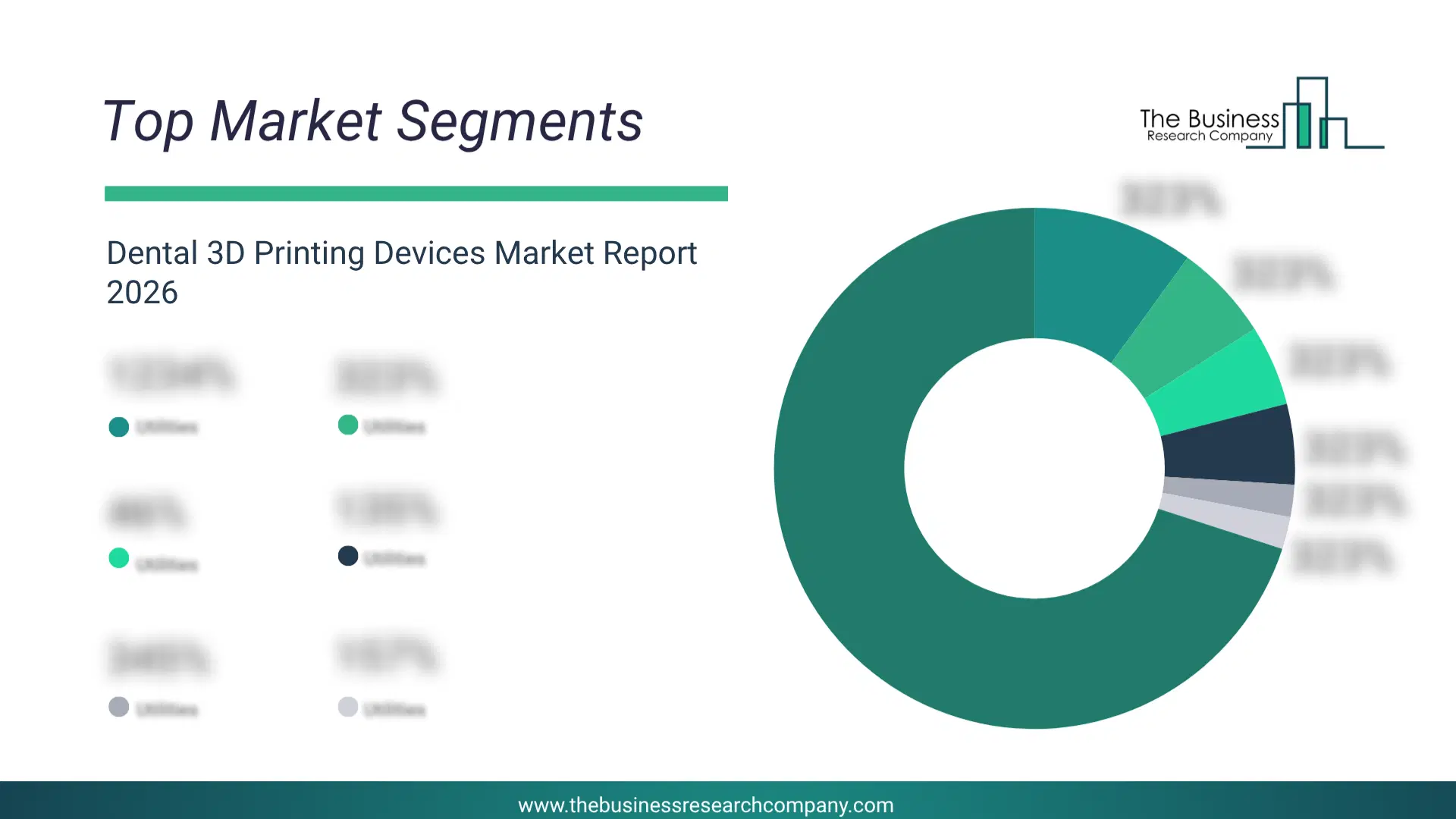
1) By Device Type: Desktop 3D Printers, Industrial 3D Printers, Dental Specific 3D Printers 2) By Technology Type: Stereolithography (SLA), Digital Light Processing (DLP), Selective Laser Sintering (SLS), Material Jetting 3) By Material Type: Resins, Biocompatible Materials, Thermoplastics, Wax 4) By Application Area: Orthodontics, Prosthodontics, Implantology, Maxillofacial Surgery, Custom Dental Devices 5) By End-User: Dental Laboratories, Dental Clinics, Educational Institutions, Research Organizations Subsegments: 1) By Desktop 3D Printers: Resin-Based Desktop Printers, Fused Deposition Modeling (FDM) Desktop Printers, Multi-Material Desktop Printers 2) By Industrial 3D Printers: Selective Laser Sintering (SLS) Industrial Printers, Multi-Jet Fusion (MJF) Printers, Binder Jetting Printers, Polyjet Printers 3) By Dental Specific 3D Printers: Crown And Bridge Printers, Denture Printers, Orthodontic Appliance Printers, Surgical Guide PrintersWhat Is The Driver Of The Dental 3D Printing Devices Market?
The rising prevalence of dental disorders is expected to propel the growth of the dental 3D printing devices market going forward. Dental disorders are a group of conditions that impair the health, function, or structure of the teeth and surrounding oral tissues. Increasing dental disorders are largely driven by poor dietary habits, especially high sugar and acid intake that promote tooth decay and gum disease. Dental 3D printing devices help address dental disorders by enabling the rapid, precise, and cost-effective production of customized dental solutions such as crowns, bridges, aligners, dentures, and surgical guides, improving treatment accuracy and patient outcomes. For instance, in January 2024, according to a report published by the American Cancer Society, a US-based nonprofit cancer advocacy organization, an estimated 58,450 adults in the United States, comprising 41,510 men and 16,940 women, are projected to be diagnosed with oral or oropharyngeal cancer in 2024, compared to 54,000 adults in 2022. Therefore, the rising prevalence of dental disorders is driving the growth of the dental 3D printing devices industry.Key Players In The Global Dental 3D Printing Devices Market
Major companies operating in the dental 3d printing devices market are Renishaw, Stratasys Ltd, 3D Systems Corporation, Roland DG Corporation, Formlabs Inc, Materialise NV, Desktop Metal Inc, Carbon Inc, EnvisionTEC GmbH, SprintRay Inc, Prodways Group SA, UnionTech, Structo Pte Ltd, Kulzer GmbH, BEGO GmbH And Co KG, Sisma SpA, Asiga Pty Ltd, Rapid Shape GmbH, Shining 3D Dental, DWS Systems, Ackuretta Technologies, Planmeca Group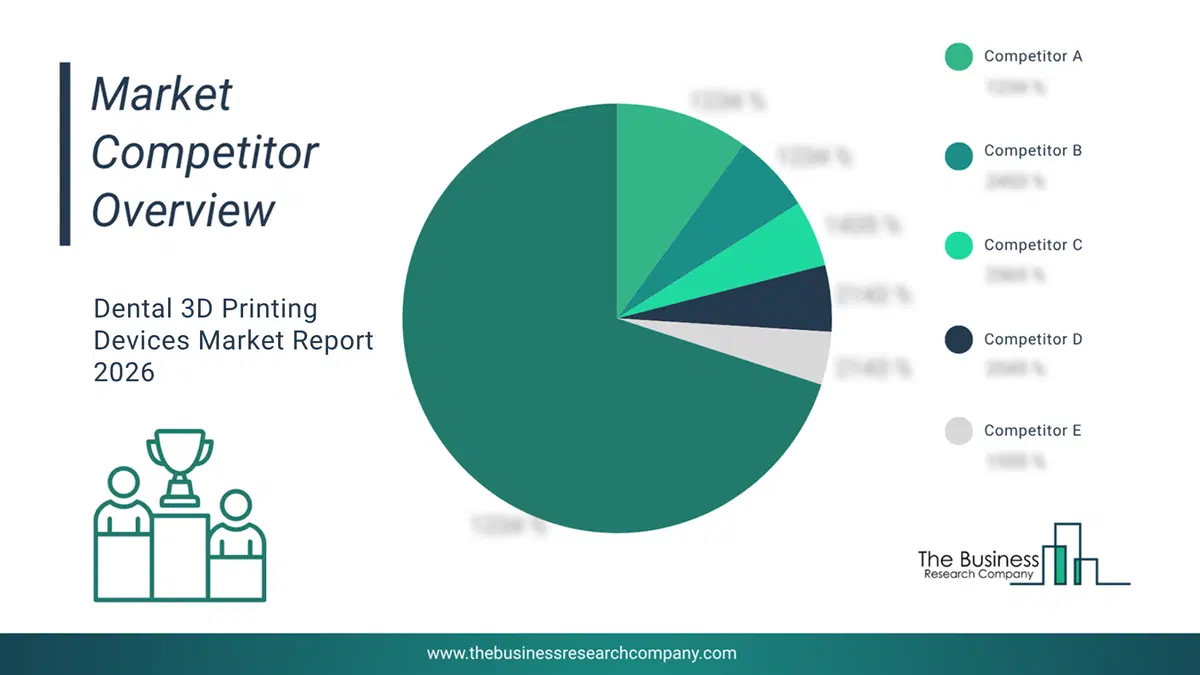
This chart is for illustrative purposes; the full report includes a detailed competitor analysis and comprehensive overview of the top 10 companies in the market.
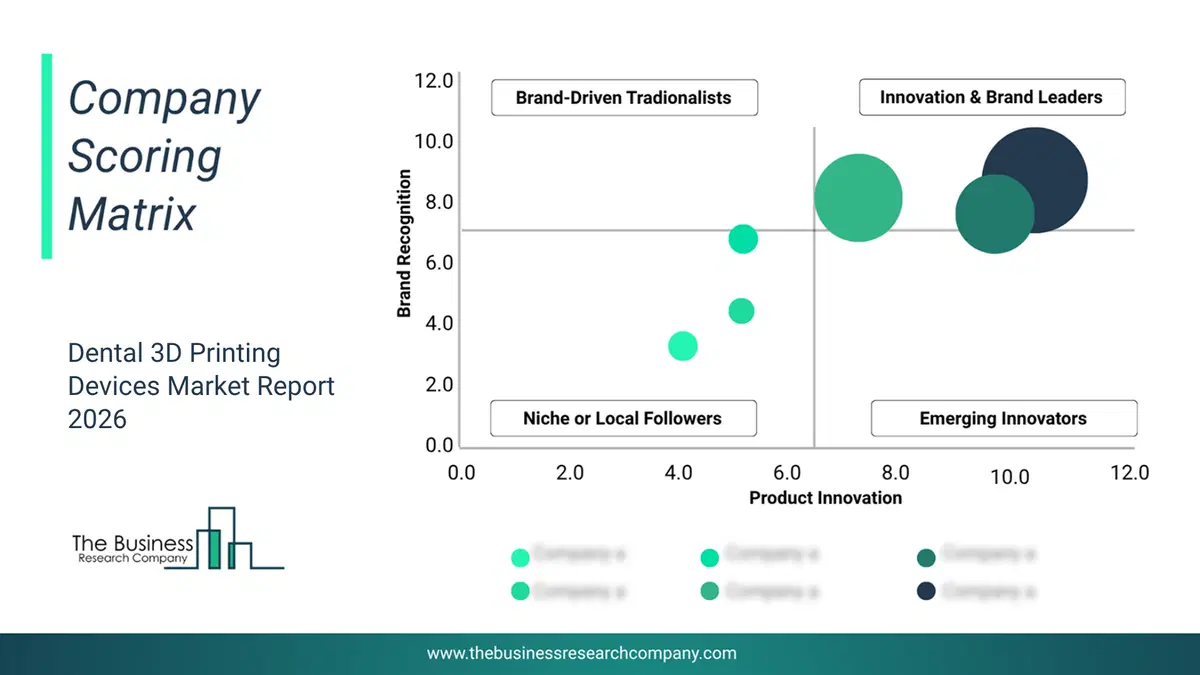
This chart maps companies by product innovation and brand strength, with bubble size indicating relative revenue, helping identify market leaders, challengers, and niche players. This is an illustrative chart; the full report provides a complete and accurate competitive analysis.
Global Dental 3D Printing Devices Market Trends and Insights
Major companies operating in the dental 3D printing devices market are focusing on developing advanced technologies such as 3D-printed dentures to enhance treatment precision, reduce turnaround times, and improve patient-specific customization. 3D-printed dentures refer to dental prosthetics that are digitally designed and manufactured using 3D printing technology, enabling precise, customizable, and efficient replacement of missing teeth. For instance, in February 2024, 3D Systems Corporation, a US-based computer manufacturing company, launched the industry's first multi-material, jetted, monolithic dentures to streamline production and improve denture quality. It combines custom materials for teeth and gums in a single piece, delivering superior durability, break resistance, and lifelike esthetics, significantly reducing production time and labor for dental labs. This innovation provides patients with faster, more comfortable, and longer-lasting dentures, enhancing both clinical outcomes and satisfaction.What Are Latest Mergers And Acquisitions In The Dental 3D Printing Devices Market?
In January 2024, Align Technology Inc., a US-based medical device company, acquired Cubicure GmbH for an undisclosed amount. Through this acquisition, Align Technology aims to enhance and expand its direct 3D printing capabilities for dental applications by incorporating Cubicure’s patented hot lithography technology, enabling the use of highly viscous resins to create durable, heat-resistant polymers with outstanding precision. Cubicure GmbH is an Austria-based manufacturing company that provides dental 3D printing devices.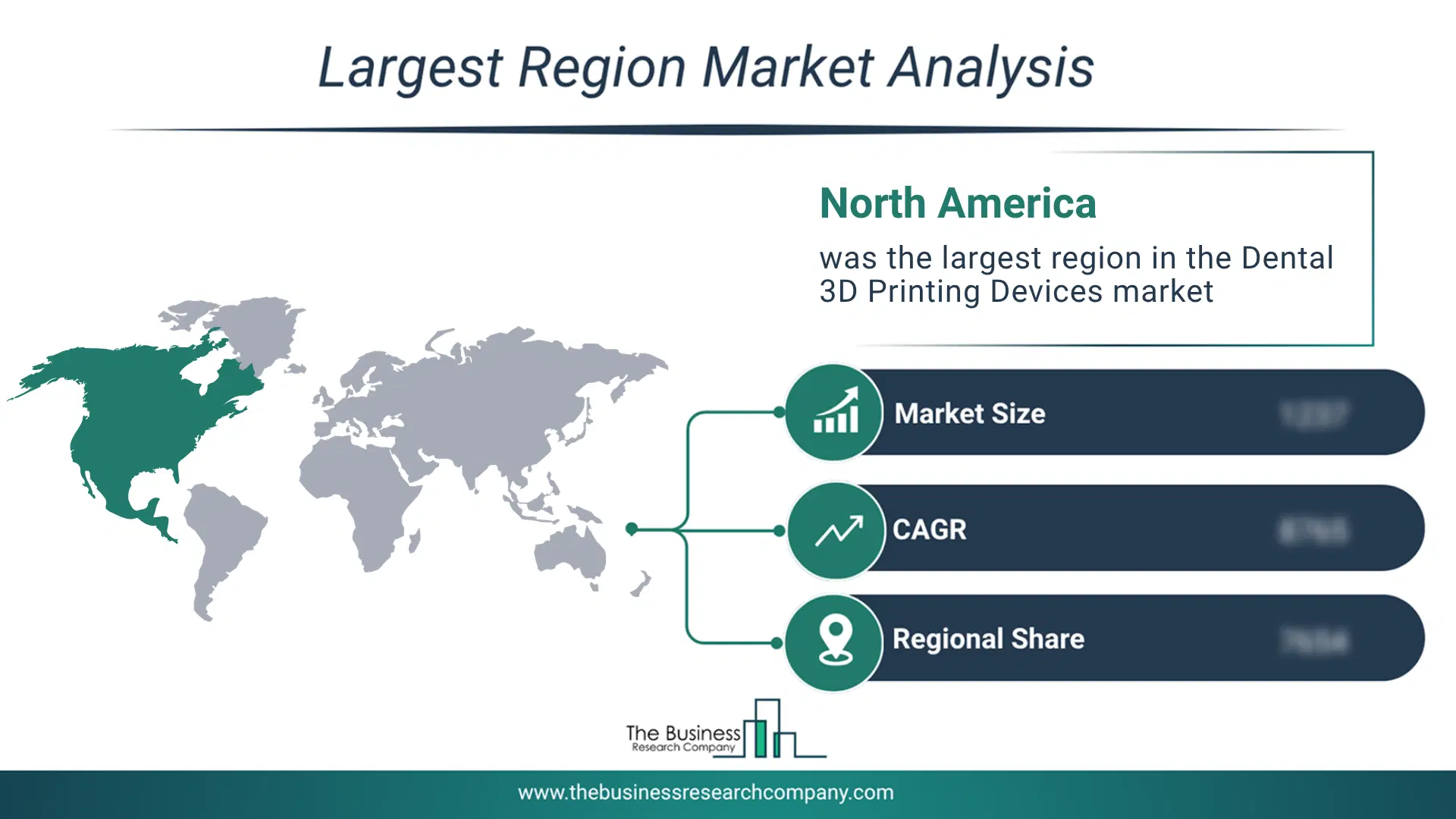
Regional Outlook
North America was the largest region in the dental 3D printing devices market in 2025. Asia-Pacific is expected to be the fastest-growing region in the forecast period. The regions covered in this market report are Asia-Pacific, South East Asia, Western Europe, Eastern Europe, North America, South America, Middle East, Africa. The countries covered in this market report are Australia, Brazil, China, France, Germany, India, Indonesia, Japan, Taiwan, Russia, South Korea, UK, USA, Canada, Italy, SpainWhat Defines the Dental 3D Printing Devices Market?
The dental 3D printing devices market consists of sales of night guards and splints, implant-supported prosthetics, and gingival masks and soft tissue models. Values in this market are ‘factory gate’ values, that is, the value of goods sold by the manufacturers or creators of the goods, whether to other entities (including downstream manufacturers, wholesalers, distributors, and retailers) or directly to end customers. The value of goods in this market includes related services sold by the creators of the goods.How is Market Value Defined and Measured?
The market value is defined as the revenues that enterprises gain from the sale of goods and/or services within the specified market and geography through sales, grants, or donations in terms of the currency (in USD unless otherwise specified). The revenues for a specified geography are consumption values that are revenues generated by organizations in the specified geography within the market, irrespective of where they are produced. It does not include revenues from resales along the supply chain, either further along the supply chain or as part of other products.
This chart presents market attractiveness based on a quantitative evaluation of growth, competition, strategic alignment, and risk, offering a clear view of opportunity areas for decision-making. This chart is for illustrative purposes; the full report contains the complete analysis.

This chart highlights the Total Addressable Market (TAM) by estimating the maximum revenue opportunity using an assumption-driven approach, supporting strategic planning and opportunity sizing across markets. The chart is illustrative; the full report provides a more comprehensive analysis.
What Key Data and Analysis Are Included in the Dental 3D Printing Devices Market Report 2026?
The dental 3d printing devices market research report is one of a series of new reports from The Business Research Company that provides market statistics, including industry global market size, regional shares, competitors with the market share, detailed market segments, market trends and opportunities, and any further data you may need to thrive in the dental 3d printing devices industry. The market research report delivers a complete perspective of everything you need, with an in-depth analysis of the current and future state of the industry.Dental 3D Printing Devices Market Report Forecast Analysis
| Report Attribute | Details |
|---|---|
| Market Size Value In 2026 | $7.37 billion |
| Revenue Forecast In 2030 | $13.42 billion |
| Growth Rate | CAGR of 16.2% from 2026 to 2030 |
| Base Year For Estimation | 2025 |
| Actual Estimates/Historical Data | 2020-2025 |
| Forecast Period | 2026 - 2030 |
| Market Representation | Revenue in USD Billion and CAGR from 2026 to 2030 |
| Segments Covered | Device Type, Technology Type, Material Type, Application Area, End-User |
| Regional Scope | Asia-Pacific, Western Europe, Eastern Europe, North America, South America, Middle East, Africa |
| Country Scope | The countries covered in the report are Australia, Brazil, China, France, Germany, India, Indonesia, Japan, Taiwan, Russia, South Korea, UK, USA, Canada, Italy, Spain. |
| Key Companies Profiled | Renishaw, Stratasys Ltd, 3D Systems Corporation, Roland DG Corporation, Formlabs Inc, Materialise NV, Desktop Metal Inc, Carbon Inc, EnvisionTEC GmbH, SprintRay Inc, Prodways Group SA, UnionTech, Structo Pte Ltd, Kulzer GmbH, BEGO GmbH And Co KG, Sisma SpA, Asiga Pty Ltd, Rapid Shape GmbH, Shining 3D Dental, DWS Systems, Ackuretta Technologies, Planmeca Group |
| Customization Scope | Request for Customization |
| Pricing And Purchase Options | Explore Purchase Options |