
Deployable Inflatable Lunar Habitat Market Report 2026
Global Outlook – By Product Type (Single-Module, Multi-Module), By Material (Polymer Films, Composite Materials, Other Materials), By Deployment Mechanism (Automated, Manual), By Application (Scientific Research, Commercial, Defense, Other Applications), By End-User (Space Agencies, Private Space Companies, Research Institutes, Other End-Users) – Market Size, Trends, Strategies, and Forecast to 2030
Deployable Inflatable Lunar Habitat Market Overview
• Deployable Inflatable Lunar Habitat market size has reached to $1.14 billion in 2025 • Expected to grow to $2.65 billion in 2030 at a compound annual growth rate (CAGR) of 18.3% • Growth Driver: Growing Emphasis On Sustainable Lunar Bases Fuels Demand For Market Due To Advancements In In-Situ Resource Utilization And Cost-Efficient Design • Market Trend: Breakthrough Inflatable Habitat Technology Signals Future Of Space Living • North America was the largest region in 2025 and Asia-Pacific is the fastest growing region.What Is Covered Under Deployable Inflatable Lunar Habitat Market?
A deployable inflatable lunar habitat is a type of space habitat designed for lunar exploration that can be compactly stored during transport and then quickly expanded by inflation once deployed on the Moon's surface. These habitats provide temporary or longer-term living and working space for astronauts, offering advantages such as lightweight structure, ease and speed of deployment, and efficient use of volume compared to rigid habitats. The main product types of deployable inflatable lunar habitats are single-module and multi-module. A single-module deployable inflatable lunar habitat is a compact, lightweight structure designed for lunar deployment that can be inflated on-site to provide a self-contained living and working environment for astronauts. The materials used in these are polymer films, composite materials, and others, by deployment mechanisms including automated and manual, used in applications such as scientific research, commercial, defense, and others, with end-users including space agencies, private space companies, research institutes, and others.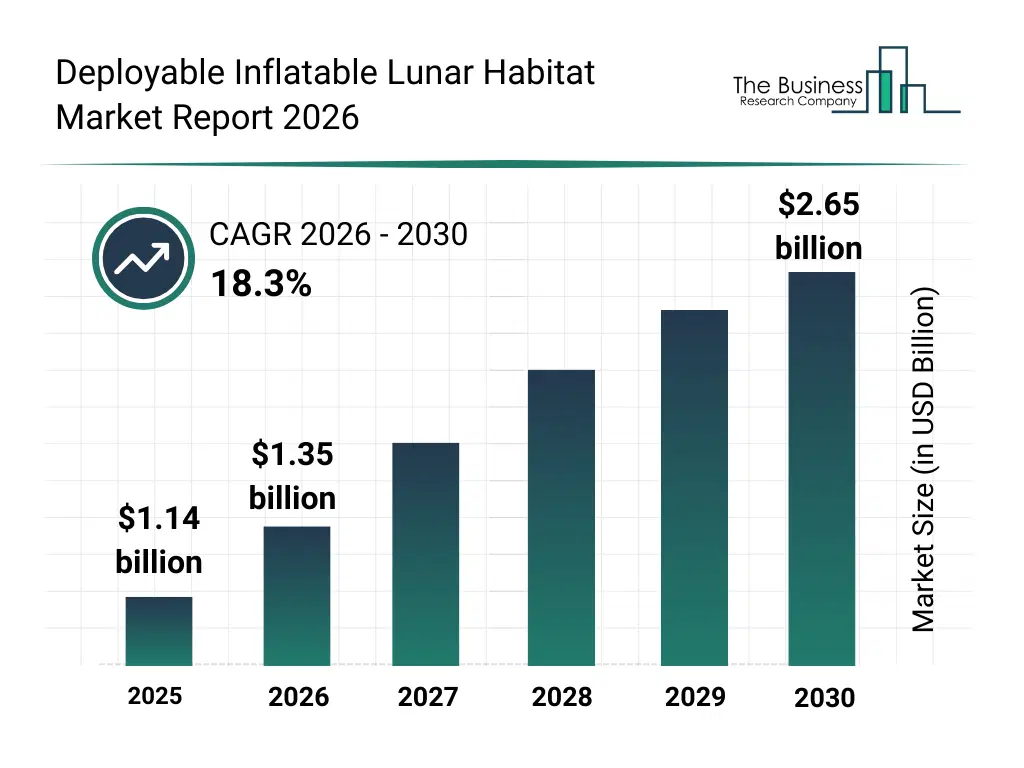
What Is The Deployable Inflatable Lunar Habitat Market Size and Share 2026?
The deployable inflatable lunar habitat market size has grown rapidly in recent years. It will grow from $1.14 billion in 2025 to $1.35 billion in 2026 at a compound annual growth rate (CAGR) of 18.5%. The growth in the historic period can be attributed to testing of inflatable habitat modules in terrestrial analogs, early integration of life-support systems, advancements in lightweight and flexible structural materials, increasing interest in lunar exploration programs, development of rapid deployment mechanisms.What Is The Deployable Inflatable Lunar Habitat Market Growth Forecast?
The deployable inflatable lunar habitat market size is expected to see rapid growth in the next few years. It will grow to $2.65 billion in 2030 at a compound annual growth rate (CAGR) of 18.3%. The growth in the forecast period can be attributed to expansion of commercial lunar missions, development of radiation-shielded inflatable habitats, integration with autonomous deployment systems, increased use of modular and scalable designs, adoption of advanced thermal insulation and monitoring systems. Major trends in the forecast period include increasing development of multilayer radiation and micrometeoroid shielding for inflatable habitats, advancements in high-strength, lightweight inflatable structural materials for lunar environments, rising deployment of modular, expandable habitat systems for scalable lunar bases, growth in integrated life-support and environmental control systems optimized for inflatable habitats, expansion of rapid-deployment mechanisms enabling fast operational readiness on the lunar surface.
Global Deployable Inflatable Lunar Habitat Market Segmentation
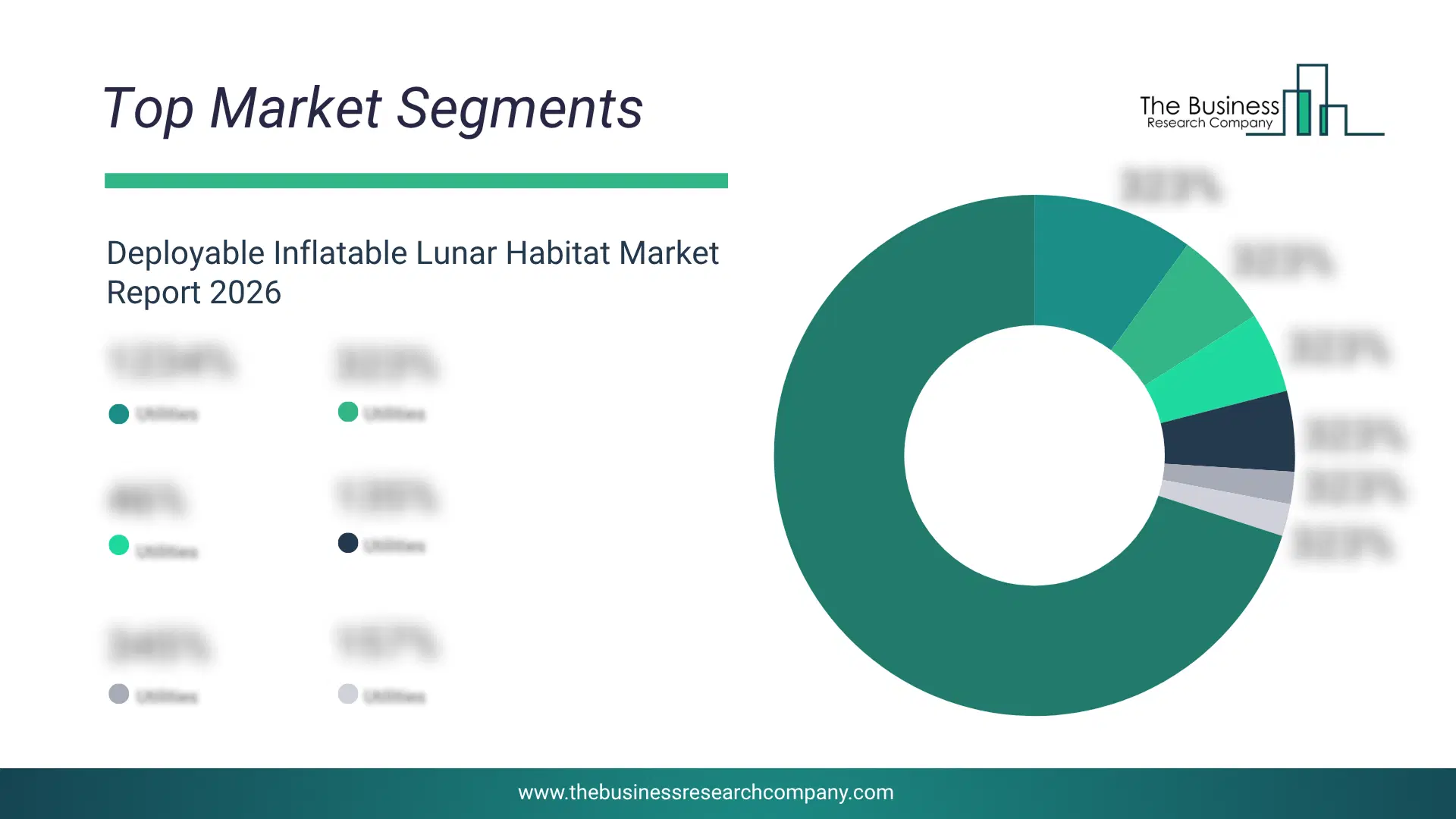
1) By Product Type: Single-Module, Multi-Module 2) By Material: Polymer Films, Composite Materials, Other Materials 3) By Deployment Mechanism: Automated, Manual 4) By Application: Scientific Research, Commercial, Defense, Other Applications 5) By End-User: Space Agencies, Private Space Companies, Research Institutes, Other End-Users Subsegments: 1) By Single-Module: Rigid Frame, Fabric Shell, Hybrid 2) By Multi-Module: Connected Modules, Expandable Modules, Stackable ModulesWhat Is Driver Of The Deployable Inflatable Lunar Habitat Market?
The growing emphasis on sustainable lunar bases is expected to drive the deployable inflatable lunar habitat market. A sustainable lunar base is designed for long-duration human occupation, minimizing reliance on Earth by using advanced recycling systems and in-situ resource utilization (ISRU) for air, water, and fuel, while supporting scientific and exploration activities. Inflatable lunar habitats complement this focus due to their lightweight, compact design, lower launch costs, scalable living space, integrated life support, and radiation protection, enabling longer stays on the Moon. For instance, in July 2023, according to Situation Publishing, a UK-based B2B technology publisher, NASA awarded $150 million in 2023 to 11 companies, each contributing 10–25% of the costs, to advance technologies supporting sustainable lunar exploration, including habitats, power, transportation, and infrastructure. Therefore, growing focus on sustainable lunar bases is driving the growth of the deployable inflatable lunar habitat industry.Key Players In The Global Deployable Inflatable Lunar Habitat Market
Major companies operating in the deployable inflatable lunar habitat market are Airbus SE, Collins Aerospace (RTX Corporation), Lockheed Martin Corporation, Northrop Grumman Corporation, National Aeronautics and Space Administration (NASA), Thales Alenia Space S.p.A., Sierra Nevada Corporation, European Space Agency, Sierra Space Corporation, ILC Dover LP, Redwire Corporation, Spartan Space, Axiom Space Inc., Bigelow Aerospace, GITAI Inc., Astrobotic Technology Inc., SpaceFund Inc., Max Space, Astroport Space Technologies Inc., Lunexus Space Inc.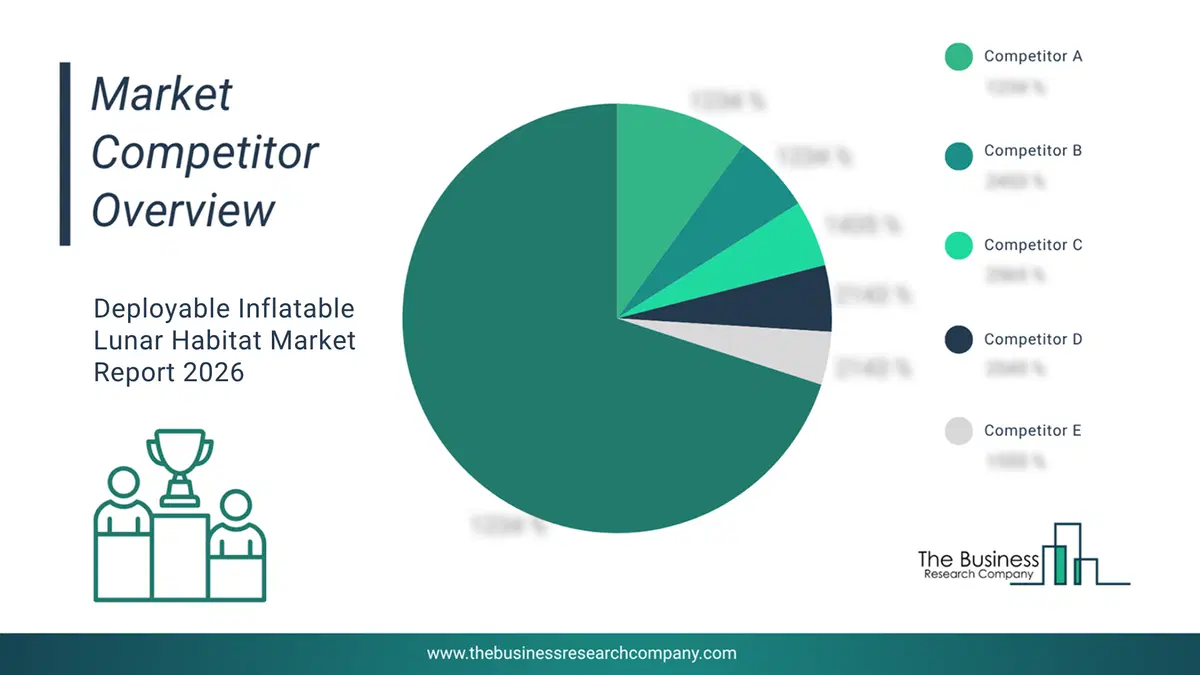
This chart is for illustrative purposes; the full report includes a detailed competitor analysis and comprehensive overview of the top 10 companies in the market.
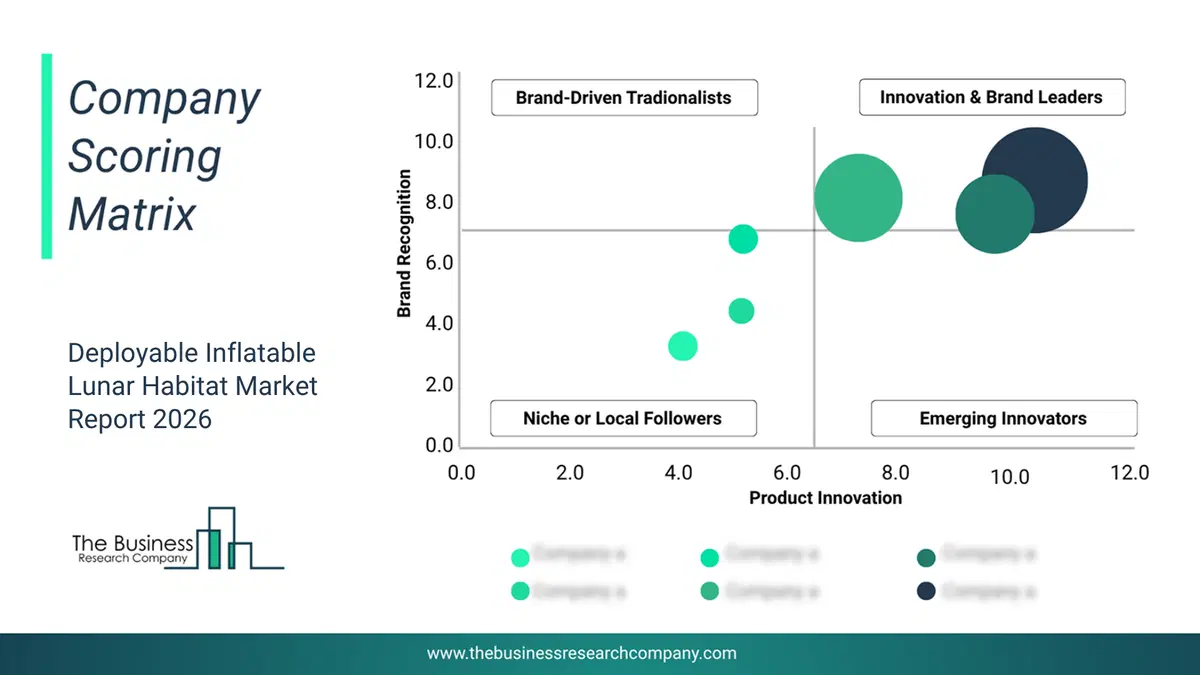
This chart maps companies by product innovation and brand strength, with bubble size indicating relative revenue, helping identify market leaders, challengers, and niche players. This is an illustrative chart; the full report provides a complete and accurate competitive analysis.
Global Deployable Inflatable Lunar Habitat Market Trends and Insights
Major companies operating in the deployable inflatable lunar habitat market are focusing on developing advanced products such as expandable inflatable habitats to advance the development of high-volume, lightweight habitation systems capable of supporting human life in space or on planetary surfaces. An expandable inflatable habitat is a lightweight, fabric-based structure designed to be compactly stowed for launch and then inflated to provide a large, pressurized environment for human habitation or research in space or on planetary surfaces. For instance, in January 2024, Sierra Space, a US-based commercial space technology company, launched the Large Integrated Flexible Environment (LIFE) habitat. The LIFE habitat is a full-scale, expandable structure built from high-strength fabric materials that significantly surpassed the National Aeronautics and Space Administration’s recommended safety factor during pressure testing, demonstrating robust performance under extreme conditions. It offers a compact launch configuration that inflates to create a living and working space multiple times larger than its transport volume, positioning it as a scalable solution for future orbital and planetary habitation needs.What Are Latest Mergers And Acquisitions In The Deployable Inflatable Lunar Habitat Market? Sierra Space Joins NASA To Develop Next-Generation Lunar Habitat Solutions
In May 2025, Sierra Space, a US-based commercial space company, partnered with NASA under the NextSTEP-2 program to evaluate and adapt its inflatable-habitat technology for lunar surface missions. The aim of the partnership is to assess how Sierra Space’s expandable space-station modules originally developed for low-Earth orbit can be engineered for deployment on the Moon to support future human habitation. NASA is a US-based government space agency responsible for the nation’s civil space program and advanced aerospace research.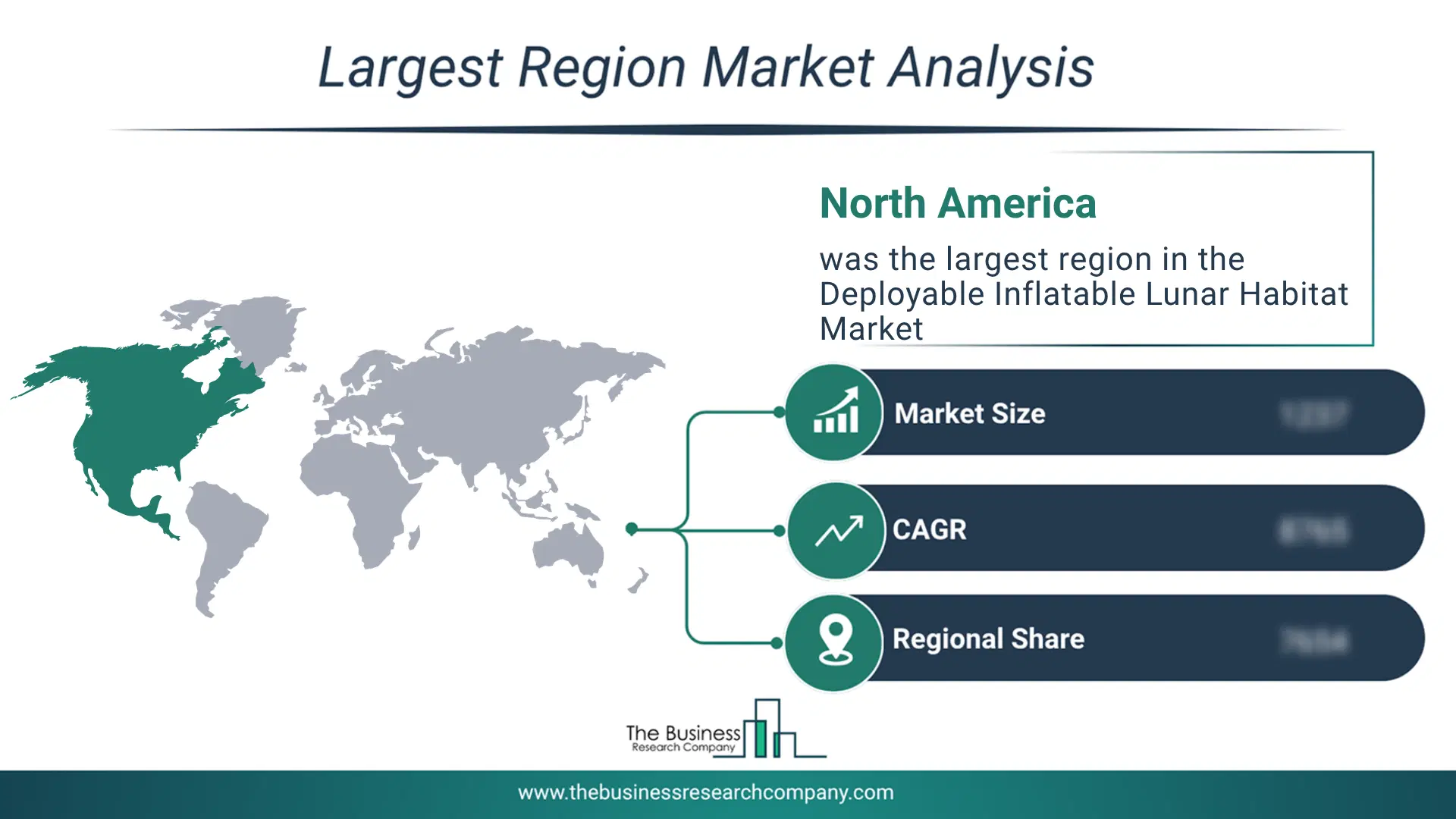
Regional Insights
North America was the largest region in the deployable inflatable lunar habitat market in 2025. Asia-Pacific is expected to be the fastest-growing region in the forecast period. The regions covered in this market report are Asia-Pacific, South East Asia, Western Europe, Eastern Europe, North America, South America, Middle East, Africa. The countries covered in this market report are Australia, Brazil, China, France, Germany, India, Indonesia, Japan, Taiwan, Russia, South Korea, UK, USA, Canada, Italy, SpainWhat Defines the Deployable Inflatable Lunar Habitat Market?
The deployable inflatable lunar habitat market consists of sales of inflatable habitat modules, modular structural components, life-support systems, radiation shielding materials, thermal insulation layers, deployment mechanisms, and integrated monitoring systems. Values in this market are ‘factory gate’ values, that is the value of goods sold by the manufacturers or creators of the goods, whether to other entities (including downstream manufacturers, wholesalers, distributors and retailers) or directly to end customers. The value of goods in this market includes related services sold by the creators of the goods.How is Market Value Defined and Measured?
The market value is defined as the revenues that enterprises gain from the sale of goods and/or services within the specified market and geography through sales, grants, or donations in terms of the currency (in USD unless otherwise specified). The revenues for a specified geography are consumption values that are revenues generated by organizations in the specified geography within the market, irrespective of where they are produced. It does not include revenues from resales along the supply chain, either further along the supply chain or as part of other products.
This chart presents market attractiveness based on a quantitative evaluation of growth, competition, strategic alignment, and risk, offering a clear view of opportunity areas for decision-making. This chart is for illustrative purposes; the full report contains the complete analysis.

This chart highlights the Total Addressable Market (TAM) by estimating the maximum revenue opportunity using an assumption-driven approach, supporting strategic planning and opportunity sizing across markets. The chart is illustrative; the full report provides a more comprehensive analysis.
What Key Data and Analysis Are Included in the Deployable Inflatable Lunar Habitat Market Report 2026?
The deployable inflatable lunar habitat market research report is one of a series of new reports from The Business Research Company that provides market statistics, including industry global market size, regional shares, competitors with the market share, detailed market segments, market trends and opportunities, and any further data you may need to thrive in the deployable inflatable lunar habitat industry. The market research report delivers a complete perspective of everything you need, with an in-depth analysis of the current and future state of the industry.Deployable Inflatable Lunar Habitat Market Report Forecast Analysis
| Report Attribute | Details |
|---|---|
| Market Size Value In 2026 | $1.35 billion |
| Revenue Forecast In 2030 | $2.65 billion |
| Growth Rate | CAGR of 18.3% from 2026 to 2030 |
| Base Year For Estimation | 2025 |
| Actual Estimates/Historical Data | 2020-2025 |
| Forecast Period | 2026 - 2030 |
| Market Representation | Revenue in USD Billion and CAGR from 2026 to 2030 |
| Segments Covered | Product Type, Material, Deployment Mechanism, Application, End-User |
| Regional Scope | Asia-Pacific, Western Europe, Eastern Europe, North America, South America, Middle East, Africa |
| Country Scope | The countries covered in the deployable inflatable lunar habitat market report are Australia, Brazil, China, France, Germany, India, Indonesia, Japan, Taiwan, Russia, South Korea, UK, USA, Canada, Italy, Spain |
| Key Companies Profiled | Airbus SE, Collins Aerospace (RTX Corporation), Lockheed Martin Corporation, Northrop Grumman Corporation, National Aeronautics and Space Administration (NASA), Thales Alenia Space S.p.A., Sierra Nevada Corporation, European Space Agency, Sierra Space Corporation, ILC Dover LP, Redwire Corporation, Spartan Space, Axiom Space Inc., Bigelow Aerospace, GITAI Inc., Astrobotic Technology Inc., SpaceFund Inc., Max Space, Astroport Space Technologies Inc., Lunexus Space Inc. |
| Customization Scope | Request for Customization |
| Pricing And Purchase Options | Explore Purchase Options |