
Desktop Personal Computer (PC) Graphics Card Market Report 2026
Global Outlook – By Type (Dedicated Graphics Card, Integrated Graphics Solutions, Hybrid Solutions), By Distribution Channel (Online, Offline), By Application (Gaming, Video Editing, Machine Learning And Artificial Intelligence, Cryptocurrency Mining, Other Applications), By End User (Consumer, Commercial, Enterprise) – Market Size, Trends, Strategies, and Forecast to 2030
Desktop Personal Computer (PC) Graphics Card Market Overview
• Desktop Personal Computer (PC) Graphics Card market size has reached to $73.45 billion in 2025 • Expected to grow to $93.16 billion in 2030 at a compound annual growth rate (CAGR) of 4.8% • Growth Driver: Growth Of The Esports Industry Fueling The Growth Of The Market Due To Increasing Demand For High-performance Gaming And Graphics Processing • Market Trend: Technology Advancement In AI-Enabled Graphics Processing Driving Innovation • Asia-Pacific was the largest region and fastest growing region.What Is Covered Under Desktop Personal Computer (PC) Graphics Card Market?
Desktop personal computer (PC) graphics cards are hardware components designed to process and render visual data for display on desktop computers. They integrate graphics processing units (GPUs), onboard memory, power delivery, and cooling systems to accelerate graphics rendering, video processing, and parallel computing tasks. These components enhance system performance by enabling high-quality image rendering, smooth video playback, and efficient execution of graphics-intensive and compute-intensive applications. The main types of desktop personal computer (PC) graphics card include dedicated graphics card, integrated graphics solutions, and hybrid solutions. Dedicated graphics card refers to separate graphics processing hardware with dedicated memory and processing resources designed to deliver high graphical performance for demanding computing workloads. These graphics solutions are distributed through online and offline channels. The various applications involved are gaming, video editing, machine learning and artificial intelligence, cryptocurrency mining, and others, and they are used by several end users such as consumer, commercial, and enterprise.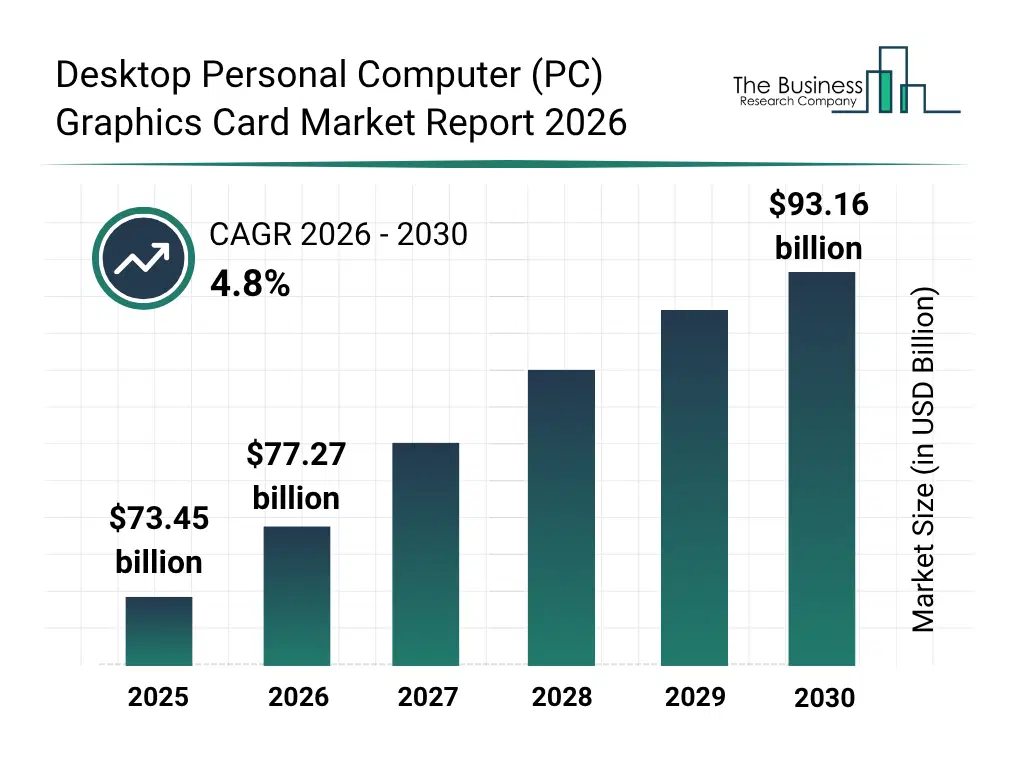
What Is The Desktop Personal Computer (PC) Graphics Card Market Size and Share 2026?
The desktop personal computer (PC) graphics card market size has grown strongly in recent years. It will grow from $73.45 billion in 2025 to $77.27 billion in 2026 at a compound annual growth rate (CAGR) of 5.2%. The growth in the historic period can be attributed to increasing demand for desktop gaming, rising adoption of high-resolution displays, growing use of graphics-intensive applications, expanding demand for video editing capabilities, increasing adoption of dedicated graphics cards.What Is The Desktop Personal Computer (PC) Graphics Card Market Growth Forecast?
The desktop personal computer (PC) graphics card market size is expected to see steady growth in the next few years. It will grow to $93.16 billion in 2030 at a compound annual growth rate (CAGR) of 4.8%. The growth in the forecast period can be attributed to increasing demand for AI-enabled desktop computing, rising need for higher graphics processing performance, growing adoption of advanced graphics memory, expanding demand for high-performance computing applications, increasing demand for energy-efficient graphics processing. Major trends in the forecast period include increasing adoption of high-performance graphics processing units, rising demand for advanced graphics memory, growing integration of advanced cooling systems, increasing adoption of high-efficiency power delivery designs, rising demand for higher graphics processing performance.
Global Desktop Personal Computer (PC) Graphics Card Market Segmentation
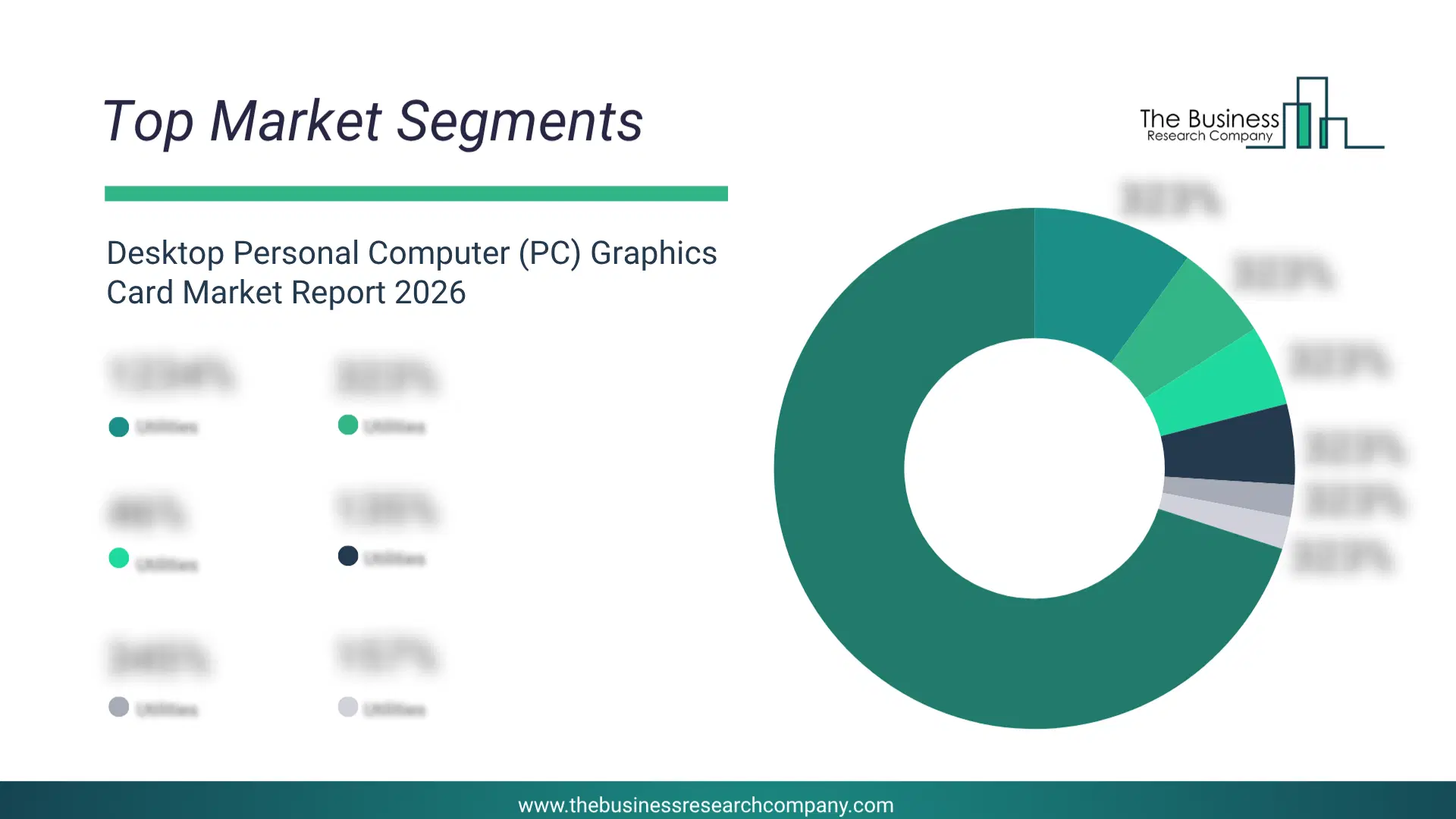
1) By Type: Dedicated Graphics Card, Integrated Graphics Solutions, Hybrid Solutions 2) By Distribution Channel: Online, Offline 3) By Application: Gaming, Video Editing, Machine Learning And Artificial Intelligence, Cryptocurrency Mining, Other Applications 4) By End User: Consumer, Commercial, Enterprise Subsegments: 1) By Dedicated Graphics Card: Gaming Graphics Cards, Workstation Graphics Cards, Professional Visualization Graphics Cards, High Performance Graphics Cards, Entry Level Graphics Cards 2) By Integrated Graphics Solutions: Processor Integrated Graphics, Chipset Integrated Graphics, Unified Memory Graphics, Low Power Graphics Solutions, Mainstream Graphics Solutions 3) By Hybrid Solutions: Switchable Graphics Solutions, Dual Graphics Solutions, Integrated And Dedicated Graphics Solutions, Dynamic Graphics Switching Solutions, Power Optimized Graphics SolutionsWhat Is The Driver Of The Desktop Personal Computer (PC) Graphics Card Market?
The growth of esports industry is expected to propel the growth of the desktop personal computer (PC) graphics card market going forward. The esports industry refers to organized competitive video gaming in which professional players and teams compete in tournaments across various gaming titles for prize money, sponsorships, and audience engagement. The esports industry is increasing due to the rising number of professional esports tournaments, which continue to attract more players, viewers, and commercial investments worldwide. Desktop personal computer (PC) graphics cards enable the growth of the esports industry by delivering high frame rates, low latency, and superior graphics performance required for competitive gaming and professional esports events. For instance, in December 2023, according to the China Audio-Video and Digital Publishing Association (CAVDPA), a China-based industry association, the number of esports users reached 488 million in 2023, while the number of professional non-exhibition esports tournaments increased to 127 in 2023, compared with 98 tournaments in 2022, representing an increase of 29.6% year over year. Therefore, the growth of esports industry is driving the growth of the desktop personal computer (PC) graphics card industry.Key Players In The Global Desktop Personal Computer (PC) Graphics Card Market
Major companies operating in the desktop personal computer (PC) graphics card market are ASUSTeK Computer Inc, Acer Inc, Micro-Star International Co Ltd, GIGABYTE Technology Co Ltd, Yeston Digital Technology Co Ltd, ASRock Inc, PNY Technologies Inc, Inno3D Multimedia Limited, XFX Technology Inc, Palit Microsystems Ltd, Sapphire Technology Limited, ZOTAC Technology Limited, TUL Corporation, Colorful Group Co Ltd, Sparkle Computer Co Ltd, Maxsun Technology Co Ltd, BIOSTAR Microtech International Corp, GUNNIR Technology Co Ltd, PELADN Technology Co Ltd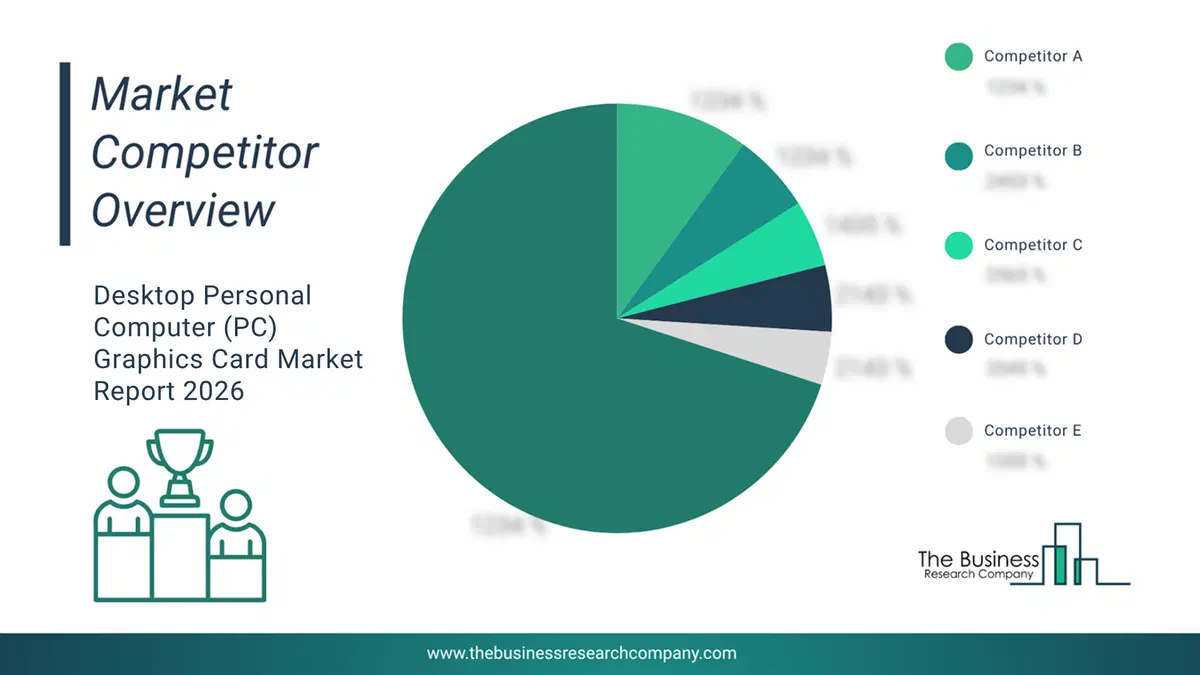
This chart is for illustrative purposes; the full report includes a detailed competitor analysis and comprehensive overview of the top 10 companies in the market.
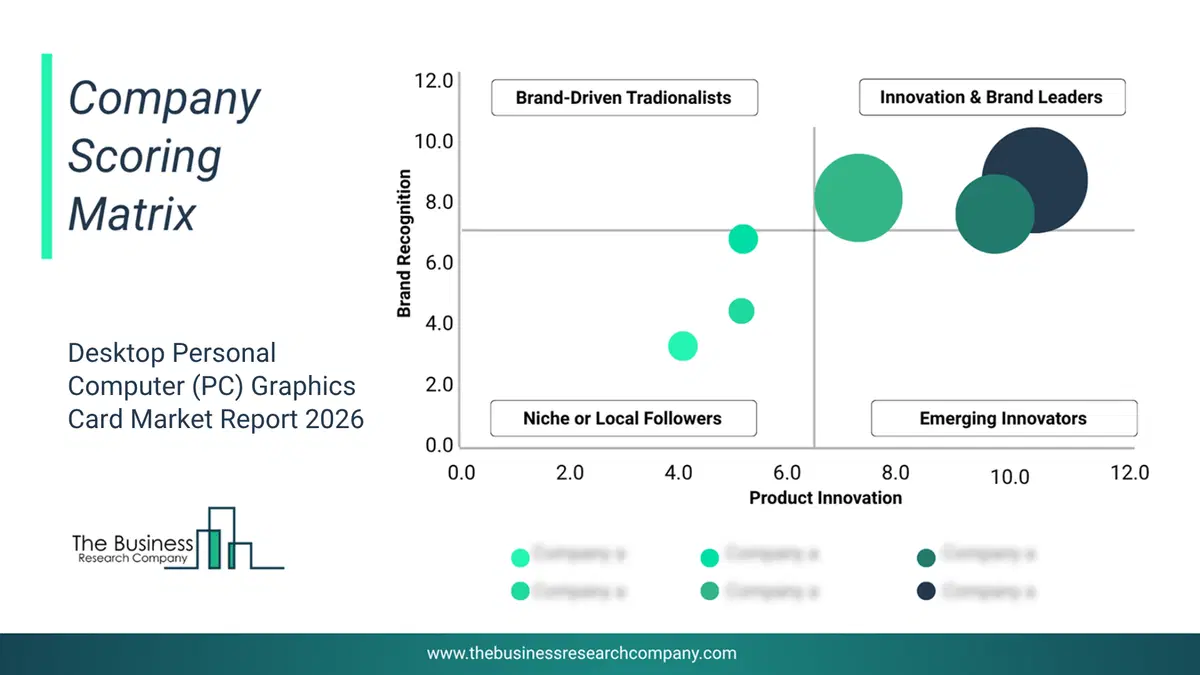
This chart maps companies by product innovation and brand strength, with bubble size indicating relative revenue, helping identify market leaders, challengers, and niche players. This is an illustrative chart; the full report provides a complete and accurate competitive analysis.
Global Desktop Personal Computer (PC) Graphics Card Market Trends and Insights
Major companies operating in the desktop personal computer (PC) graphics card market are focusing on technology advancement in AI-enabled graphics processing, such as, manufacturing advanced AI-powered graphics cards to deliver higher gaming performance, faster AI inference, enhanced content creation, and improved real-time rendering capabilities. Manufacturing advanced AI-powered graphics cards refers to the design and production of graphics processing units (GPUs) with dedicated AI acceleration capabilities to efficiently handle artificial intelligence workloads, high-performance computing, and graphics-intensive applications. For instance, in January 2025, NVIDIA, a US-based semiconductor company, launched the GeForce RTX 5090 based on the Blackwell architecture. The graphics card features fifth-generation Tensor Cores for accelerated AI processing, DLSS 4 with Multi Frame Generation for AI-enhanced rendering, and 32 GB of GDDR7 memory to support demanding gaming, AI, and creative workloads.What Are Latest Mergers And Acquisitions In The Desktop Personal Computer (PC) Graphics Card Market?
In September 2025, NVIDIA Corporation, a US-based artificial intelligence and accelerated computing company, partnered with Intel Corporation to jointly develop multiple generations of AI infrastructure and personal computing products. With this partnership, NVIDIA Corporation and Intel Corporation aim to combine NVIDIA’s AI, accelerated computing, and NVLink technologies with Intel’s x86 CPU architecture and manufacturing capabilities to deliver custom data center CPUs, AI infrastructure platforms, and x86 system-on-chips (SoCs) with integrated NVIDIA RTX GPU chiplets for next-generation enterprise and consumer computing. Intel Corporation is a US-based semiconductor company specializing in designing and manufacturing desktop graphics cards through their intel arc a-series line (such as the Arc A770 and A750) and the newer intel arc b-series.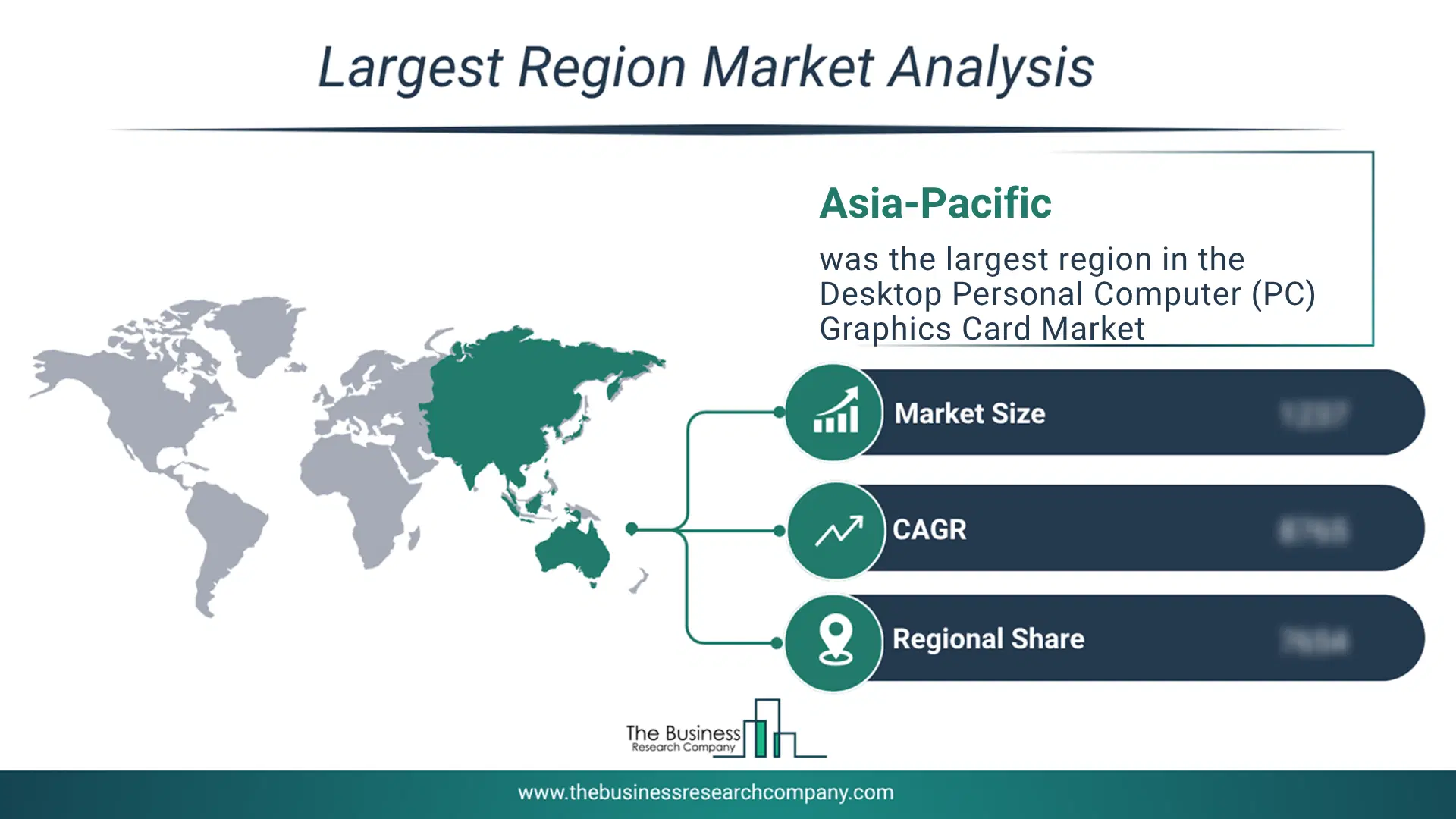
Regional Insights
Asia-Pacific was the largest region in the desktop personal computer (PC) graphics card market in 2025. Asia-Pacific is expected to be the fastest-growing region in the forecast period. The regions covered in this market report are Asia-Pacific, South East Asia, Western Europe, Eastern Europe, North America, South America, Middle East, Africa. The countries covered in this market report are Australia, Brazil, China, France, Germany, India, Indonesia, Japan, Taiwan, Russia, South Korea, UK, USA, Canada, Italy, Spain.What Defines the Desktop Personal Computer (PC) Graphics Card Market?
The desktop personal computer (PC) graphics card market consists of sales of gaming graphics cards, workstation graphics cards, professional visualization graphics cards, GPU accelerator cards, graphics processing units (GPUs), graphics card cooling systems, graphics card backplates, graphics card power connectors, and related graphics card components and accessories. Values in this market are ‘factory gate’ values, that is, the value of goods sold by the manufacturers or creators of the goods, whether to other entities (including downstream manufacturers, wholesalers, distributors, and retailers) or directly to end customers. The value of goods in this market includes related services sold by the creators of the goods.How is Market Value Defined and Measured?
The market value is defined as the revenues that enterprises gain from the sale of goods and/or services within the specified market and geography through sales, grants, or donations in terms of the currency (in USD unless otherwise specified). The revenues for a specified geography are consumption values that are revenues generated by organizations in the specified geography within the market, irrespective of where they are produced. It does not include revenues from resales along the supply chain, either further along the supply chain or as part of other products.
This chart presents market attractiveness based on a quantitative evaluation of growth, competition, strategic alignment, and risk, offering a clear view of opportunity areas for decision-making. This chart is for illustrative purposes; the full report contains the complete analysis.

This chart highlights the Total Addressable Market (TAM) by estimating the maximum revenue opportunity using an assumption-driven approach, supporting strategic planning and opportunity sizing across markets. The chart is illustrative; the full report provides a more comprehensive analysis.
What Key Data and Analysis Are Included in the Desktop Personal Computer (PC) Graphics Card Market Report 2026?
The desktop personal computer (pc) graphics card market research report is one of a series of new reports from The Business Research Company that provides market statistics, including industry global market size, regional shares, competitors with the market share, detailed market segments, market trends and opportunities, and any further data you may need to thrive in the desktop personal computer (pc) graphics card industry. The market research report delivers a complete perspective of everything you need, with an in-depth analysis of the current and future state of the industry.Desktop Personal Computer (PC) Graphics Card Market Report Forecast Analysis
| Report Attribute | Details |
|---|---|
| Market Size Value In 2026 | $77.27 billion |
| Revenue Forecast In 2030 | $93.16 billion |
| Growth Rate | CAGR of 4.8% from 2026 to 2030 |
| Base Year For Estimation | 2025 |
| Actual Estimates/Historical Data | 2020-2025 |
| Forecast Period | 2026 - 2030 |
| Market Representation | Revenue in USD Billion and CAGR from 2026 to 2030 |
| Segments Covered | Type, Distribution Channel, Application, End User |
| Regional Scope | Asia-Pacific, Western Europe, Eastern Europe, North America, South America, Middle East, Africa |
| Country Scope | The countries covered in the report are Australia, Brazil, China, France, Germany, India, Indonesia, Japan, Taiwan, Russia, South Korea, UK, USA, Canada, Italy, Spain. |
| Key Companies Profiled | ASUSTeK Computer Inc, Acer Inc, Micro-Star International Co Ltd, GIGABYTE Technology Co Ltd, Yeston Digital Technology Co Ltd, ASRock Inc, PNY Technologies Inc, Inno3D Multimedia Limited, XFX Technology Inc, Palit Microsystems Ltd, Sapphire Technology Limited, ZOTAC Technology Limited, TUL Corporation, Colorful Group Co Ltd, Sparkle Computer Co Ltd, Maxsun Technology Co Ltd, BIOSTAR Microtech International Corp, GUNNIR Technology Co Ltd, PELADN Technology Co Ltd |
| Customization Scope | Request for Customization |
| Pricing And Purchase Options | Explore Purchase Options |