
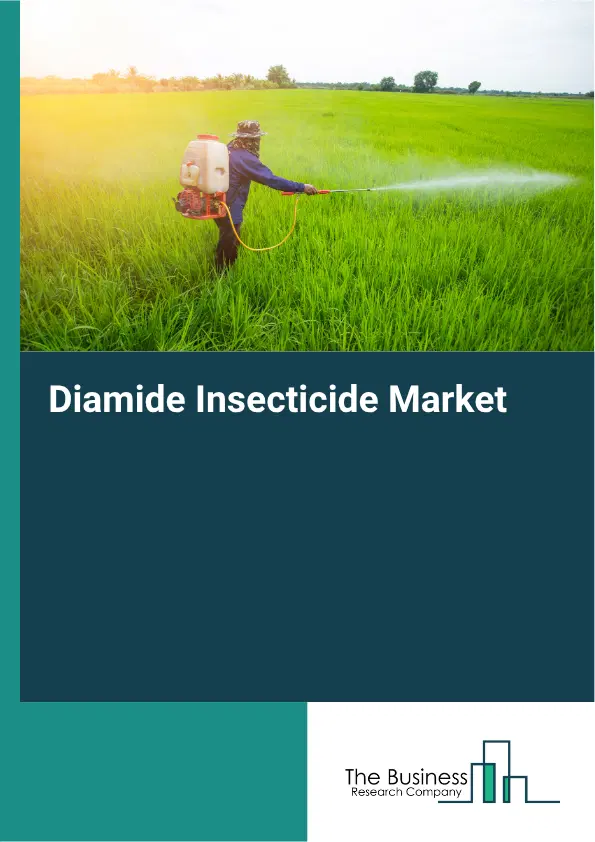
Diamide Insecticide Market Report 2026
Global Outlook – By Type (Broflanilide, Chlorantraniliprole, Cyantraniliprole, Cyclaniliprole, Cyhalodiamide, Other Types), By Crop Type (Cereals And Grains, Fruits And Vegetables, Oilseeds And Pulses, Other Crop Types), By Pest Type (Lepidopteran Pests, Coleopteran Pests, Hemipteran Pests, Other Pest Types), By Distribution Channel (Direct Sales, Agricultural Retailers And Dealers, Distributors And Wholesalers, E Commerce Platforms), By Application Method (Foliar Spray, Seed Treatment, Soil Application, Chemigation, Other Application Methods) – Market Size, Trends, Strategies, and Forecast to 2030
Diamide Insecticide Market Overview
• Diamide Insecticide market size has reached to $2.92 billion in 2025 • Expected to grow to $4.58 billion in 2030 at a compound annual growth rate (CAGR) of 9.3% • Growth Driver: Rising Food Demand Driving The Market Growth Due To Increasing Crop Protection Needs To Enhance Agricultural Productivity • Market Trend: Next-Generation Insecticidal Chemistries Advance Diamide Insecticide Solutions • North America was the largest region in 2025 and Asia-Pacific is the fastest growing region.What Is Covered Under Diamide Insecticide Market?
Diamide insecticides are a class of synthetic chemical compounds designed to affect insect nervous and muscular systems by targeting specific biological pathways, particularly ryanodine receptor channels. They are characterized by their selective mode of action, high efficacy against insect pests, and ability to provide targeted pest control with reduced impact on non-target organisms. The main types of diamide insecticides include broflanilide, chlorantraniliprole, cyantraniliprole, cyclaniliprole, cyhalodiamide, and other types. Broflanilide is a meta-diamide insecticide that acts on insect gamma-aminobutyric acid receptor channels to disrupt nerve function and control insect pests. These insecticides are used for cereals and grains, fruits and vegetables, oilseeds and pulses, and other crop types, targeting lepidopteran pests, coleopteran pests, hemipteran pests, and other pest types. They are distributed through direct sales, agricultural retailers and dealers, distributors and wholesalers, and e-commerce platforms and are applied through foliar spray, seed treatment, soil application, chemigation, and others.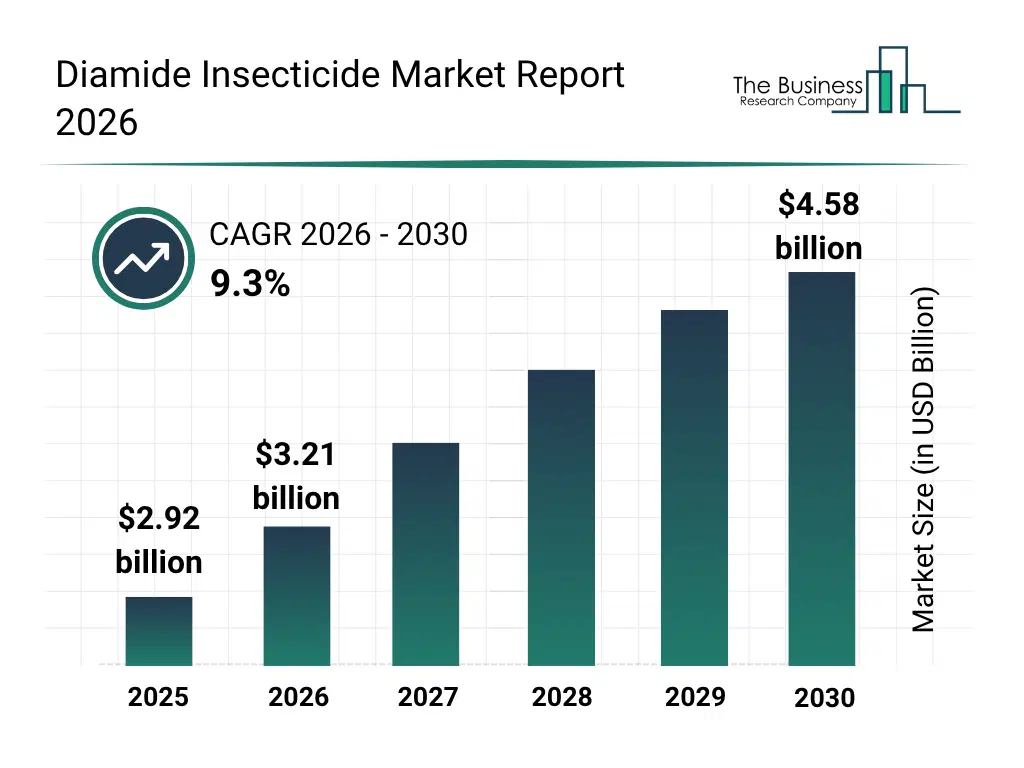
What Is The Diamide Insecticide Market Size and Share 2026?
The diamide insecticide market size has grown strongly in recent years. It will grow from $2.92 billion in 2025 to $3.21 billion in 2026 at a compound annual growth rate (CAGR) of 10.0%. The growth in the historic period can be attributed to increasing crop losses from lepidopteran pests, rising demand for effective insect pest control, adoption of selective insecticide modes of action, expansion of high-value crop cultivation, increasing need for improved agricultural productivity.What Is The Diamide Insecticide Market Growth Forecast?
The diamide insecticide market size is expected to see strong growth in the next few years. It will grow to $4.58 billion in 2030 at a compound annual growth rate (CAGR) of 9.3%. The growth in the forecast period can be attributed to growing demand for targeted pest management, increasing crop protection requirements from intensifying agriculture, rising adoption of advanced insecticide formulations, increasing emphasis on insecticide resistance management, expansion of diamide applications across diverse crop types. Major trends in the forecast period include increasing development of selective diamide insecticide formulations, rising adoption of diamide insecticides for resistance management, growing demand for broad-spectrum crop pest protection, increasing use of seed treatment applications for pest control, expanding development of next-generation diamide molecules.Tariff Impact On Diamide Insecticide Market
Tariffs are impacting the diamide insecticides market by increasing the cost of imported active ingredients, chemical intermediates, formulation materials, and agricultural chemical manufacturing equipment required for diamide insecticide production. This is raising production and distribution costs, particularly for technically complex products such as broflanilide, chlorantraniliprole, and cyantraniliprole, with import-dependent regions including Asia-Pacific, Latin America, and North America being more exposed. Formulation-intensive segments such as suspension concentrates, water dispersible granules, and seed treatment products are also affected by higher input and logistics costs. However, tariffs are encouraging local manufacturing, regional sourcing of chemical intermediates, supplier diversification, and investment in domestic crop protection production capacity, improving long-term supply chain resilience.
Global Diamide Insecticide Market Segmentation
1) By Type: Broflanilide, Chlorantraniliprole, Cyantraniliprole, Cyclaniliprole, Cyhalodiamide, Other Types 2) By Crop Type: Cereals And Grains, Fruits And Vegetables, Oilseeds And Pulses, Other Crop Types 3) By Pest Type: Lepidopteran Pests, Coleopteran Pests, Hemipteran Pests, Other Pest Types 4) By Distribution Channel: Direct Sales, Agricultural Retailers And Dealers, Distributors And Wholesalers, E Commerce Platforms 5) By Application Method: Foliar Spray, Seed Treatment, Soil Application, Chemigation, Other Application Methods Subsegments: 1) By Broflanilide: Technical Grade Broflanilide, Suspension Concentrate Broflanilide, Wettable Powder Broflanilide, Water Dispersible Granule Broflanilide 2) By Chlorantraniliprole: Technical Grade Chlorantraniliprole, Suspension Concentrate Chlorantraniliprole, Water Dispersible Granule Chlorantraniliprole, Seed Treatment Chlorantraniliprole 3) By Cyantraniliprole: Technical Grade Cyantraniliprole, Suspension Concentrate Cyantraniliprole, Oil Dispersion Cyantraniliprole, Seed Treatment Cyantraniliprole 4) By Cyclaniliprole: Technical Grade Cyclaniliprole, Suspension Concentrate Cyclaniliprole, Water Dispersible Granule Cyclaniliprole 5) By Cyhalodiamide: Technical Grade Cyhalodiamide, Suspension Concentrate Cyhalodiamide, Wettable Powder Cyhalodiamide 6) By Other Types: Flubendiamide, Tetrachlorantraniliprole, Experimental Diamide MoleculesWhat Is The Driver Of The Diamide Insecticide Market?
The rising food demand is expected to propel the growth of the diamide insecticide market going forward. Food demand is increasing due to population growth, as a rising global population increases the need for food products to meet the nutritional requirements of more people. Increasing food demand drives diamide insecticide demand by encouraging farmers to improve crop productivity and protect yields from insect pests, leading to greater adoption of effective crop protection solutions such as diamide insecticides. For instance, in June 2026, according to the United States Department of Agriculture Economic Research Service (USDA ERS), a US-based federal agency, U.S. consumers, businesses, and government entities spent $2.51 trillion on food in 2025, measured in inflation-adjusted 2025 dollars, up from $2.49 trillion in 2024, reflecting an increase in real food spending, indicating continued growth in consumer demand for food. Therefore, the rising food demand is driving the growth of the diamide insecticide industry.Key Players In The Global Diamide Insecticide Market
Major companies operating in the diamide insecticide market are Syngenta AG, Bayer AG, BASF SE, Corteva Agriscience Inc., FMC Corporation, Sumitomo Chemical Co. Ltd., UPL Limited, Mitsui Chemicals Crop & Life Solutions Inc., Nissan Chemical Corporation, Nufarm Limited, PI Industries Limited, Rallis India Limited, Coromandel International Limited, Ishihara Sangyo Kaisha Ltd., Nihon Nohyaku Co. Ltd., Dhanuka Agritech Limited, Best Agrolife Limited, Insecticides (India) Limited, Crystal Crop Protection Limited, Meghmani Organics Limited, Gharda Chemicals Limited, Indofil Industries Limited, Dharmaj Crop Guard Limited, Parijat Industries Pvt. Ltd., HPM Chemicals & Fertilizers Ltd.
This chart is for illustrative purposes; the full report includes a detailed competitor analysis and comprehensive overview of the top 10 companies in the market.
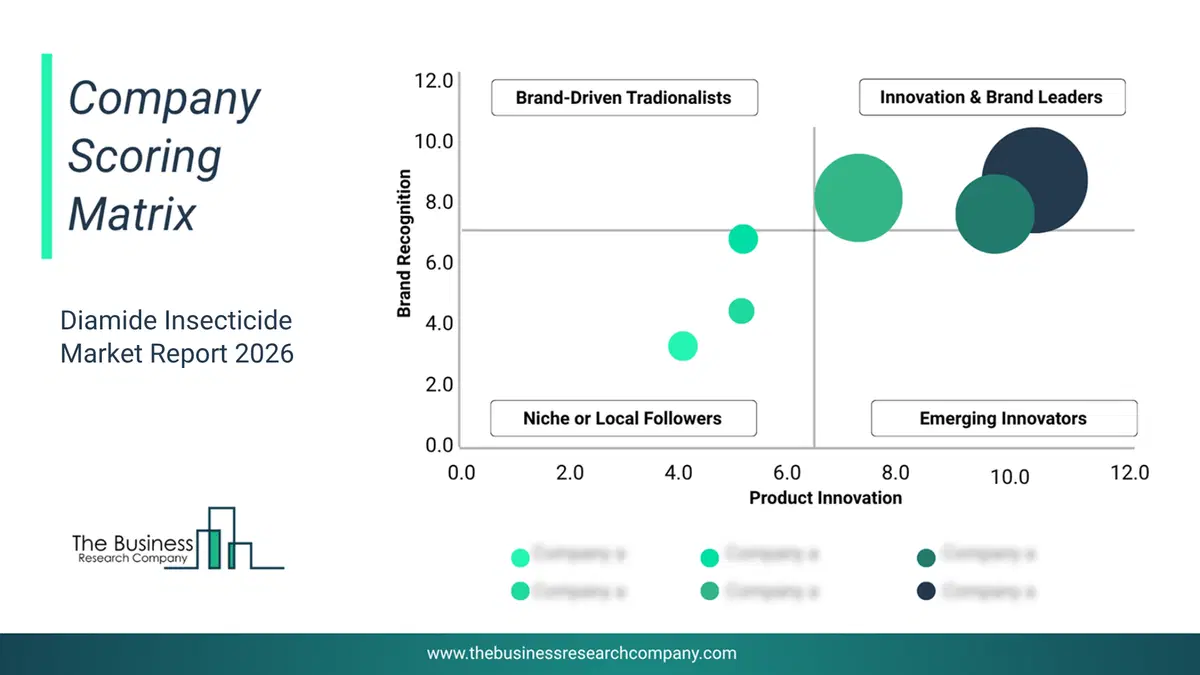
This chart maps companies by product innovation and brand strength, with bubble size indicating relative revenue, helping identify market leaders, challengers, and niche players. This is an illustrative chart; the full report provides a complete and accurate competitive analysis.
Global Diamide Insecticide Market Trends and Insights
Major companies operating in the diamide insecticide market are focusing on developing innovative solutions such as next-generation insecticidal chemistries to improve pest control performance, provide targeted action against resistant pests, and support sustainable crop protection practices. Next-generation insecticidal chemistries refer to advanced pesticide compounds developed with improved biological activity, selectivity, and environmental safety profiles compared with conventional insecticides. For instance, in May 2026, Metisa Biotechnology Co. Ltd., a China-based biotechnology company, received official ISO 1750 approval for cyanoflanilide, a next-generation insecticidal chemistry designed as a novel meta-diamide insecticide for effective pest management. It offers benefits such as improved pest control efficacy, targeted insect activity, and potential support for resistance management. The approval aims to help customers access innovative crop protection solutions while supporting the industry trend toward advanced and sustainable agricultural technologies.What Are Latest Mergers And Acquisitions In The Diamide Insecticide Market?
In January 2026, Tagros Chemicals India Private Limited, an India-based agrochemical company, acquired Bayer AG’s global Flubendiamide assets across the Latin America, Europe, Middle East and Africa, and Asia Pacific regions for an undisclosed amount. Through this acquisition, Tagros aims to strengthen its position in the diamide insecticide segment by gaining access to Flubendiamide formulations, product registrations, technical know-how, and established brands across more than 25 international markets. Bayer AG is a Germany-based pharmaceutical and agrochemical company that developed and commercialized Flubendiamide, a diamide insecticide used for controlling lepidopteran pests in crops.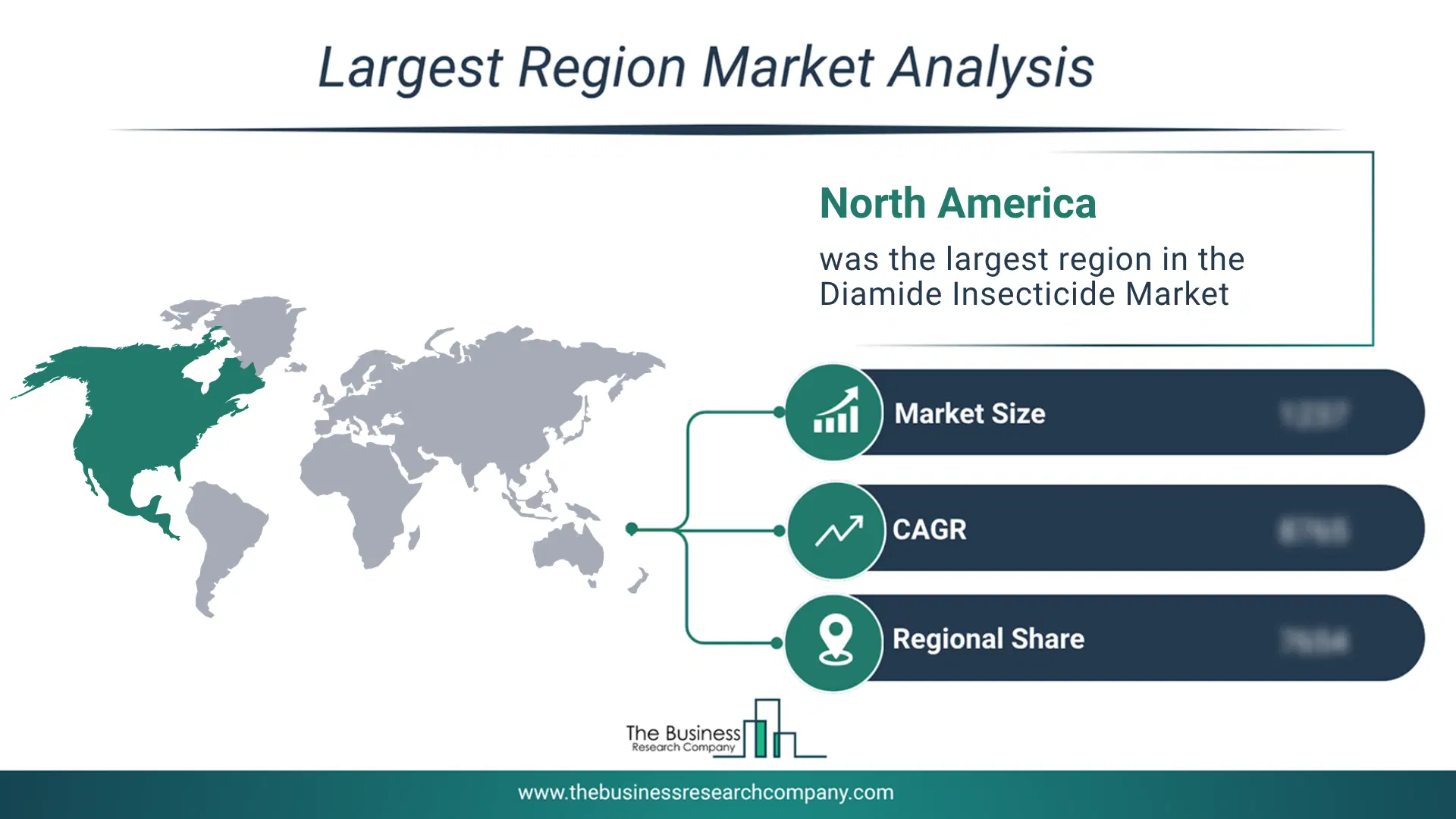
Regional Outlook
North America was the largest region in the diamide insecticide market in 2025. Asia-Pacific is expected to be the fastest-growing region in the forecast period. The regions covered in this market report are Asia-Pacific, South East Asia, Western Europe, Eastern Europe, North America, South America, Middle East, Africa. The countries covered in this market report are Australia, Brazil, China, France, Germany, India, Indonesia, Japan, Taiwan, Russia, South Korea, UK, USA, Canada, Italy, Spain.What Defines the Diamide Insecticide Market?
The diamide insecticide market consists of sales of flubendiamide, and tetraniliprole. Values in this market are ‘factory gate’ values, that is, the value of goods sold by the manufacturers or creators of the goods, whether to other entities (including downstream manufacturers, wholesalers, distributors, and retailers) or directly to end customers. The value of goods in this market includes related services sold by the creators of the goods.How is Market Value Defined and Measured?
The market value is defined as the revenues that enterprises gain from the sale of goods and/or services within the specified market and geography through sales, grants, or donations in terms of the currency (in USD unless otherwise specified). The revenues for a specified geography are consumption values that are revenues generated by organizations in the specified geography within the market, irrespective of where they are produced. It does not include revenues from resales along the supply chain, either further along the supply chain or as part of other products.
This chart presents market attractiveness based on a quantitative evaluation of growth, competition, strategic alignment, and risk, offering a clear view of opportunity areas for decision-making. This chart is for illustrative purposes; the full report contains the complete analysis.

This chart highlights the Total Addressable Market (TAM) by estimating the maximum revenue opportunity using an assumption-driven approach, supporting strategic planning and opportunity sizing across markets. The chart is illustrative; the full report provides a more comprehensive analysis.
What Key Data and Analysis Are Included in the Diamide Insecticide Market Report 2026?
The diamide insecticide market research report is one of a series of new reports from The Business Research Company that provides market statistics, including industry global market size, regional shares, competitors with the market share, detailed market segments, market trends and opportunities, and any further data you may need to thrive in the diamide insecticide industry. The market research report delivers a complete perspective of everything you need, with an in-depth analysis of the current and future state of the industry.Diamide Insecticide Market Report Forecast Analysis
| Report Attribute | Details |
|---|---|
| Market Size Value In 2026 | $3.21 billion |
| Revenue Forecast In 2030 | $4.58 billion |
| Growth Rate | CAGR of 9.3% from 2026 to 2030 |
| Base Year For Estimation | 2025 |
| Actual Estimates/Historical Data | 2020-2025 |
| Forecast Period | 2026 - 2030 |
| Market Representation | Revenue in USD Billion and CAGR from 2026 to 2030 |
| Segments Covered | Type, Crop Type, Pest Type, Distribution Channel, Application Method |
| Regional Scope | Asia-Pacific, Western Europe, Eastern Europe, North America, South America, Middle East, Africa |
| Country Scope | The countries covered in the report are Australia, Brazil, China, France, Germany, India, Indonesia, Japan, Taiwan, Russia, South Korea, UK, USA, Canada, Italy, Spain. |
| Key Companies Profiled | Syngenta AG, Bayer AG, BASF SE, Corteva Agriscience Inc., FMC Corporation, Sumitomo Chemical Co. Ltd., UPL Limited, Mitsui Chemicals Crop & Life Solutions Inc., Nissan Chemical Corporation, Nufarm Limited, PI Industries Limited, Rallis India Limited, Coromandel International Limited, Ishihara Sangyo Kaisha Ltd., Nihon Nohyaku Co. Ltd., Dhanuka Agritech Limited, Best Agrolife Limited, Insecticides (India) Limited, Crystal Crop Protection Limited, Meghmani Organics Limited, Gharda Chemicals Limited, Indofil Industries Limited, Dharmaj Crop Guard Limited, Parijat Industries Pvt. Ltd., HPM Chemicals & Fertilizers Ltd. |
| Customization Scope | Request for Customization |
| Pricing And Purchase Options | Explore Purchase Options |