

Differential-Privacy Edge-Device Market Report 2026
Global Outlook – By Component (Hardware, Software, Services), By Device Type (Sensors, Gateways, Cameras, Wearables, Other Device Types), By Deployment Mode (On-Premises, Cloud, Hybrid), By End-User (Banking, Financial Services, And Insurance (BFSI), Healthcare, Manufacturing, Retail, Government, Information Technology (IT) And Telecommunications, Other End-Users) – Market Size, Trends, Strategies, and Forecast to 2030
Differential-Privacy Edge-Device Market Overview
• Differential-Privacy Edge-Device market size has reached to $1.66 billion in 2025 • Expected to grow to $5.23 billion in 2030 at a compound annual growth rate (CAGR) of 25.7% • Growth Driver: Increasing Concern About Data Privacy And Security Driving The Market Due To Rising Risks Of Consumer Data Breaches • Market Trend: Technological Innovation In On-Device Differential Privacy Advancing Edge Analytics • North America was the largest region in 2025 and Asia-Pacific is the fastest growing region.What Is Covered Under Differential-Privacy Edge-Device Market?
Differential-privacy edge device is a sensor, phone, gateway, or embedded compute node that collects and processes data locally and applies differential-privacy mechanisms such as adding calibrated noise or using randomized response to statistics or model updates before anything leaves the device. Its purpose is to enable useful analytics or federated learning at the edge while providing provable privacy guarantees, limiting the chance of identifying individuals and reducing raw-data exposure to central servers. The main components of differential-privacy edge-devices include hardware, software, and services. Hardware-based differential-privacy edge-devices refer to devices equipped with integrated processing units and privacy-preserving algorithms that enable data collection and computation at the edge while ensuring individual data privacy through differential-privacy techniques. These devices include sensors, gateways, cameras, wearables, and others, and can be deployed on-premises, in the cloud, or through hybrid models. The key end-users include banking, financial services, and insurance (BFSI), healthcare, manufacturing, retail, government, IT and telecommunications, and others.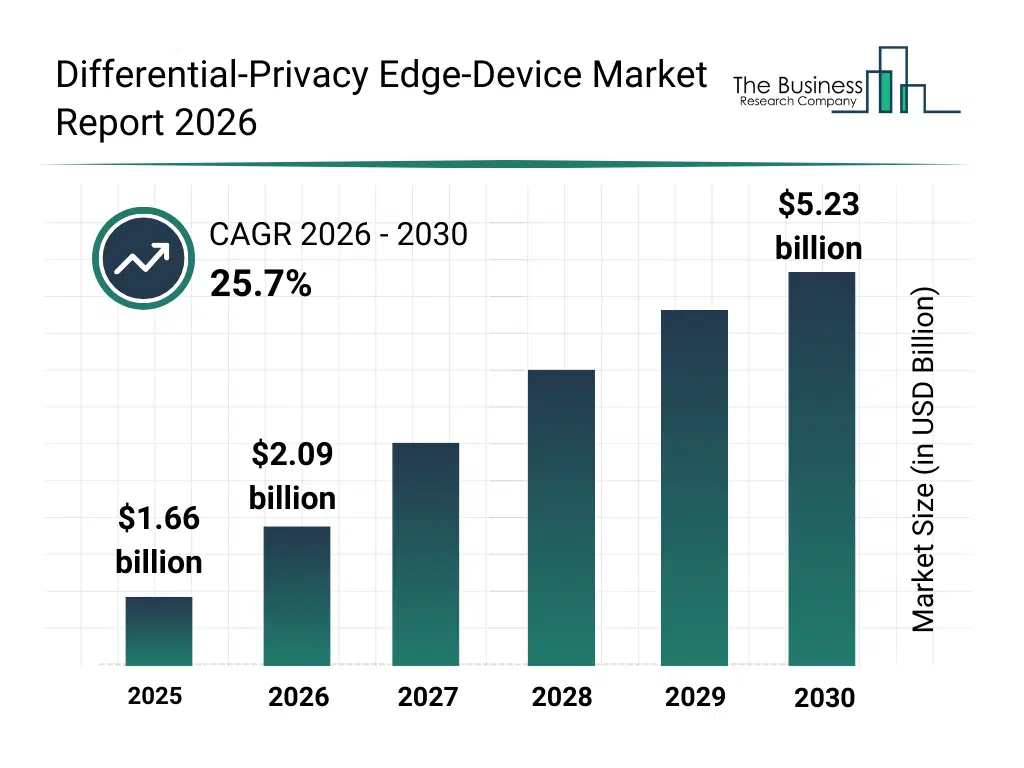
What Is The Differential-Privacy Edge-Device Market Size and Share 2026?
The differential-privacy edge-device market size has grown exponentially in recent years. It will grow from $1.66 billion in 2025 to $2.09 billion in 2026 at a compound annual growth rate (CAGR) of 26.0%. The growth in the historic period can be attributed to growing concern over user data privacy, adoption of edge computing, rising use of sensors and gateways, regulatory compliance requirements, increasing deployment of iot devices.What Is The Differential-Privacy Edge-Device Market Growth Forecast?
The differential-privacy edge-device market size is expected to see exponential growth in the next few years. It will grow to $5.23 billion in 2030 at a compound annual growth rate (CAGR) of 25.7%. The growth in the forecast period can be attributed to integration of AI-driven privacy algorithms, expansion of cloud and hybrid edge deployments, rising adoption in healthcare and bfs i sectors, demand for secure federated learning, development of specialized differential privacy sdk and platforms. Major trends in the forecast period include privacy-preserving edge analytics, federated learning implementation, differential privacy mechanism adoption, local data processing optimization, secure data sharing across networks.
Global Differential-Privacy Edge-Device Market Segmentation
1) By Component: Hardware, Software, Services 2) By Device Type: Sensors, Gateways, Cameras, Wearables, Other Device Types 3) By Deployment Mode: On-Premises, Cloud, Hybrid 4) By End-User: Banking, Financial Services, And Insurance (BFSI), Healthcare, Manufacturing, Retail, Government, Information Technology (IT) And Telecommunications, Other End-Users Subsegments: 1) By Hardware: Edge processors, Sensors, Memory And Storage, Network Modules, Secure Enclaves Or TPM 2) By Software: Differential Privacy SDKs, Privacy-Preserving Analytics Platforms, Data Anonymization Tools, Security And Encryption Software 3) By Services: Consulting And Implementation, Managed Privacy Services, Support And Maintenance, Training And CertificationWhat Is The Driver Of The Differential-Privacy Edge-Device Market?
The increasing concern about data privacy and security is expected to propel the growth of the differential-privacy edge-device market going forward. Data privacy and security refer to the policies, controls, and safeguards that protect personally identifiable information from unauthorized access or misuse while preserving confidentiality, integrity, and availability. The concern about data privacy and security is rising due to a sharp, government-reported increase in consumer fraud losses that reflects broader risks to personal data. Differential-privacy edge devices help by keeping analytics and aggregation local, minimizing the movement of raw personal data and reducing breach exposure across networks. For instance, in September 2023, according to Deloitte, a UK-based professional services firm, In 2023, 67% of smartphone users expressed concern about data security and privacy on their devices, while 62% of smart home users reported similar worries, an increase of 13 and 10 percentage points, respectively, compared to 2022. Therefore, the increasing concern about data privacy and security is driving the differential-privacy edge-device industry.Key Players In The Global Differential-Privacy Edge-Device Market
Major companies operating in the differential-privacy edge-device market are Apple Inc., Google LLC, Microsoft Corporation, Samsung Electronics Co. Ltd., Meta Platforms Inc., Alibaba Group Holding Limited, Amazon Web Services Inc., Huawei Technologies Co. Ltd., Robert Bosch GmbH, Sony Group Corporation, International Business Machines Corporation (IBM Corporation), Intel Corporation, Xiaomi Corporation, Qualcomm Technologies Inc., NVIDIA Corporation, NEC Corporation, ZTE Corporation, Tuya Inc., Shelly Group AD, Edge Impulse Inc.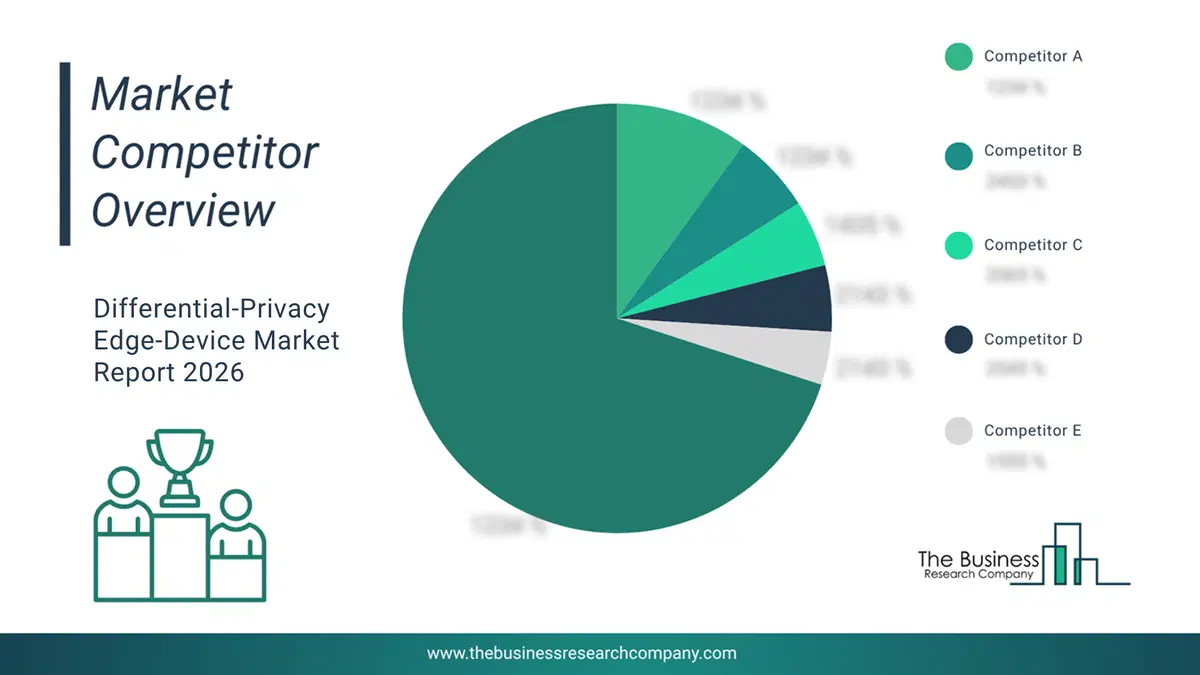
This chart is for illustrative purposes; the full report includes a detailed competitor analysis and comprehensive overview of the top 10 companies in the market.
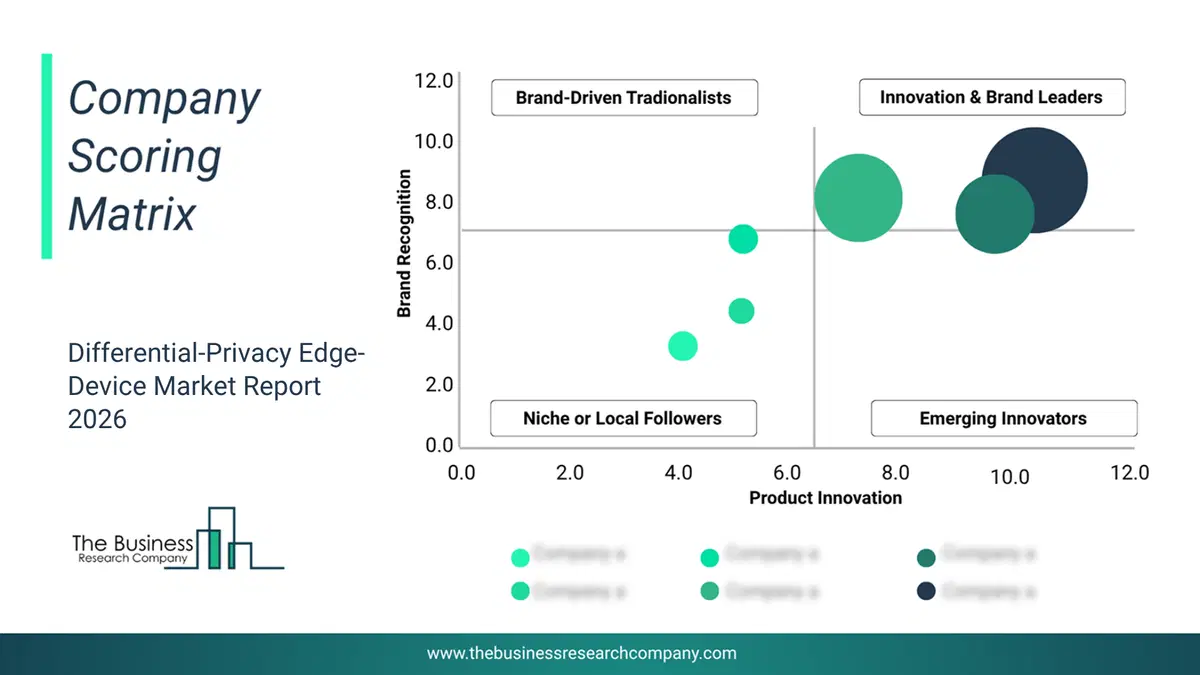
This chart maps companies by product innovation and brand strength, with bubble size indicating relative revenue, helping identify market leaders, challengers, and niche players. This is an illustrative chart; the full report provides a complete and accurate competitive analysis.
Global Differential-Privacy Edge-Device Market Trends and Insights
Major companies operating in the differential-privacy edge-device market are focusing on developing innovation such as on-device differentially private product analytics to learn aggregate usage safely from devices. On-device differentially private analytics adds mathematically calibrated noise and uses threshold or secure aggregation so only crowd-level patterns are learned while individual user data remains unobservable. For instance, in September 2024, Brave Software, a US-based software company that builds privacy-focused internet tools, launched Nebula, a differentially private system for privacy-preserving analytics in the Brave browser, with formal differential-privacy guarantees via sample-and-threshold DP with verifiable user-side thresholding and dummy data. efficient design with lower server overhead than local or shuffle differential-privacy (DP) models; enables population-level product insights without revealing any individual user’s choices; powers privacy-preserving telemetry directly from edge devices (browsers or phones) to improve features while keeping sensitive data on the device.What Are Latest Mergers And Acquisitions In The Differential-Privacy Edge-Device Market?
In June 2024, Mozilla Corporation, a US-based internet software and privacy technology company, acquired Anonym for an undisclosed amount. With this acquisition, Mozilla aims to integrate Anonym’s differential-privacy-based ad-measurement and secure, on-device aggregation pipelines into its products so advertisers and publishers can evaluate campaign performance using noise-added, aggregate analytics computed on users’ devices, improving privacy while still enabling effectiveness metrics across the web. Anonym is a US-based privacy-preserving digital advertising technology company.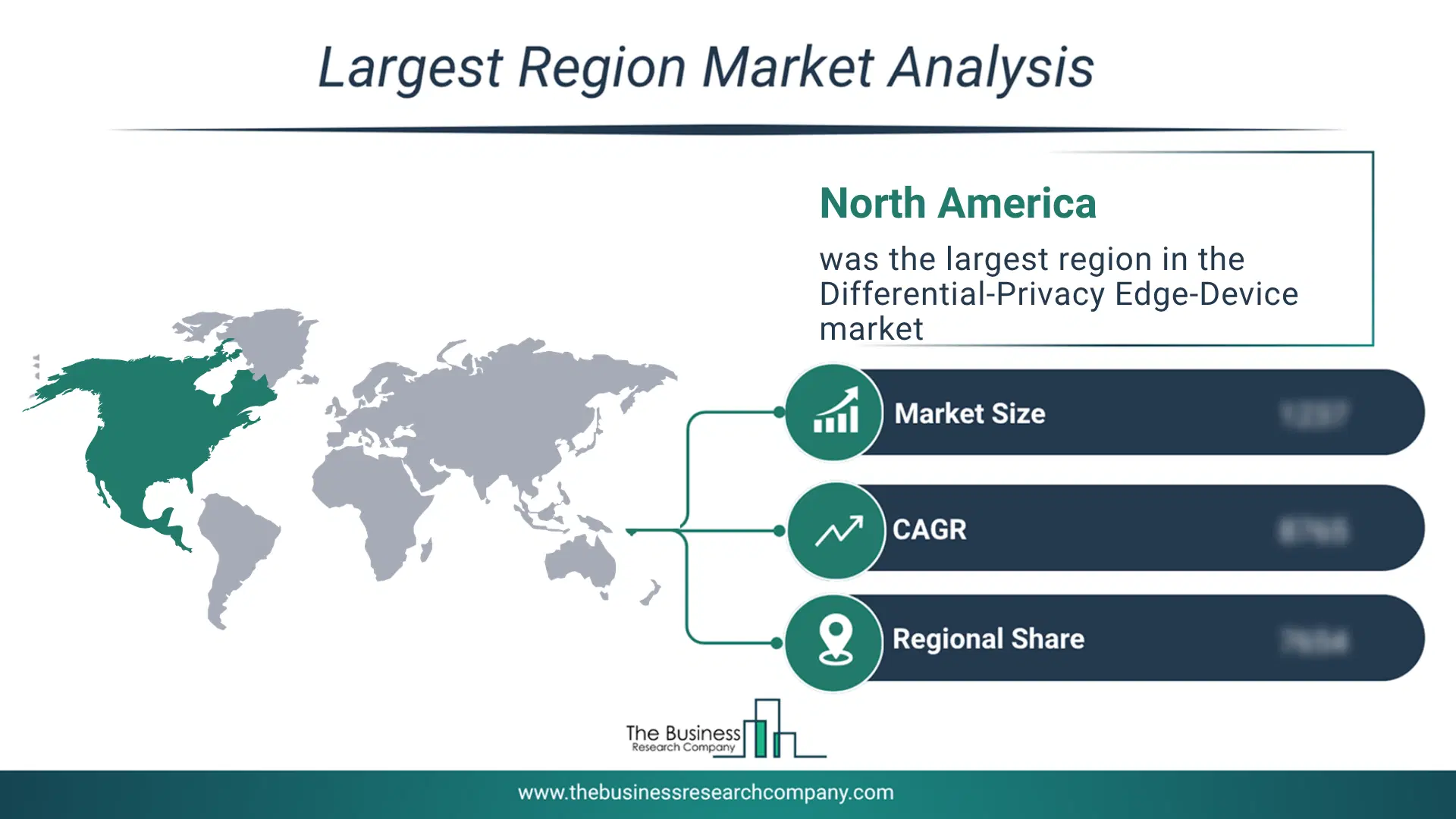
Regional Insights
North America was the largest region in the differential-privacy edge-device market in 2025. Asia-Pacific is expected to be the fastest-growing region in the forecast period. The regions covered in this market report are Asia-Pacific, South East Asia, Western Europe, Eastern Europe, North America, South America, Middle East, Africa. The countries covered in this market report are Australia, Brazil, China, France, Germany, India, Indonesia, Japan, Taiwan, Russia, South Korea, UK, USA, Canada, Italy, Spain.What Defines the Differential-Privacy Edge-Device Market?
The differential-privacy edge-device market consists of revenues earned by entities by providing services such as on-device data anonymization and aggregation services, differential privacy budget management and policy orchestration services, differential privacy model calibration and deployment services, managed firmware and security update services for privacy compliance, and edge-to-cloud privacy analytics and reporting services. The market value includes the value of related goods sold by the service provider or included within the service offering. The differential-privacy edge-device market also includes sales of differential-privacy edge gateways, privacy-preserving smart cameras, internet of things sensor nodes with differential-privacy co-processors, industrial edge controllers with differential-privacy accelerators, and mobile edge compute units with built-in differential privacy. Values in this market are ‘factory gate’ values; that is, the value of goods sold by the manufacturers or creators of the goods, whether to other entities (including downstream manufacturers, wholesalers, distributors, and retailers) or directly to end customers. The value of goods in this market includes related services sold by the creators of the goods.How is Market Value Defined and Measured?
The market value is defined as the revenues that enterprises gain from the sale of goods and/or services within the specified market and geography through sales, grants, or donations in terms of the currency (in USD unless otherwise specified). The revenues for a specified geography are consumption values that are revenues generated by organizations in the specified geography within the market, irrespective of where they are produced. It does not include revenues from resales along the supply chain, either further along the supply chain or as part of other products.
This chart presents market attractiveness based on a quantitative evaluation of growth, competition, strategic alignment, and risk, offering a clear view of opportunity areas for decision-making. This chart is for illustrative purposes; the full report contains the complete analysis.

This chart highlights the Total Addressable Market (TAM) by estimating the maximum revenue opportunity using an assumption-driven approach, supporting strategic planning and opportunity sizing across markets. The chart is illustrative; the full report provides a more comprehensive analysis.
What Key Data and Analysis Are Included in the Differential-Privacy Edge-Device Market Report 2026?
The differential-privacy edge-device market research report is one of a series of new reports from The Business Research Company that provides market statistics, including industry global market size, regional shares, competitors with the market share, detailed market segments, market trends and opportunities, and any further data you may need to thrive in the differential-privacy edge-device industry. The market research report delivers a complete perspective of everything you need, with an in-depth analysis of the current and future state of the industry.Differential-Privacy Edge-Device Market Report Forecast Analysis
| Report Attribute | Details |
|---|---|
| Market Size Value In 2026 | $2.09 billion |
| Revenue Forecast In 2030 | $5.23 billion |
| Growth Rate | CAGR of 25.7% from 2026 to 2030 |
| Base Year For Estimation | 2025 |
| Actual Estimates/Historical Data | 2020-2025 |
| Forecast Period | 2026 - 2030 |
| Market Representation | Revenue in USD Billion and CAGR from 2026 to 2030 |
| Segments Covered | Component, Device Type, Deployment Mode, End-User |
| Regional Scope | Asia-Pacific, Western Europe, Eastern Europe, North America, South America, Middle East, Africa |
| Country Scope | The Countries Covered In This Market Report Are Australia, Brazil, China, France, Germany, India, Indonesia, Japan, Taiwan, Russia, South Korea, Uk, Usa, Canada, Italy, Spain. |
| Key Companies Profiled | Apple Inc., Google LLC, Microsoft Corporation, Samsung Electronics Co. Ltd., Meta Platforms Inc., Alibaba Group Holding Limited, Amazon Web Services Inc., Huawei Technologies Co. Ltd., Robert Bosch GmbH, Sony Group Corporation, International Business Machines Corporation (IBM Corporation), Intel Corporation, Xiaomi Corporation, Qualcomm Technologies Inc., NVIDIA Corporation, NEC Corporation, ZTE Corporation, Tuya Inc., Shelly Group AD, Edge Impulse Inc. |
| Customization Scope | Request for Customization |
| Pricing And Purchase Options | Explore Purchase Options |