
Digital Battlefield Market Report 2026
Global Outlook – By Solution (Hardware, Services), By Technology (Artificial Intelligence, 3D Printing, Internet of Things, Big Data Analytics, Robotic Process Automation, Cloud Computing and Master Data Management, Digital Twin, Other Technologies), By Installation (New Procurement, Upgradation ), By Platform (Land, Naval, Airborne, Space ), By Application (Warfare Platform, Cyber Security, Logistics and Transportation, Surveillance and Situational Awareness, Command and Control, Health Monitoring, Design and Manufacturing, Other Applications) – Market Size, Trends, Strategies, and Forecast to 2030
Digital Battlefield Market Overview
• Digital Battlefield market size has reached to $70.59 billion in 2025 • Expected to grow to $164.49 billion in 2030 at a compound annual growth rate (CAGR) of 18.3% • Growth Driver: Rising Military Expenditure Accelerates Growth of the Digital Battlefield Market due to Increased Investment in Advanced Defense Technologies and Infrastructure • Market Trend: Elevating Military Capabilities With Advanced Surveillance Radars • North America was the largest region in 2025 and Asia-Pacific is the fastest growing region.What Is Covered Under Digital Battlefield Market?
A digital battlefield refers to an interconnected network of airborne platforms, weapon systems, and surveillance and communication devices. It provides various mechanisms, such as real-time mapping, allowing military officials to make real-time choices, especially in war-like scenarios. It is used for mission rehearsal, execution, and after-action. It provides real-time situation awareness on the military battlefield. The main types of solutions in the digital battlefield markets are hardware, software, and services. Hardware in the digital battlefield market refers to the machinery and equipment used by the armed forces, such as all weapon systems, weapon platforms, vehicles, tanks, aircraft, and missiles. The various technologies are artificial intelligence, 3D printing, internet of things, big data analytics, robotic process automation, cloud computing and master data management, digital twin, blockchain, AR, VR, and 5G, which are installed through new procurement and upgradation. Different technologies include artificial intelligence, 3D printing, internet of things, big data analytics, robotic process automation, cloud computing, master data management, digital twin, and others that involve various installations such as new procurement, upgradation. The different platforms include land, naval, airborne, and space and involve several applications such as warfare platforms, cyber security, logistics and transportation, surveillance and situational awareness, command and control, health monitoring, design and manufacturing, and others.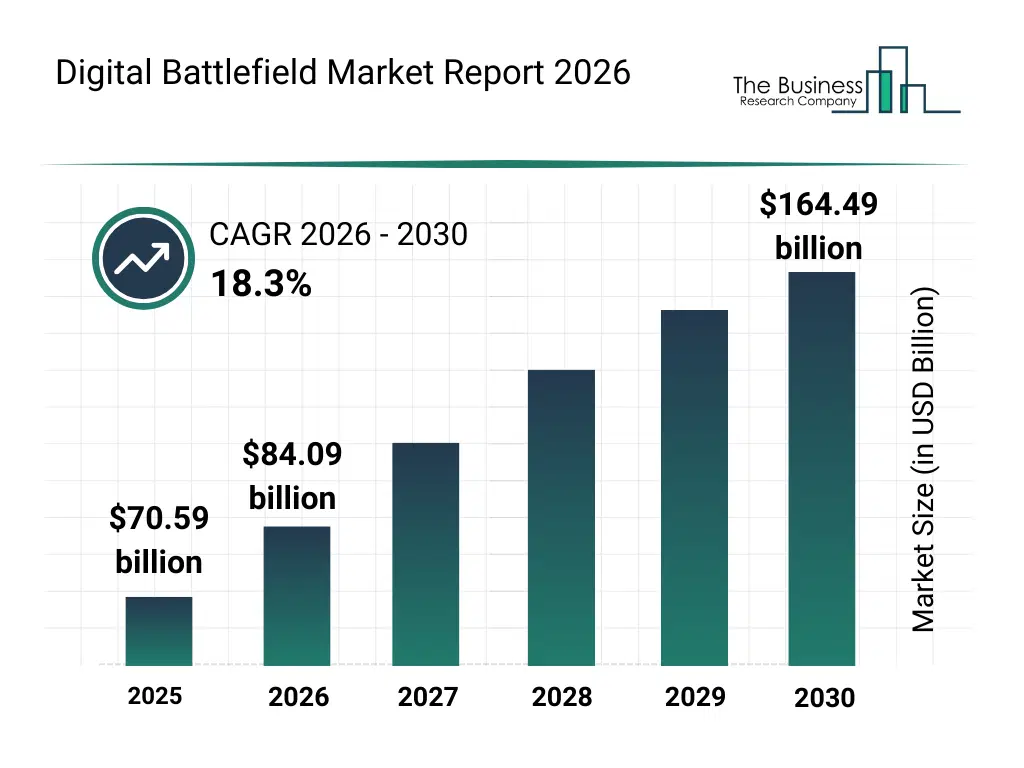
What Is The Digital Battlefield Market Size and Share 2026?
The digital battlefield market size has grown rapidly in recent years. It will grow from $70.59 billion in 2025 to $84.09 billion in 2026 at a compound annual growth rate (CAGR) of 19.1%. The growth in the historic period can be attributed to increased deployment of communication and tracking devices to enable real-time battlefield coordination, rising adoption of imaging and display systems to enhance situational awareness for military personnel, early integration of command and control software to support mission planning and execution, growth in use of wearable and night vision devices to improve soldier capability and survivability, expansion of data distribution and computer hardware systems to manage escalating battlefield information flows.What Is The Digital Battlefield Market Growth Forecast?
The digital battlefield market size is expected to see rapid growth in the next few years. It will grow to $164.49 billion in 2030 at a compound annual growth rate (CAGR) of 18.3%. The growth in the forecast period can be attributed to growing integration of ai-enabled situational awareness and decision-support tools, increasing adoption of interconnected digital platforms supporting multi-domain operations, rising demand for advanced security and inventory management systems across defense forces, expanding investment in next-generation weapon integration and network-centric warfare capabilities, continued modernization of military fleets driving upgrades in communication, tracking, and imaging devices. Major trends in the forecast period include increasing deployment of real-time battlefield decision-support platforms, growing adoption of advanced tactical communication and sensor fusion systems, rising integration of wearable combat technologies to enhance soldier performance, expansion of digital-twin-enabled mission rehearsal and simulation environments, advancements in multi-domain situational awareness and battlefield data distribution.
Global Digital Battlefield Market Segmentation
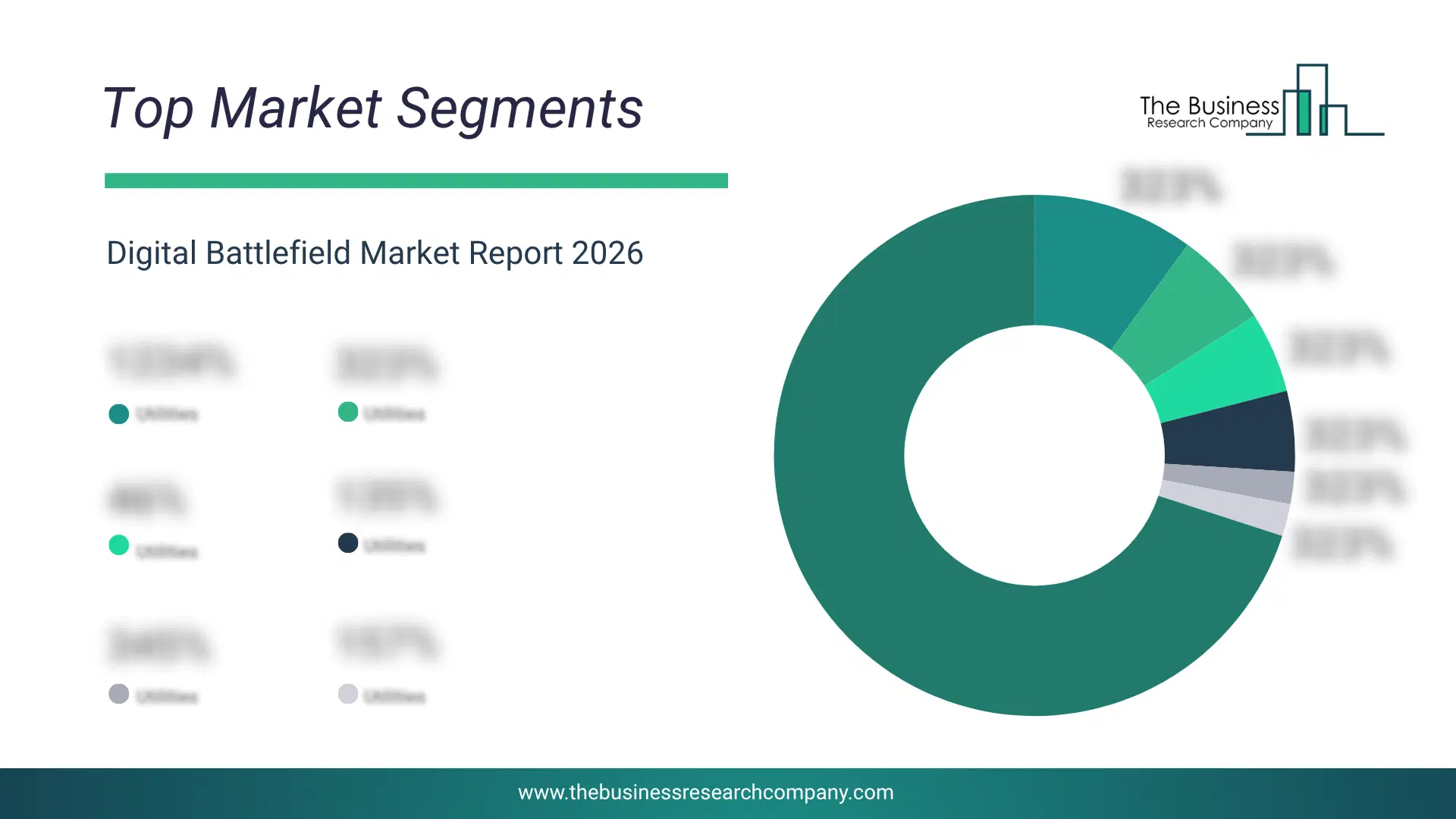
1) By Solution: Hardware, Services 2) By Technology: Artificial Intelligence, 3D Printing, Internet of Things, Big Data Analytics, Robotic Process Automation, Cloud Computing and Master Data Management, Digital Twin, Other Technologies 3) By Installation: New Procurement, Upgradation 4) By Platform: Land, Naval, Airborne, Space 5) By Application: Warfare Platform, Cyber Security, Logistics and Transportation, Surveillance and Situational Awareness, Command and Control, Health Monitoring, Design and Manufacturing, Other Applications Subsegments: 1) By Hardware: Communication Equipment, Sensors and Surveillance Systems, Command and Control Systems, Cybersecurity Hardware, Drones and Unmanned Aerial Vehicles (UAVs) 2) By Services: Integration Services, Training and Simulation Services, Maintenance and Support Services, Cybersecurity Services, Consulting Services for Digital TransformationWhat Is Driver Of The Digital Battlefield Market?
The rising military expenditure is expected to propel the growth of the digital battlefield market going forward. Military expenditure is the financial resources allocated by a government or a nation to fund its military forces, defense infrastructure, and related activities. Military expenditure plays an important role in funding the research, development, and deployment of advanced digital technologies, enabling the modernization and effectiveness of digital battlefield capabilities. It facilitates the acquisition of cutting-edge equipment, cybersecurity measures, and digital infrastructure essential for national defense. For instance, in October 2025, according to the UK Parliament's House of Commons Library, a UK-based government administration, Defence spending outlined in the 2025 Spending Review is expected to total USD 83.3 billion (£62.2 billion) in 2025/26, increasing to USD 98.2 billion (£73.5 billion) in 2028/29, which corresponds to an annual average real-terms growth rate of 3.8% over this period. Therefore, rising military expenditure is driving the growth of the digital battlefield industry.Key Players In The Global Digital Battlefield Market
Major companies operating in the digital battlefield market are BAE Systems plc, Northrop Grumman Corporation, Raytheon Technologies Corporation, Lockheed Martin Corporation, Thales Group, L3Harris Technologies Inc., Elbit Systems Ltd., General Dynamics Corporation, Leonardo S.P.A, Israel Aerospace Industries, Saab AB, ATOS SE, Airbus S.A.S., Rheinmetall AG, Honeywell Aerospace, Pratt & Whitney, Rolls-Royce Holdings plc, Safran S.A., Spirit AeroSystems Inc., Triumph Group Inc., International Business Machines Corporation, Microsoft Corporation, Amazon Web Services Inc., Google LLC, Oracle Corporation, Cisco Systems Inc., Dell Technologies Inc., Hewlett Packard Enterprise Development LP, Intel Corporation, Advanced Micro Devices Inc., Samsung Electronics Co. Ltd., Huawei Technologies Co. Ltd., Ericsson AB, Nokia Corporation, Collins Aerospace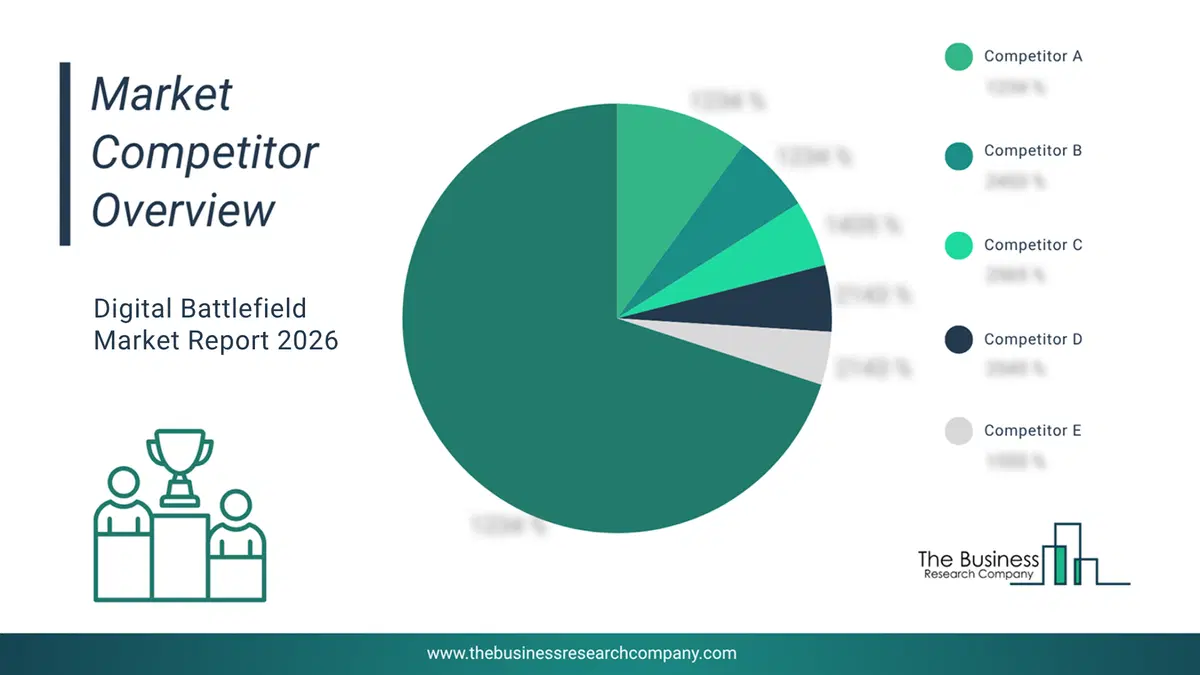
This chart is for illustrative purposes; the full report includes a detailed competitor analysis and comprehensive overview of the top 10 companies in the market.
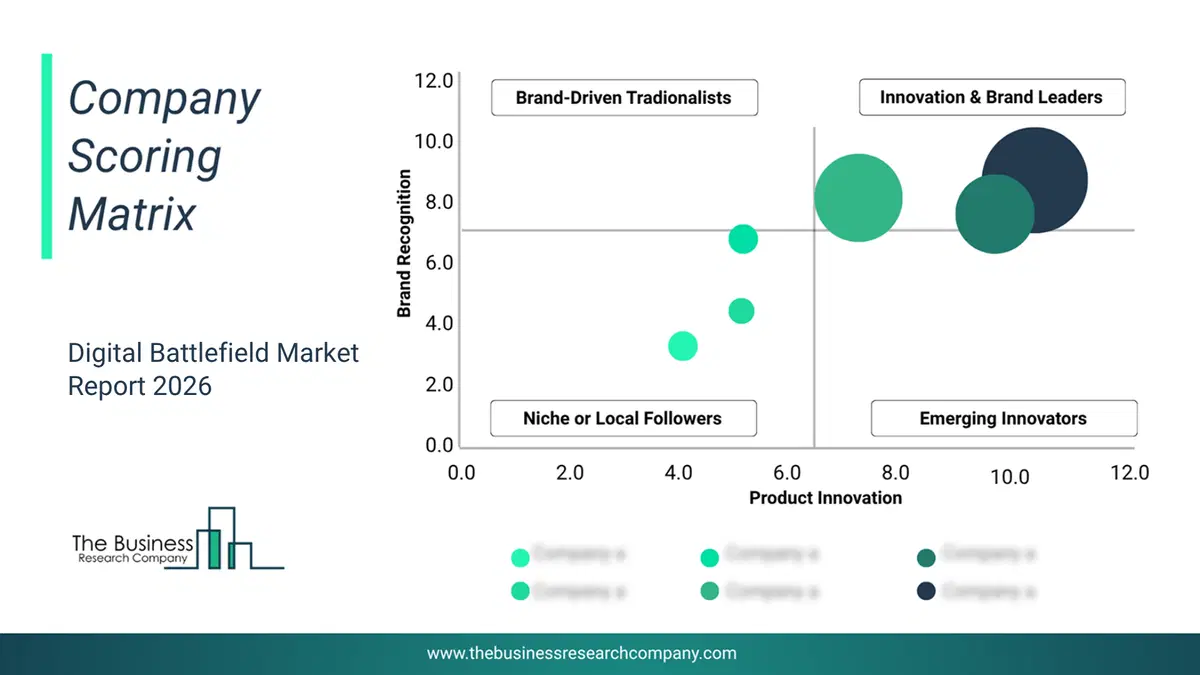
This chart maps companies by product innovation and brand strength, with bubble size indicating relative revenue, helping identify market leaders, challengers, and niche players. This is an illustrative chart; the full report provides a complete and accurate competitive analysis.
Global Digital Battlefield Market Trends and Insights
Major companies operating in the digital battlefield market are increasing their focus on introducing advanced surveillance radars, such as PrecISR, to gain a competitive edge in the market. Surveillance radars are sophisticated radar systems equipped with modern technology and capabilities for monitoring, detecting, and tracking objects in various environments. For instance, in February 2023, Hensoldt AG, a Germany-based aerospace company, launched the PrecISR multi-mission surveillance radars, which offer high performance in a compact design and are suitable for a variety of airborne platforms, including UAVs, helicopters, and special mission aircraft. The radar is capable of detecting and intercepting small and low-flying aircraft, tracking and plotting moving objects on the ground, as well as identifying objects with ease. Moreover, it can track more than a thousand targets on air, land, and sea simultaneously and detect small to large targets in high-sea states.What Are Latest Mergers And Acquisitions In The Digital Battlefield Market? Meta Platforms Inc. And Anduril Industries Inc. Partner To Develop AIDriven XR Military Solutions
In May 2025, Meta Platforms Inc., a US-based technology company, partnered with Anduril Industries Inc. to develop AI-driven defense and security solutions. With this partnership aims to create advanced extended reality (XR) military tech that enhances soldiers' situational awareness and autonomy control, aiming to improve battlefield effectiveness while reducing costs for the U.S. military. Anduril Industries Inc. is a US-based defense technology company that offers digital battlefield.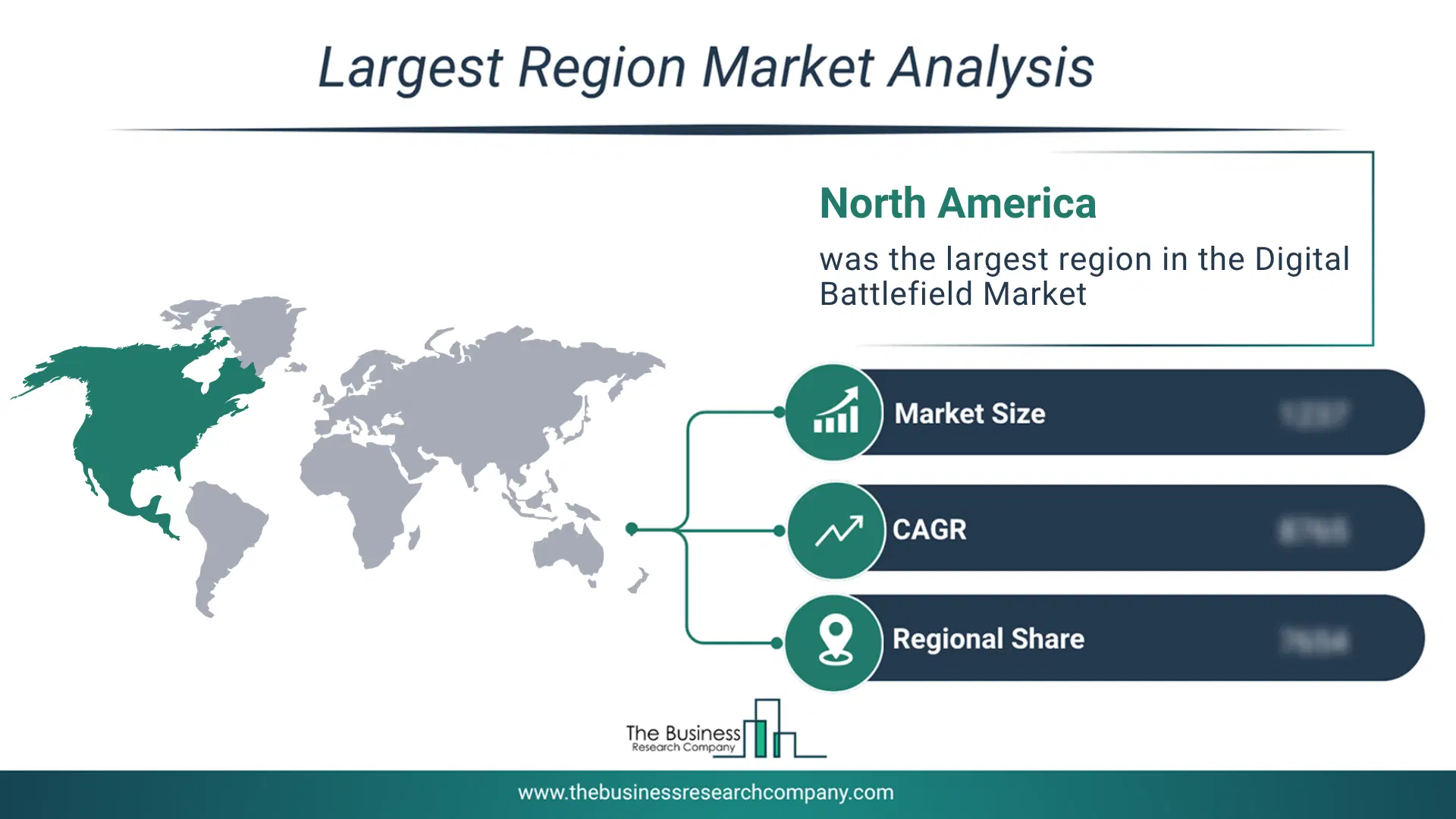
Regional Insights
North America was the largest region in the digital battlefield market in 2025. Asia-Pacific is expected to be the fastest-growing region in the forecast period. The regions covered in this market report are Asia-Pacific, South East Asia, Western Europe, Eastern Europe, North America, South America, Middle East, Africa. The countries covered in this market report are Australia, Brazil, China, France, Germany, India, Indonesia, Japan, Taiwan, Russia, South Korea, UK, USA, Canada, Italy, SpainWhat Defines the Digital Battlefield Market?
The digital battlefield market includes revenues earned by entities by communication devices, wearable devices, imaging devices, display devices, tracking devices, computer hardware devices, data distribution units, night vision devices, RFID, command and control software, military situational awareness, security management, inventory management, fleet management, and weapon integration. The market value includes the value of related goods sold by the service provider or included within the service offering.How is Market Value Defined and Measured?
The market value is defined as the revenues that enterprises gain from the sale of goods and/or services within the specified market and geography through sales, grants, or donations in terms of the currency (in USD unless otherwise specified). The revenues for a specified geography are consumption values that are revenues generated by organizations in the specified geography within the market, irrespective of where they are produced. It does not include revenues from resales along the supply chain, either further along the supply chain or as part of other products.
This chart presents market attractiveness based on a quantitative evaluation of growth, competition, strategic alignment, and risk, offering a clear view of opportunity areas for decision-making. This chart is for illustrative purposes; the full report contains the complete analysis.

This chart highlights the Total Addressable Market (TAM) by estimating the maximum revenue opportunity using an assumption-driven approach, supporting strategic planning and opportunity sizing across markets. The chart is illustrative; the full report provides a more comprehensive analysis.
What Key Data and Analysis Are Included in the Digital Battlefield Market Report 2026?
The digital battlefield market research report is one of a series of new reports from The Business Research Company that provides market statistics, including industry global market size, regional shares, competitors with the market share, detailed market segments, market trends and opportunities, and any further data you may need to thrive in the digital battlefield industry. The market research report delivers a complete perspective of everything you need, with an in-depth analysis of the current and future state of the industry.Digital Battlefield Market Report Forecast Analysis
| Report Attribute | Details |
|---|---|
| Market Size Value In 2026 | $84.09 billion |
| Revenue Forecast In 2030 | $164.49 billion |
| Growth Rate | CAGR of 18.3% from 2026 to 2030 |
| Base Year For Estimation | 2025 |
| Actual Estimates/Historical Data | 2020-2025 |
| Forecast Period | 2026 - 2030 |
| Market Representation | Revenue in USD Billion and CAGR from 2026 to 2030 |
| Segments Covered | Solution, Technology, Installation, Platform, Application |
| Regional Scope | Asia-Pacific, Western Europe, Eastern Europe, North America, South America, Middle East, Africa |
| Country Scope | The countries covered in the digital battlefield market report are Australia, Brazil, China, France, Germany, India, Indonesia, Japan, Taiwan, Russia, South Korea, UK, USA, Canada, Italy, Spain |
| Key Companies Profiled | BAE Systems plc, Northrop Grumman Corporation, Raytheon Technologies Corporation, Lockheed Martin Corporation, Thales Group, L3Harris Technologies Inc., Elbit Systems Ltd., General Dynamics Corporation, Leonardo S.P.A, Israel Aerospace Industries, Saab AB, ATOS SE, Airbus S.A.S., Rheinmetall AG, Honeywell Aerospace, Pratt & Whitney, Rolls-Royce Holdings plc, Safran S.A., Spirit AeroSystems Inc., Triumph Group Inc., International Business Machines Corporation, Microsoft Corporation, Amazon Web Services Inc., Google LLC, Oracle Corporation, Cisco Systems Inc., Dell Technologies Inc., Hewlett Packard Enterprise Development LP, Intel Corporation, Advanced Micro Devices Inc., Samsung Electronics Co. Ltd., Huawei Technologies Co. Ltd., Ericsson AB, Nokia Corporation, Collins Aerospace |
| Customization Scope | Request for Customization |
| Pricing And Purchase Options | Explore Purchase Options |