
Digital Camera Market Report 2026
Global Outlook – By Type ( Compact Digital Cameras, Mirrorless Interchangeable Lens Cameras, Digital Single-Lens Reflex Cameras), By Lens Type ( Built-In, Interchangeable), By Digital Sensor Type ( Charge-Coupled Device (CCD) Sensor, Complementary Metal-Oxide-Semiconductor (CMOS) Sensor, Live Metal-Oxide-Semiconductor (MOS) Sensor), By Resolution ( Low-Resolution Cameras, High-Resolution Cameras), By End User ( Personal, Profession) – Market Size, Trends, Strategies, and Forecast to 2030
Digital Camera Market Overview
• Digital Camera market size has reached to $7.12 billion in 2025 • Expected to grow to $9.07 billion in 2030 at a compound annual growth rate (CAGR) of 4.8% • Growth Driver: Smartphone Penetration Driving Growth Of Digital Camera Market • Market Trend: Next-Generation Advanced Compact Cameras Are Redefining Photography • Asia-Pacific was the largest region and fastest growing region.What Is Covered Under Digital Camera Market?
A digital camera is an electronic device that records and stores photographic images in digital form rather than on traditional photographic film. It offers various features and functionalities, including different shooting modes and adjustable settings for exposure and focus, and often includes built-in image processing capabilities. Digital cameras enable users to preview and review their images instantly on a display screen, facilitating easy sharing and editing of captured media through digital platforms. The main types of digital cameras are compact digital cameras, mirrorless interchangeable lens cameras, and digital single-lens reflex cameras. Compact digital cameras are small, lightweight cameras designed for everyday use, typically featuring fixed lenses and easy-to-use controls. The lens types involved are built-in and interchangeable, which are attached by a charge-coupled device (CCD) sensor, a complementary metal-oxide-semiconductor (CMOS) sensor, a live metal-oxide-semiconductor (MOS) sensor with a low-resolution camera, and a high-resolution camera used in personal and professional settings.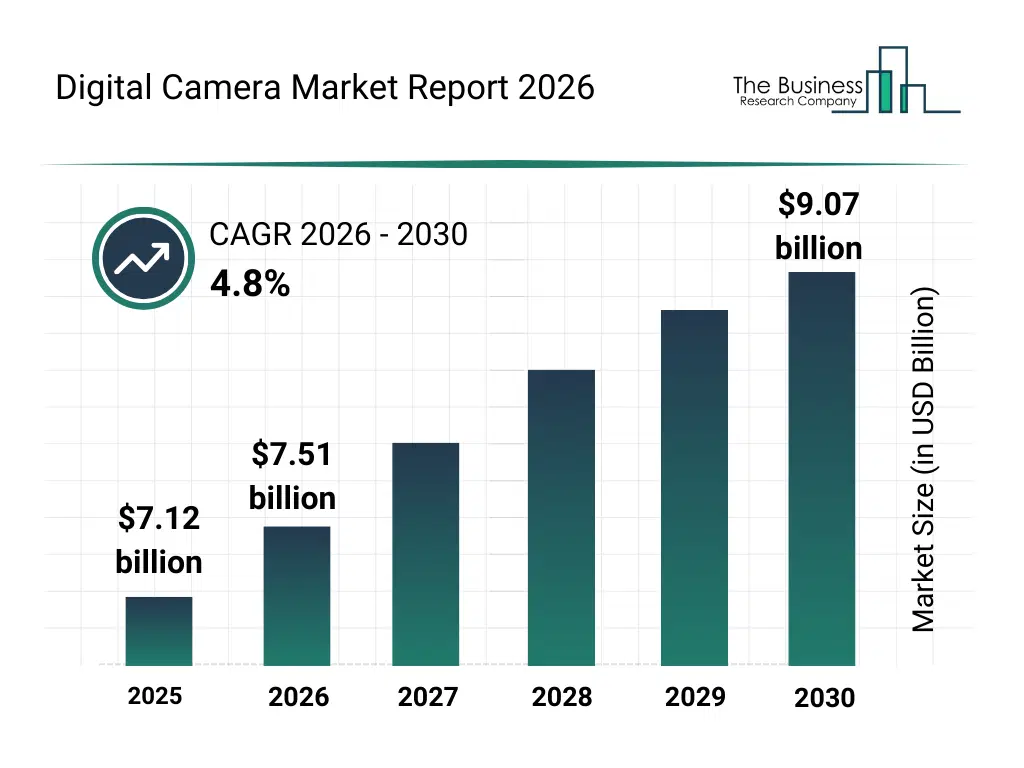
What Is The Digital Camera Market Size 2026 And Growth Rate?
The digital camera market size has grown strongly in recent years. It will grow from $7.12 billion in 2025 to $7.51 billion in 2026 at a compound annual growth rate (CAGR) of 5.5%. The growth in the historic period can be attributed to transition from film to digital photography, declining costs of digital imaging technology, growth of social media photo sharing, increasing consumer interest in hobby photography, professional demand for high quality imaging.What Is The Digital Camera Market Growth Forecast?
The digital camera market size is expected to see steady growth in the next few years. It will grow to $9.07 billion in 2030 at a compound annual growth rate (CAGR) of 4.8%. The growth in the forecast period can be attributed to integration of AI based photography features, rising demand for professional content creation, growth in travel and experiential photography, advancements in cmos sensor technology, expansion of hybrid photo video camera usage. Major trends in the forecast period include growing adoption of mirrorless cameras over dslrs, increasing demand for high resolution image sensors, rising popularity of vlogging and content creation cameras, expansion of advanced image processing and autofocus features, growing preference for lightweight and compact camera designs.
Global Digital Camera Market Segmentation
1) By Type: Compact Digital Cameras, Mirrorless Interchangeable Lens Cameras, Digital Single-Lens Reflex Cameras 2) By Lens Type: Built-In, Interchangeable 3) By Digital Sensor Type: Charge-Coupled Device (CCD) Sensor, Complementary Metal-Oxide-Semiconductor (CMOS) Sensor, Live Metal-Oxide-Semiconductor (MOS) Sensor 4) By Resolution: Low-Resolution Cameras, High-Resolution Cameras 5) By End User: Personal, Profession Subsegments: 1) By Compact Digital Cameras: Point-And-shoot Cameras, Slim And Ultra-compact Cameras, Waterproof And Shockproof Compact Cameras, High Zoom Compact Cameras, Travel And Vlogging Compact Cameras, Advanced Compact Cameras With Manual Controls 2) By Mirrorless Interchangeable Lens Cameras: Entry-level Mirrorless Cameras, Mid-range Mirrorless Cameras, High-End Mirrorless Cameras, Full-Frame Mirrorless Cameras, Aps-c Sensor Mirrorless Cameras, Travel And Vlogging Mirrorless Cameras 3) By Digital Single-lens Reflex (Dslr) Cameras: Entry-level Dslr Cameras, Mid-Range Dslr Cameras, Professional Dslr Cameras, Full-frame Dslr Cameras, Aps-c Sensor Dslr Cameras, Sport And Action Dslr CamerasWhat Is The Driver Of The Digital Camera Market?
The increasing penetration of smartphones is expected to propel the growth of the digital camera market going forward. Smartphones refer to mobile devices that combine the functionality of a cellular phone with features typically found in a personal computer. Smartphone penetration is rising due to technological advances, affordability, better connectivity, diverse functions, ecosystem integration, and digital lifestyle trends. Smartphones enhance digital cameras by offering editing tools, instant sharing, connectivity, and serving as complementary devices for storage, remote control, and content management. For instance, in October 2025, according to the Demand Sage is a U.S.-based technology company, smartphone penetration in the United States reached 82.2% in 2023, up from 76.5% in 2022. The increasing penetration of smartphones is driving the growth of the digital camera industry.Key Players In The Global Digital Camera Market
Major companies operating in the digital camera market are Samsung Electronics Co. Ltd., Sony Corporation, LG Electronics Inc., Hewlett-Packard Inc., Panasonic Corporation, Canon Inc., Fujifilm Holdings Corporation, Ricoh Company Ltd., Olympus Corporation, Nikon Corporation, Carl Zeiss AG, Casio Computer Co. Ltd., DJI Technology Co. Ltd., Eastman Kodak Company, GoPro Inc., Polaroid Corporation, Tamron Co. Ltd., Leica Camera AG, Blackmagic Design Pty. Ltd., Sigma Corporation, Phase One A/S, YI Technology Co. Ltd., Hasselblad Group, Vivo Technology Company Limited, Arashi Vision Inc (Insta360)
This chart is for illustrative purposes; the full report includes a detailed competitor analysis and comprehensive overview of the top 10 companies in the market.
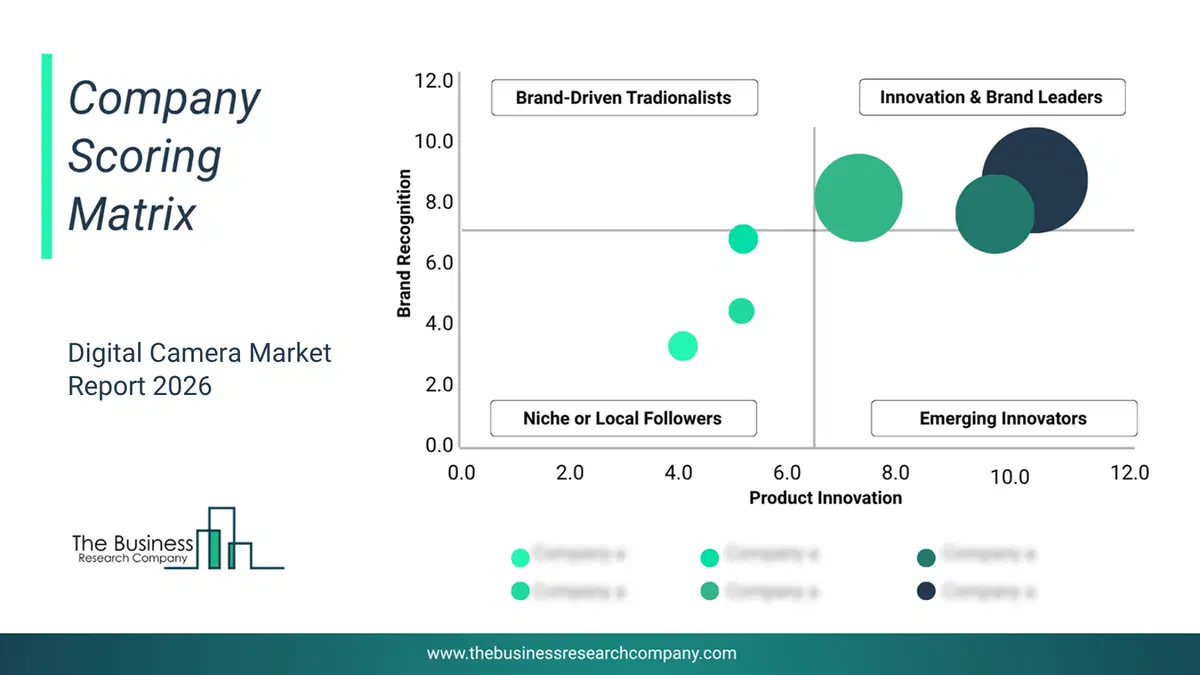
This chart maps companies by product innovation and brand strength, with bubble size indicating relative revenue, helping identify market leaders, challengers, and niche players. This is an illustrative chart; the full report provides a complete and accurate competitive analysis.
Global Digital Camera Market Trends and Insights
Major companies operating in the digital camera market are focusing on developing innovative digital cameras, such as next-generation compact digital cameras, to cater to the evolving needs of photographers. The next-generation compact cameras, exemplified by the Fujifilm X100VI and the Sony α6700, offer cutting-edge features tailored for advanced photography and videography needs. For instance, in February 2024, Fujifilm Holdings Corp., a Japan-based camera manufacturing company, launched the X100VI Digital Camera, a next-generation advanced compact camera. The X100VI Digital Camera incorporates a 5-axis, in-body image stabilization function with up to 6.0 stops, an X-TransTM CMOS 5 HR sensor with approximately 40.2 megapixels, and a fixed 23mm F2.0 lens. The X100VI features an Advanced Hybrid Viewfinder, 6.2K/30P movie recording, and Camera to Cloud integration for Adobe’s Frame.io, enabling wireless photo and video uploads. Its design includes aluminum surfaces, an ultra-thin tilt LCD monitor, and an integrated body design for versatile shooting styles.What Are Latest Mergers And Acquisitions In The Digital Camera Market?
In March 2024, Nikon Corporation, a Japan-based optics and photographic equipment manufacturer, acquired Red Digital Cinema LLC for an undisclosed amount. Through this acquisition, Nikon aims to expand its presence in the professional digital camera market by leveraging RED's innovative technology and expertise in cinema cameras, including unique image compression technology and color science, to develop distinctive products that push the boundaries of film and video production. Red Digital Cinema, LLC is a US-based manufacturer of digital cameras specializing in digital cinematography.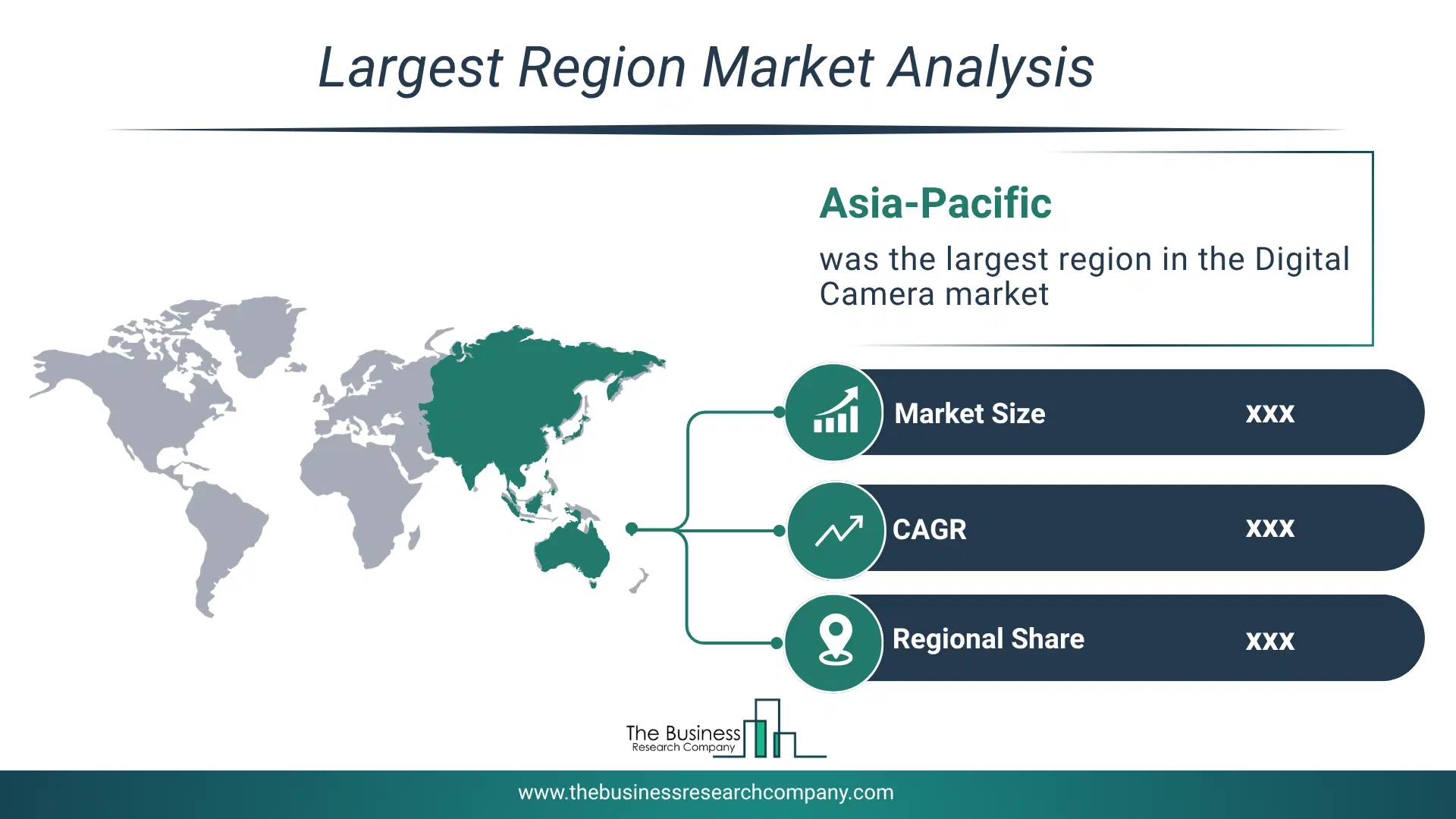
Regional Outlook
Asia-Pacific was the largest region in the digital camera market in 2025. Asia-Pacific is expected to be the fastest-growing region in the forecast period. The regions covered in this market report are Asia-Pacific, South East Asia, Western Europe, Eastern Europe, North America, South America, Middle East, Africa. The countries covered in this market report are Australia, Brazil, China, France, Germany, India, Indonesia, Japan, Taiwan, Russia, South Korea, UK, USA, Canada, Italy, Spain.What Defines the Digital Camera Market?
The digital camera market consists of sales of point-and-shoot cameras, action cameras, bridge cameras, instant cameras, and smartphone cameras. Values in this market are ‘factory gate’ values, that is, the value of goods sold by the manufacturers or creators of the goods, whether to other entities (including downstream manufacturers, wholesalers, distributors, and retailers) or directly to end customers. The value of goods in this market includes related services sold by the creators of the goods.How is Market Value Defined and Measured?
The market value is defined as the revenues that enterprises gain from the sale of goods and/or services within the specified market and geography through sales, grants, or donations in terms of the currency (in USD unless otherwise specified). The revenues for a specified geography are consumption values that are revenues generated by organizations in the specified geography within the market, irrespective of where they are produced. It does not include revenues from resales along the supply chain, either further along the supply chain or as part of other products.
This chart presents market attractiveness based on a quantitative evaluation of growth, competition, strategic alignment, and risk, offering a clear view of opportunity areas for decision-making. This chart is for illustrative purposes; the full report contains the complete analysis.

This chart highlights the Total Addressable Market (TAM) by estimating the maximum revenue opportunity using an assumption-driven approach, supporting strategic planning and opportunity sizing across markets. The chart is illustrative; the full report provides a more comprehensive analysis.
What Key Data and Analysis Are Included in the Digital Camera Market Report 2026?
The digital camera market research report is one of a series of new reports from The Business Research Company that provides market statistics, including industry global market size, regional shares, competitors with the market share, detailed market segments, market trends and opportunities, and any further data you may need to thrive in the digital camera industry. The market research report delivers a complete perspective of everything you need, with an in-depth analysis of the current and future state of the industry.Digital Camera Market Report Forecast Analysis
| Report Attribute | Details |
|---|---|
| Market Size Value In 2026 | $7.51 billion |
| Revenue Forecast In 2030 | $9.07 billion |
| Growth Rate | CAGR of 4.8% from 2026 to 2030 |
| Base Year For Estimation | 2025 |
| Actual Estimates/Historical Data | 2020-2025 |
| Forecast Period | 2026 - 2030 |
| Market Representation | Revenue in USD Billion and CAGR from 2026 to 2030 |
| Segments Covered | Type, Lens Type, Digital Sensor Type, Resolution, End User |
| Regional Scope | Asia-Pacific, Western Europe, Eastern Europe, North America, South America, Middle East, Africa |
| Country Scope | The countries covered in the report are Australia, Brazil, China, France, Germany, India, Indonesia, Japan, Taiwan, Russia, South Korea, UK, USA, Canada, Italy, Spain. |
| Key Companies Profiled | Samsung Electronics Co. Ltd., Sony Corporation, LG Electronics Inc., Hewlett-Packard Inc., Panasonic Corporation, Canon Inc., Fujifilm Holdings Corporation, Ricoh Company Ltd., Olympus Corporation, Nikon Corporation, Carl Zeiss AG, Casio Computer Co. Ltd., DJI Technology Co. Ltd., Eastman Kodak Company, GoPro Inc., Polaroid Corporation, Tamron Co. Ltd., Leica Camera AG, Blackmagic Design Pty. Ltd., Sigma Corporation, Phase One A/S, YI Technology Co. Ltd., Hasselblad Group, Vivo Technology Company Limited, Arashi Vision Inc (Insta360) |
| Customization Scope | Request for Customization |
| Pricing And Purchase Options | Explore Purchase Options |