

Digital Chronic Disease Management Market Report 2026
Global Outlook – By Disease Type (Musculoskeletal Disorders, Diabetes, Cardiovascular Diseases, Chronic Respiratory Diseases, Obesity And Metabolic Disorders, Hypertension, Cancer, Mental Health And Behavioral Disorders), By Technology (Mobile Applications, Telehealth Services, Wearable Devices, Health Management Platforms), By Deployment Mode (Web Based, Cloud Based, On Premise), By Application (Population Health Management, Remote Patient Monitoring, Medication Adherence Management, Care Coordination, Lifestyle And Wellness Management), By End User (Patients, Healthcare Providers, Payors, Pharmaceutical Companies) – Market Size, Trends, Strategies, and Forecast to 2030
Digital Chronic Disease Management Market Overview
• Digital Chronic Disease Management market size has reached to $8.28 billion in 2025 • Expected to grow to $15.6 billion in 2030 at a compound annual growth rate (CAGR) of 13.4% • Growth Driver: Increasing Adoption Of Telehealth Services Fueling The Growth Of The Market Due To Rising Demand For Convenient And Accessible Remote Healthcare • Market Trend: Hinge Health Launches AI-Powered Care Tools For Chronic Disease Management • North America was the largest region in 2025 and Asia-Pacific is the fastest growing region.What Is Covered Under Digital Chronic Disease Management Market?
Digital chronic disease management refers to the use of digital health technologies to monitor, manage, and support patients with long-term chronic conditions. Its primary use is to enable continuous patient monitoring, improve treatment adherence, enhance patient engagement, and reduce hospital visits through proactive and personalized care management. The main disease types of digital chronic disease management include musculoskeletal disorders, diabetes, cardiovascular diseases, chronic respiratory diseases, obesity and metabolic disorders, hypertension, cancer, and mental health and behavioral disorders. Musculoskeletal disorders refer to long-term conditions affecting muscles, bones, and joints that require continuous monitoring and digital intervention. These solutions use technologies including mobile applications, telehealth services, wearable devices, and health management platforms and are deployed through web based, cloud based, and on premise systems. They find application in population health management, remote patient monitoring, medication adherence management, care coordination, and lifestyle and wellness management, serving end users including patients, healthcare providers, payors, and pharmaceutical companies.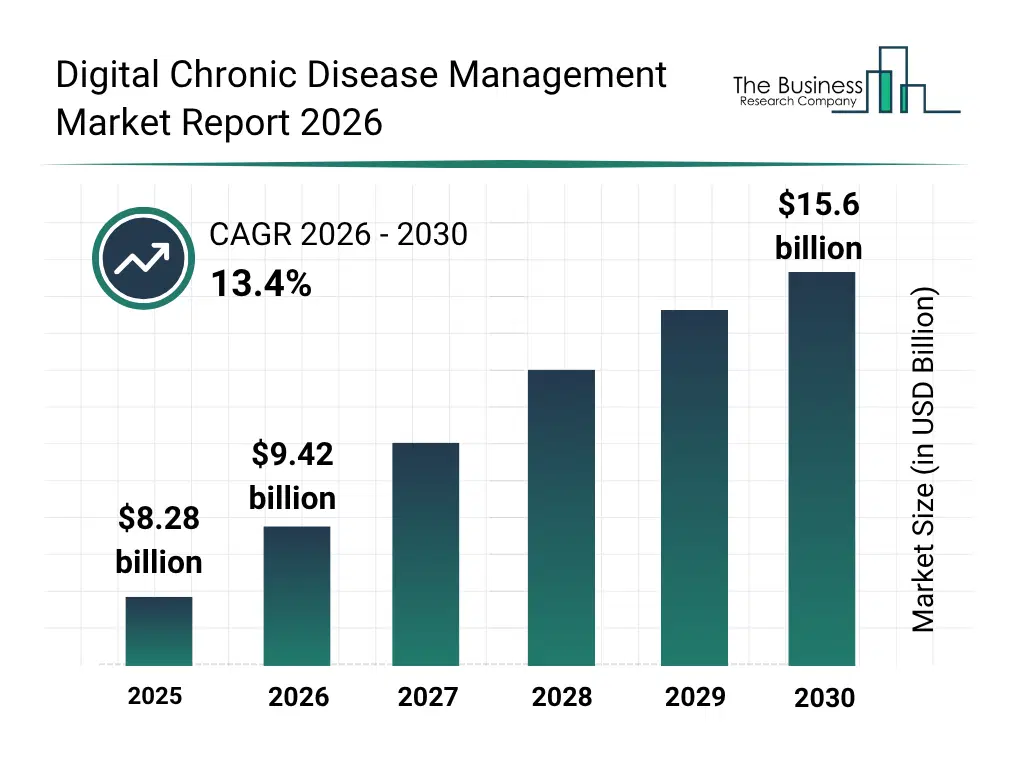
What Is The Digital Chronic Disease Management Market Size and Share 2026?
The digital chronic disease management market size has grown rapidly in recent years. It will grow from $8.28 billion in 2025 to $9.42 billion in 2026 at a compound annual growth rate (CAGR) of 13.9%. The growth in the historic period can be attributed to rising prevalence of chronic diseases worldwide, increasing healthcare expenditure on long term disease management, growing demand for preventive healthcare services, expansion of telehealth adoption across healthcare systems, increasing focus on reducing hospital admissions and healthcare costs.What Is The Digital Chronic Disease Management Market Growth Forecast?
The digital chronic disease management market size is expected to see rapid growth in the next few years. It will grow to $15.6 billion in 2030 at a compound annual growth rate (CAGR) of 13.4%. The growth in the forecast period can be attributed to growing demand for continuous patient monitoring solutions, increasing adoption of value based healthcare models, expansion of home healthcare and virtual care services, rising investment in digital health ecosystems, increasing emphasis on patient centric chronic care management. Major trends in the forecast period include increasing adoption of personalized care plans for chronic disease management, growing use of remote patient monitoring programs to reduce hospital readmissions, rising focus on medication adherence tracking and patient engagement solutions, expansion of home based chronic disease management services and virtual care models, increasing integration of multidisciplinary care coordination for long term disease management.
Global Digital Chronic Disease Management Market Segmentation
1) By Disease Type: Musculoskeletal Disorders; Diabetes; Cardiovascular Diseases; Chronic Respiratory Diseases; Obesity And Metabolic Disorders; Hypertension; Cancer; Mental Health And Behavioral Disorders 2) By Technology: Mobile Applications; Telehealth Services; Wearable Devices; Health Management Platforms 3) By Deployment Mode: Web Based; Cloud Based; On Premise 4) By Application: Population Health Management; Remote Patient Monitoring; Medication Adherence Management; Care Coordination; Lifestyle And Wellness Management 5) By End User: Patients; Healthcare Providers; Payors; Pharmaceutical Companies Subsegments: 1) By Musculoskeletal Disorders: Sports Injuries; Osteoarthritis; Rheumatoid Arthritis; Osteoporosis; Chronic Back Pain; Joint Disorders; Muscular Disorders; Spine Disorders 2) By Diabetes: Diabetic Kidney Disease; Type One Diabetes; Type Two Diabetes; Gestational Diabetes; Prediabetes; Insulin Resistance Disorders; Diabetic Neuropathy; Diabetic Retinopathy 3) By Cardiovascular Diseases: Cardiomyopathy; Coronary Artery Disease; Heart Failure; Arrhythmia; Stroke; Peripheral Artery Disease; Congenital Heart Disease; Ischemic Heart Disease 4) By Chronic Respiratory Diseases: Allergic Respiratory Disorders; Chronic Obstructive Pulmonary Disease; Asthma; Pulmonary Fibrosis; Sleep Apnea; Bronchitis; Emphysema; Cystic Fibrosis 5) By Obesity And Metabolic Disorders: Dyslipidemia; Obesity; Metabolic Syndrome; Hyperlipidemia; Fatty Liver Disease; Thyroid Disorders; Polycystic Ovary Syndrome; Insulin Resistance 6) By Hypertension: Gestational Hypertension; Primary Hypertension; Secondary Hypertension; Resistant Hypertension; Pulmonary Hypertension; Isolated Systolic Hypertension; Malignant Hypertension; White Coat Hypertension 7) By Cancer: Pancreatic Cancer; Breast Cancer; Lung Cancer; Colorectal Cancer; Prostate Cancer; Blood Cancer; Skin Cancer 8) By Mental Health And Behavioral Disorders: Obsessive Compulsive Disorder; Depression; Anxiety Disorders; Bipolar Disorder; Schizophrenia; Substance Use Disorders; Eating Disorders; Post Traumatic Stress DisorderWhat Is The Driver Of The Digital Chronic Disease Management Market?
The increasing adoption of telehealth services is expected to propel the growth of the digital chronic disease management market going forward. Telehealth services refer to the delivery of healthcare consultations, monitoring, diagnosis, and patient engagement through digital communication technologies such as video conferencing platforms, remote monitoring systems, and mobile health applications. The increasing adoption of telehealth services is due to the growing demand for convenient and accessible healthcare, as patients and providers seek faster remote consultations and continuous care management. Digital chronic disease management is used in telehealth services to enable remote monitoring, continuous patient engagement, personalized treatment support, and real-time management of chronic conditions such as diabetes, hypertension, and cardiovascular diseases. For instance, in April 2023, FAIR Health Inc., a US-based nonprofit organization, showed a 7.3% national increase in telehealth usage, rising from 5.5% of medical claim lines in December 2022 to 5.9% in January 2023. Therefore, the increasing adoption of telehealth services is driving the growth of the digital chronic disease management industry.Key Players In The Global Digital Chronic Disease Management Market
Major companies operating in the digital chronic disease management market are International Business Machines Corporation; F. Hoffmann-La Roche Ltd.; Bayer Aktiengesellschaft; Koninklijke Philips N.V.; Medtronic plc; AstraZeneca PLC; NTT DATA Group Corporation; Epic Systems Corporation; Teladoc Health Inc.; DexCom Inc.; Abbott Laboratories; Health Catalyst Inc.; AptarGroup Inc.; Hinge Health Inc.; ScienceSoft USA Corporation; Omada Health Inc.; WellDoc Inc.; Virta Health Corp.; Glooko Inc.; DarioHealth Corp.; Credo Health Services Pvt. Ltd.; ResMed Inc.; BiofourmisGlobal Digital Chronic Disease Management Market Trends and Insights
Major companies operating in the digital chronic disease management market are focusing on developing innovative products, such as AI-powered care tools to enhance remote patient monitoring, improve personalized treatment delivery, support continuous patient engagement, and optimize chronic disease outcomes. AI-powered care tools are intelligent digital healthcare solutions designed to analyze patient health data, provide virtual care assistance, deliver personalized therapy recommendations, and support remote chronic disease management. For instance, in February 2025, Hinge Health, a US-based digital healthcare company, launched AI-powered care tools, including Movement Analysis and the Robin AI Care Assistant, designed to support musculoskeletal chronic disease management. The platform utilizes computer vision technology and AI-driven virtual assistance to deliver personalized exercise guidance, monitor patient progress remotely, and improve accessibility to digital physical therapy and chronic pain management services.What Are Latest Mergers And Acquisitions In The Digital Chronic Disease Management Market?
In February 2025, Teladoc Health, Inc., a US-based telemedicine and virtual healthcare company acquired Catapult Health LLC for $70 million. Through this acquisition, Teladoc Health aimed to strengthen its chronic condition management and preventive care capabilities by integrating at-home diagnostic testing, virtual wellness evaluations, and early disease detection services into its digital healthcare ecosystem. Catapult Health, LLC is a US-based digital healthcare company specializing in preventive care, virtual health assessments, chronic disease risk identification, and remote patient engagement solutions.Regional Outlook
North America was the largest region in the digital chronic disease management market in 2025. Asia-Pacific is expected to be the fastest-growing region in the forecast period. The regions covered in this market report are Asia-Pacific, South East Asia, Western Europe, Eastern Europe, North America, South America, Middle East, Africa. The countries covered in this market report are Australia, Brazil, China, France, Germany, India, Indonesia, Japan, Taiwan, Russia, South Korea, UK, USA, Canada, Italy, Spain.What Defines the Digital Chronic Disease Management Market?
The digital chronic disease management market includes revenues earned by entities by providing services such as chronic care coordination, digital therapeutics support, health coaching, patient engagement programs, AI-driven disease monitoring, and data analytics services. The market value includes the value of related goods sold by the service provider or included within the service offering. The digital chronic disease management market also includes sales of continuous glucose monitors, smart blood pressure monitors, pulse oximeters, and connected inhalers. Values in this market are ‘factory gate’ values, that is the value of goods sold by the manufacturers or creators of the goods, whether to other entities (including downstream manufacturers, wholesalers, distributors and retailers) or directly to end customers. The value of goods in this market includes related services sold by the creators of the goods.How is Market Value Defined and Measured?
The market value is defined as the revenues that enterprises gain from the sale of goods and/or services within the specified market and geography through sales, grants, or donations in terms of the currency (in USD unless otherwise specified). The revenues for a specified geography are consumption values that are revenues generated by organizations in the specified geography within the market, irrespective of where they are produced. It does not include revenues from resales along the supply chain, either further along the supply chain or as part of other products.What Key Data and Analysis Are Included in the Digital Chronic Disease Management Market Report 2026?
The digital chronic disease management market research report is one of a series of new reports from The Business Research Company that provides market statistics, including industry global market size, regional shares, competitors with the market share, detailed market segments, market trends and opportunities, and any further data you may need to thrive in the digital chronic disease management industry. The market research report delivers a complete perspective of everything you need, with an in-depth analysis of the current and future state of the industry.Digital Chronic Disease Management Market Report Forecast Analysis
| Report Attribute | Details |
|---|---|
| Market Size Value In 2026 | $9.42 billion |
| Revenue Forecast In 2030 | $15.6 billion |
| Growth Rate | CAGR of 13.4% from 2026 to 2030 |
| Base Year For Estimation | 2025 |
| Actual Estimates/Historical Data | 2020-2025 |
| Forecast Period | 2026 - 2030 |
| Market Representation | Revenue in USD Billion and CAGR from 2026 to 2030 |
| Segments Covered | Disease Type, Technology, Deployment Mode, Application, End User |
| Regional Scope | Asia-Pacific, Western Europe, Eastern Europe, North America, South America, Middle East, Africa |
| Country Scope | The countries covered in the report are Australia, Brazil, China, France, Germany, India, ... |
| Key Companies Profiled | International Business Machines Corporation; F. Hoffmann-La Roche Ltd.; Bayer Aktiengesellschaft; Koninklijke Philips N.V.; Medtronic plc; AstraZeneca PLC; NTT DATA Group Corporation; Epic Systems Corporation; Teladoc Health Inc.; DexCom Inc.; Abbott Laboratories; Health Catalyst Inc.; AptarGroup Inc.; Hinge Health Inc.; ScienceSoft USA Corporation; Omada Health Inc.; WellDoc Inc.; Virta Health Corp.; Glooko Inc.; DarioHealth Corp.; Credo Health Services Pvt. Ltd.; ResMed Inc.; Biofourmis |
| Customization Scope | Request for Customization |
| Pricing And Purchase Options | Explore Purchase Options |