
Digital Identity Global Market Opportunities And Strategies To 2035
By Component (Solutions, Services), By Type (Single-Factor Authentication, Multi-Factor Authentication), By Deployment Type (Cloud, On-Premises), By Organization (Large Enterprises, Small And Medium Enterprises (SMEs)), By Vertical (Banking Financial Services And Insurance, Retail And E-Commerce, Government And Defense, Healthcare, IT And ITES, Telecommunications, Energy And Utilities, Other Verticals), And By Region, Opportunities And Strategies – Global Forecast To 2035
Digital Identity Market Definition
Digital identity refers to the collection of electronically stored credentials and attributes that uniquely describe and authenticate an individual, organization, or device within digital environments. It is used by individuals, enterprises, and governments to verify identities, enable secure access to systems, and facilitate digital transactions. The digital identity market consists of revenues generated by entities (organizations, sole traders, and partnerships) that provide digital identity solutions and services used to create, manage, authenticate, and secure digital identities across various applications and industries. The market includes platforms and tools that enable identity verification, authentication, access control, and identity lifecycle management. These solutions are widely adopted across sectors to enhance security, improve user experience, comply with regulations, and enable digital transformation initiatives.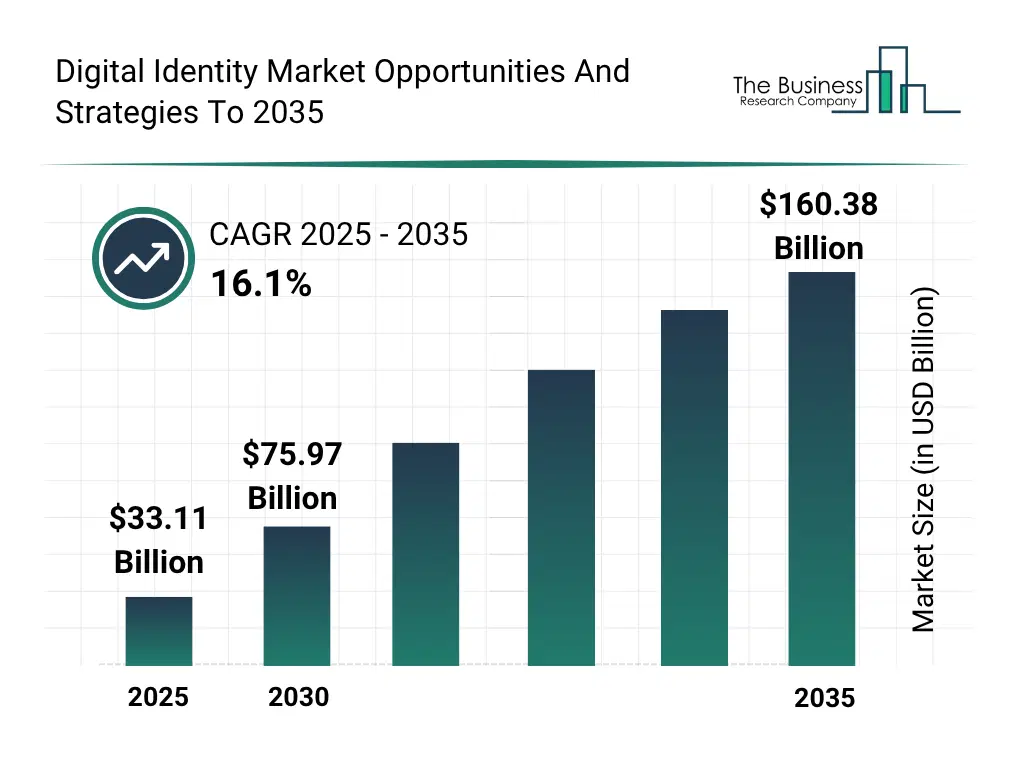
Digital Identity Market Size
The global digital identity market reached a value of nearly $33,110.0 million in 2025, having grown at a compound annual growth rate (CAGR) of 19.4% since 2020. The market is expected to grow from $33,110.0 million in 2025 to $75,971.4 million in 2030 at a rate of 18.1%. The market is then expected to grow at a CAGR of 16.1% from 2030 and reach $160,377.1 million in 2035. Growth in the historic period resulted from growing adoption of online services and digital transactions, growing emphasis on seamless and frictionless customer experiences, increasing demand for secure remote onboarding and verification and growing expansion of e-commerce and digital payment. Factors that negatively affected growth in the historic period were high implementation and integration costs and concerns over data privacy and misuse of personal information. Going forward, rising incidence of identity fraud and cyberattacks, rising regulatory pressure for data privacy and compliance, increasing government initiatives for financial inclusion and increasing adoption of digital wallets will drive the growth. Factors that could hinder the growth of the digital identity market in the future include lack of user awareness, scalability challenges in large population deployments and impact of trade wars and tariffs.
Digital Identity Market Segmentation
The digital identity market is segmented by component, by type, by deployment, by organization size, by vertical.By Component –
The digital identity market is segmented by component into:
- a) Solutions
- b) Services
By Type –
The digital identity market is segmented by type into:
- a) Single-Factor Authentication
- b) Multi-Factor Authentication
By Deployment Type –
The digital identity market is segmented by deployment type into:
- a) Into Cloud
- b) On-Premises
By Organization Size –
The digital identity market is segmented by Organization Size into:
- a) Large Enterprises
- b) Small And Medium Enterprises (SMEs)
By Vertical –
The digital identity market is segmented by vertical into:
- a) Banking, Financial Services, And Insurance
- b) Retail And E-Commerce
- c) Government And Defense
- d) Healthcare
- e) It And ITeS
- f) Telecommunications
- g) Energy And Utilities
- h) Other Verticals
By Geography - The digital identity market is segmented by geography into:
- China
- India
- Japan
- Australia
- Indonesia
- South Korea
- USA
- Canada
- Brazil
- France
- Germany
- UK
- Italy
- Spain
- Russia
-
o Asia Pacific
o Africa